Short-Term Debt Grew Four Times Faster Than Long-Term Debt
Federal debt rose 7.4 per cent to Rs 83.6 trillion. Short-term domestic borrowing rose 24.8 per cent. That gap is what matters.
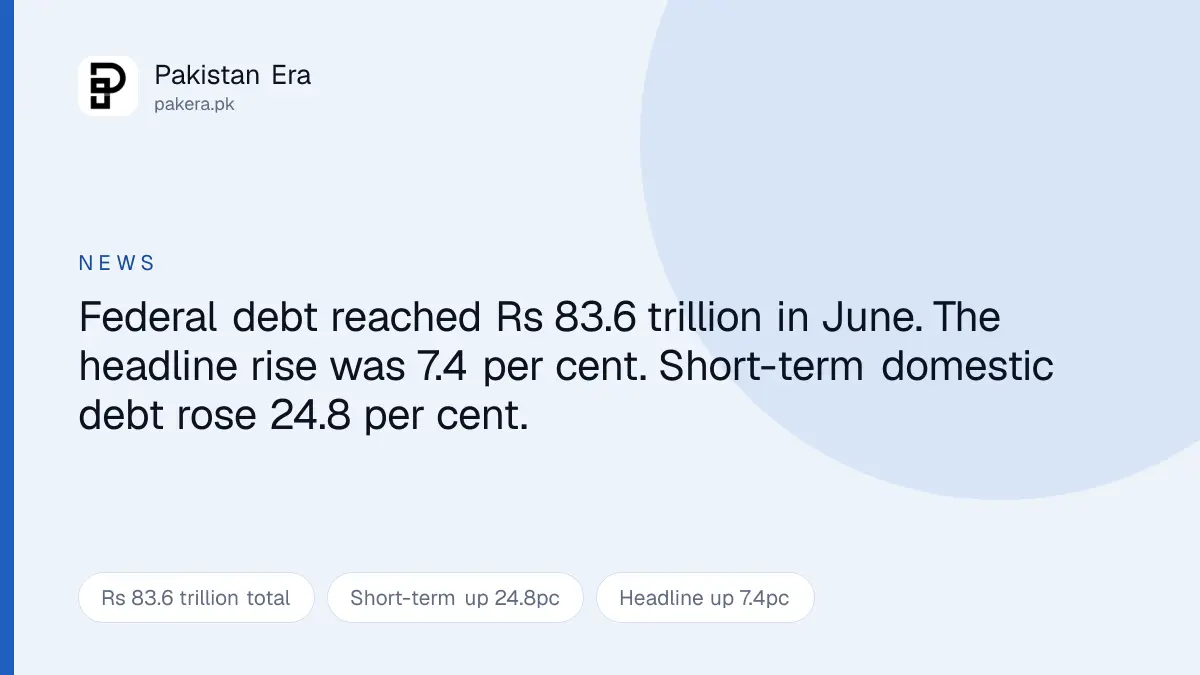
Pakistan's federal government debt reached Rs 83.642 trillion in June 2026, up 7.4 per cent on the year, according to State Bank figures.
The number being repeated everywhere is Rs 16 billion a day. It is accurate, and it is the least interesting thing in the release.
Here is what is underneath it. Long-term domestic debt grew about 6 per cent. Short-term domestic debt grew about 25 per cent.
The numbers, and the arithmetic on them
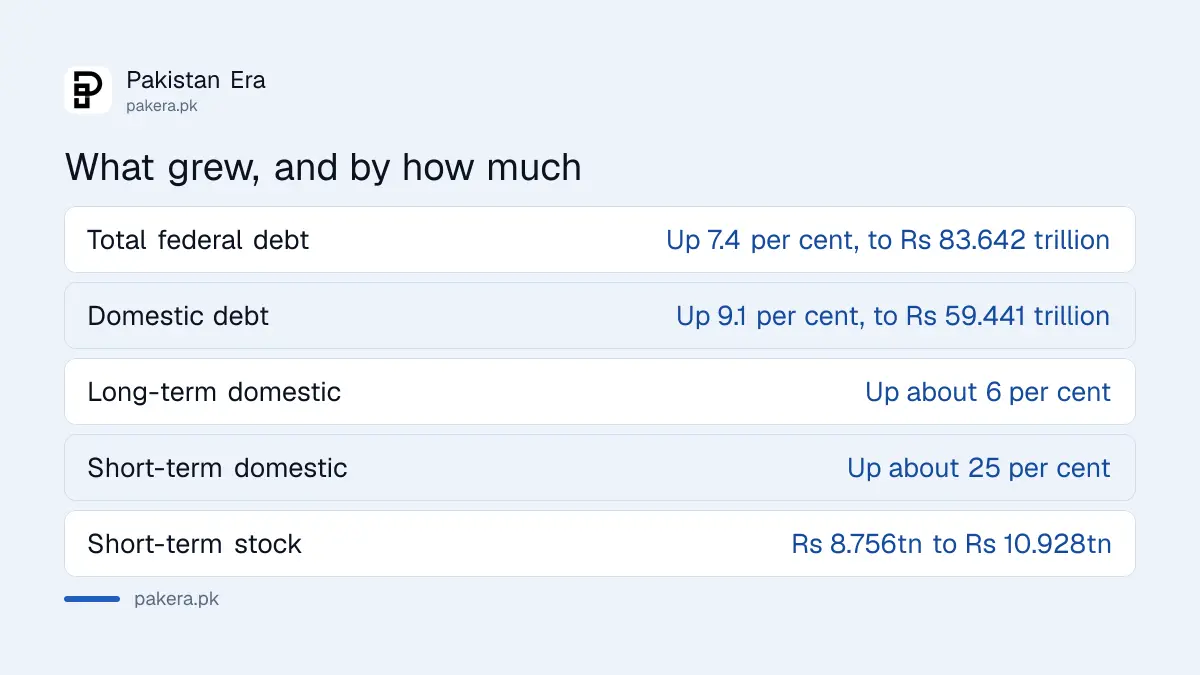
These are the reported figures. The percentages in the right column are our own arithmetic on them, so you can check the working.
| Measure | Figure | Change |
|---|---|---|
| Total federal debt, June 2026 | Rs 83.642tn | Up 7.4 per cent on the year |
| Total federal debt, May 2026 | Rs 81.955tn | Up 2.1 per cent in a month |
| Domestic debt | Rs 59.441tn | Up 9.1 per cent on the year |
| Long-term domestic | Rs 45.653tn to Rs 48.446tn | About 6 per cent |
| Short-term domestic | Rs 8.756tn to Rs 10.928tn | About 25 per cent |
Subtracting domestic from total leaves roughly Rs 24.2 trillion that is not domestic. That subtraction is ours, not a reported figure, so treat it as an indication of scale rather than an official external debt number.
Short-term borrowing grew four times faster than long-term
That is the finding, and it is available to anyone who divides two numbers in the release.
Short-term debt went from Rs 8.756 trillion to Rs 10.928 trillion, a rise of 24.8 per cent. Long-term domestic debt rose 6.1 per cent over the same period. So short-term borrowing grew almost exactly four times as fast as long-term.
Against the headline figure for all federal debt, 7.4 per cent, it grew about three and a half times as fast. We are being precise about which comparison is which, because the two get muddled easily and the long-term contrast is the meaningful one.
As a share of domestic debt, short-term paper moved from roughly 16 per cent to about 18 per cent in a year. That sounds small. On a base of Rs 59 trillion, it is not.
Why the maturity matters more than the total
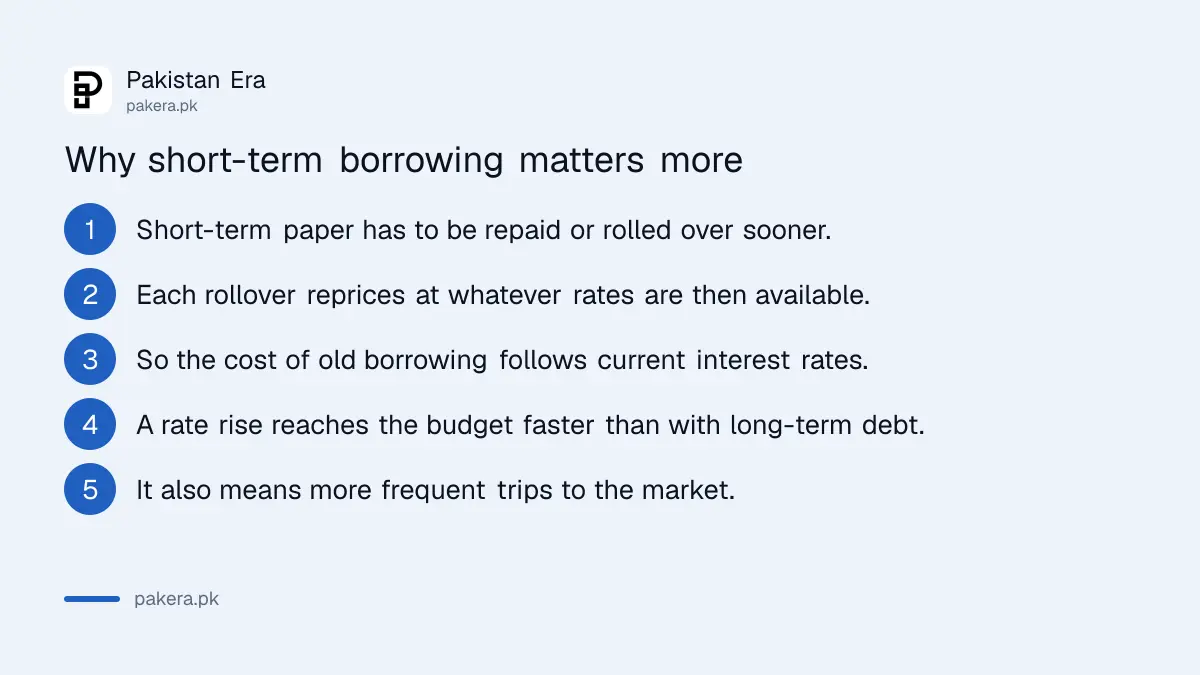
A large debt at a fixed low rate for twenty years is a very different problem from the same debt that has to be renewed every few months. The size is identical. The exposure is not.
- Short-term paper comes due sooner, so it must be repaid or rolled over.
- Each rollover reprices at whatever rates prevail on that day.
- So old borrowing inherits new interest rates rather than keeping the rate it was issued at.
- A policy rate rise reaches the budget quickly, instead of over decades.
- It means more frequent trips to the market, and each one has to find buyers.
The practical translation is that a government leaning on short-term borrowing has less protection if rates move against it. Interest costs then compete with everything else in the budget, which is where this stops being an abstraction and starts affecting what gets funded.
None of that means a crisis is coming, and we are not predicting one. It means the composition is worth watching as closely as the total, and almost nobody reports the composition.
About that Rs 16 billion a day
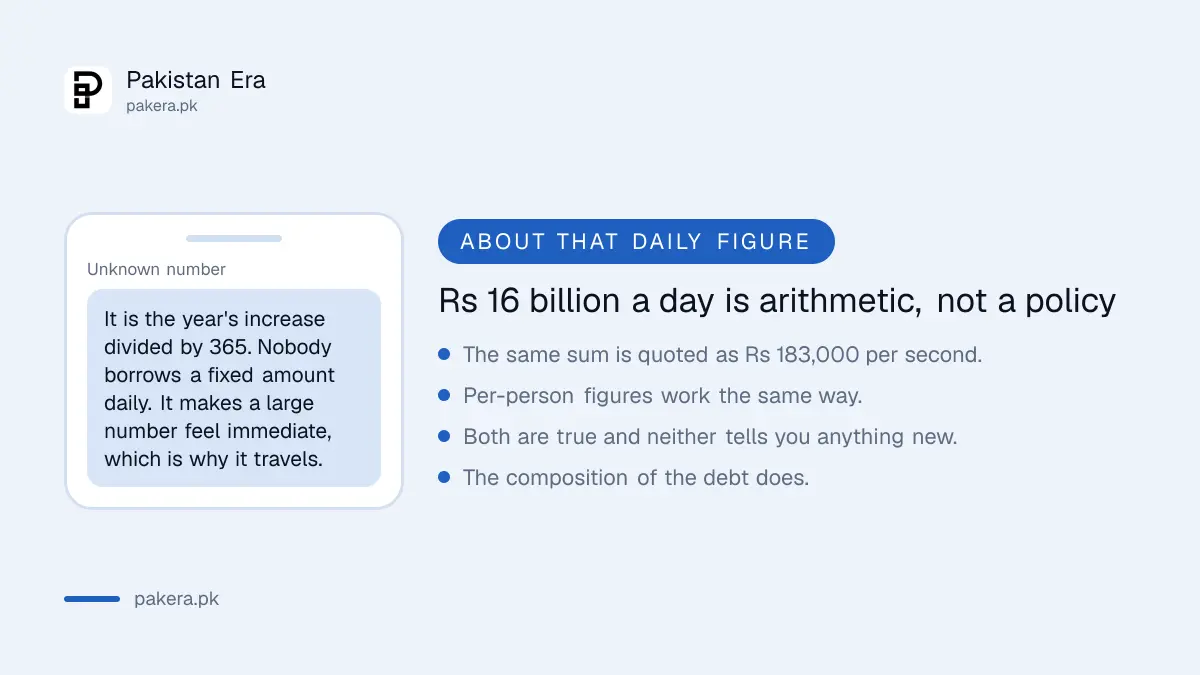
You will also see it as Rs 183,000 per second. Both are the same annual increase, divided by different units of time.
Nobody borrows a fixed sum every day. Government borrowing happens in auctions, in lumps, on a schedule. The daily figure is the year's rise divided by 365, and its purpose is to make a large abstract number feel immediate.
It is not dishonest. It is just not information. You knew the debt grew 7.4 per cent before the division, and you know exactly the same thing after it.
The same caution applies to a figure we could easily print ourselves. Rs 83.642 trillion across a population of roughly 240 million works out at about Rs 350,000 per person. That is our own arithmetic, it is striking, and it is exactly the same kind of device, because no individual owes it and it changes nothing about the underlying position.
We are including it precisely to say that. When a number is presented to you in a unit designed to shock, ask what the unit is doing.
What would actually be worth knowing
Three things this release does not tell you, which would change the picture:
The average cost of the debt. A rising stock at a falling interest rate is a different situation from a rising stock at a rising one.
The maturity profile in detail. We know short-term grew faster. How much falls due in the next twelve months is the number that determines refinancing pressure.
What the borrowing funded. Debt raised to build something that generates a return is not the same as debt raised to pay interest on earlier debt, even though both appear identically in the total.
That last question is the one the government's own long-term plan is supposed to answer, and it is being unveiled this month. Whatever growth targets it sets have to be financed, and this release is the starting position they are being set from. We covered the framework in our explainer on Vision Pakistan 2047.
For where this sits against household costs, our running note on why fuel prices move the way they do is in why petrol prices do not fall with oil, since the petroleum levy is itself a revenue instrument.
Those are the questions to ask when the next release lands.
A note on our sourcing
The figures here are State Bank data as reported. We attempted to read the release directly and sbp.org.pk refused our automated request, which is a bot block rather than a fault, and the site works normally in a browser.
So we are not claiming to have read the original release. We are attributing the numbers and being explicit about which calculations are ours: the percentage changes, the share of domestic debt, the implied external figure and the per-person figure are all our arithmetic on the published totals.
We flag that kind of thing because the difference between a reported figure and a derived one is exactly where errors enter, and it is set out in our editorial standards.
Questions readers are asking
How much is Pakistan's government debt?
Federal government debt stood at Rs 83.642 trillion in June 2026, up 7.4 per cent year on year, per State Bank figures.
Is the debt really growing by Rs 16 billion a day?
That figure is the annual increase divided by 365. It is arithmetically correct but it is a presentation device rather than a description of how borrowing happens.
What is the difference between domestic and external debt?
Domestic debt is owed within Pakistan in rupees. Domestic debt was Rs 59.441 trillion, which leaves roughly Rs 24.2 trillion by our subtraction that is not domestic.
Why does short-term debt matter?
It has to be repaid or rolled over sooner, and each rollover reprices at current interest rates. That means rate rises reach the budget faster than they would with long-term borrowing.
How fast did short-term debt grow?
From Rs 8.756 trillion to Rs 10.928 trillion, roughly 25 per cent, against a 7.4 per cent rise in total federal debt.
What is the debt per person?
Roughly Rs 350,000 on a population of about 240 million. That is our own arithmetic and it is a rhetorical device, since no individual owes that amount.
Does this mean Pakistan will default?
Nothing in these figures says that and we are not forecasting it. The composition is worth watching, which is a different statement from a prediction.
About the author

Tax, Bills and Technology Writer
Ali Akhtar is a young and curious voice here at Pakistan Era. He is currently pursuing his A-Levels and has a growing interest in Pakistan’s changing industrial landscape and educational trends. Ali likes to write in a way that helps him explain and explore the world around him. His writing reflects the perspective of the new generation navigating the evolving trends of Pakistan where technology, youth innovation, and shifting opportunities are reshaping the country’s future.