Oil Fell 11 Per Cent and Petrol Fell 1 Per Cent, and the Reason Is Printed on Your Receipt
Brent crashed 11.3 per cent. Petrol came down 1.2 per cent to Rs 331.95. Most of what you pay per litre was never tracking crude at all.
Petrol came down to Rs 331.95 a litre late on Sunday, a cut of Rs 4.08. Diesel came down Rs 2.45 to Rs 389.93. It is the second consecutive decrease, and it follows global crude having one of its worst days of the year.
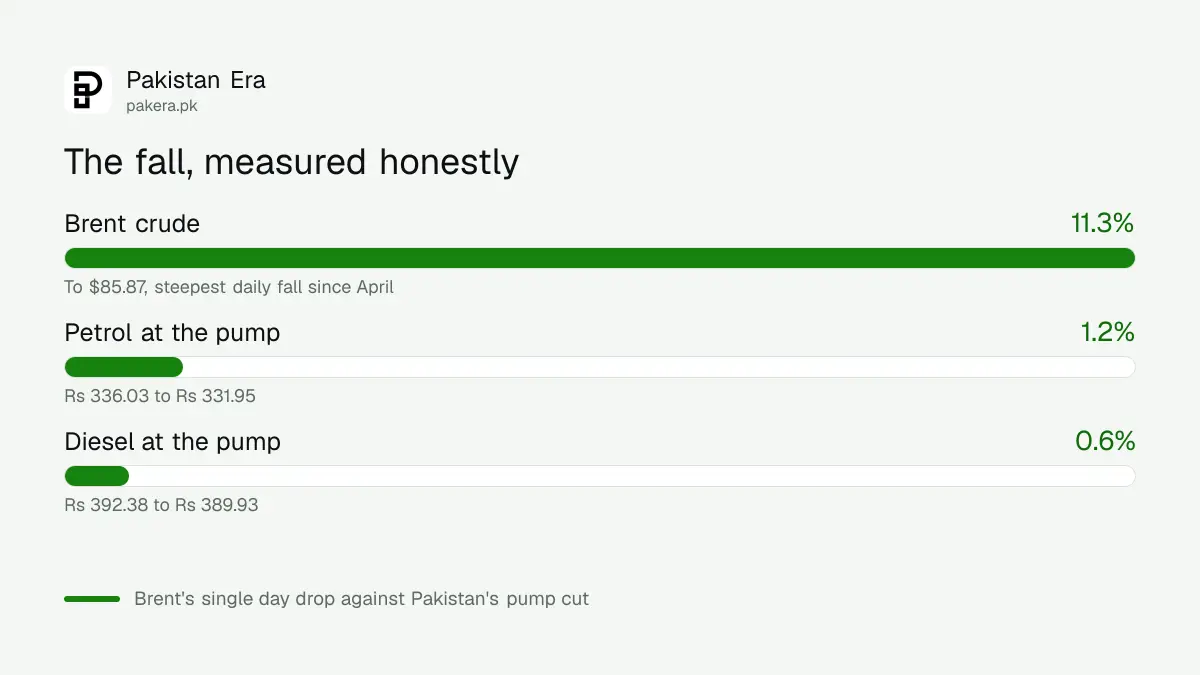
Here is the comparison nobody printed. Brent fell 11.3 per cent. Petrol at the pump fell 1.2 per cent.
The numbers, before the explanations
| Before | After | Change | |
|---|---|---|---|
| Petrol | Rs 336.03 | Rs 331.95 | Down Rs 4.08, or 1.2 per cent |
| Diesel | Rs 392.38 | Rs 389.93 | Down Rs 2.45, or 0.6 per cent |
| Brent crude | Fell to $85.87 | Down 11.3 per cent | |
Those percentages are ours, worked out from the rupee figures rather than quoted from anyone. A nine to one gap between the fall in oil and the fall at the pump is the thing worth explaining, and the coverage that reported the cut did not attempt it.
Most of what you pay was never tracking oil
This is the whole answer, and it is simpler than the debate around it suggests.
The price of a litre is built from a stack of components. Only one of them, the ex refinery cost, has anything to do with what crude is trading at. Everything else is a fixed number of rupees per litre.
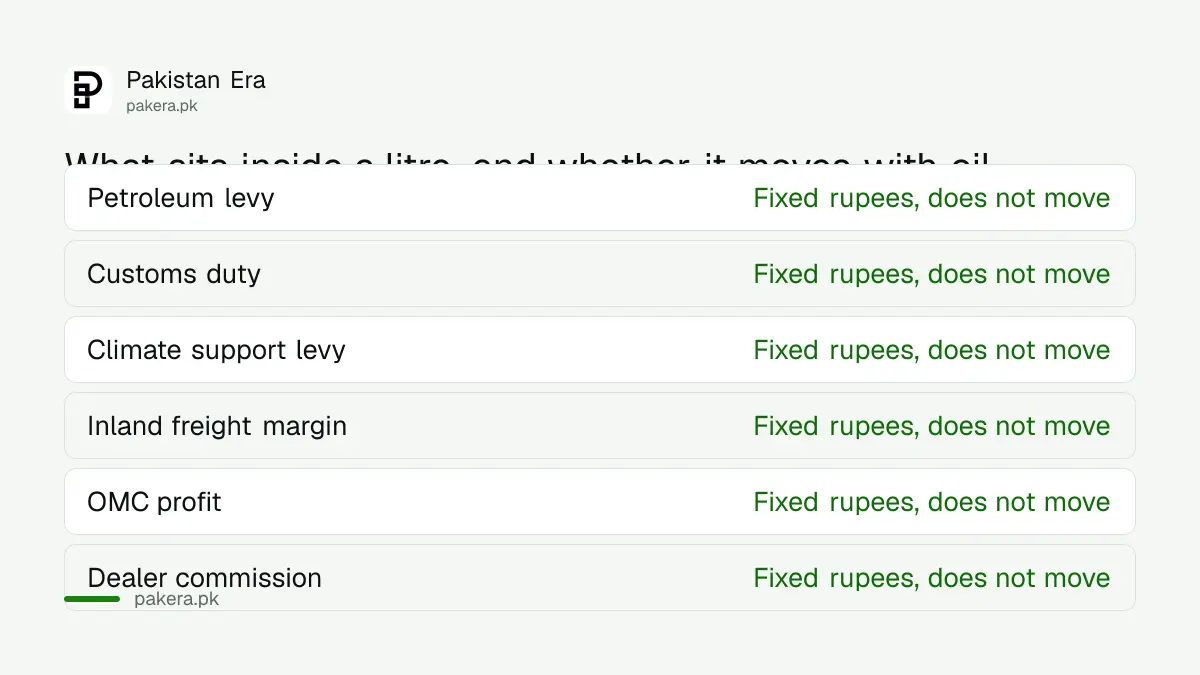
From the April 2026 breakdown as reported, a litre of petrol carried a petroleum levy of Rs 160.61, customs duty of Rs 24.12, a climate support levy of Rs 2.50, inland freight margin of Rs 7.52, OMC profit of Rs 7.87 and dealer commission of Rs 8.64.
Add those up and you are past Rs 211 before anybody has bought a drop of oil.
An important caveat: the petroleum levy is revised periodically and was reported at Rs 117.41 in May, so those are not necessarily the figures applying this month, and we have not been able to confirm the August numbers. The structure is the point and it does not change with the figure. These are rupee amounts, not percentages, so they do not shrink when crude falls.
What that does to the arithmetic
Work it through with round numbers and it stops being mysterious.
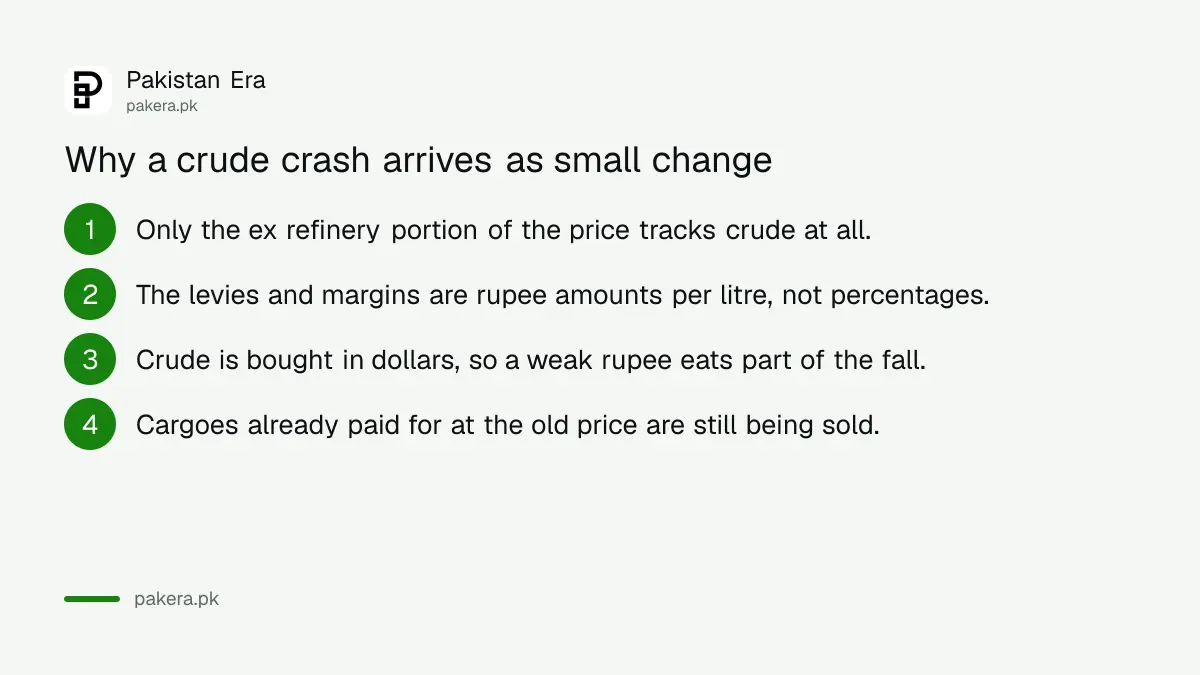
If roughly two thirds of the pump price is fixed rupee components, then only about a third is exposed to the oil price at all. An 11 per cent fall in crude applied to a third of the price is a fall of under 4 per cent in the total, before anything else interferes.
Then two things interfere.
The rupee. Crude is bought in dollars. A rupee that has weakened offsets part of the fall before it ever reaches a pricing calculation, and the rupee has had a difficult few weeks.
Timing. The fuel being sold this week was bought weeks ago at the old price. Cargoes are not repriced retrospectively because the market moved on Monday.
Between them, an 11.3 per cent crash arrives as 1.2 per cent. Not because someone is hiding the difference, but because the difference was never going to make it.
Which cuts both ways, and is the part worth remembering
The same structure that blunts a fall also blunts a rise.
When crude spikes, the fixed components do not grow either, so the pump price moves by less than the headline too. Pakistani drivers experience a smoother ride than the oil market does, in both directions.
That is genuinely worth knowing before deciding the system is simply rigged against consumers. What it is, unambiguously, is expensive. A structure where over half the price is government charge means the state is funded from every litre, and that is a policy choice rather than an accident of markets.
Why the levy is that size
Because the revenue is committed elsewhere.
FBR has to collect Rs 15.264 trillion this financial year, one of the largest targets in Pakistan's history, which we covered in the July collection figures. The petroleum levy is among the most reliable collection instruments available: it is charged at a handful of points, it is very hard to evade, and demand for fuel barely moves when the price does.
Cutting it would pass the full oil saving to drivers and open a hole in the target. That is the trade being made every month, and it is made quietly.
The bigger energy picture this sits in
Fuel at the pump is only one part of what a household pays for energy, and the rest of it has been moving the wrong way.
Gas is the most expensive it has ever been here, after the disruption to Qatari cargoes forced spot buying, which we covered in the RLNG increase. Generation has shifted toward coal because gas stopped being affordable, which we covered in the change in the power mix. And hybrids, the obvious consumer response to expensive fuel, got a tax rise rather than relief when the concession lapsed on 1 July.
A cheaper barrel of oil is good news arriving into a set of costs that are not improving.
What to actually watch
Not the Brent headline. Two other things.
The levy notification. A change in the petroleum levy moves the pump price more reliably than a change in crude does, because it applies in full and immediately.
The rupee. A stronger rupee delivers a bigger pump cut from the same barrel price than a weaker one does.
Our daily petrol price page tracks the number itself, and prices now move on a short cycle rather than fortnightly, so the figure in this article will be superseded quickly. The mechanism will not.
When the price does move
Prices now change every 24 hours rather than fortnightly, which makes individual moves smaller and more frequent than people expect.
A worked example of a single revision, and how the petrol and diesel lines can move in opposite directions on the same day, is in the 6 August change.
Questions readers are asking
What is the petrol price in Pakistan now?
Rs 331.95 a litre, down Rs 4.08. Diesel is Rs 389.93, down Rs 2.45. It is the second consecutive decrease.
Why did petrol only fall 1 per cent when oil fell 11 per cent?
Because most of the pump price is fixed rupee components rather than a share of the oil price. Levies, duties and margins are set in rupees per litre, so they do not shrink when crude falls.
How much of a litre of petrol is tax?
On the April 2026 breakdown, the petroleum levy alone was Rs 160.61 with customs duty of Rs 24.12 and a climate support levy of Rs 2.50 on top. The levy is revised periodically and we could not confirm the current month's figure.
Does the exchange rate affect petrol prices?
Yes, directly. Crude is bought in dollars, so a weaker rupee cancels out part of any fall in the barrel price before it reaches the pump.
Will prices fall further if oil keeps dropping?
Somewhat, and by much less than the oil move. The same structure limits both increases and decreases, so the pump is always smoother than the market.
Why does the government not cut the levy instead?
Because it is one of the most dependable taxes available and the annual revenue target is Rs 15.264 trillion. Cutting it would pass the saving on and leave a gap in that number.
About the author

Senior Writer, Public Services and Technology
Shahid joined us in 2024 as an author. He is a senior contributor to Pakistan's leading technology websites. He writes detailed articles, mostly covering his expertise in the latest tech, mobiles, apps, gadgets, and step-by-step guides. His ideology is to help people understand the latest trends and explain complex methods through very easy-to-understand guides.