Petrol Rs 346.16, Diesel Rs 372.03 From Today
Petrol is Rs 346.16 a litre and diesel Rs 372.03 from 3 September. Both rose, and it is the second increase in two days.
Petrol is Rs 346.16 a litre and high speed diesel Rs 372.03, effective 3 September. Petrol rose Rs 2.29 and diesel Rs 1.11. Both figures are reported rather than read on an OGRA page, for the reason given at the end.
Both rose, and petrol rose twice as fast as diesel. This is the second increase in two days, after a smaller rise on 2 September that took petrol to Rs 343.87 and diesel to Rs 370.92.
The Rs 32.63 diesel cut is quietly unwinding. On 20 August diesel fell to Rs 363.06 after refineries agreed to it. It has risen at almost every revision since and now sits Rs 8.97 above that floor. The cut has not been cancelled. It is being eaten by the daily mechanism, a couple of rupees at a time, which is a slower and much less visible way to arrive at the same place.
A single day diesel cut of that size does not come from the market. Refineries agreed to it after the Prime Minister directed the Petroleum Minister to negotiate with them, and on the same day the levy on diesel rose Rs 1.72. We set out what that means in the Rs 32.63 diesel cut and who paid for it.
Worth holding these two numbers together. Dealers threatened a national shutdown over a margin increase of Rs 1.34 a litre, settled on 15 August and due to reach the pump today. Since that settlement the daily mechanism has moved petrol Rs 17.36. The thing that was negotiated is a fraction of the thing that moves on its own, and nobody had to agree to it.
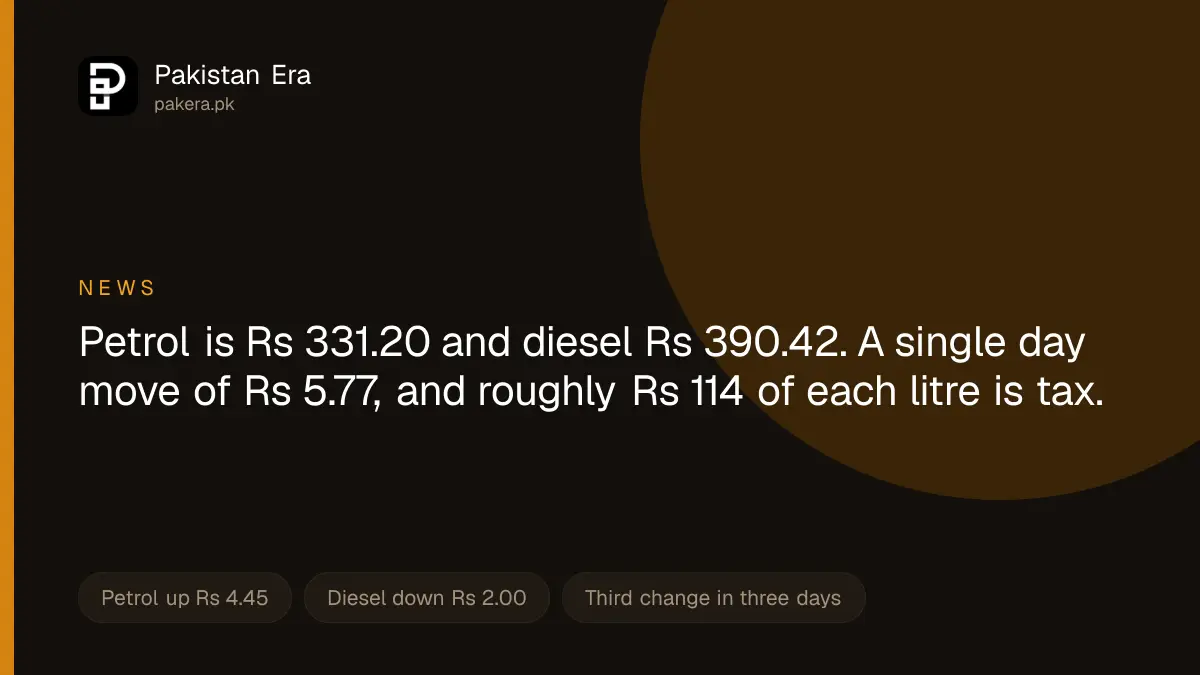
Roughly Rs 114 of every litre of petrol is tax and duty, and about Rs 100 on diesel. Against a pump price of Rs 346.16 that is around 33 per cent of what you hand over.
That is why this page cannot be a price ticker. Here is the run:
| Effective | Petrol | High speed diesel |
|---|---|---|
| 4 August | Down Rs 4.08 to Rs 331.95 | Down Rs 2.45 to Rs 389.93 |
| 5 August | Down Rs 3.39 to Rs 328.56 | Down Rs 4.07 to Rs 385.86 |
| 6 August | Up Rs 4.45 to Rs 333.01 | Down Rs 2.00 to Rs 383.86 |
| 13 August | Down 94 paisas to Rs 324.98 | Up 54 paisas to Rs 382.79 |
| 14 August | Up 45 paisas to Rs 325.43 | Up Rs 1.16 to Rs 383.95 |
| 18 August | Up Rs 5.77 to Rs 331.20 | Up Rs 6.47 to Rs 390.42 |
| 19 August | Up Rs 3.34 to Rs 334.54 | Up Rs 5.27 to Rs 395.69 |
| 20 August | Up Rs 2.97 to Rs 337.51 | Down Rs 32.63 to Rs 363.06 |
| 21 August | Up 27 paisas to Rs 337.78 | Up Rs 1.64 to Rs 364.70 |
| 22 to 24 August | Up Rs 3.81 to Rs 341.59 | Up Rs 3.59 to Rs 368.29 |
| 25 August | Up 39 paisas to Rs 341.98 | Up Rs 2.40 to Rs 370.69 |
| 26 to 27 August | Up Rs 1.12 to Rs 343.10 | Up Rs 1.11 to Rs 371.80 |
| 28 August | Down 50 paisas to Rs 342.60 | Down 19 paisas to Rs 371.61 |
| 29 to 31 August | Down 58 paisas to Rs 342.02 | Down 17 paisas to Rs 371.44 |
| 1 September | Up 77 paisas to Rs 342.79 | Down Rs 1.03 to Rs 370.41 |
| 2 September | Up Rs 1.08 to Rs 343.87 | Up 51 paisas to Rs 370.92 |
| 3 September | Up Rs 2.29 to Rs 346.16 | Up Rs 1.11 to Rs 372.03 |
Three revisions in three days, moving in opposite directions on the third. Since 17 July 2026, OGRA revises ex depot petroleum prices every 24 hours, calculates them itself, and publishes them on its own website without waiting for the prime minister to approve anything. The fortnightly announcement that half the country planned its tank around no longer exists.
The 13 and 14 August figures are worked back from the announced changes against the rate notified that day, which is why they carry paisa level detail. Days between 6 and 13 August also moved, each one revised on the same daily cycle.
One caution carried over from earlier. Some outlets reported 6 August petrol as Rs 333.10. The previous rate of Rs 328.56 plus the announced Rs 4.45 increase gives Rs 333.01, so we used that and treated the other as a transposition.
So this article is not going to pretend to be your price ticker. It is going to show you where the official number actually lives, which almost no coverage of this does.
Where to get today's real price
We opened ogra.org.pk and confirmed it: the Oil and Gas Regulatory Authority, established by the federal government on 28 March 2002, now carries a Daily Fuel Prices section with two parts, Price Publication and Platts Data.
That second one is the useful one and it is new. OGRA has been directed to publish the daily Platts assessments it prices from, for MS 92 RON petrol and HSD 10 ppm diesel, so anyone can compare the international benchmark against the domestic pump rate instead of taking the calculation on trust.
One warning that matters more than it should. There is a site at ogra.com.pk that ranks well for these searches and is not the regulator. The regulator is on .org.pk. If you are checking a price you intend to act on, check the domain first.
What actually changed in July
| Before | Now |
|---|---|
| Prices set on the 1st and 16th | Reviewed every 24 hours |
| Summary approved by the federal government | OGRA calculates and publishes, then informs the DG Oil office |
| Benchmark data not published | Daily Platts assessments published for MS 92 RON and HSD 10 ppm |
| A date to fill your tank before | No announcement schedule at all |
Two dates get quoted for this and they are not in conflict. OGRA began publishing daily Platts reference prices from 1 July 2026. The daily revision of actual ex depot prices took effect from 17 July 2026. The calculation itself uses a seven day rolling average of international prices, plus freight and the exchange rate, so a single day's spike does not land on the pump in full.
The weekend rule nobody mentions
Prices notified on a Friday hold through Saturday and Sunday. Daily pricing is daily on working days.
This is the one piece of predictability left in the system, and it is worth knowing for a practical reason: if a Friday price is a good one, it is good for three days, and if it is a bad one, you are stuck with it for three days too.
What OGRA still cannot do on its own
The autonomy has limits, and they are the limits that decide most of what you pay.
The petroleum levy cannot exceed the ceiling approved by the federal cabinet, and any change to the levy rate requires approval from the Finance Division. OGRA moves the price with the market. It does not set the tax, and the tax is the part of the pump price that policy actually controls.
That distinction is the whole reason a falling international price so often fails to show up at the pump, which we went through in detail in why petrol prices do not fall when oil does, and it is the mechanism behind the dynamic petroleum levy agreed with the IMF.
Imports changed too, quietly
Alongside the pricing change, high speed diesel imports now route exclusively through Pakistan State Oil, while oil marketing companies may import petrol in line with their market shares.
That is a structural change hiding inside a pricing announcement. Concentrating diesel imports in one state buyer affects who carries the currency risk and who has leverage over supply, and diesel is the fuel that moves freight, farm equipment and public transport. It belongs in the same conversation as the digital fuel tracking system ordered around the same time.
What daily pricing changes for you
- Queueing before a rise no longer works. There is no announced date to queue before.
- Changes are usually smaller, but not always. Most revisions are paisas. Then diesel rose Rs 11.74 across 18 and 19 August and fell Rs 32.63 on 20 August. The fortnightly shock has not been abolished, only made less predictable about when it arrives.
- Quoted prices need a fuel clause. If you haul, deliver or drive for a platform, a fare quoted on Monday's fuel cost is exposed by Wednesday.
- Any price in an article is history. Including the one at the top of this page.
For households the change is mildly good. Smaller movements, no fortnightly queue. For anyone who prices work in advance, it is worse, because a cost that used to be fixed for two weeks now has to be absorbed daily, and small operators absorb it out of their own margin.
Why diesel still costs more than petrol
Rs 372.03 against Rs 346.16 is a gap of about Rs 28.70 a litre. It was Rs 61 on 19 August, so it can move a long way in a week. The gap is not about the fuel. It is about tax treatment. High speed diesel carries the heavier levy burden and has for years, because freight, agriculture and public transport cannot easily stop buying it, which makes it a dependable revenue line.
This is why the diesel number matters even if you drive a petrol car. Diesel sets the cost of moving vegetables to your market. A petrol change reaches people who buy petrol; a diesel change reaches your grocery bill within weeks.
How to keep track from here
- Bookmark OGRA's Daily Fuel Prices page on ogra.org.pk. It is the only definitionally correct source.
- Check the domain before trusting a price. The lookalikes rank well.
- Stop planning a tank fill around an announcement. There is no announcement.
- Treat any figure older than a few days as history, including ours.
Some outlets are still describing fuel prices as being set by periodic government review. That was true until mid July. It is not how the system works now, and the gap between the two descriptions is where people get caught out.
Our pieces on the targeted fuel subsidy under consideration, the fuel quota app and the Rs 458 peak and bike subsidy cover what else is moving around petroleum pricing.
What sits behind the number
The price on the board is mostly not the cost of fuel, and three pieces explain the parts of it.
The state collected Rs 1.567 trillion in petroleum levy last year, up 29 per cent and above both its original and revised targets. That is the single biggest reason the pump price does not track the international market.
Refining capacity is the other half of the supply picture, and the policy meant to expand it is covered in the refining policy amendments.
When dealers stop selling, the question is which pumps still serve. A dealers' association strike does not bind company operated sites, which we explain in which pumps stay open during a strike.
Questions readers are asking
What is the petrol price in Pakistan today?
Rs 346.16 a litre and diesel Rs 372.03, effective 3 September 2026. Prices are normally revised every 24 hours, so check OGRA's Daily Fuel Prices page on ogra.org.pk for the current figure rather than any article.
When did Pakistan switch to daily fuel pricing?
Daily revision of ex depot prices took effect from 17 July 2026. OGRA began publishing daily Platts reference prices from 1 July 2026.
Do petrol prices change on weekends?
No. A price notified on Friday remains unchanged on Saturday and Sunday.
Who sets the petrol price in Pakistan now?
OGRA calculates and publishes ex depot prices daily without prior approval from the federal government or the prime minister, and informs the DG Oil office. The petroleum levy stays within the cabinet approved ceiling and any change to it needs Finance Division approval. That describes the mechanism, and 20 August showed its limits: a Rs 32.63 cut in diesel came from the Prime Minister instructing a minister to negotiate with refineries, not from the formula.
Where can I see the official rate?
On ogra.org.pk, under Daily Fuel Prices, which has both a price publication and the daily Platts data the prices are calculated from. Note that ogra.com.pk is a different site and not the regulator.
Why is diesel dearer than petrol?
It used to be the levy, and we have said so on this page before. That explanation stopped working on 20 August, when the diesel levy rose to Rs 80 and matched petrol exactly while diesel stayed Rs 25.55 dearer. We do not have a full account of what now explains the gap. Diesel movements still feed into food and freight prices in a way petrol movements do not, and that part is unchanged.
How we checked today
We went to OGRA first on 3 September 2026. Its website responded, but the notified petroleum price pages we opened carry RLNG and gas decisions, and the retail petrol and diesel figures were not exposed as readable text on any page we could reach. So today's numbers are reported, taken from consistent coverage by Business Recorder, The Express Tribune and other outlets, rather than read on the regulator's own page.
One check we can offer, and this time it spans two revisions. We had Rs 342.79 and Rs 370.41 from 1 September. Adding the reported rises of Rs 1.08 and 51 paisa for 2 September, then Rs 2.29 and Rs 1.11 for 3 September, gives exactly Rs 346.16 and Rs 372.03. The arithmetic agrees with the numbers being reported, which is not proof, but it is better than repeating a figure that does not reconcile.
About the author

Tax, Bills and Technology Writer
Ali Akhtar is a young and curious voice here at Pakistan Era. He is currently pursuing his A-Levels and has a growing interest in Pakistan’s changing industrial landscape and educational trends. Ali likes to write in a way that helps him explain and explore the world around him. His writing reflects the perspective of the new generation navigating the evolving trends of Pakistan where technology, youth innovation, and shifting opportunities are reshaping the country’s future.