Pakistan Wants to Track Every Litre of Fuel It Sells
The PM has ordered digital tracking of fuel from refinery to pump, modelled on FBR's system, plus a restructuring of OGRA.
When a petrol pump tells you it has no fuel, there has never been a reliable way to know whether that is true.
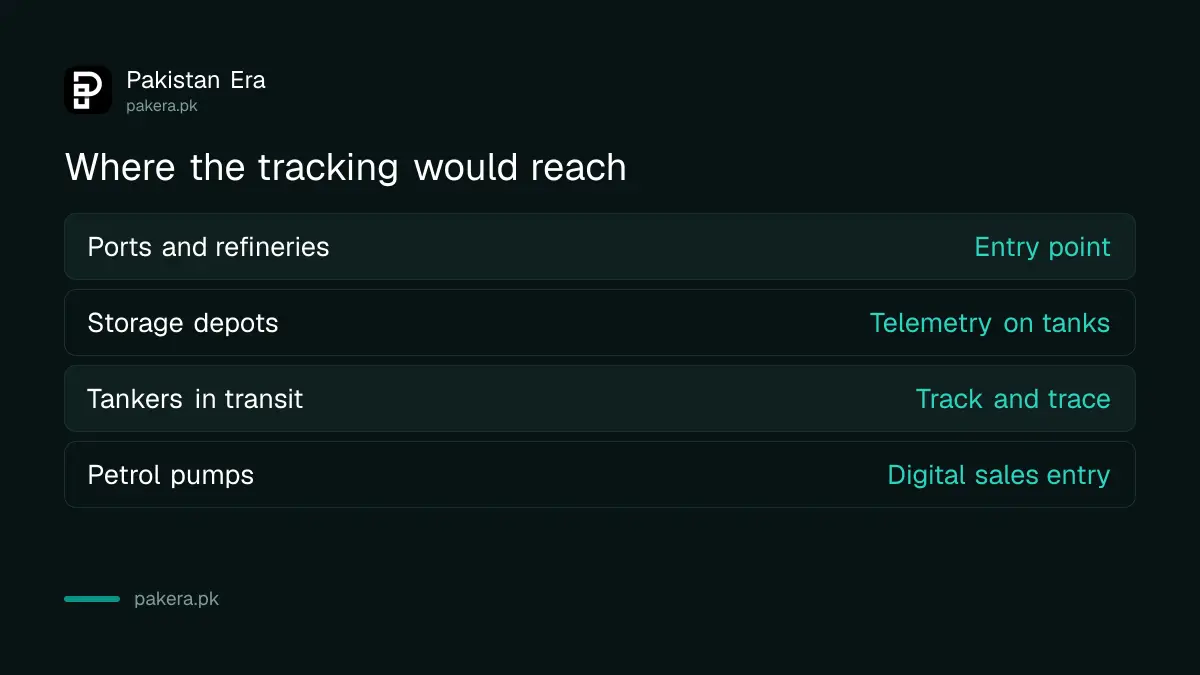
The Prime Minister has ordered a nationwide fuel tracking system Pakistan would run on the same model FBR uses for tax monitoring, following petroleum digitally from ports and refineries through depots and tankers to the pump itself. It comes with a broader restructuring of the Oil and Gas Regulatory Authority.
The part most coverage is missing is that several pieces of this already exist. What changes is whether they are joined up and enforced.
What is actually being ordered?
Digital monitoring across the whole supply chain, plus a comprehensive restructuring of OGRA including bringing in qualified private sector specialists through a merit based process.
| Stage | What gets monitored |
|---|---|
| Ports and refineries | Fuel entering the system |
| Storage depots | Tank levels through telemetry |
| Tankers in transit | Movement, through track and trace |
| Petrol pumps | Sales, through digital entry |
The staff point matters more than the technology. A regulator that cannot hire people who understand supply chain data is not going to run a supply chain data system, regardless of what it installs.
Does OGRA not already do this?
Partly, yes, and this is the honest context. OGRA already operates a National Monitoring Dashboard, a Tanker Track and Trace System, Depot Tank Telemetry, the Rahguzar mobile app, a Digital Sales Entry System and a Central Monitoring Cell.
So the announcement is less about building new tools than about making the existing ones work together and actually bite. That is a considerably harder problem than procurement, and a much less photogenic one.
It also explains the FBR comparison. FBR's track and trace has a mixed record, with implementation fights, legal challenges and industries resisting it for years. Choosing that as the model tells you the ambition. It does not tell you the outcome.
What is hoarding and why does it happen?
Holding back fuel that could be sold, usually because a price increase is expected and stock bought at the old price becomes more valuable the moment it rises.
Pakistan has just moved to daily petroleum pricing, which sharpens that incentive rather than removing it. When prices moved fortnightly, everyone knew the date. When they can move any day, a pump owner watching the international market has more chances to profit from a pause.
An enforcement campaign in July identified multiple cases of hoarding and unnecessary supply disruption, with show cause notices and legal action following. So this is not theoretical, and the regulator has already found what it went looking for.
Would it actually reach your local pump?
That is the whole question, and the honest answer is that the last step is the hardest.
Tracking tankers and depots is comparatively easy, because they are large, few and already licensed. Tracking sales at thousands of individual pumps means every one of them entering data reliably, and pumps that hoard have every reason to enter data unreliably.
What would tell you it is working:
- Enforcement actions continuing after the announcement cycle ends, not just during a campaign.
- Data published rather than held internally, since a dashboard nobody outside sees is a dashboard nobody can check.
- Pumps being penalised by name, which is the only deterrent that changes behaviour.
- Shortages becoming rarer before a price rise, which is the outcome that actually matters to you.
What would have to go right?
In order, because each step depends on the one before it:
- The existing tools have to talk to each other. A depot telemetry feed that cannot be reconciled against tanker movement and pump sales is three separate numbers, not a supply chain view.
- The data has to be trusted enough to act on. Enforcement built on figures a pump can dispute goes nowhere.
- OGRA has to be staffed to use it, which is why the restructuring matters more than the software.
- Penalties have to be large enough to beat the profit from hoarding, or they become a cost of doing business.
- It has to survive the news cycle, since enforcement campaigns in Pakistan have a habit of fading once the coverage does.
What does this mean for you?
Nothing immediately, and probably nothing for months. Systems like this take a long time to reach the forecourt, and this one starts from tools that already exist without having fixed the problem.
The realistic benefit, if it lands, is fewer artificial shortages in the days around a price change. That is a real improvement for anyone who has queued at a pump that mysteriously had nothing the night before a rise.
What it will not do is make fuel cheaper. Hoarding distorts availability rather than setting the price, and the price is set by international markets, the exchange rate and the levies stacked on top.
Our pieces on the targeted fuel subsidy being considered and the fuel quota app system cover the two other things happening to petroleum policy at the same time.
Frequently asked questions
What is the new fuel tracking system?
A nationwide digital system to monitor petroleum movement from ports and refineries through depots and tankers to petrol pumps, modelled on FBR's monitoring approach.
Does OGRA already track fuel?
Partly. It runs a monitoring dashboard, tanker track and trace, depot telemetry, a sales entry system and a central monitoring cell. The order is about joining these up and enforcing them.
Will this reduce petrol prices?
No. Hoarding affects availability rather than price, which is set by international markets, the exchange rate and levies. The benefit would be fewer artificial shortages.
Why do pumps hoard fuel?
Because stock bought before a price increase becomes more valuable after it. Daily pricing gives more opportunities for that, not fewer.
Is OGRA being restructured?
Yes. The Prime Minister ordered a comprehensive restructuring, including appointing qualified private sector experts through a merit based process.
When would any of this take effect?
No timeline has been given. The existing tools are already live, so the change is about integration and enforcement rather than a launch date.
About the author

Senior Writer, Public Services and Technology
Shahid joined us in 2024 as an author. He is a senior contributor to Pakistan's leading technology websites. He writes detailed articles, mostly covering his expertise in the latest tech, mobiles, apps, gadgets, and step-by-step guides. His ideology is to help people understand the latest trends and explain complex methods through very easy-to-understand guides.