Targeted Fuel Subsidy Is Back on the Table
The government has signalled a return of targeted fuel subsidy, days after another price rise. What is confirmed and what is not.
The government raised fuel prices on 30 July. On 31 July it signalled that a targeted fuel subsidy might be coming back.
Those two things landing a day apart tells you more than either does alone. A targeted fuel subsidy in Pakistan means help aimed at specific people rather than a price cut for everyone, and every previous attempt at one has run into the same problem: deciding who qualifies and getting the money to them.
Nothing has been announced beyond the signal. That matters, because this subject attracts confident rumours.
What has the government actually said?
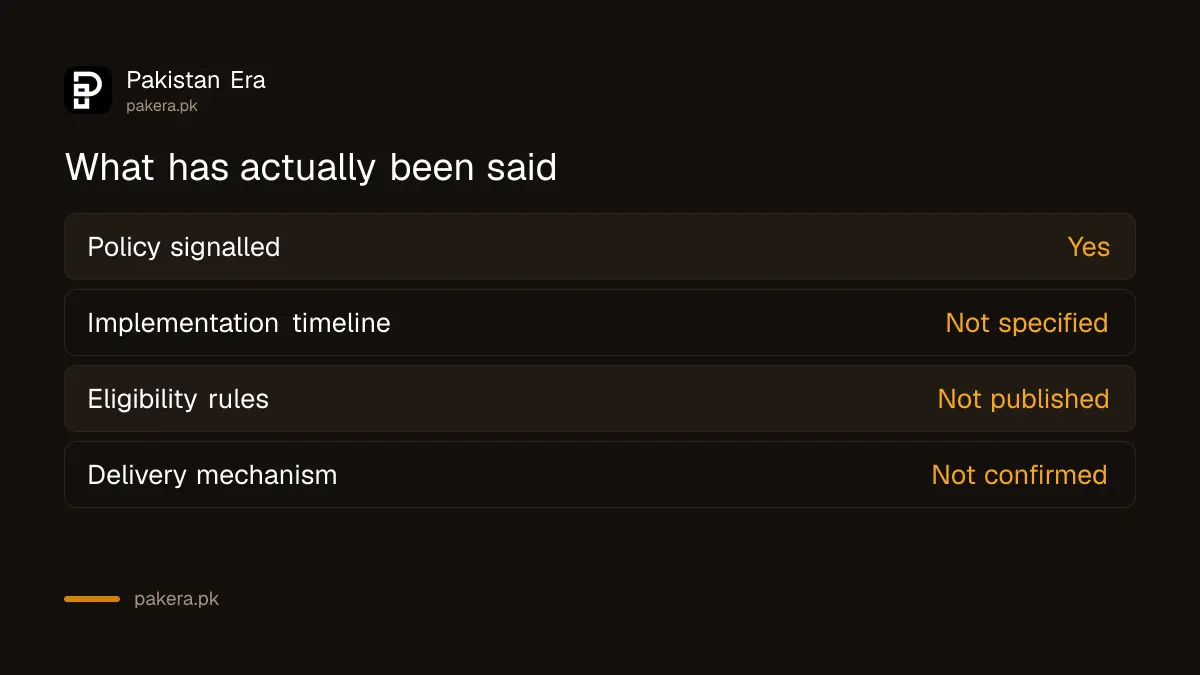
That a targeted subsidy is under consideration. No implementation timeline, no eligibility criteria, no delivery mechanism and no budget figure.
| Detail | Status |
|---|---|
| Policy direction signalled | Yes |
| Implementation timeline | Not specified |
| Who qualifies | Not published |
| How money reaches people | Not confirmed |
| Cost to the exchequer | Not stated |
So treat anything you read describing how to apply as invented. There is nothing to apply for.
What does targeted actually mean?
That the subsidy goes to some people and not others, rather than cutting the pump price for everyone.
The logic is sound. A general price cut costs enormous amounts and hands the largest benefit to whoever buys the most fuel, which is not the people who need help. Targeting concentrates a smaller budget on households that actually feel Rs 458 petrol.
The execution is where it falls apart. Every targeted scheme has to answer three questions, and Pakistan has struggled with all three: who qualifies, how you prove it, and how the money gets to them without leaking on the way.
How would it likely work?
Unknown, but there are only a few mechanisms available and each has a history.
- Motorcycle and rickshaw targeting, which reaches the right people, since a bike owner is rarely wealthy. Pakistan has used this approach before.
- Existing welfare databases, which avoid building new machinery but inherit whatever is wrong in the data.
- App based quotas, which are auditable but exclude people without smartphones, who are disproportionately the target.
- Cross subsidy from higher grades, charging more for premium fuel to fund the rest, which needs no delivery mechanism at all.
That last one is the least discussed and the most likely to actually function, because it never requires handing anybody money.
Why does this keep coming back?
Because fuel prices keep rising and the political cost keeps arriving with them. Petrol reached Rs 458 this year, and each increase produces the same cycle: public anger, a signalled relief measure, then a scheme that is narrower than trailed.
The structural problem is that Pakistan cannot afford a general subsidy and cannot easily deliver a targeted one. So the announcement arrives quickly and the implementation does not.
Our earlier piece on the Rs 458 petrol price and the bike subsidy covers the last time this happened, and the fuel quota app system explains the mechanism most likely to be reused.
Has Pakistan tried this before?
Repeatedly, which is the most useful guide to what happens next.
The pattern is consistent. A price shock produces political pressure. A relief measure is announced, usually aimed at motorcycles or low income households. The scheme then either arrives smaller than trailed, arrives late, or is quietly replaced by something administratively easier.
The reason is not bad faith so much as arithmetic. Pakistan's fuel pricing carries petroleum levy and other charges that fund the budget, so a subsidy is not just money out, it is revenue foregone from a line the budget is already relying on. Every rupee of relief has to come from somewhere in a fiscal position with no slack in it.
That is why cross subsidy keeps reappearing as an option. Charging more for high octane to fund relief on regular petrol costs the exchequer nothing, needs no eligibility list and no delivery mechanism. It is unpopular with the people who buy premium fuel, which is a much smaller and less politically urgent group.
What should you do?
Nothing yet, and be sceptical of anyone telling you otherwise.
- Do not pay anyone to register you for a subsidy that does not exist. That scam follows every announcement of this kind.
- Watch for the eligibility criteria, which is the first real detail and the one that decides whether it affects you.
- Check whether it runs through an existing database or a new registration, since that determines whether you need to do anything at all.
- Treat any date circulating before an official notification as a guess.
If it does arrive in the shape it has taken before, motorcycle owners are the most likely beneficiaries and no application may be needed. That is worth knowing before somebody offers to sign you up for a fee.
Frequently asked questions
Is the fuel subsidy confirmed?
No. The government has signalled that a targeted subsidy is under consideration. No timeline, eligibility or mechanism has been announced.
Who would qualify for a targeted fuel subsidy?
Not published. Previous Pakistani schemes have focused on motorcycle owners and low income households, but nothing has been confirmed this time.
How do I apply?
You cannot. There is no scheme to apply to yet, and anyone charging a fee to register you is running a scam.
Why not just cut petrol prices for everyone?
A general cut costs far more and gives the biggest benefit to whoever buys the most fuel. Targeting concentrates a smaller budget on people who need it.
When would it start?
No timeline has been given. Treat any circulating date as speculation until an official notification appears.
What is the current petrol price?
Prices were increased again on 30 July 2026, after reaching Rs 458 earlier in the year. Check the current notified rate, as it changes fortnightly.
About the author

Tax, Bills and Technology Writer
Ali Akhtar is a young and curious voice here at Pakistan Era. He is currently pursuing his A-Levels and has a growing interest in Pakistan’s changing industrial landscape and educational trends. Ali likes to write in a way that helps him explain and explore the world around him. His writing reflects the perspective of the new generation navigating the evolving trends of Pakistan where technology, youth innovation, and shifting opportunities are reshaping the country’s future.