Diesel Falls Rs 32.63 in a Day, and the Tax on It Went Up
Diesel fell to Rs 363.06 after refineries agreed to cut prices. On the same day its levy rose Rs 1.72, so refineries absorbed more than the cut.
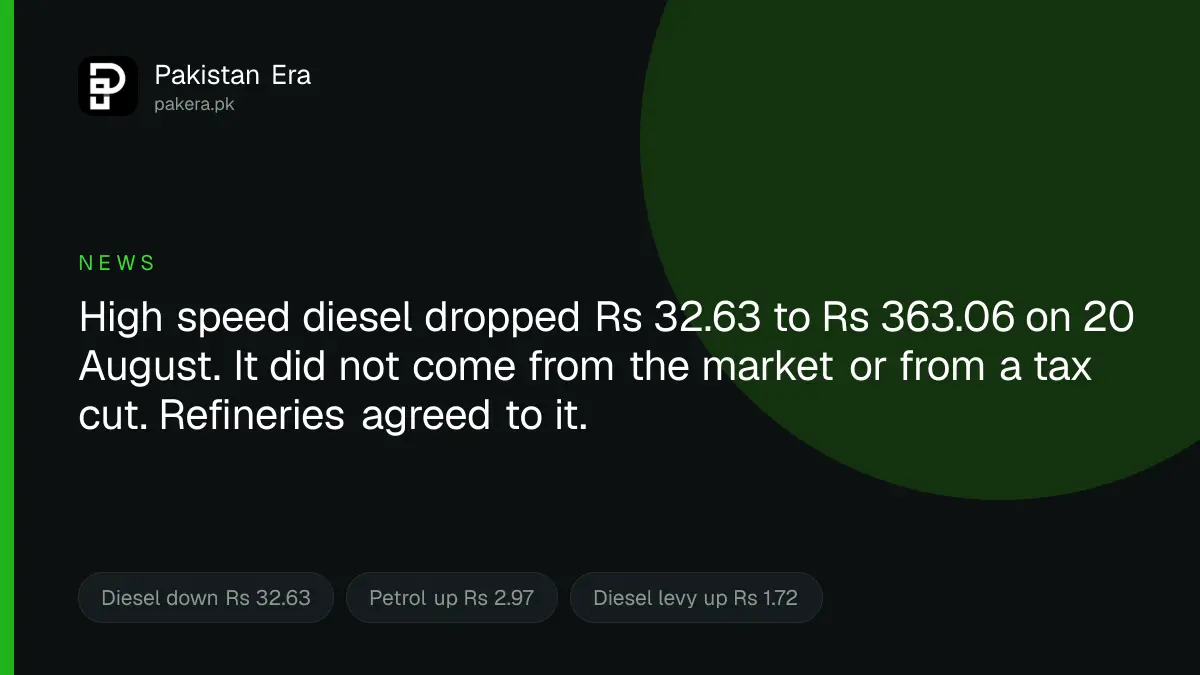
High speed diesel fell Rs 32.63 a litre on 20 August 2026, to Rs 363.06. Petrol went the other way, up Rs 2.97 to Rs 337.51.
A cut that size is not normal. Most daily revisions move the price by paisas.
What makes it worth a page rather than a line is where it came from. The market did not deliver it and no tax was cut to fund it. Refineries agreed to it.
What changed
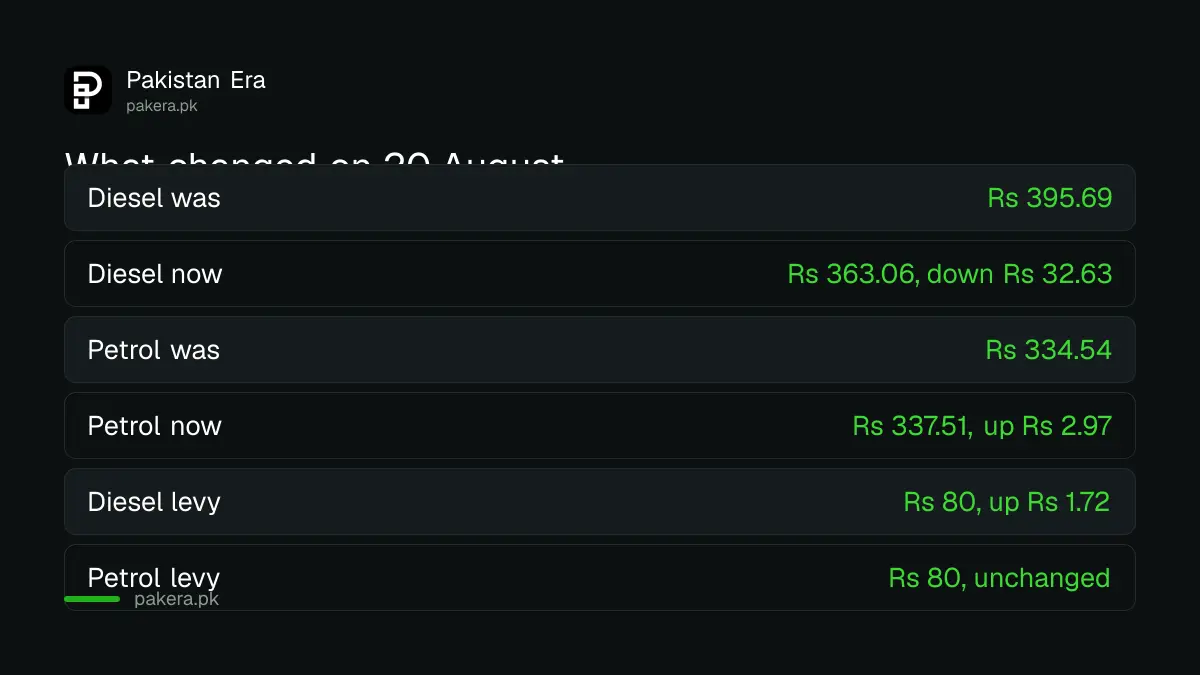
| Item | 19 August | 20 August |
|---|---|---|
| High speed diesel | Rs 395.69 | Rs 363.06, down Rs 32.63 |
| Petrol | Rs 334.54 | Rs 337.51, up Rs 2.97 |
| Levy on diesel | Rs 78.28 | Rs 80, up Rs 1.72 |
| Levy on petrol | Rs 80 | Rs 80, unchanged |
Read the third row again, because it is the part that will not appear in most coverage.
The tax on diesel went up on the same day its price came down. The petroleum levy on high speed diesel rose by Rs 1.72 to Rs 80 a litre.
So the reduction on the refinery side is not Rs 32.63. It is closer to Rs 34.35, because it had to cover a levy increase before it could reach the pump at all.
Where the cut came from
The Prime Minister directed the Petroleum Minister to negotiate with oil refineries on price.
According to the Petroleum Minister, the refineries accepted the government's request and decided to make a significant reduction in diesel prices. The reason given for why this was possible with diesel specifically is that most of Pakistan's diesel is produced locally by refineries rather than imported.
That is the mechanism. Not a fall in international prices, not a tax concession, but a negotiated reduction by domestic producers after the government asked.
It is worth being clear about what that does and does not mean.
It means the saving is real and it is at the pump today. It also means the saving depends on an agreement rather than on a rule, and agreements can end.
The gap between the two fuels has collapsed

Yesterday diesel sat about Rs 61 above petrol, and the gap had been widening for days. Today it is Rs 25.55.
This forces us to correct something we have written before, so we will do it plainly.
We have explained the diesel premium by saying diesel carries a heavier levy burden. That explanation no longer holds. Both fuels now carry a levy of Rs 80 a litre, and diesel is still the dearer of the two by Rs 25.55.
Whatever accounts for the remaining gap, it is not the levy. We do not yet have a full account of it and we would rather say that than reach for the old explanation because it used to work.
Why a diesel cut reaches people who never buy diesel
This is the reason a diesel number matters more than a petrol one.
Diesel moves goods. It runs trucks, tractors, buses and generators. Petrol mostly moves people in cars and on motorbikes.
So a change in the petrol price reaches people who buy petrol, while a change in the diesel price works its way into what vegetables cost at your market, what a delivery charge is, and what a bus fare has to cover.
Three cautions before anyone expects that at the shops this week:
- Freight costs pass through slowly in both directions, and they pass down more slowly than they pass up.
- Diesel had risen about Rs 72 a litre over the preceding month. Today's cut gives back under half of that, so this is a partial retreat from a climb, not a new low.
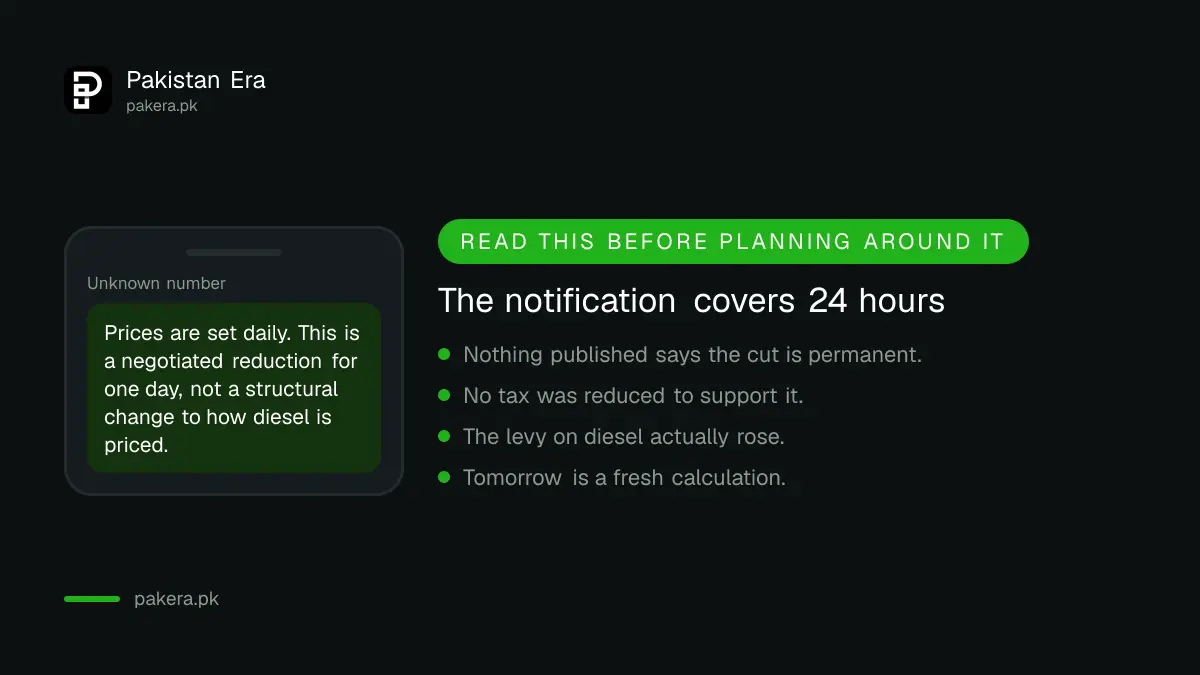
- The notification covers 24 hours. Tomorrow is a fresh calculation.
What this does to the daily pricing story
Since 17 July 2026, OGRA has revised ex depot petroleum prices every 24 hours, calculating them itself and publishing them without waiting for approval from the prime minister. We have described the system that way, because that is what the mechanism says.
Today qualifies it, and we should say so rather than leaving the tidier version standing.
A price move of this size, produced by the Prime Minister instructing a minister to negotiate with producers, is not the automatic operation of a formula. The formula still runs daily. But it now clearly sits alongside direct intervention, and on 20 August the intervention was the larger force by a wide margin.
We have added that qualification to our daily fuel price page rather than quietly editing around it.
The broader question of why pump prices resist falling when international prices do is covered in why petrol prices do not fall when oil does, and the scale of the levy is in the record Rs 1.567 trillion collected last year.
What we could not verify
We checked OGRA's notified petroleum prices page at 11:20 PKT on 20 August 2026. It listed notifications up to 19 August only, so the notification for today's prices was not published there when we looked.
That matters because our own guidance tells readers to check OGRA's site rather than an article. That guidance still stands, but on the day of a change the authority's page may lag the notification by several hours.
The figures here therefore come from two independent reports that agree with each other exactly, and which agree with the previous day's rates we already held. We have not read the notification document itself.
We do not know what the refineries received in return, whether the arrangement has an agreed duration, or what margins were involved. Nothing published sets out those terms.
We also cannot tell you whether this holds tomorrow, and neither can anybody else.
Update, 21 August. It held. Diesel is Rs 364.70 today, up Rs 1.64, having given back only a twentieth of the Rs 32.63 it lost. That is the daily mechanism moving, not the refinery agreement unwinding. Petrol is Rs 337.78, up 27 paisas. We are recording this because we asked the question in public and it deserves an answer on the same page.
Questions readers are asking
What is the diesel price in Pakistan today?
Rs 364.70 a litre on 21 August 2026. It fell Rs 32.63 to Rs 363.06 on 20 August and has given back Rs 1.64 since, so the cut has largely held. Petrol is Rs 337.78.
Why did diesel fall so much?
Refineries agreed to reduce prices after the Prime Minister directed the Petroleum Minister to negotiate with them. Most of Pakistan's diesel is produced locally rather than imported.
Was the tax on diesel cut?
No. The petroleum levy on diesel rose by Rs 1.72 to Rs 80 a litre on the same day, so the refinery reduction had to absorb that before reaching the pump.
Is the cut permanent?
Nothing published says so. Prices are notified daily and this notification covers 24 hours.
Will food and transport get cheaper?
Possibly, but slowly. Freight costs pass down more slowly than they pass up, and diesel had risen about Rs 72 a litre in the preceding month, so this returns under half of that.
Why is diesel still dearer than petrol?
Both now carry the same Rs 80 levy, so the old explanation about a heavier tax burden no longer accounts for the Rs 25.55 gap. We do not have a full explanation for what remains.
Where can I check the official rate?
On ogra.org.pk, but note that its notified prices page can lag by several hours on the day of a change. Note also that ogra.com.pk is a different site and not the regulator.
About the author

Senior Writer, Public Services and Technology
Shahid joined us in 2024 as an author. He is a senior contributor to Pakistan's leading technology websites. He writes detailed articles, mostly covering his expertise in the latest tech, mobiles, apps, gadgets, and step-by-step guides. His ideology is to help people understand the latest trends and explain complex methods through very easy-to-understand guides.