Pakistan Cabinet Committee Approves FIA Act, PPC and CrPC Amendments
A federal cabinet committee approved amendments to the FIA Act, PPC and CrPC on 28 September. The text is not public and none is law yet. The stages ahead.
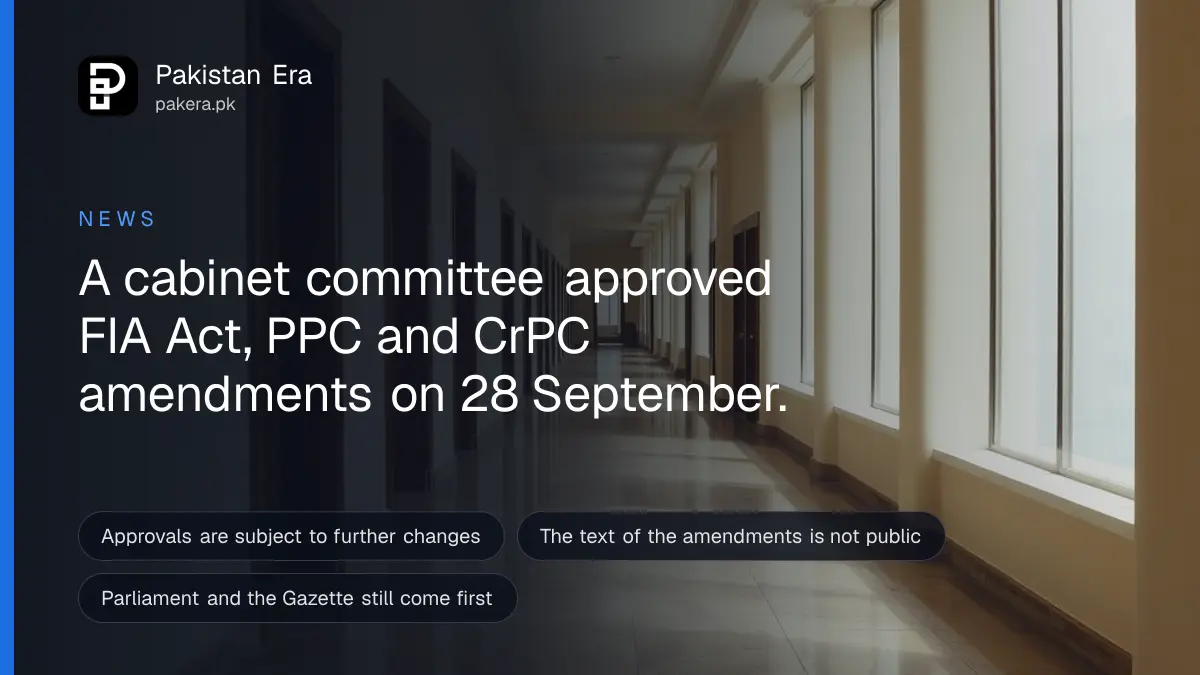
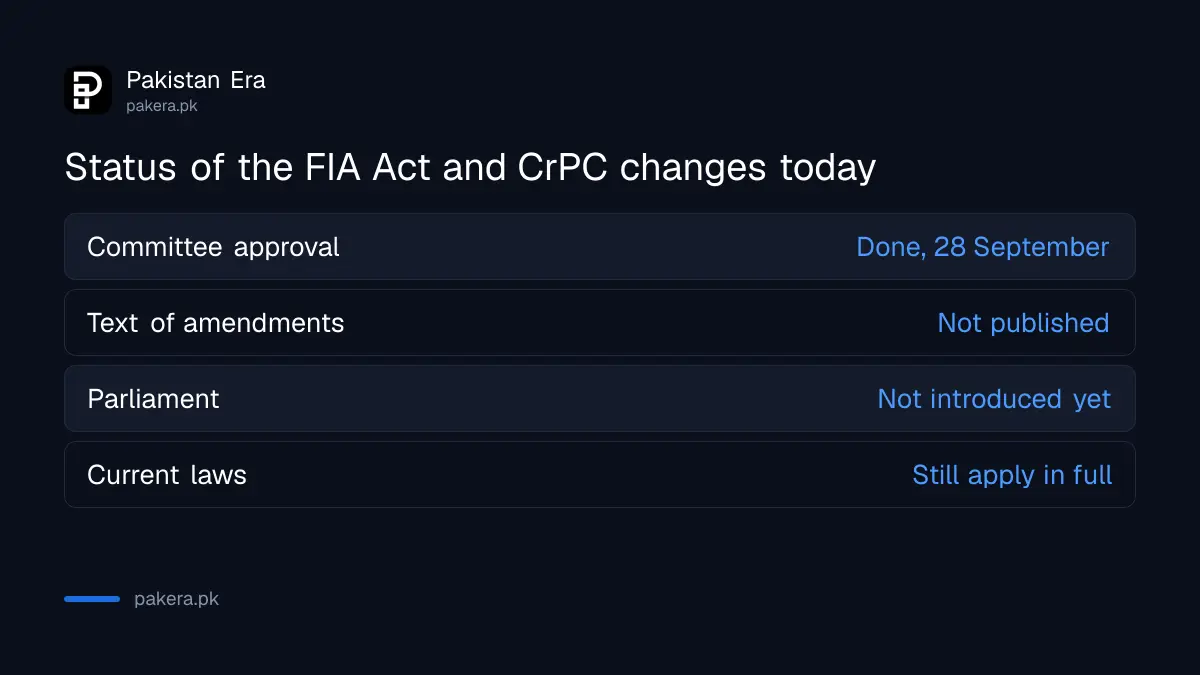
A federal cabinet committee has approved proposed amendments to the FIA Act, 1974, the Pakistan Penal Code and the Code of Criminal Procedure. That is an early step. None of these changes is law yet, and the government has not published what the amendments actually say.
The approval came from the Cabinet Committee on Disposal of Legislative Cases, chaired by Federal Law Minister Senator Azam Nazeer Tarar. We read the Press Information Department's release, PR No. 306, posted at 6:37 pm on 28 September 2026. Radio Pakistan carried the same news on 29 September.
Each approval came with a condition. The release says the FIA Act changes were approved "subject to incorporation of the Committee's recommendations and necessary amendments". So the drafts will change again before anyone sees them.
The committee approved changes to five laws and rules
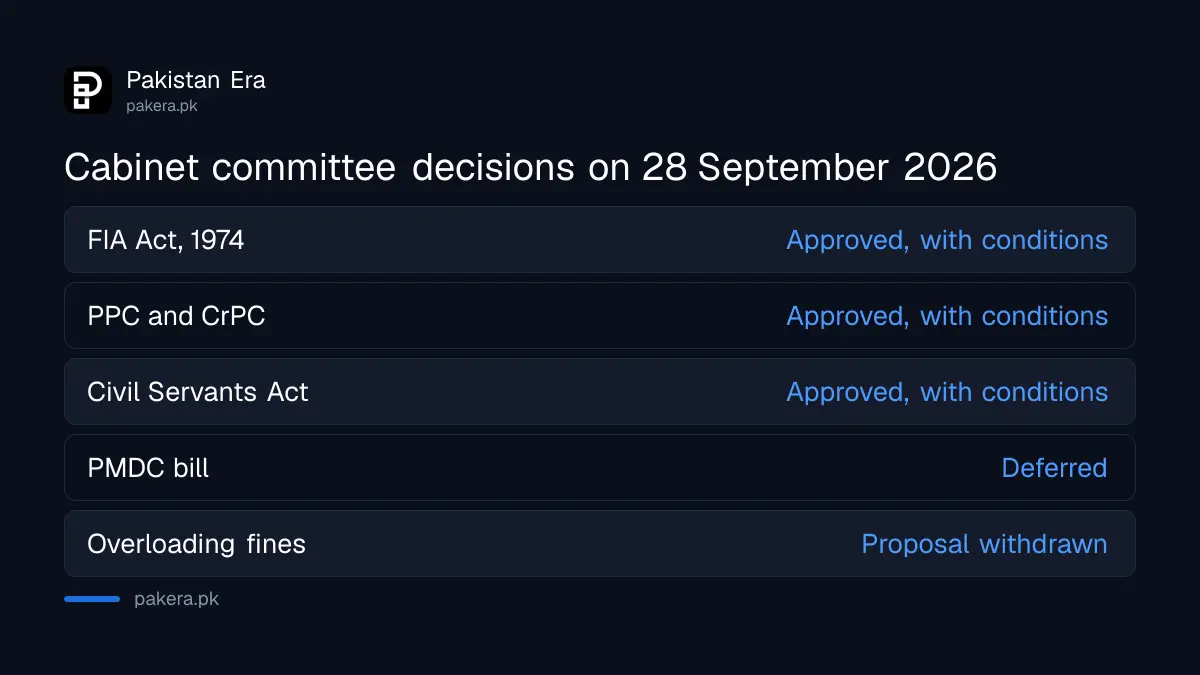
The Cabinet Committee on Disposal of Legislative Cases approved proposed amendments to the FIA Act, the Pakistan Penal Code, the Code of Criminal Procedure, the Civil Servants Act and the Immigration Rules. It deferred one bill on the medical council and withdrew one proposal on overloading fines.
Here is the full list, as the official release gives it:
| Law or proposal | Committee decision |
|---|---|
| FIA Act, 1974 | Approved, subject to the committee's recommendations and necessary amendments |
| Pakistan Penal Code, 1860 | Approved, subject to necessary amendments and recommendations |
| Code of Criminal Procedure, 1898 | Approved, subject to necessary amendments and recommendations |
| Civil Servants Act, 1973 | Approved, subject to necessary amendments |
| Immigration Rules, 1979 | Approved |
| Pakistan Medical and Dental Council (Amendment) Bill, 2026 | Consideration deferred |
| Higher overloading penalties, National Highways Safety Ordinance, 2000 | Proposal withdrawn |
The Immigration Rules are the only item approved without a condition attached. Every other approval still waits on further drafting.
The government has not said what the amendments change
Neither the PID release nor Radio Pakistan describes the content of any amendment. There is no list of sections, no new offence and no new penalty in either statement. So any claim about what these changes do is, for now, not based on an official text.
That matters because these are big laws. The FIA Act, 1974 is the law that sets up the Federal Investigation Agency and lists what it can investigate. The Pakistan Penal Code defines crimes and punishments. The Code of Criminal Procedure sets the rules for arrest, bail, investigation and trial, and for how an FIR is registered.
A change to any of them can touch ordinary people. Arrest powers, bail rules and which agency handles a complaint all sit in these laws. If you hear a specific claim, such as a new power or a new punishment, ask where it is written. On 29 September, neither official statement carried any such detail.
Committee approval is not the same as a new law
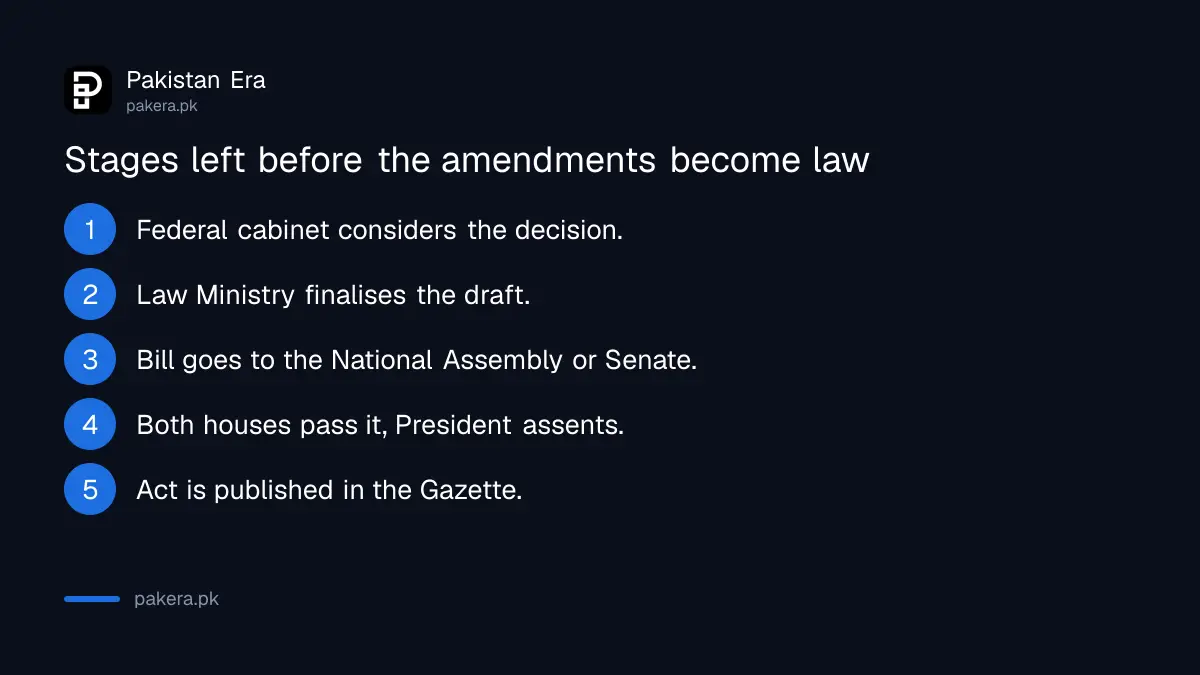
A cabinet committee approval is an internal government decision. For a change to an Act of Parliament to take effect, it normally needs the federal cabinet's approval, a bill passed by both houses of Parliament, the President's assent and publication in the Gazette of Pakistan.
These are the usual stages still ahead for the FIA Act, PPC and CrPC changes:
- The federal cabinet considers the committee's decision.
- The Law Ministry finalises the draft with the committee's recommendations.
- The bill is introduced in the National Assembly or the Senate.
- A standing committee of that house can review it and suggest changes.
- Both houses pass it, and the President gives assent.
- The Act is published in the Gazette of Pakistan and comes into force.
The government can also issue an ordinance, which takes effect at once but lasts for a limited time unless Parliament extends it or passes it as an Act. The release does not say which route the government will take. It gives no timeline either.
Rules are different. The Immigration Rules, 1979 are made by the government under a parent law, so amending them does not need a vote in Parliament. They still take effect only once the change is notified.
Civil servants and immigration rules are also on the list
The committee also approved proposed changes to the Civil Servants Act, 1973 and the Immigration Rules, 1979. The Civil Servants Act governs the terms of service of federal government employees. Many of those officers are also filing asset declarations on the FBR portal this autumn. As with the criminal laws, the release does not say what will change.
Two other items did not go through. Consideration of the Pakistan Medical and Dental Council (Amendment) Bill, 2026 was deferred, so it may come back at a later meeting. And a proposal to raise penalties for overloading under the National Highways Safety Ordinance, 2000 was withdrawn.
That last one is worth noting for transporters. On 28 September, the overloading fines on national highways stayed where they were, because the proposal to raise them was withdrawn.
What you can do while the text is not public
Nothing changes for you today. The FIA, the police and the courts keep working under the current laws until an amendment is passed and notified. If you have a complaint with the FIA now, the current process still applies, and filing an FIA complaint online works the same way it did last week.
When a bill is introduced, its text is usually posted on the National Assembly or Senate website. That is the first point where the public can read the actual changes. Until then, the PID release is the only official statement.
If you are an accused person, a complainant or a lawyer with a case under the FIA Act, PPC or CrPC, watch for the Gazette. The law that applies to you is the one in force on the relevant date, and this is general information, not legal advice.
Common questions
Has the FIA Act been amended?
No. A cabinet committee approved proposed amendments on 28 September 2026. They still need further drafting, Parliament's approval or an ordinance, and notification before they become law.
Who chaired the cabinet committee meeting?
Federal Minister for Law and Justice Senator Azam Nazeer Tarar chaired the Cabinet Committee on Disposal of Legislative Cases.
What do the CrPC and PPC amendments change?
The government has not said. The official release lists the laws but gives no details of the proposed changes.
Was the PMDC amendment bill approved?
No. Consideration of the Pakistan Medical and Dental Council (Amendment) Bill, 2026 was deferred.
Are overloading fines on national highways going up?
Not from this meeting. The proposal to increase overloading penalties under the National Highways Safety Ordinance, 2000 was withdrawn.
How we verified this
What we checked, where we read it, and what we could not confirm.
Last checked at about 1:10 pm PKT on Tuesday 29 September 2026. The committee's decisions and their conditions come from the Press Information Department release PR No. 306, dated 28 September 2026. Radio Pakistan reported the same decisions on 29 September. Neither source gives the text or content of the amendments. The stages ahead describe the usual federal law making process, not a timetable the government has announced.
About the author

Tax, Bills and Technology Writer
Ali Akhtar is a young and curious voice here at Pakistan Era. He is currently pursuing his A-Levels and has a growing interest in Pakistan’s changing industrial landscape and educational trends. Ali likes to write in a way that helps him explain and explore the world around him. His writing reflects the perspective of the new generation navigating the evolving trends of Pakistan where technology, youth innovation, and shifting opportunities are reshaping the country’s future.