Pakistan's LPG Committee Caps Each Company at 20 Tonnes a Day, 90% of Local LPG to Be Auctioned
Pakistan's LPG Committee met on 7 November: 90% of local LPG goes to open auction, 10% to hard areas, 20 tonnes a day per company. Cylinder price unchanged.
یہ صفحہ اردو میں پڑھیں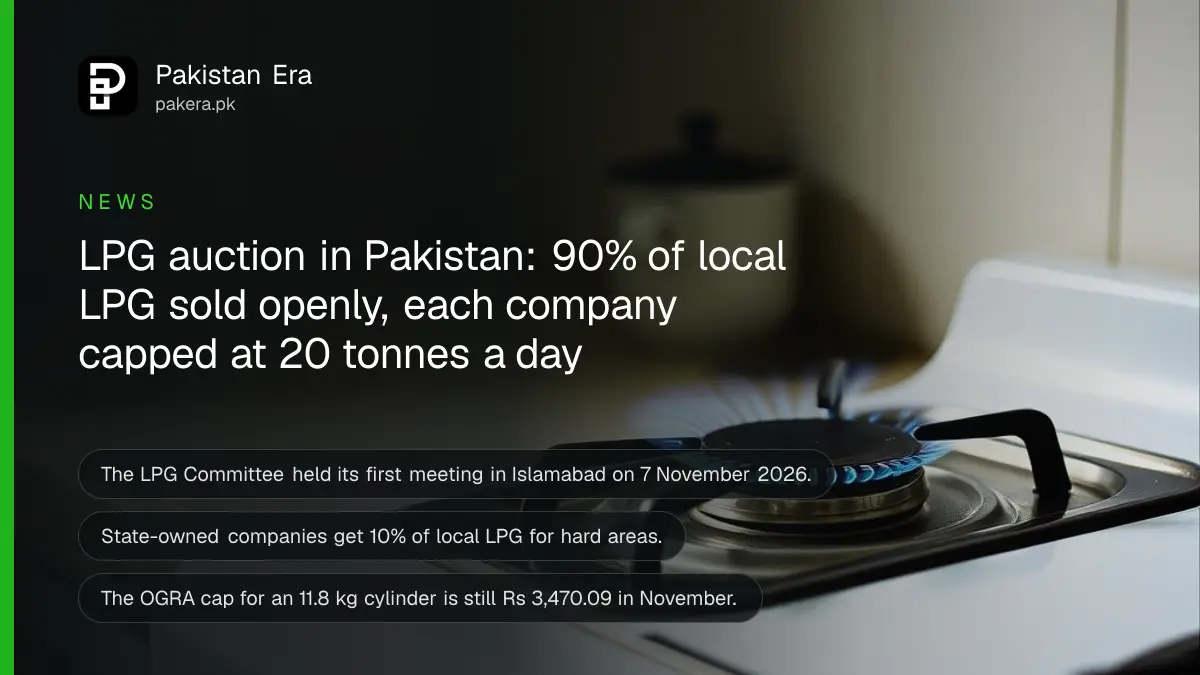
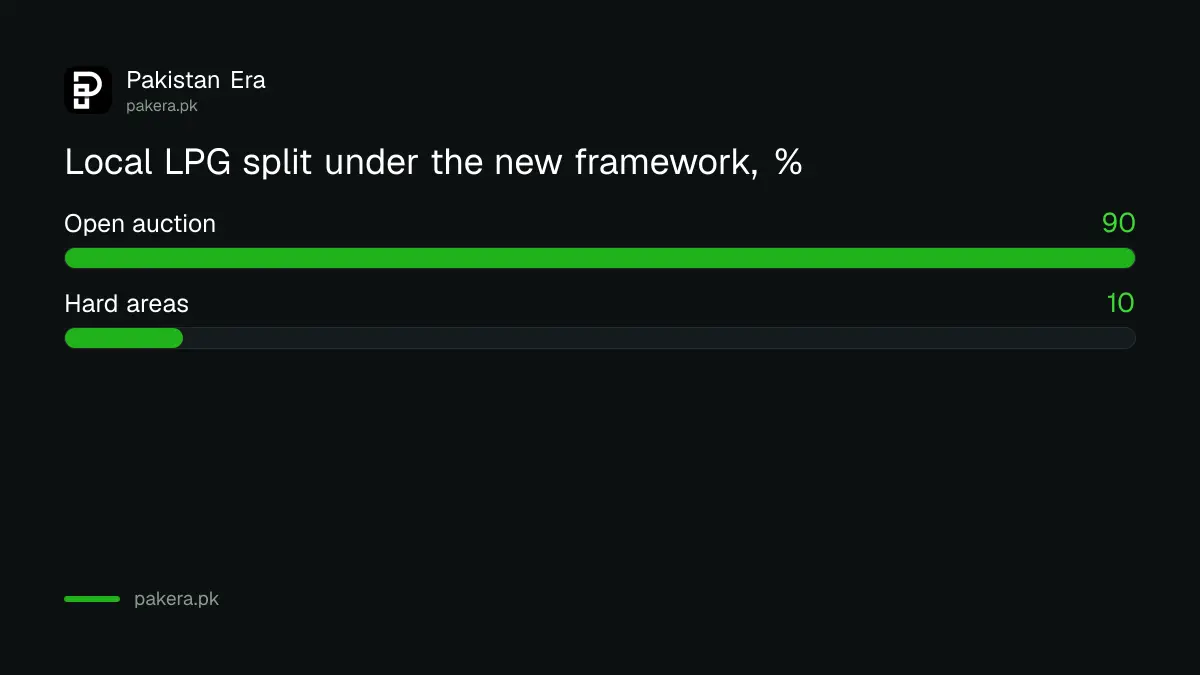
Pakistan's new LPG Committee has decided that each company bidding for locally produced LPG can win at most 20 metric tonnes a day. The committee met for the first time in Islamabad on 7 November 2026, according to a Press Information Department (PID) release. Under the framework the federal cabinet approved on 4 November, local producers will give 10 per cent of their LPG to state-owned companies for hard areas and sell the other 90 per cent by open auction.
No price change was announced. The OGRA cap for November is still Rs 3,470.09 for an 11.8 kg domestic cylinder. Here is what was decided, who sits on the committee, and what it could mean for the cylinder you buy this winter.
The LPG Committee set a 20 tonne daily cap per company
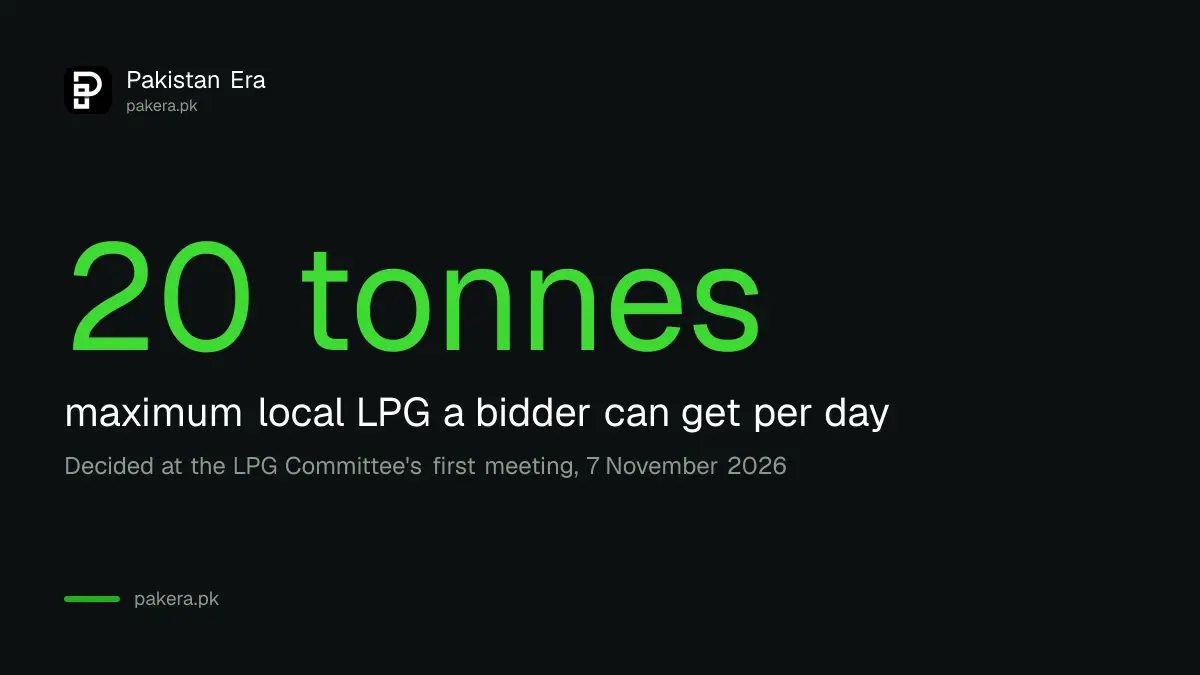
At its first meeting on 7 November, the committee decided that no company taking part in the auction can be allocated more than 20 metric tonnes of local LPG a day. The PID release says this gives a fair chance to every eligible bidder.
The meeting was chaired by the Secretary Petroleum. Federal Minister for Petroleum Ali Pervaiz Malik attended. The release lists three decisions:
- A maximum allocation of 20 metric tonnes per day for each company in the auction.
- Daily LPG production will be closely monitored.
- Production figures will be presented to the Prime Minister, to keep watch on supply.
The minister said the aim is a level playing field for companies and better access for consumers who could not buy LPG at fair prices.
90 per cent of local LPG will be sold by open auction
Local LPG producers will offer 90 per cent of their output through auctions held "in media presence", meaning in public. The other 10 per cent goes to state-owned LPG marketing companies for hard areas, the remote places private sellers serve least.
This split comes from the LPG auction framework approved by the federal cabinet on 4 November 2026, as the PID release states. The committee's job is to put that framework into practice.
| Item | What the PID release says |
|---|---|
| Auctioned share | 90 per cent of local production |
| Hard areas share | 10 per cent, to state-owned LPG marketing companies |
| Cap per company | 20 metric tonnes per day |
| Cabinet approval | 4 November 2026 |
| First committee meeting | 7 November 2026, Islamabad |
| Price change | None announced |
The release does not name the hard areas, the auction dates or the companies eligible to bid. We will add them when the Petroleum Division publishes them.
Six officials sit on the LPG Committee
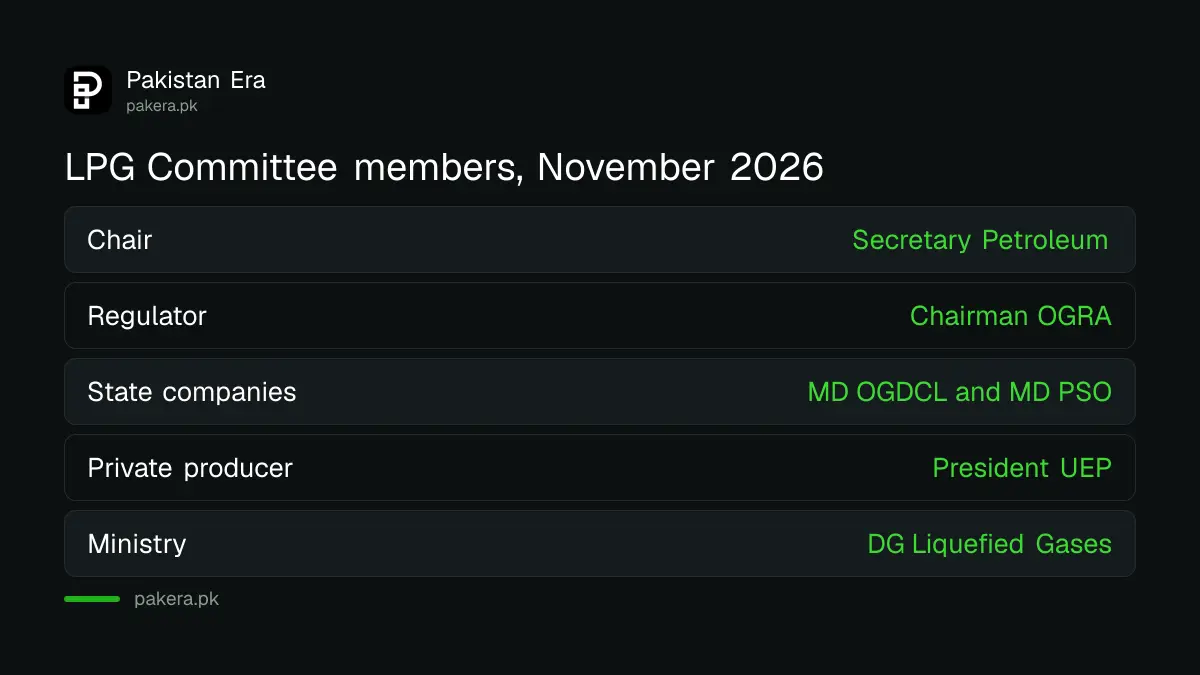
The committee is chaired by the Secretary Petroleum and has five members from the regulator, two state companies, one private producer and the ministry's LPG wing. It oversees auctions, reviews supply and checks pricing and bidding.
- Secretary Petroleum, chair
- Chairman, Oil and Gas Regulatory Authority (OGRA)
- Managing Director, Oil and Gas Development Company Limited (OGDCL)
- Managing Director, Pakistan State Oil (PSO)
- President, United Energy Pakistan Limited (UEP)
- Director General (Liquefied Gases), Petroleum Division
Its mandate, in the release's words, is to oversee auctions of local LPG, review market supply arrangements and periodically assess pricing and bidding mechanisms.
Most of Pakistan's LPG is imported, so the auction covers less than a third
The auction applies only to locally produced LPG. OGRA's 2024-25 industry report put local supply at 29 per cent of the market. The other 71 per cent was imported, and the new mechanism does not cover it.
OGRA's report counted 704,911 metric tonnes of local LPG in 2024-25, against 1,692,651 tonnes imported. We explain those figures in our page on where Pakistan's LPG comes from.
Our own rough sum, using that 2024-25 figure and not a government number: 90 per cent of local output is about 1,740 tonnes a day. At 20 tonnes a day per company, it would take at least 87 winning bidders to take it all up. The 10 per cent share is about 190 tonnes a day. Production this year may differ, so treat these as a guide to scale only.
Cylinder prices stay at the OGRA cap for now
The committee announced no price change. OGRA's notified maximum for November 2026 is Rs 3,470.09 for an 11.8 kg domestic cylinder, and it changes on the first of each month.
A shop charging more than OGRA's notified price is breaking the rules, auction or no auction. Our November LPG price page lists every cylinder size. If a dealer overcharges you, our guide on reporting LPG overcharging to OGRA shows how to complain.
An earlier round of LPG auctions ran into trouble in August 2026, when results were held back after court cases, as we reported in our August story. Whether the new framework settles those questions is not stated in the release.
What to watch next
Three things will show whether the auction changes anything for households: the first auction date and results, the list of hard areas that get the 10 per cent, and OGRA's December price notification at the end of this month.
Frequently asked questions
What did the LPG Committee decide on 7 November 2026?
It capped each bidding company at 20 metric tonnes of local LPG a day, ordered close monitoring of daily production and said figures will go to the Prime Minister.
How much local LPG will be auctioned?
90 per cent of what local producers make. The other 10 per cent goes to state-owned LPG companies for hard areas.
Will the LPG cylinder price go down?
No price change was announced. The OGRA cap for November 2026 is Rs 3,470.09 for an 11.8 kg cylinder.
Who chairs the LPG Committee?
The Secretary Petroleum. Members come from OGRA, OGDCL, PSO, UEP and the Petroleum Division's Liquefied Gases wing.
Does the auction cover imported LPG?
No. The release speaks only of indigenous, meaning locally produced, LPG. Imports were 71 per cent of supply in OGRA's 2024-25 report.
When did the cabinet approve the LPG auction framework?
On 4 November 2026, according to the PID release on the committee's first meeting.
Sources and last checked
We read PID press release No. 80 of 7 November 2026 on pid.gov.pk on 8 November 2026. Supply figures are from OGRA's State of the Regulated Petroleum Industry 2024-25 report, and the November price from OGRA's notification of 31 October 2026. For every month's rate this year, see our LPG price list for 2026.
About the author

Global Affairs & Political Economy Writer
Muhammad Hatim is a book lover who started writing because he enjoys it. At Pakistan Era he writes about international relations, geopolitics and the global economy, with a particular interest in South Asia and the forces behind current events.