Pakistan Asks the IMF for a Flexible Fuel Levy, the Fix for the Problem We Explained This Morning
The petroleum minister wants a dynamic levy that drops when oil spikes and returns when it calms. What it fixes, and what it quietly is not.
This morning we explained why petrol barely moves when oil crashes: most of the pump price is a fixed rupee levy that never tracks the barrel. By lunchtime, the petroleum minister had proposed changing exactly that.
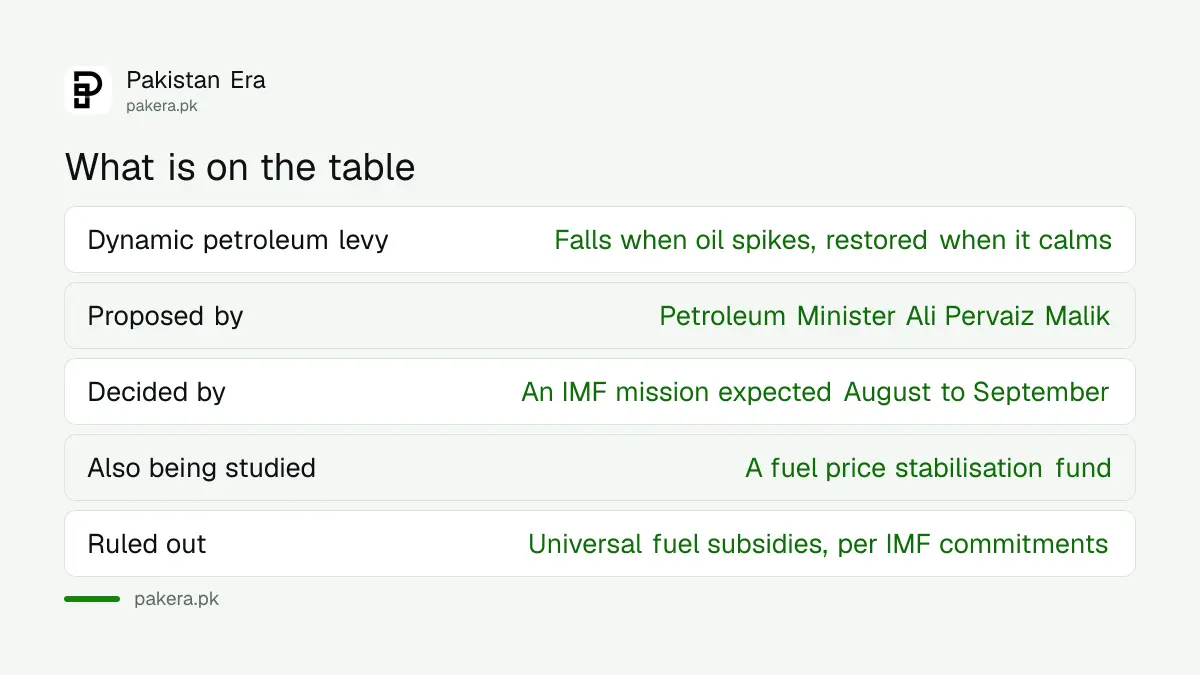
Ali Pervaiz Malik wants the IMF to allow a dynamic petroleum development levy: one the government can cut temporarily when world oil prices spike, then restore once they settle. He plans to put it to the IMF mission expected between August and September.
What is actually being proposed
Two instruments, one idea.
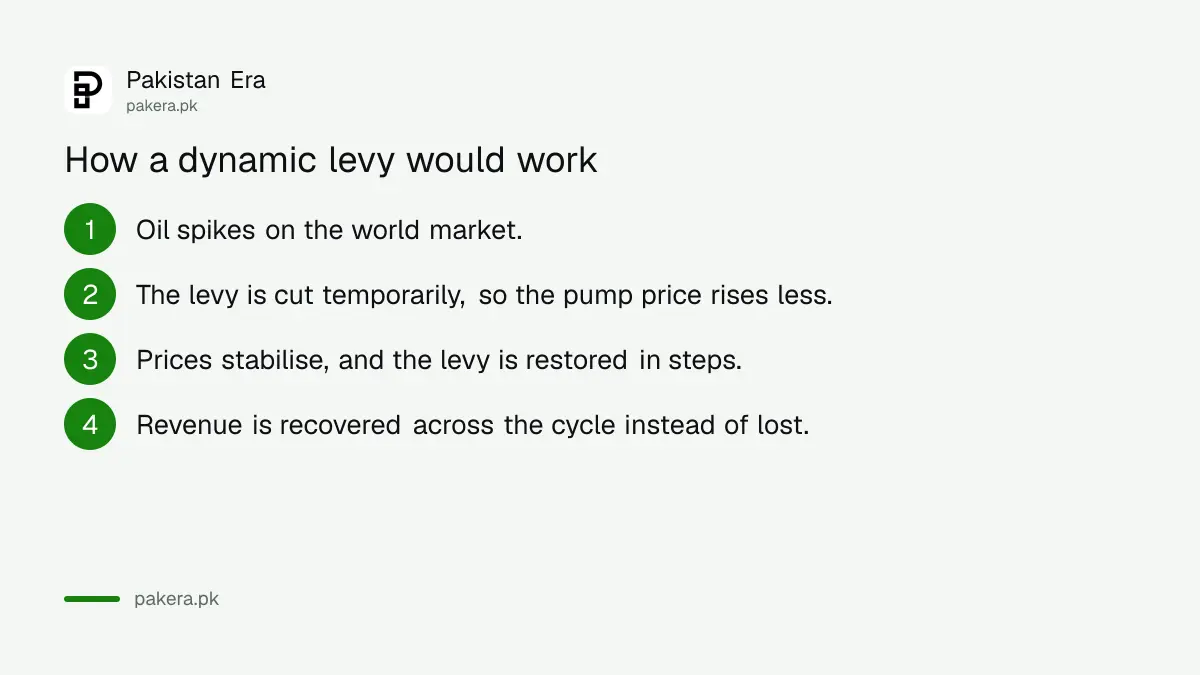
The first is the dynamic levy itself. Today the levy is a fixed rupee amount per litre, which is why an 11 per cent oil crash arrived at the pump as a 1 per cent cut, and equally why a spike lands softer than it should. A dynamic levy would make the cushioning deliberate: absorb the spike by shrinking the levy, recover the revenue by restoring it later.
The second is a fuel price stabilisation fund, still being evaluated, which would bank money in calm periods and spend it cushioning shocks, without resorting to across the board subsidies.
The line worth quoting is the constraint: commitments under the IMF programme leave little room for universal fuel subsidies, so the government prefers targeted support for vulnerable consumers. That is consistent with the targeted fuel subsidy work already underway.
This has already been tried once, quietly
Malik pointed to a precedent: during the recent Middle East conflict, the levy was temporarily lowered as oil surged, then restored in steps once markets calmed. That is the dynamic levy in all but name, done ad hoc.
What the IMF is being asked for is permission to make it a standing mechanism rather than an emergency improvisation. The distinction matters to the Fund because the levy is a committed revenue line: FBR's Rs 15.264 trillion year, which we covered in the July collection figures, leans on fuel revenue precisely because it is stable. A levy that flexes is a revenue line that wobbles, and that is the argument the mission will have.
What it would fix, and what it quietly is not
Be clear about what a dynamic levy does for you as a buyer of petrol: it smooths shocks. It does not lower prices.
When oil spikes, you would feel less of it. But the mechanism is symmetrical in a way nobody advertises: when oil crashes, the levy is restored into the falling price, which means the crash reaches the pump even less than it does today. The revenue lost in the bad weeks is recovered in the good ones, and the person it is recovered from is you, in the weeks you would otherwise have had cheap fuel.
That is not a scandal. Smoothing is a defensible policy, and households budget better against stable prices than volatile ones. But the honest description is that this trades your best weeks for insurance against your worst ones, at a levy level that stays high throughout. Anyone presenting it as relief is describing the half of the cycle they prefer.
Today's mechanism against the proposed one
| Fixed levy, today | Dynamic levy, proposed | |
|---|---|---|
| When oil spikes | Full shock passes through, minus the fixed cushion | Levy cut absorbs part of the spike |
| When oil crashes | Small pump cut, as we saw this week | Even smaller, the levy restores into the fall |
| Revenue | Stable, which is why the IMF likes it | Wobbles short term, recovers across the cycle |
| Who decides | Monthly notification | A formula, or a minister, which is the open question |
The last row is the one to hold onto when the mission's answer comes. A rule that triggers itself at defined prices is a shock absorber. A discretionary lever is a political instrument that will be pulled hardest in the months before elections, and the difference between the two is written in the fine print, not the announcement.
What to watch
Three things decide whether this becomes real.
The IMF mission, August to September. A yes in the staff report is the mechanism existing; a polite acknowledgement is it not.
The rules, if approved. A formula that triggers automatically at defined oil prices is a real mechanism. Ministerial discretion to cut the levy near elections is a different instrument wearing the same name.
The stabilisation fund's seed money. A fund cushions nothing until something is in it, and the first deposit has to come from somewhere in a budget that has no slack.
Until any of that lands, the pump price keeps moving on the current mechanics, which the daily petrol price page tracks.
Questions readers are asking
What is a dynamic petroleum levy?
A levy the government can temporarily reduce when world oil prices spike and restore once they stabilise, smoothing pump prices instead of passing shocks through.
Who proposed it and to whom?
Petroleum Minister Ali Pervaiz Malik, for discussion with the IMF mission expected between August and September 2026.
Would this make petrol cheaper?
No. It would make prices smoother. Spikes would hurt less, and crashes would reach the pump less too, because the levy is restored into them.
Why does the IMF get a say on Pakistan's fuel tax?
Because the levy is a committed revenue line under the IMF programme, and the same commitments rule out universal fuel subsidies. Changing how the levy behaves changes a number the programme depends on.
What is the fuel price stabilisation fund?
A separate idea under evaluation: a fund that accumulates in calm periods and spends during shocks, cushioning prices without broad subsidies. It does not exist yet.
Has Pakistan done this before?
Once, ad hoc: the levy was lowered during the recent Middle East conflict as oil surged, then restored gradually. The proposal would turn that improvisation into a standing mechanism.
About the author

Senior Writer, Public Services and Technology
Shahid joined us in 2024 as an author. He is a senior contributor to Pakistan's leading technology websites. He writes detailed articles, mostly covering his expertise in the latest tech, mobiles, apps, gadgets, and step-by-step guides. His ideology is to help people understand the latest trends and explain complex methods through very easy-to-understand guides.