FBR Opened FY27 Ahead of Target, and the Hard Part Is Still Coming
FBR collected Rs 820 billion in July against a Rs 780 billion target. What the head by head numbers show, and what Rs 15.264 trillion needs.
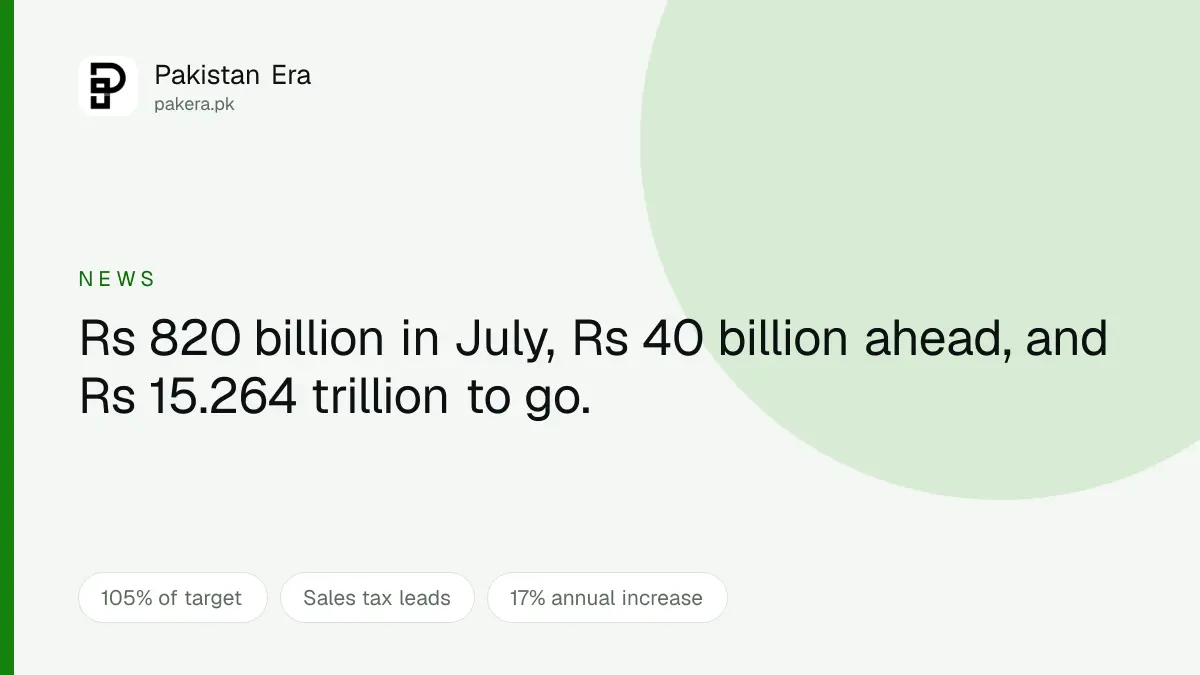
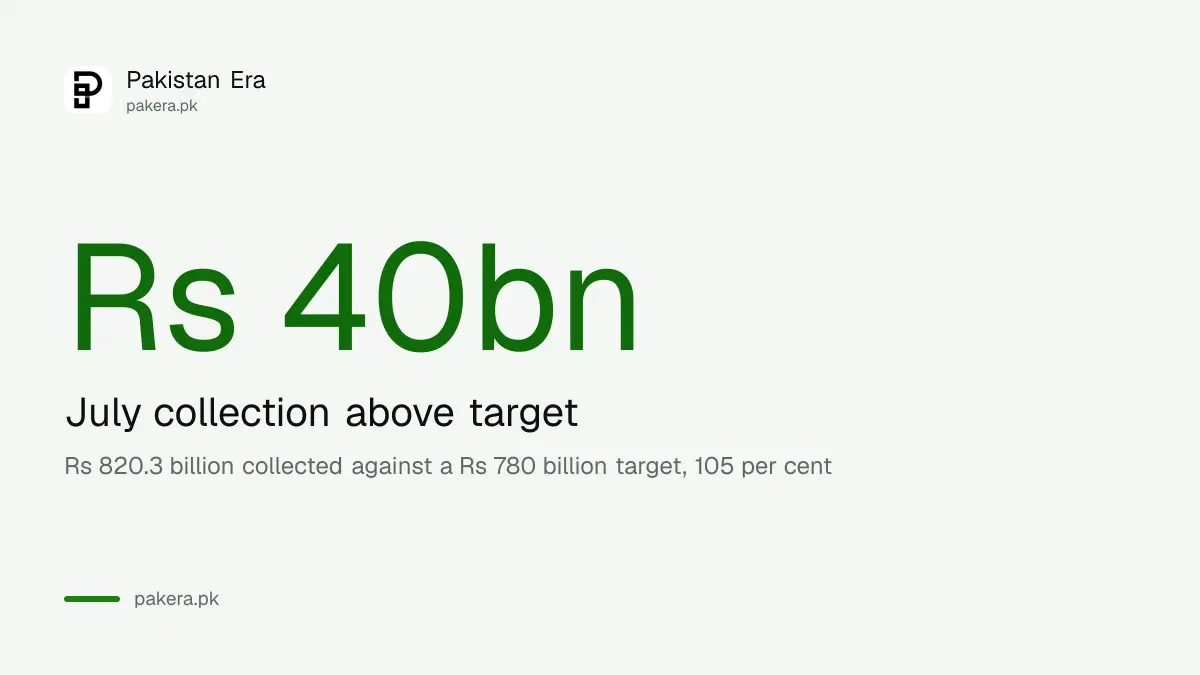
The Federal Board of Revenue collected Rs 820.3 billion in July, the first month of the 2026 to 2027 financial year, against a target of Rs 780 billion. That is roughly Rs 40 billion ahead, or 105 per cent of what was asked.
Beating a July target is unusual enough that the coverage called it a rare feat. It is a genuinely good start. It is also the easiest month of the twelve, and the size of what follows is worth understanding before anyone reads too much into it.
The numbers behind the headline
Gross collection for the month was Rs 918.9 billion. Refunds of Rs 98.6 billion were paid out, which brings the net figure to the Rs 820.3 billion that gets reported.
The gap between those two numbers matters more than it looks. Refunds are money the FBR has already taken and is giving back, mostly to exporters and manufacturers who paid input tax. When refunds are held rather than paid, net collection looks better while businesses fund the government with their working capital. Rs 98.6 billion released in a single month is the FBR paying rather than holding, which is the healthier version of the same statistic.
| Head | July FY27, gross | Share of gross |
|---|---|---|
| Sales tax | Rs 413.2 billion | About 45 per cent |
| Income tax | Rs 343.1 billion | About 37 per cent |
| Customs duty | Rs 114.8 billion | About 12 per cent |
| Federal excise | Rs 47.8 billion | About 5 per cent |
| Gross total | Rs 918.9 billion |
Dawn reported the month as eight per cent up on last July, Rs 820 billion against Rs 756 billion. The ProPakistani account of the same figures did not carry a year on year comparison, so treat the eight per cent as one outlet's reporting rather than a confirmed official line.
Sales tax doing the heavy lifting says something
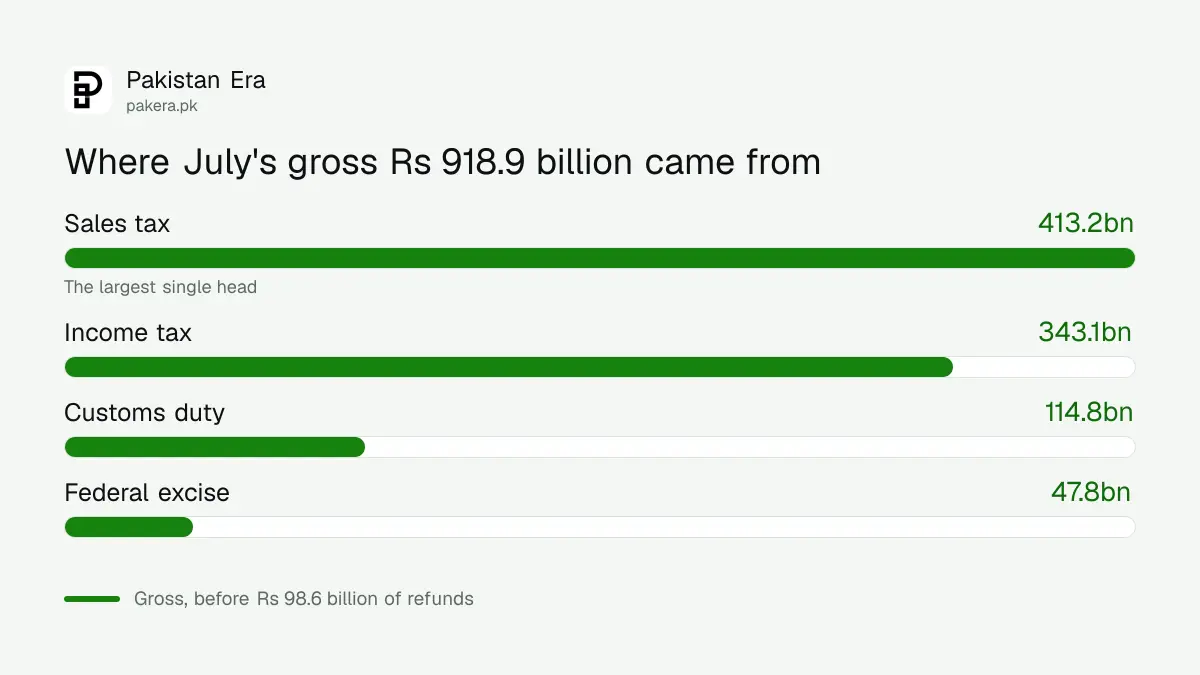
Sales tax brought in more than income tax, and by a wide margin. That is the shape of Pakistan's tax base rather than a one month quirk, and it is the part economists keep raising.
Sales tax is indirect. It is charged on what you buy, at the same rate whether you are earning Rs 40,000 a month or Rs 400,000. Income tax is direct and scales with what you earn. A system leaning on the first more than the second collects proportionally more from people with less, because they spend a larger share of their income on taxed goods.
This is why widening the direct tax net keeps appearing in every budget speech, and why it keeps being difficult. Collecting sales tax at the point of sale is administratively simple. Getting an untaxed business onto the income tax roll is not.
If you want to see what the direct side looks like for you specifically, our salary tax calculator runs the current slabs.
The annual target is the real story
FY26 closed with more than Rs 13 trillion collected, against a revised target of Rs 12.983 trillion. FY27 asks for Rs 15.264 trillion.
That is an increase of roughly 17 per cent in a single year, and it is one of the largest collection targets in Pakistan's history. Senate and National Assembly finance committees have both raised concerns about it, describing it as ambitious. The FBR chairman has expressed optimism. Both of those are on the record, and which one turns out to be right is a question about the next eleven months rather than this one.
Rs 15.264 trillion works out to about Rs 1.27 trillion a month on average. July came in at Rs 820 billion. July is always a light month, so the two are not directly comparable, but the distance between them is the size of the acceleration required.
What a big collection target means for ordinary taxpayers
Targets of this size get met in three ways, and they are not equally comfortable.
- Economic growth. More activity means more tax at the same rates. This is the painless route and the least reliable.
- Widening the net. Bringing untaxed businesses and undocumented income into the system. This is the route everyone says they want and the one that takes years.
- Raising rates and squeezing existing filers. The fastest route, and the one already compliant taxpayers feel first, because they are the easiest to reach.
The third is where the pressure usually lands. It is worth watching for changes to withholding rates, to advance tax on transactions, and to the difference between filer and non filer treatment on things like property transfers and vehicle registration. Those are the levers that move revenue quickly without needing new legislation.
What to watch over the next few months
One good month is one month. The signals worth tracking are whether the surplus holds through the quarter, whether refunds keep being paid rather than deferred to flatter the net figure, and whether income tax closes any of the gap on sales tax.
The wider economic picture matters too. If the Saudi investment interest currently being discussed converts into actual projects, that eventually shows up here as customs duty on imported machinery and income tax on new employment. Interest of that size takes years to reach a revenue line, which is worth remembering when it is announced.
On the documentation side, the rollout of a single digital ID and the growth of digital payments are both, in the long run, tax base stories. Transactions that leave a record are transactions that can be taxed.
Questions readers are asking
How much did FBR collect in July of FY27?
Rs 820.3 billion net, against a target of Rs 780 billion. That is about Rs 40 billion above target, or 105 per cent of the month's goal.
What is the FBR target for 2026 to 2027?
Rs 15.264 trillion. Some coverage rounds it to Rs 15.2 trillion. It is roughly 17 per cent above what was collected in FY26.
Why are gross and net collection different?
Because refunds are paid out of what has been collected. July's gross was Rs 918.9 billion and Rs 98.6 billion went back out as refunds, leaving Rs 820.3 billion net. The net figure is the one normally quoted.
Which tax raises the most money in Pakistan?
Sales tax. In July it brought in Rs 413.2 billion against Rs 343.1 billion of income tax. That balance is a long standing feature of the system rather than a monthly variation.
Does beating the July target mean the annual target will be met?
Not by itself. July is the lightest month of the year and Rs 15.264 trillion needs an average of about Rs 1.27 trillion a month. Parliamentary finance committees have called the annual figure ambitious, and one month does not settle that.
How does this affect my own tax bill?
Not directly and not immediately. The risk to existing filers is indirect: large targets tend to bring higher withholding and advance tax rates, which are collected from people already in the system. Our salary tax calculator shows what the current slabs mean for your income.
About the author

Senior Writer, Public Services and Technology
Shahid joined us in 2024 as an author. He is a senior contributor to Pakistan's leading technology websites. He writes detailed articles, mostly covering his expertise in the latest tech, mobiles, apps, gadgets, and step-by-step guides. His ideology is to help people understand the latest trends and explain complex methods through very easy-to-understand guides.