One Digital ID for Everything: Pakistan's Plan
The PM wants one digital identity for banking, health and government services, running on the new Sky 47 data centre. What that means.
One login for your bank, your hospital record, your utility account and every government document you have ever queued for. That is the plan, and the building it will run in opened last week.
Prime Minister Shehbaz Sharif has ordered the newly built National Central Data Center, Sky 47, put into use across all federal institutions immediately. The Pakistan single digital ID sitting on top of it is meant to give citizens one identity for public services rather than a separate account, form and queue for each.
It is a genuinely good idea. It is also the largest concentration of Pakistani citizens' data ever attempted, and both of those things are true at once.
What is the single digital ID?
One verified identity that works across government services. Under the National Digital Vision, that would cover document verification, banking, healthcare, transfers and other essential services through a unified platform instead of separate systems that do not talk to each other.
The framework comes from the Digital Nation Pakistan Act 2025, which established the National Digital Commission. The prime minister chairs it and all four provincial chief ministers sit on it, which matters because service delivery is largely provincial and a federal ID that provinces ignore would be useless.
What is Sky 47?
A single national data centre for the public sector, inaugurated in Islamabad in late July with a capacity of 8.5 megawatts. The argument for it is consolidation: instead of every government institution running its own data centre, they share one.
That saves real money. Duplicated infrastructure across dozens of departments is expensive, badly secured and impossible to keep consistent, and anyone who has been told two government offices have different versions of their own details has met the problem.
The counter argument is the same fact stated differently. One centre holding everything is one target, one point of failure and one place where a policy change affects every citizen at once.
Which services come first?
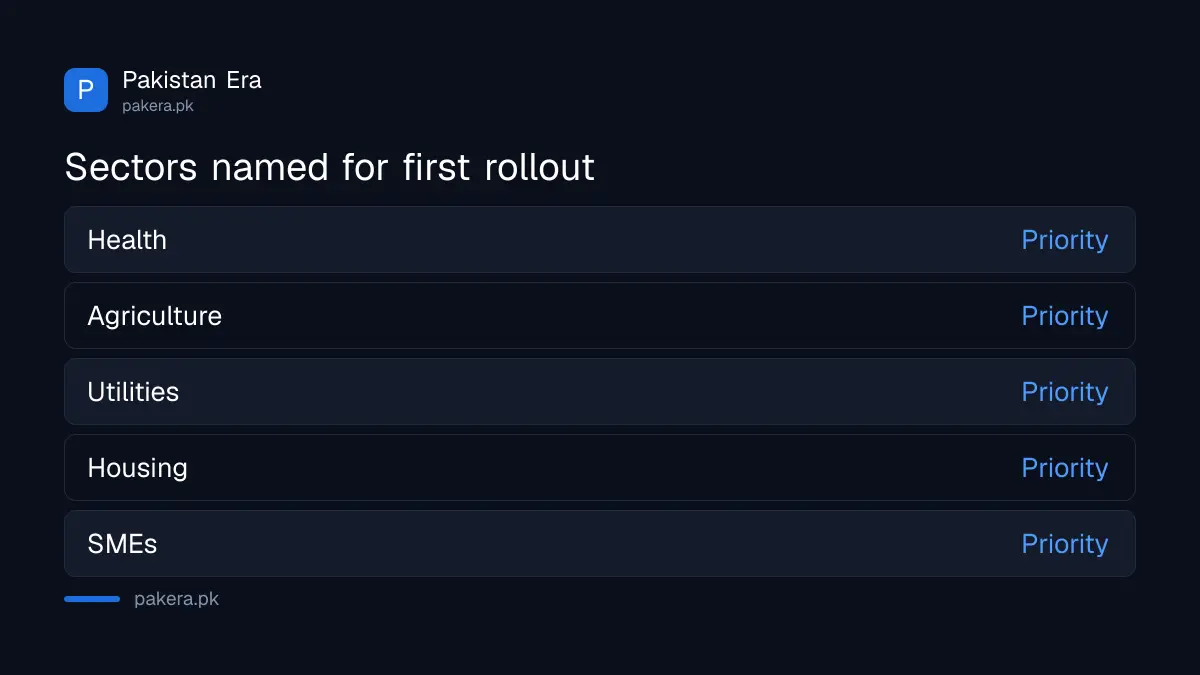
Health, agriculture, utilities, housing and small and medium enterprises. The prime minister named those five specifically for first implementation.
That list is more interesting than it looks. Health and utilities are the highest volume interactions most people have with the state, so starting there means the system gets stress tested by real demand rather than eased in through something quiet. Agriculture and SMEs are where records barely exist, which means building rather than digitising.
| Sector | Why it was chosen |
|---|---|
| Health | Highest volume, records currently fragmented |
| Utilities | Almost universal contact with citizens |
| Agriculture | Large population, minimal existing records |
| Housing | Records exist but are scattered across agencies |
| SMEs | Largely informal, hard to reach any other way |
What could actually go wrong?
The concentration question, and it deserves asking now rather than after something happens. A single identity linked to a single data centre means a breach is not a leak of one department's records, it is a leak of everything about someone.
Points worth holding the government to as this rolls out:
- What happens when the record is wrong. A single ID means one error propagates everywhere, and correcting government records in Pakistan is not currently a two day job.
- Who can query it. A unified identity is only as private as the access controls around it, and those are rarely published.
- What happens to people without smartphones or reliable internet, who are disproportionately the ones relying on public services.
- Whether provinces actually adopt it, since the chief ministers sitting on the commission is a promising sign rather than a guarantee.
- What the fallback is when the system is down, because a queue you cannot join is worse than a queue.
None of that is an argument against doing it. Countries that have built this well have made services dramatically easier to use. It is an argument for asking the questions while the answers can still change.
What would make this actually work?
Other countries have done this well and the pattern is fairly consistent. In rough order of how much they matter:
- A correction process that works. If a wrong record can be fixed in days rather than months, people trust the system. If not, one error follows you everywhere.
- An offline route for every service. Any system that only works through an app excludes exactly the people who need public services most.
- Published access rules, so citizens can see which department can query what rather than having to assume.
- Provincial buy in that goes beyond the commission. Health and utilities are delivered provincially, so a federal ID they do not honour achieves nothing.
- One service done properly before ten are attempted. A working health record beats five half migrated systems.
When does any of this reach you?
Not soon, and be sceptical of anything suggesting otherwise. What has happened is a directive to operationalise a data centre and a stated intention for the ID. No citizen facing service has launched.
The realistic sequence is that federal institutions migrate to Sky 47 first, then a pilot appears in one of the five named sectors, then it either works and expands or stalls quietly. The gap between a prime ministerial directive and a working service in Pakistan is usually measured in years.
Our piece on the Sky 47 data centre opening covers the infrastructure itself, and the shift in digital payments shows what happens when this sort of plan actually lands, since Raast went from an announcement to 742 million transactions a quarter.
Frequently asked questions
What is Pakistan's single digital ID?
One verified identity intended to work across public services including document verification, banking, healthcare and transfers, replacing separate systems for each.
Is it available now?
No. What exists is a data centre and a directive to put it into use across federal institutions. No citizen facing digital ID service has launched.
What is Sky 47?
The National Central Data Center in Islamabad, inaugurated in late July 2026 with 8.5 megawatts of capacity, intended to replace separate data centres run by individual institutions.
Which services get it first?
Health, agriculture, utilities, housing and small and medium enterprises, named by the prime minister for first implementation.
Who runs the programme?
The National Digital Commission, established under the Digital Nation Pakistan Act 2025, chaired by the prime minister with all four provincial chief ministers as members.
Will this replace my CNIC?
Nothing announced suggests the CNIC goes away. The digital ID is described as a way to access services, not as a replacement identity document.
About the author

Senior Writer, Public Services and Technology
Shahid joined us in 2024 as an author. He is a senior contributor to Pakistan's leading technology websites. He writes detailed articles, mostly covering his expertise in the latest tech, mobiles, apps, gadgets, and step-by-step guides. His ideology is to help people understand the latest trends and explain complex methods through very easy-to-understand guides.