A Saudi Group Has Earmarked $10 Billion for Pakistan, and the Word Earmarked Is Doing a Lot of Work
Jeddah based Falcon Vision says it has earmarked up to $10 billion for Pakistan. What was actually agreed, and what the record suggests.
A Jeddah based group called Falcon Vision Company told Pakistan's Board of Investment it has earmarked up to 10 billion dollars for potential investment here, across infrastructure and technology among other sectors.
Ten billion dollars is a number worth taking seriously. It is also worth reading the sentence carefully, because almost every word in it is doing defensive work.
What was actually said, and by whom
Muhammad Tariq Ghaus, vice chairman and president of Falcon Vision, met the Board of Investment along with other senior representatives. He said Saudi investors were seriously assessing opportunities in Pakistan and had earmarked up to 10 billion dollars for potential investment across multiple sectors.
Investment Minister Qaiser Ahmed Sheikh said the government would provide full facilitation, and set out the incentives already available: income tax exemption for Special Economic Zones until 2035, duty concessions on imported machinery, one window facilitation for approvals, and full repatriation of profits.
That is the whole of it. A meeting, a stated intention, and a list of standing incentives.
The distance between interest and investment
Foreign investment moves through stages, and this one is at the first.
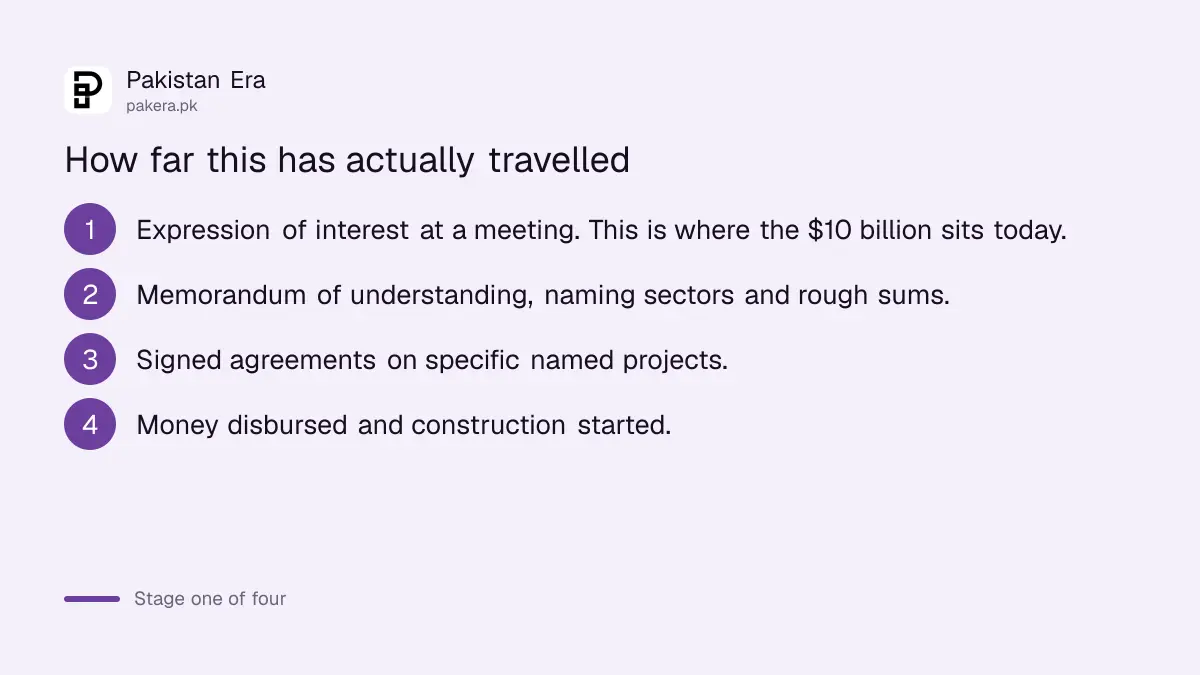
- Expression of interest. A meeting, a figure, a public statement. This is where the 10 billion dollars sits today.
- Memorandum of understanding. Sectors named, rough sums attached, signatures on a document that is still not binding.
- Signed agreements on specific projects. A named plant, a named site, a named counterparty.
- Money disbursed. Construction, hiring, imports arriving at the port.
Coverage of this announcement made the point directly: Saudi Arabia has announced several potential investments in Pakistan in recent years, and progress on many large projects has been slower than initially expected. That is not a criticism of this particular group. It is the base rate, and it is why expressions of investor interest are watched closely rather than banked.
None of which makes the meeting meaningless. Stage one is a real stage, and nothing reaches stage four without passing through it.
The incentives on offer are the same ones everyone gets
| Incentive | What it covers |
|---|---|
| SEZ income tax exemption | Runs until 2035 for qualifying zone enterprises |
| Duty concessions | On imported plant and machinery |
| One window facilitation | Approvals handled through a single channel |
| Profit repatriation | Full, meaning earnings can leave the country |
These are Pakistan's standing investment framework rather than anything created for this group. Profit repatriation is usually the one that decides things: an investor putting capital into a country with periodic dollar shortages wants certainty that earnings can be taken out, and that certainty is a policy promise rather than a physical guarantee.
Why infrastructure and technology are the sectors named
The two sectors mentioned are the ones with the clearest need and the longest payback.
Pakistan's power, transport and water infrastructure all carry visible deficits, and infrastructure suits sovereign linked capital because the timelines are long and the returns are regulated rather than competitive.
Technology is a newer story here and it is starting to show up in things you can point at. The country's first AI data centre and the Sindh data centre programme are both the kind of asset that needs exactly this class of investor: heavy capital expenditure, long horizon, and a return that depends on the country growing rather than on this quarter.
Data centres in particular need reliable power, which loops back to infrastructure. The two sectors named are not independent bets.
What would make this real
Three things would signal that this is moving rather than circulating.
A named project. Not a sector, not a province, a project. "Infrastructure and technology" describes the entire economy.
A local partner or a registered entity. Foreign capital of this size arrives through a joint venture or a locally incorporated vehicle. Registration is a matter of public record and it happens before the money does.
A timeline with a first phase. Ten billion dollars is never deployed at once. A credible plan has a first tranche, and its size tells you more than the headline figure does.
Until at least one of those appears, the accurate description of this is a serious conversation, not a transaction.
What it would mean if it happened
Investment of this scale is felt as employment, imports and eventually tax. Machinery arriving generates customs duty, construction generates jobs, and operating companies generate income tax, which is the chain that connects an announcement like this to the revenue figures the FBR reports every month.
The lag is the thing to hold on to. Even a project that signs this year does not reach a revenue line for several. Announcements are instant and economies are slow, and most of the disappointment around foreign investment news comes from confusing the two.
Questions readers are asking
Has Saudi Arabia committed 10 billion dollars to Pakistan?
No. A Jeddah based private group, Falcon Vision, said it has earmarked up to that amount for potential investment while assessing opportunities. It is an expression of interest, not a commitment and not a government to government agreement.
Who is Falcon Vision?
A Jeddah based company. Its vice chairman and president, Muhammad Tariq Ghaus, led the delegation that met the Board of Investment. It is a private group rather than a Saudi state entity.
Which sectors were mentioned?
Infrastructure and modern technology were named, described as part of multiple sectors of interest. No specific project was identified in the announcement.
What incentives did Pakistan offer?
The standing framework: income tax exemption in Special Economic Zones until 2035, duty concessions on machinery imports, one window facilitation for approvals, and full profit repatriation. These are existing policies rather than new terms.
Why are previous Saudi investment announcements brought up?
Because several were announced in recent years and progressed more slowly than expected, a point the coverage of this meeting made itself. It is context for reading the figure, not a prediction about this group.
When would any of this show up in the economy?
Years, if it proceeds. Capital of this size moves through agreements, registration and construction before it employs anyone or pays any tax. The first visible signal would be a named project with a first phase attached.
About the author

Public Services and Education Journalist
Fajr Riaz is a journalist and content writer at Pakistan Era, based in Lahore. She covers the questions people meet in everyday life in Pakistan: how a public service works, what a change in the rules means, and where to find a reliable answer.