Sindh Is Building Three Data Centres of Its Own
Sindh has ordered a plan for three provincial data centres, a week after the federal Sky 47 opened. Duplication or sensible backup?
Last week the federal government opened a national data centre and argued that one shared facility would save the country from every department running its own. This week Sindh ordered three of its own.
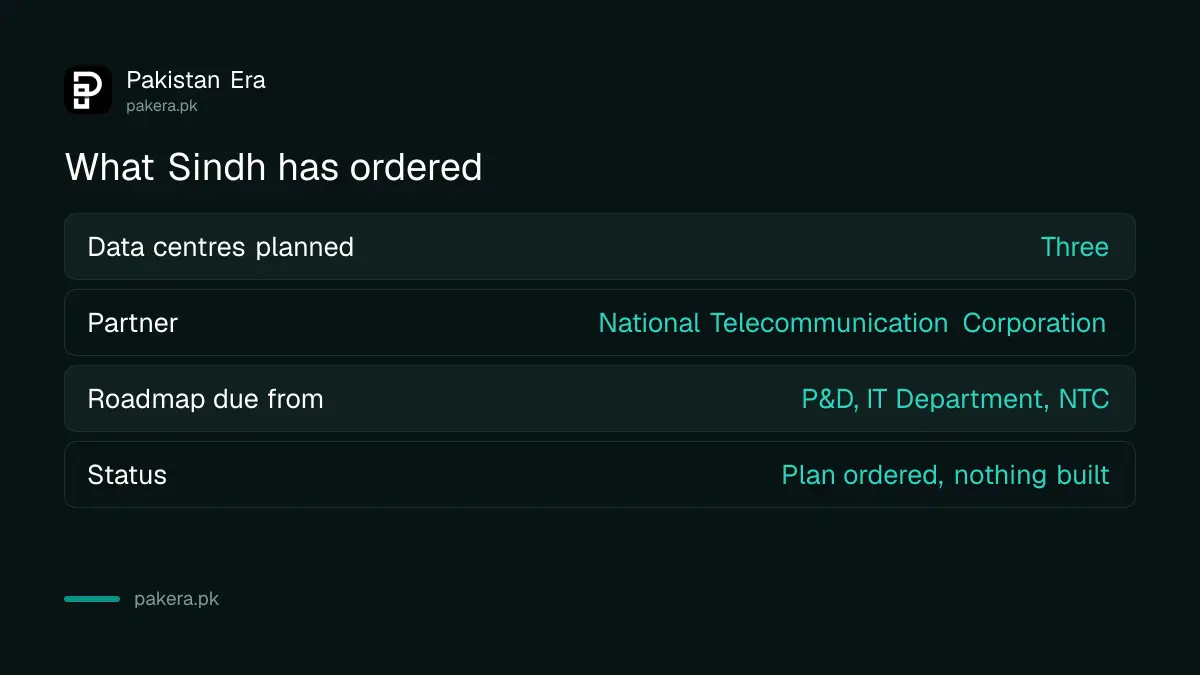
Chief Minister Murad Ali Shah has directed officials to prepare a plan for three modern provincial data centres under the Digital Sindh project, after meeting the National Telecommunication Corporation's managing director. Whether that is sensible provincial resilience or exactly the duplication Sky 47 was meant to end is a fair question, and nobody has answered it.
Both things can be true at once, which is what makes it interesting.
What has Sindh actually approved?
A plan, not a building. The Chief Minister directed the Planning and Development Board, the IT Department and NTC to jointly prepare a roadmap covering technical specifications, implementation timelines, governance and future expansion.
So there is no site, no budget figure and no date. Treat this as a decision to work out what it would take, which in Pakistani infrastructure terms is a real step but a long way from concrete.
What would the data centres do?
Secure storage, cloud services and disaster recovery for provincial government departments, plus better coordination between institutions that currently keep separate and often contradictory records.
The more interesting claim is connectivity. The project is meant to help extend high speed internet into rural and remote parts of Sindh, aimed at healthcare, education and online public services. That is a different job from a data centre, and it is the part worth watching, because it is where provincial digital projects usually stall.
Does this duplicate the federal data centre?
Possibly, and the tension is real rather than manufactured. The federal argument for Sky 47 was consolidation: one integrated centre for the public sector, eliminating the need for separate data centres and saving national resources.
| Federal position | Sindh position | |
|---|---|---|
| Model | One shared national centre | Three provincial centres |
| Argument | Removes duplication, saves money | Provincial control and resilience |
| Status | Built, 8.5 MW, in use | Roadmap ordered |
There is a genuine case on both sides. Service delivery in health and education is provincial, so a province wanting its own infrastructure is not empire building, it is matching the constitution. And a single national centre is a single point of failure for a country that has not been lucky with infrastructure.
The case against is simply cost. Pakistan is not a wealthy country building redundancy for the fun of it, and four sets of the same thing is how public money disappears quietly.
Who is NTC and why do they matter?
The National Telecommunication Corporation is the state's own telecom operator, serving government departments rather than the public. The meeting covered telecommunications, data management, cloud services and cybersecurity together.
That combination tells you the ambition is not just storage. A province that controls its own data centre, its own connectivity and its own security posture is a province that does not have to ask the federal government for access to its own records. Whether that is good governance or fragmentation depends on where you sit.
Why three rather than one?
Sindh has not explained the number, which is a gap worth noticing in a plan that is otherwise fairly detailed.
Three sites can be justified. Geographic distribution puts capacity nearer Karachi, the interior and the north of the province, which reduces latency and means a single flood, fire or outage does not take the province offline. Disaster recovery is explicitly among the stated aims, and you cannot do disaster recovery inside one building.
Three sites can also be harder to justify. Each needs power, cooling, security and staff who know what they are doing, and skilled data centre operations are scarce in Pakistan. One well run facility usually beats three under resourced ones, and provincial IT projects have a long history of building the thing and then not funding the people who keep it running.
The roadmap is supposed to cover governance, which is where that question gets answered. Whether it does, rather than listing hardware and calling it a plan, is the thing to look for when it appears.
What should you expect to actually happen?
Slowly, and less than announced. The realistic sequence:
- The three bodies produce a roadmap, which is the only committed step.
- A budget line appears, or does not, in a subsequent provincial budget.
- One centre gets built before three, because that is what always happens.
- Departments migrate reluctantly, because migration is the hard part nobody budgets for.
- The rural connectivity promise either materialises or quietly becomes a second phase.
Our pieces on the Sky 47 national data centre and the single digital ID plan it is meant to support cover the federal side of this, and reading all three together gives you the shape of the argument nobody is having openly yet.
Frequently asked questions
What is the Digital Sindh project?
A provincial digital transformation programme, under which the Chief Minister has ordered a plan for three modern data centres in partnership with NTC.
Are the data centres being built now?
No. A roadmap has been ordered from the Planning and Development Board, the IT Department and NTC. There is no site, budget figure or timeline yet.
Does this compete with Sky 47?
It sits awkwardly beside it. Sky 47 was justified as consolidation that removes the need for separate data centres, and this is three separate data centres.
What would they be used for?
Secure storage, cloud services and disaster recovery for provincial departments, plus extending high speed internet into rural Sindh.
Who is NTC?
The National Telecommunication Corporation, the state telecom operator that serves government institutions rather than the public.
Will this improve services for people in Sindh?
That is the stated aim for health, education and online public services, but nothing has been built and the rural connectivity element is the part most likely to slip.
About the author

Public Services and Education Journalist
Fajr Riaz is a journalist and content writer at Pakistan Era, based in Lahore. She covers the questions people meet in everyday life in Pakistan: how a public service works, what a change in the rules means, and where to find a reliable answer.