Pakistan Changes Refinery Rules to Attract $6 Billion and Cut Fuel Imports
The Cabinet Committee on Energy amended the 2023 refining policy to attract $5 to 6 billion, make Euro-V fuel and cut imports.
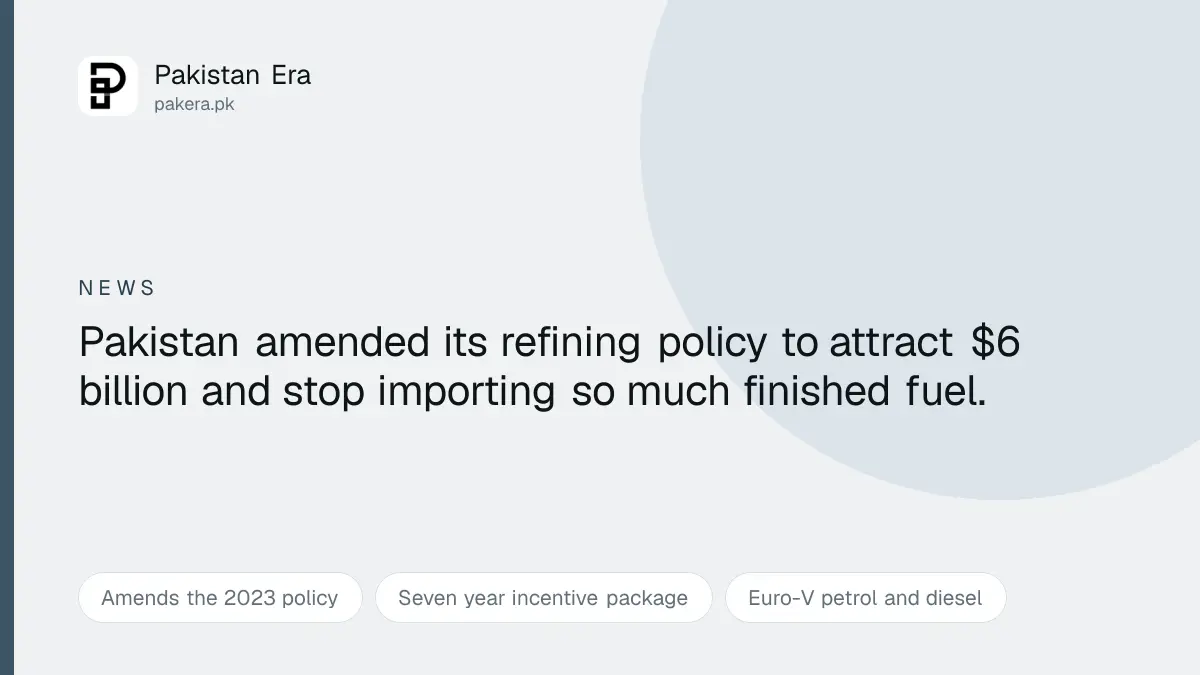
Pakistan has changed the rules for its oil refineries, and the aim is to stop importing so much finished fuel.
The Cabinet Committee on Energy, chaired by Prime Minister Shehbaz Sharif at the Prime Minister's House, approved amendments to the Pakistan Oil Refining Policy 2023. The government hopes it will bring in $5 to $6 billion of investment.
Note what this is. It is not a new policy. It is a set of changes to one that already exists, made because the original was not attracting the money it was meant to.
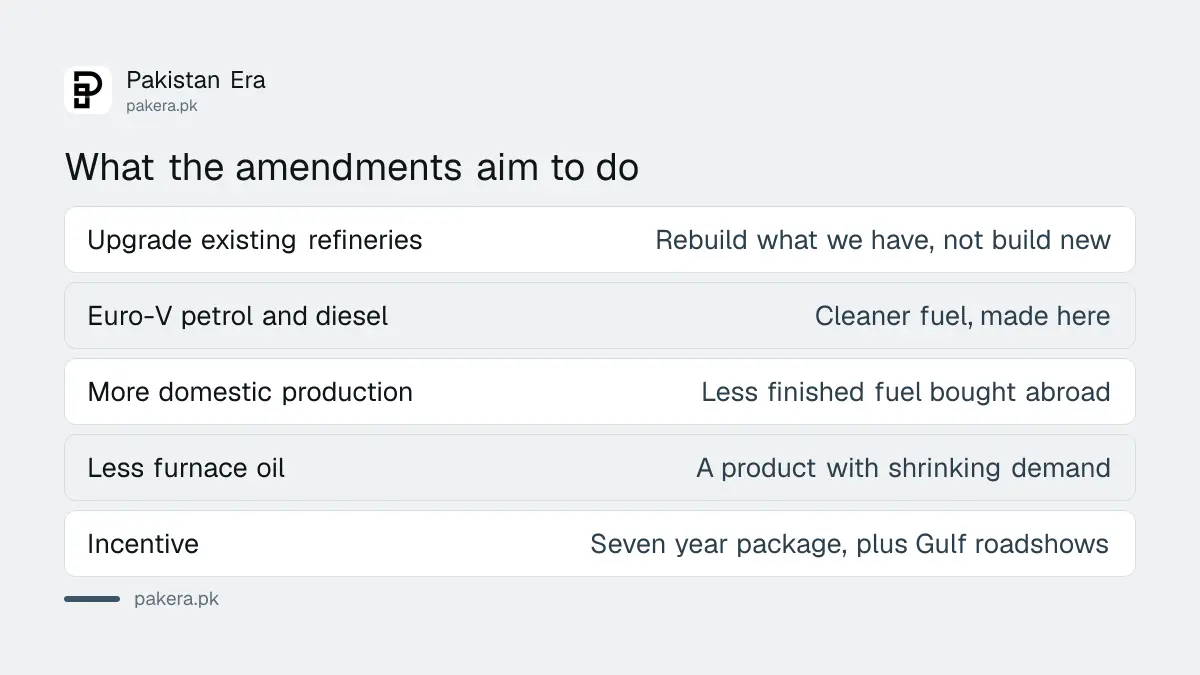
What the amendments aim to do
| Goal | What it means |
|---|---|
| Upgrade existing refineries | Rebuild what we have rather than build new |
| Produce Euro-V petrol and diesel | Cleaner fuel, made here instead of imported |
| Increase domestic production | More of our own fuel from our own plants |
| Reduce furnace oil output | Less of the heavy leftover nobody wants |
| Cut imports of refined fuel | The whole point of the exercise |
To get refiners to spend the money, the government is offering a seven-year incentive package. The Prime Minister also directed the Petroleum Division to hold investment roadshows in Qatar, Saudi Arabia and other Gulf countries.
Pakistan buys the expensive version of its own oil
Here is the problem in one sentence.
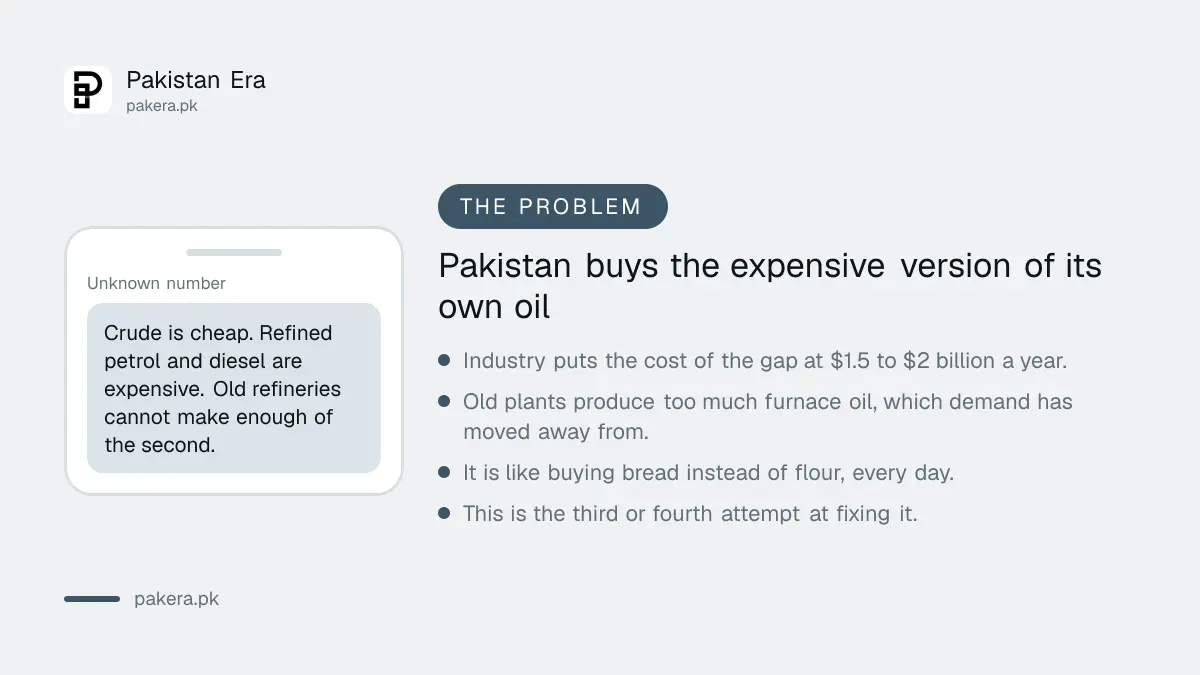
Crude oil is cheap. Refined petrol and diesel are expensive. Pakistan's refineries are old and cannot turn enough crude into the modern fuels the country actually uses, so we import a large share of finished fuel at the higher price instead.
Industry estimates put the cost of that gap at $1.5 billion to $2 billion a year in extra imports, caused by refinery upgrades not happening.
Think of it as buying bread instead of flour. You can do it, and you will pay more every single day for the privilege.
The furnace oil problem
This is the detail that explains why upgrades matter so much.
An old refinery does not choose what it produces. Run crude through outdated equipment and you get a fixed spread of products, including a lot of furnace oil, the heavy residue at the bottom.
Pakistan used to burn furnace oil in power stations. It burns much less now, because that generation has shifted. So refineries make a product with shrinking demand, and cannot make enough of the petrol and diesel that demand is rising for.
Upgrading changes the mix. Less furnace oil, more of what people actually buy.
What Euro-V means for you
Euro-V is a fuel quality standard. Lower sulphur, cleaner burning.
Two practical effects. Air quality improves, which matters in Lahore and Karachi where winter smog is a public health emergency rather than a nuisance. And modern engines run properly: newer vehicles are built for cleaner fuel, and dirty fuel damages their emission systems.
This connects to the vehicle policy argument we set out in the piece on the Auto Policy delay. There is limited sense in encouraging cleaner and newer vehicles while the fuel going into them stays dirty.
Why this may not happen quickly
We should be straight with you. This is the third or fourth attempt at getting Pakistani refineries upgraded, and the reasons it has stalled before have not disappeared.
Refinery upgrades are enormous projects. Billions of dollars, years of construction, and a return that arrives over decades. Investors commit that only when they trust the rules will not change.
Policy has changed repeatedly. The fact that a 2023 policy is being amended in 2026 is itself the evidence. Each amendment is a reason for an investor to wait and see whether another one is coming.
The money is being sought abroad. Roadshows in the Gulf mean the capital is not expected to come from inside Pakistan, and foreign investors price political and currency risk into every decision.
None of that makes the policy wrong. It explains why an announcement and a refinery are very different things.
What it would mean for fuel prices
Honestly: not much, and not soon.
Pump prices are set by OGRA every 24 hours from international prices, plus freight, the exchange rate and taxes, which we explain in the guide to daily fuel pricing. Refining locally does not remove those inputs. Crude still has to be bought in dollars.
What it would change is the import bill, meaning the country's dollar spending rather than the price on your receipt. That matters for the rupee and for the current account, which is the same pressure we described in the piece on record remittances.
So this is a national accounts story, not a cheaper petrol story. Anyone promising you lower pump prices from it is overselling.
What to watch
- Whether any refiner actually signs. A commitment with a number and a date, not an expression of interest.
- Whether the seven-year incentive survives the next budget or IMF review.
- Whether the Gulf roadshows produce anything beyond photographs.
- Euro-V fuel appearing at pumps, which is the only consumer-visible proof that upgrades happened.
Questions readers are asking
What did the government approve?
Amendments to the Pakistan Oil Refining Policy 2023, approved by the Cabinet Committee on Energy chaired by Prime Minister Shehbaz Sharif, intended to attract $5 to $6 billion for refinery upgrades.
Is this a new policy?
No. It amends the existing 2023 policy, which had not delivered the investment it was designed to attract.
Why does Pakistan import refined fuel?
Because its refineries are old and cannot convert enough crude into the petrol and diesel the country uses. Industry estimates put the cost of that gap at $1.5 to $2 billion a year.
What is Euro-V fuel?
A fuel quality standard with much lower sulphur. It burns cleaner, which helps air quality and suits modern engines that dirty fuel can damage.
Will petrol get cheaper?
Not directly. Prices are set daily from international rates, freight, the exchange rate and taxes. Refining more at home reduces the national import bill rather than the price at the pump.
What incentive is on offer?
A seven-year incentive package, with the Petroleum Division directed to hold investment roadshows in Qatar, Saudi Arabia and other Gulf countries.
When would any of this be visible?
Refinery upgrades take years. The first consumer-visible sign would be Euro-V petrol and diesel at pumps.
About the author

Tax, Bills and Technology Writer
Ali Akhtar is a young and curious voice here at Pakistan Era. He is currently pursuing his A-Levels and has a growing interest in Pakistan’s changing industrial landscape and educational trends. Ali likes to write in a way that helps him explain and explore the world around him. His writing reflects the perspective of the new generation navigating the evolving trends of Pakistan where technology, youth innovation, and shifting opportunities are reshaping the country’s future.