The Auto Policy Was Due on 1 July. Three Fights Are Keeping It Unpublished, and the Industry Still Has Not Seen It.
The draft sits with the PM Office, unnotified. The IMF, a tariff dispute and a regulator turf war explain why, and what it means for buyers.
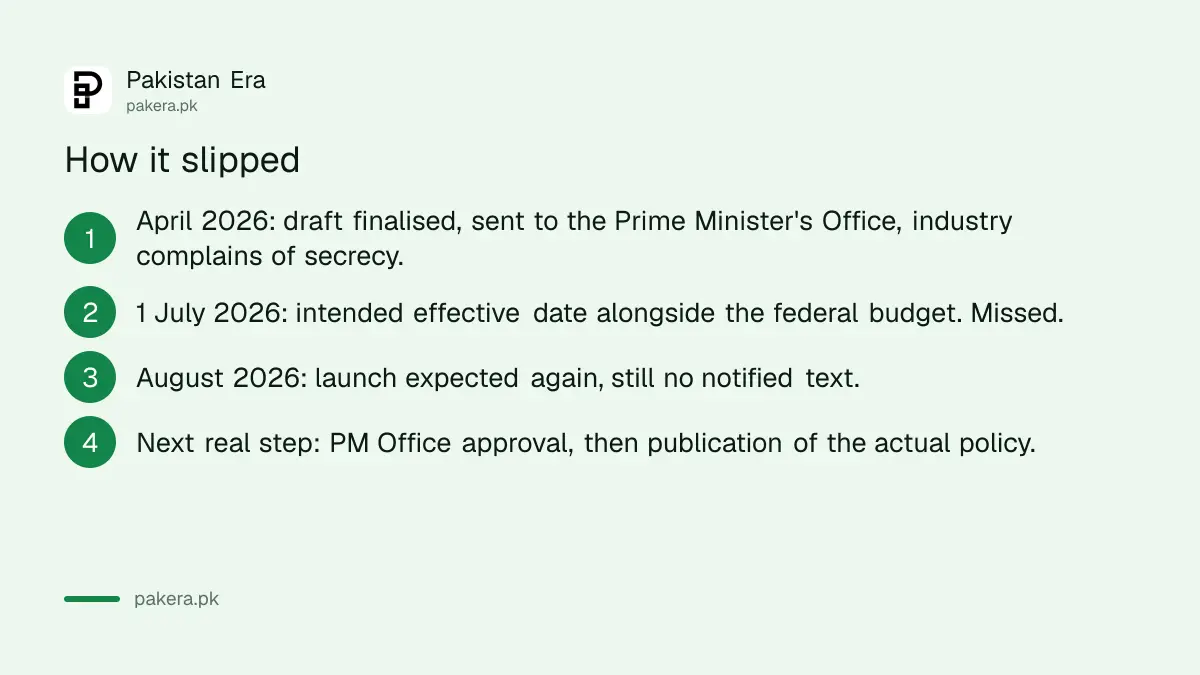
Pakistan's Auto Policy 2026-31 was meant to take effect on 1 July 2026, alongside the federal budget. It is now August, the policy has not been notified, and the car industry it governs says it has not been told what is in it.
The draft has been finalised and sent to the Prime Minister's Office, with contents to be made public after approval. That is the whole of the official position, and everything below it is proposal, dispute and reporting, not law.
We are being pedantic about that distinction on purpose, because a lot of coverage is describing tariff cuts and carbon taxes as though they are decided. Nothing here is in force. If you are about to buy or import a car on the strength of an expected policy, that is the sentence that matters.
What is reportedly in it
The provisions attracting the most attention, all of them reported rather than notified:
| Proposal | Status |
|---|---|
| Phasing out the 62 per cent additional customs duty on imported vehicles | Reported, not notified |
| Support and incentives for new energy vehicles, including electric and hybrid | Reported, disputed with the IMF |
| A carbon tax on petrol powered and hybrid vehicles | Reported as a possibility |
| Attracting investment and increasing competition | Stated objective |
If the additional customs duty phase out survives into the final text, it is the provision that would change prices for buyers most directly, because it goes to the cost of bringing a used or imported vehicle into the country.
Three fights are holding it up
This is the part worth understanding, because it explains why a policy that was ready in April still has not arrived.
The IMF and the tax on electric vehicles
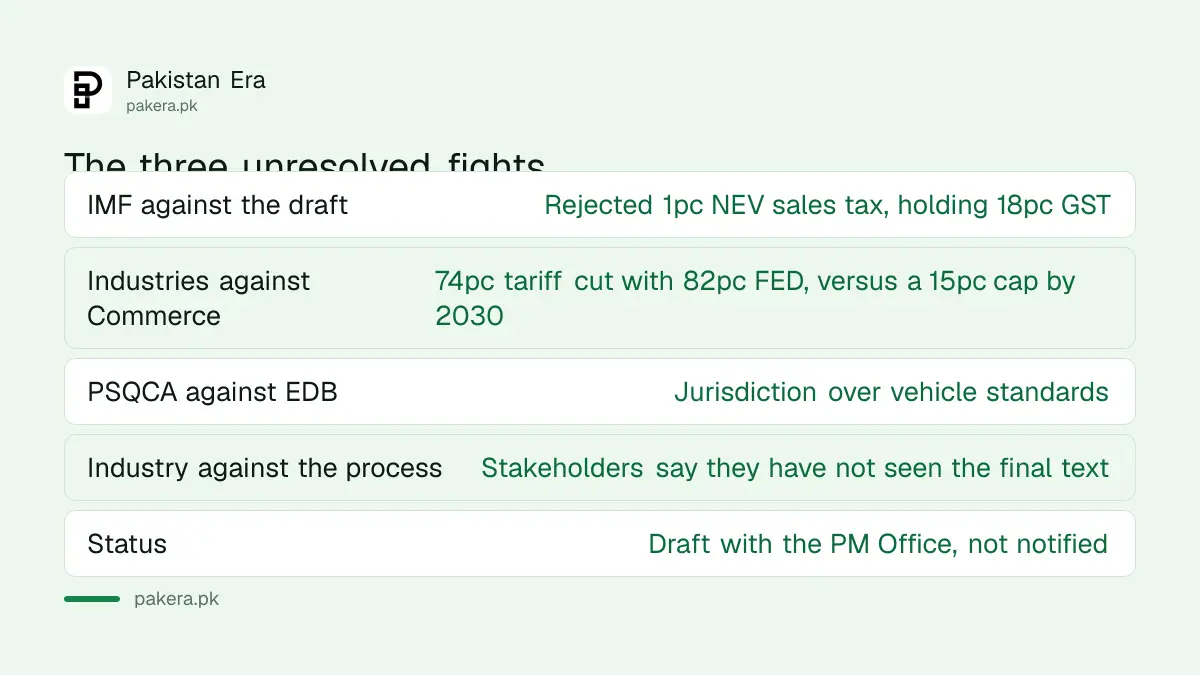
Pakistan proposed a 1 per cent sales tax on new energy vehicles as an incentive. The IMF rejected it and is holding to the standard 18 per cent GST.
That is a straightforward collision between industrial policy and a revenue programme. A country under a fund arrangement has limited room to create tax exemptions, and vehicle electrification is exactly the kind of long horizon subsidy that a short horizon fiscal programme resists.
Industries against Commerce on tariffs
The Ministry of Industries has been weighing an option pairing a 74 per cent tariff cut with an 82 per cent federal excise duty, which would lower the headline tariff while keeping effective protection for local assemblers roughly intact.
Commerce is holding to the National Tariff Policy's commitment to a 15 per cent cap by 2030.
Both positions are internally coherent and they point in opposite directions. One protects an assembly industry that employs people and has been built on protection for decades. The other is a tariff liberalisation Pakistan has already committed to on paper. The Auto Policy cannot be published until somebody loses.
A regulator turf war
Separately, a jurisdictional dispute has opened between the Pakistan Standards and Quality Control Authority and the Engineering Development Board, with the EDB and the Ministry of Industries arguing that PSQCA bypassed federal cabinet approvals and encroached on their regulatory territory.
This one is less visible and no less obstructive. Two bodies claiming the same authority over vehicle standards is not a detail you can leave unresolved in a five year policy.
The transparency complaint
Industry stakeholders have criticised the process, saying they remain unaware of the final contents despite the draft having gone to the Prime Minister's Office.
That complaint is worth taking seriously rather than dismissing as lobbying. Manufacturers plan model launches, localisation targets and investment on tariff and duty assumptions that run years ahead. A policy written behind closed doors and published as a finished instrument gives them no window to plan against, and the same applies to anyone considering an electric vehicle purchase on the strength of an incentive that may not survive contact with the IMF.
What this means if you are buying a car
Practically, three things.
Do not buy on an expected incentive. The 1 per cent NEV rate is contested by the IMF right now. Buying an electric vehicle in anticipation of a tax treatment that has not been notified is taking a policy risk with your own money.
Do not wait indefinitely for import duty relief either. The additional customs duty phase out is reported as gradual, and gradual in a five year policy can mean the first meaningful step is years out.
Running costs are moving anyway, independently of this policy. Fuel is now repriced every 24 hours under OGRA's new system, which we set out in the guide to daily petrol pricing, so the cost of owning a petrol car has become a moving number regardless of what the Auto Policy eventually says about buying one.
A carbon tax on hybrids would land on a segment that is already struggling. Hybrid sales have stalled in Pakistan for reasons we set out in the piece on hybrid sales and the auto policy, and adding a levy to a category the same policy is meant to encourage is one of the tensions still unresolved in the draft.
What would make this real
Approval by the Prime Minister's Office, followed by publication of the actual text. Until the policy is notified, every figure circulating is a proposal from a draft that at least three parties are still arguing over.
When it lands, the numbers to read first are the additional customs duty schedule, the sales tax rate that was actually agreed for new energy vehicles, and whether the federal excise duty was used to offset the tariff cut. Those three decide who the policy is really for.
Questions readers are asking
Has Pakistan's Auto Policy 2026-31 been approved?
No. The draft has been finalised and sent to the Prime Minister's Office, with contents to be released after approval. It has not been notified, and it missed its expected 1 July 2026 effective date.
Will imported car prices fall under the new auto policy?
A gradual phase out of the 62 per cent additional customs duty on imported vehicles has been reported as part of the draft, which would reduce landed costs if it survives into the final text. It is not in force and the timing of any phase out is not public.
Why is the IMF involved in Pakistan's auto policy?
Because the draft proposed a 1 per cent sales tax on new energy vehicles as an incentive. The IMF rejected it and is holding to the standard 18 per cent GST, which is a revenue question rather than an automotive one.
Is there a carbon tax on cars in Pakistan?
Not currently. A carbon tax on petrol powered and hybrid vehicles has been reported as a possible element of the draft policy. It is a proposal.
What is holding the policy up?
Three disputes: the IMF's rejection of the proposed NEV sales tax rate, a disagreement between the Ministry of Industries and Commerce over tariff cuts against the National Tariff Policy's 15 per cent cap by 2030, and a jurisdictional conflict between PSQCA and the Engineering Development Board.
When will the auto policy be announced?
It has been expected in August 2026 after missing 1 July. No official date has been notified, and the policy has slipped before.
About the author

Senior Writer, Public Services and Technology
Shahid joined us in 2024 as an author. He is a senior contributor to Pakistan's leading technology websites. He writes detailed articles, mostly covering his expertise in the latest tech, mobiles, apps, gadgets, and step-by-step guides. His ideology is to help people understand the latest trends and explain complex methods through very easy-to-understand guides.