Pakistan Earned More From Its People Abroad Than From Everything It Sold Abroad
Remittances reached a record $41.6 billion in FY26, up 8.6 per cent, against projected exports of $32.9 billion. Why that gap matters.
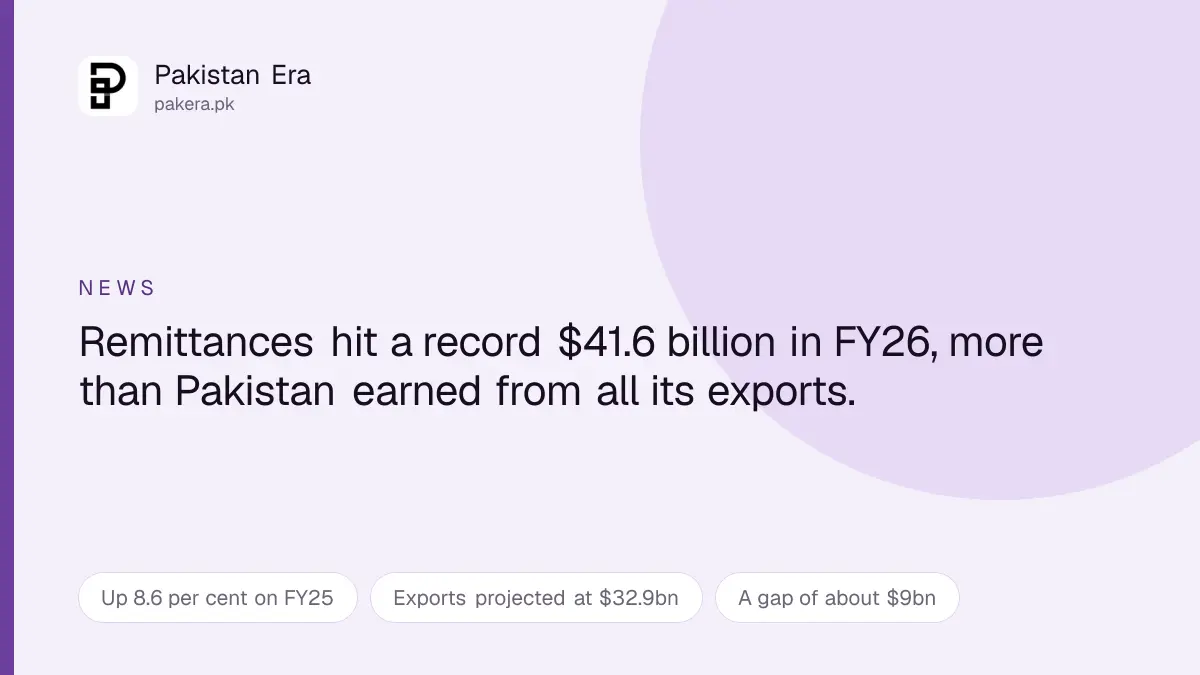
Pakistan earned more from its people abroad last year than from everything it sold abroad.
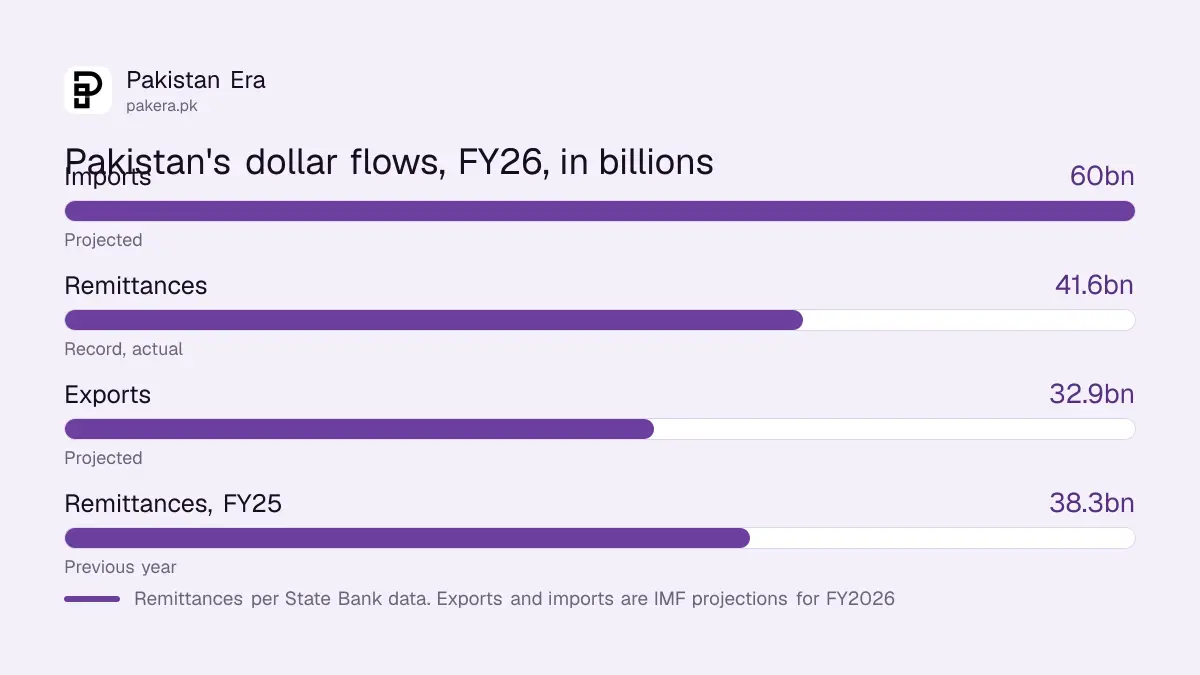
Remittances reached $41.6 billion in FY26, the highest annual figure on record, up 8.6 per cent from $38.3 billion in FY25, per State Bank data for the year ended 30 June 2026. The IMF projects Pakistan's exports at $32.9 billion for FY2026.
That is a gap of roughly nine billion dollars, and it is the most important structural fact about the Pakistani economy that almost never leads a bulletin.
What that ordering actually means
| Source of dollars | FY26 |
|---|---|
| Remittances from overseas Pakistanis | $41.6 billion, record |
| Exports, IMF projection | $32.9 billion |
| Imports, IMF projection | $60 billion |
| Remittance growth on FY25 | Up 8.6 per cent from $38.3 billion |
Read the first two lines together. A country's exports are what it makes and sells. Remittances are what its citizens earn by working somewhere else and send home. When the second is larger than the first, the economy's most reliable source of foreign exchange is not production at all.
Why this is genuinely good news, first
It would be wrong to treat a record as a problem. Remittances are the reason the balance of payments held together.
They arrive without interest, without conditions and without a repayment schedule, which distinguishes them from every other large dollar inflow available to Pakistan. A loan tranche has to be repaid and comes with a programme attached. Remittances are simply money, sent home, monthly, by people who owe the country nothing.
They are also unusually stable. Export earnings swing with global demand and commodity cycles. The instinct to support a family at home does not move with the business cycle, which is why remittances tend to hold up in exactly the conditions where exports fall.
And why the same number is uncomfortable
Three reasons, and none of them are about the people sending the money.
It is a measure of who had to leave. Forty one billion dollars represents an enormous number of Pakistanis working abroad because the return on their skills was higher elsewhere. The inflow is the compensation for an outflow of people, and the outflow is the part that does not appear in any account.
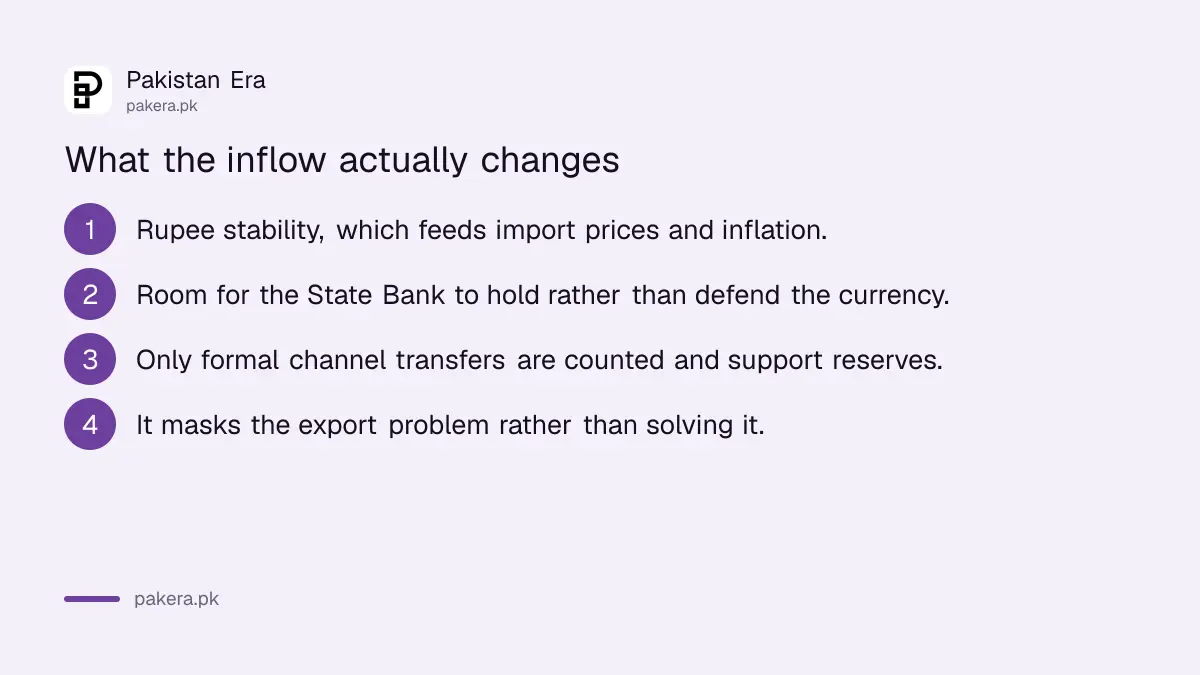
It masks the export problem rather than solving it. Dollars arriving from Dubai and Riyadh keep the rupee steady, and a steady rupee reduces the urgency of fixing why exports sit at $32.9 billion against $60 billion of imports. Concentrated in a narrow band of textiles, as we set out in the trade piece, that export base has not diversified in decades.
The source is concentrated. A large share of these inflows comes from the Gulf, which ties Pakistan's foreign exchange position to labour demand in a handful of economies and to their own policy on migrant workers. That is a dependency, and dependencies get repriced.
What it changes for you
More than it looks, because this is the flow underneath several things we cover.
- Rupee stability. Remittances are a large part of why the currency has not moved the way it did in previous crises, which feeds directly into import prices and inflation.
- The room the State Bank has. A comfortable external position is part of what lets the Monetary Policy Committee hold rather than defend the currency, which we covered in the piece on the rate hold.
- The case for formal channels. Only money sent through banking channels is counted, and it is the counted money that supports reserves. Informal transfers move the same value without any of the effect.
- Why export projects carry weight. It is the reason a copper mine matters out of proportion to its size, as we set out on Reko Diq.
What to watch
Whether FY27 holds the level. A record year sets a base that the following year is measured against, and remittance growth of 8.6 per cent is fast enough that repeating it requires either more workers abroad or higher earnings among those already there.
Also watch the gap itself. If exports rise toward remittances the economy is rebalancing. If remittances keep pulling further ahead, the structure is hardening rather than improving, and that is a slower and more serious problem than any single month's trade figure.
One caution on the comparison itself, since we are the ones making it. The $41.6 billion remittance figure is an outturn for a completed year. The $32.9 billion export figure is an IMF projection for the same period rather than a final number. The ordering is not in doubt on any reasonable revision, but the exact size of the gap will move when the final trade data lands.
Questions readers are asking
How much did Pakistan receive in remittances in FY26?
$41.6 billion, the highest annual figure on record, for the fiscal year ended 30 June 2026, according to State Bank data.
Is that more than Pakistan's exports?
Yes. The IMF projects exports of $32.9 billion for FY2026, which is roughly nine billion dollars below the remittance figure.
How much did remittances grow?
By 8.6 per cent, from $38.3 billion in FY25.
Why do remittances matter more than other dollar inflows?
Because they arrive without interest, conditions or a repayment schedule, unlike loans, and they are more stable than export earnings, which swing with global demand.
What is the risk in relying on them?
Concentration and substitution. A large share comes from Gulf economies, tying Pakistan's external position to labour demand there, and steady inflows reduce the pressure to fix why exports have not grown.
Does it matter how money is sent home?
Yes. Only transfers through formal banking channels are recorded and support official reserves. Informal transfers move the same value without the same effect.
About the author

Senior Writer, Public Services and Technology
Shahid joined us in 2024 as an author. He is a senior contributor to Pakistan's leading technology websites. He writes detailed articles, mostly covering his expertise in the latest tech, mobiles, apps, gadgets, and step-by-step guides. His ideology is to help people understand the latest trends and explain complex methods through very easy-to-understand guides.