Pakistan Bought 39 Per Cent More From America Last Year, and Still Sold It Far More
Imports from the US reached $3.265bn while exports were $6.125bn. We did the subtraction, and the surplus is the number that matters.
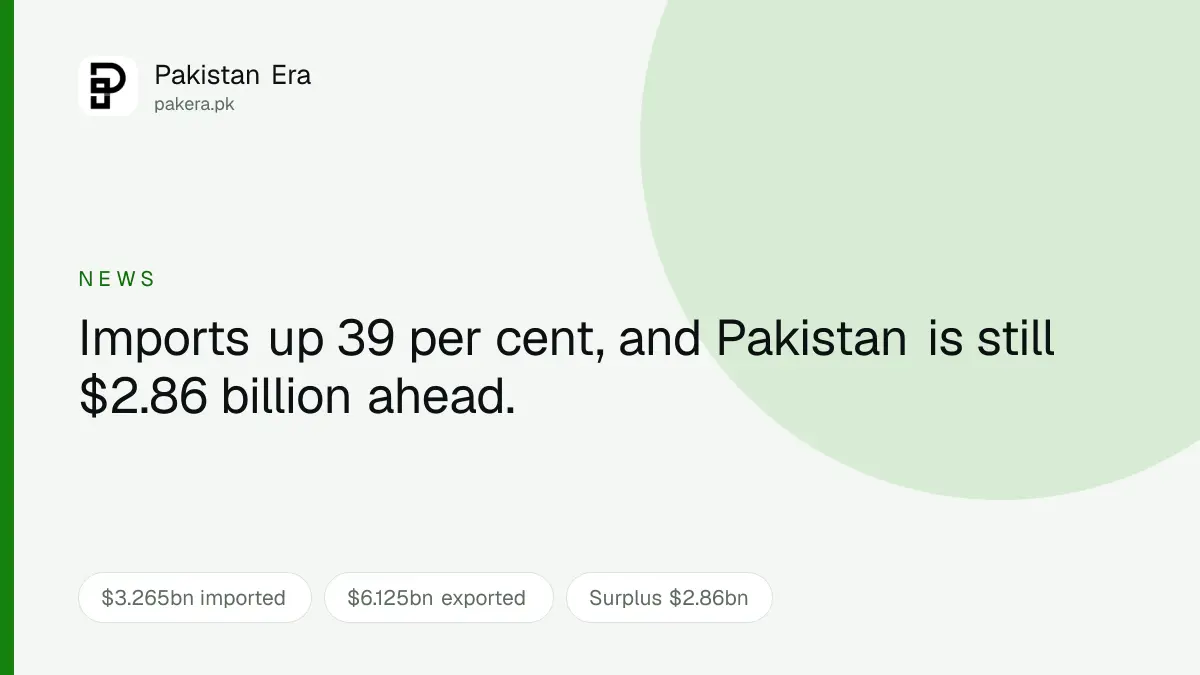
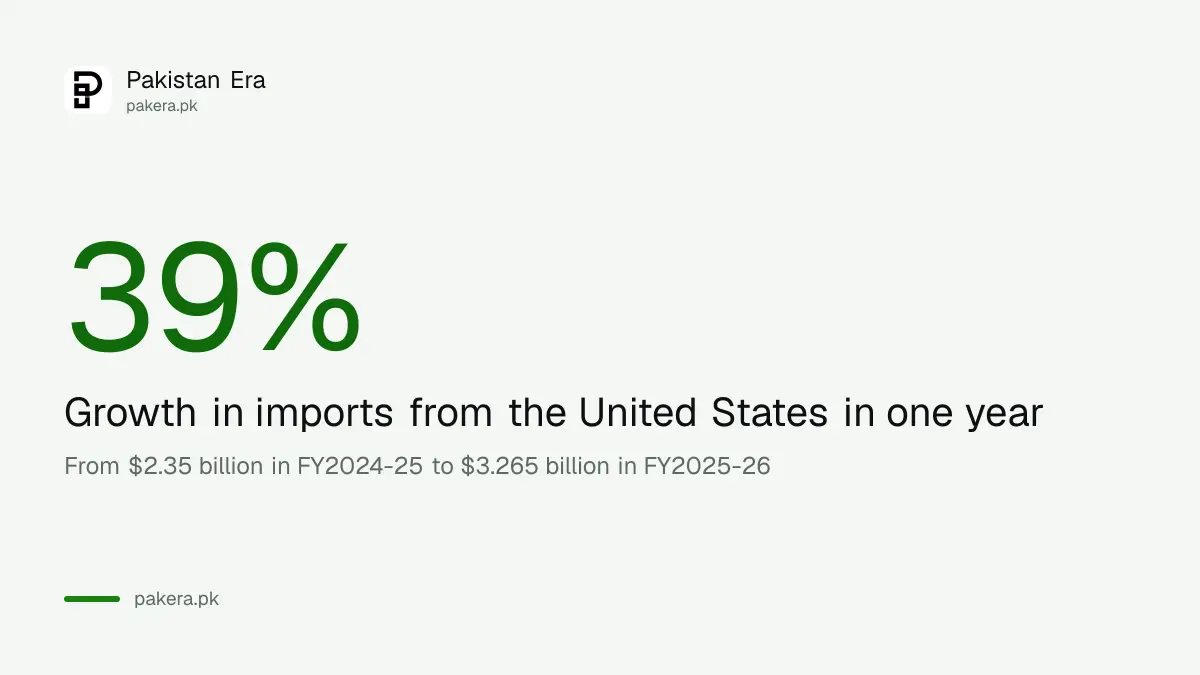
Pakistan imported $3.265 billion of goods from the United States in FY2025-26, up from $2.35 billion the year before. That is a 39 per cent jump in twelve months.
Update, 11 October 2026: The US has put a 10 per cent Section 301 tariff on Pakistani goods.
The headline everywhere is the import surge. We did the other half of the sum, and the more interesting number is what Pakistan sold in the same period: $6.125 billion.
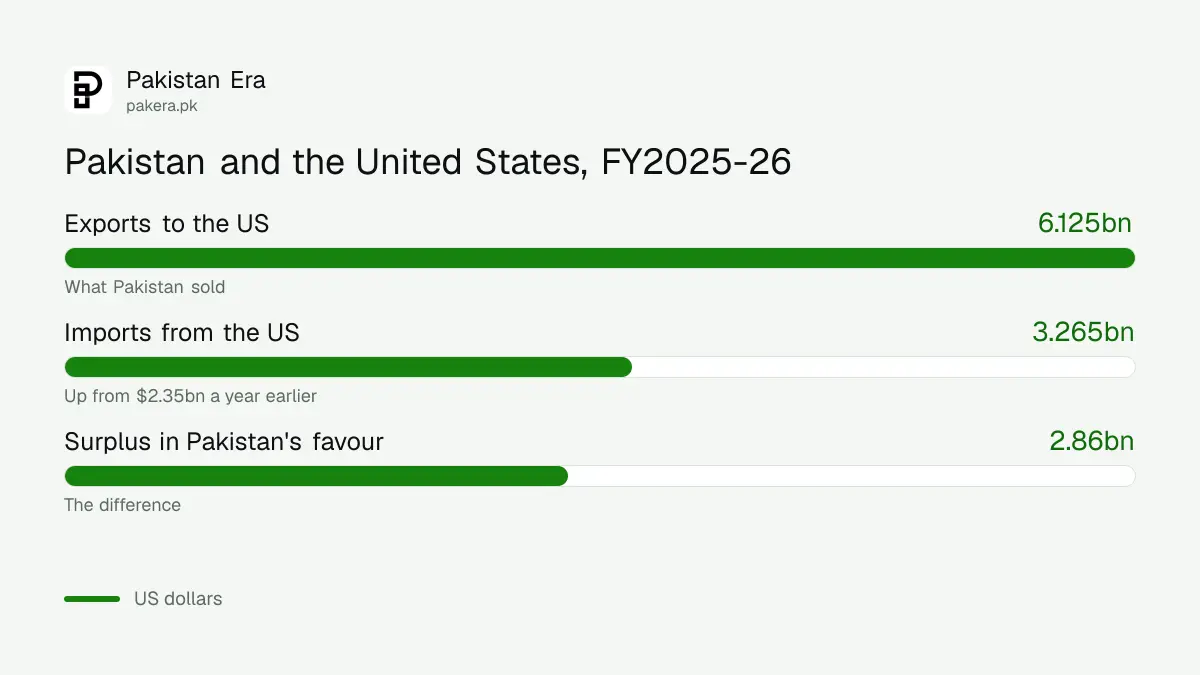
Both directions, in one place
Trade coverage tends to report one flow at a time, which is how a perfectly ordinary number ends up sounding alarming.
| Flow | FY2025-26 | FY2024-25 |
|---|---|---|
| Imports from the US | $3.265 billion | $2.35 billion |
| Exports to the US | $6.125 billion | Not stated in the reporting |
| Balance | About $2.86 billion in Pakistan's favour |
So Pakistan sold the United States almost twice what it bought. Imports grew quickly, from a small base, and the relationship still runs a substantial surplus in Pakistan's direction.
Why the imports grew
The rise is attributed to US trade policies, including tariff measures and a reciprocal trade arrangement, which encouraged Pakistan to buy more American goods.
That is worth unpacking, because reciprocal is doing a lot of work in that sentence. Where a country faces tariffs on what it sells, buying more from the tariffing partner is one of the few levers it has to argue for better treatment. An import increase in that context is not consumer demand. It is negotiation conducted through a purchase order.
What we could not establish is which goods. The commodity breakdown behind the increase is not published in the reporting we found, and we are not going to fill that gap with a guess. Cotton, machinery, scrap and petroleum products are all plausible and none is confirmed, so we have left it as a gap rather than dressing an assumption up as a finding.
A surplus with one partner is not a surplus
This is the part most likely to be misread, so it is worth stating plainly.
Pakistan running a $2.86 billion surplus with the United States tells you nothing about Pakistan's overall trade position. A country can run a comfortable surplus with one partner and a large deficit overall, and that is the normal arrangement for an economy that exports finished goods to one market and imports fuel and machinery from several others.
The United States matters to Pakistan mainly as a buyer, particularly of textiles. That is what the $6.125 billion is. The relevant risk in that relationship has never been importing too much from America. It is what happens to that export figure if tariff treatment changes.
Why the export number is the one to watch
Pakistan's export base is narrow and concentrated in textiles, and the United States is among the largest single destinations for it. That concentration is a strength while access holds and a vulnerability the moment it does not.
Two things now sit on top of that. The first is energy costs: textiles are energy intensive, and RLNG at a decade high raises the cost of every metre produced, which erodes competitiveness against regional rivals regardless of tariffs. The second is that the same conflict driving those energy prices is reshaping trade routes and insurance costs across the region.
An exporter can survive a tariff or an energy shock. Both together, against competitors facing neither, is harder.
Where this connects to money you can see
Trade figures feel abstract until they show up somewhere personal, and there are two places they do.
The first is tax. Import duty on a higher volume of goods is revenue, and customs collected Rs 114.8 billion in July alone, which we covered in the FBR's opening month. More imports mean more of that.
The second is services rather than goods. Pakistan's software and freelance exports to the United States do not appear in these numbers at all, and for a lot of readers that is the part of the relationship they actually participate in. Our guide to getting paid as a freelancer in Pakistan covers that side, and it is growing faster than anything in the table above.
What we would want to see next
The commodity breakdown, which would settle whether this is machinery for industry, agricultural inputs, or something bought principally to move a number. Those have very different implications.
And the export figure for the current year, because that is the one carrying the risk. Imports rising 39 per cent from a small base is a manageable story. Exports falling would not be.
Questions readers are asking
How much did Pakistan import from the US in FY2025-26?
$3.265 billion, up from $2.35 billion the previous year, an increase of 39 per cent.
Does Pakistan have a trade surplus with the United States?
Yes. Exports of $6.125 billion against imports of $3.265 billion leaves roughly $2.86 billion in Pakistan's favour.
Why did imports from America rise so sharply?
It is attributed to US trade policies including tariff measures and a reciprocal trade arrangement that encouraged Pakistan to increase purchases.
What is Pakistan buying from the US?
The commodity breakdown is not published in the available reporting. We have not guessed, because the answer changes what the increase means.
Does a surplus with the US mean Pakistan's trade balance is healthy?
No. A bilateral surplus with one partner says nothing about the overall position. Pakistan exports finished goods to a few markets and imports fuel and machinery from many.
What is the real risk in this relationship?
The export side. Pakistan's sales to the US are concentrated in textiles, and that figure is exposed to both tariff treatment and rising domestic energy costs at the same time.
About the author

Public Services and Education Journalist
Fajr Riaz is a journalist and content writer at Pakistan Era, based in Lahore. She covers the questions people meet in everyday life in Pakistan: how a public service works, what a change in the rules means, and where to find a reliable answer.