RLNG Costs More Now Than at Any Point Since Pakistan Started Importing It
OGRA raised August RLNG to $25.83 per mmBtu, a decade high. Why it happened, and how it reaches your gas and electricity bill.
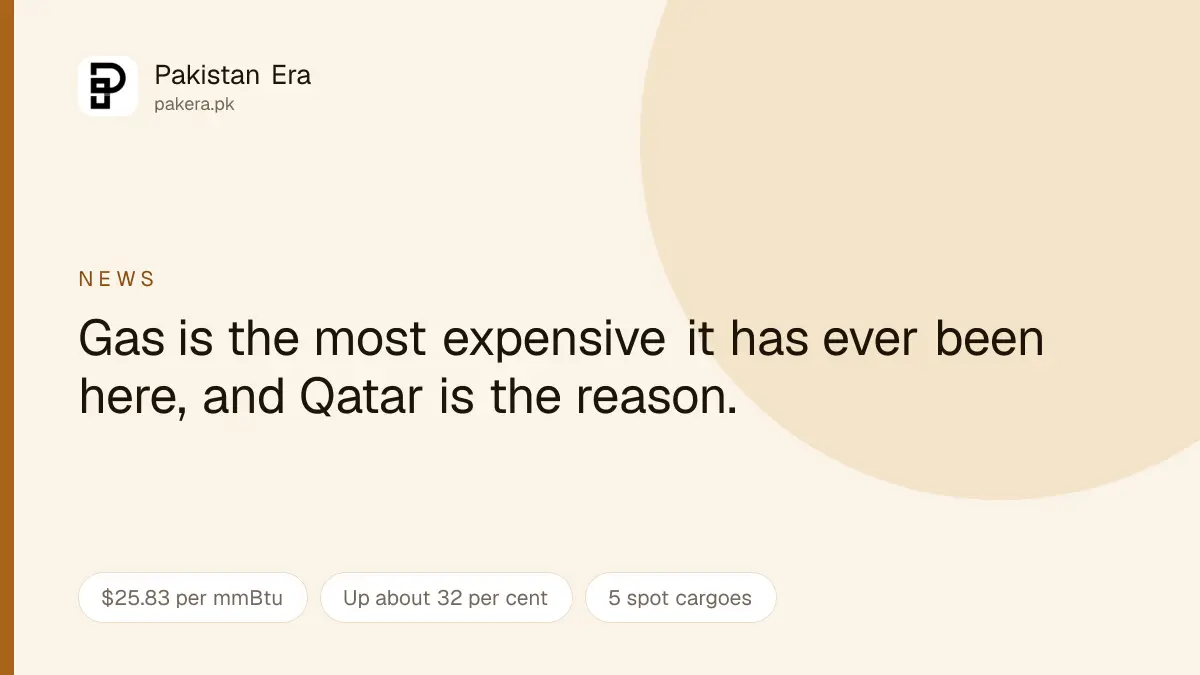
OGRA has set the August price of regasified LNG at 25.83 dollars per mmBtu for Sui Northern and 25.09 dollars for Sui Southern. That is roughly Rs 7,204 per mmBtu at retail, and it is the highest RLNG has been since Pakistan started importing it.
Update, 11 October 2026: OGRA's notified RLNG price for September 2026 is set out with its own July and August notifications, which should be read for the earlier months.
Most people will never see that number on a bill. They will see the consequences of it, spread across electricity, food and anything made in a factory, which is why it is worth understanding where it came from.
Two different percentages are circulating, and both are correct
You will see this increase reported as 32 per cent in some places and as up to 34.6 per cent in others. They are not contradicting each other. They are quoting different utilities.
| Utility | New rate | Rise | Increase |
|---|---|---|---|
| SNGPL, northern Pakistan | $25.8388 per mmBtu | $6.316 | 32.35 per cent |
| SSGC, southern Pakistan | $25.087 per mmBtu | $6.4512 | 34.6 per cent |
So SNGPL customers pay the higher rate, and SSGC customers absorbed the bigger jump to get to a slightly lower one. Roughly Rs 7,204 per mmBtu at retail either way.
One genuine inconsistency is worth flagging. The same set of figures is described as the July notification by The Nation and as the August notification by ProPakistani and Bloom Pakistan. The prices quoted are identical to the last decimal, so this is a labelling difference between outlets rather than two separate increases. We have used August, which is what OGRA's notification covers.
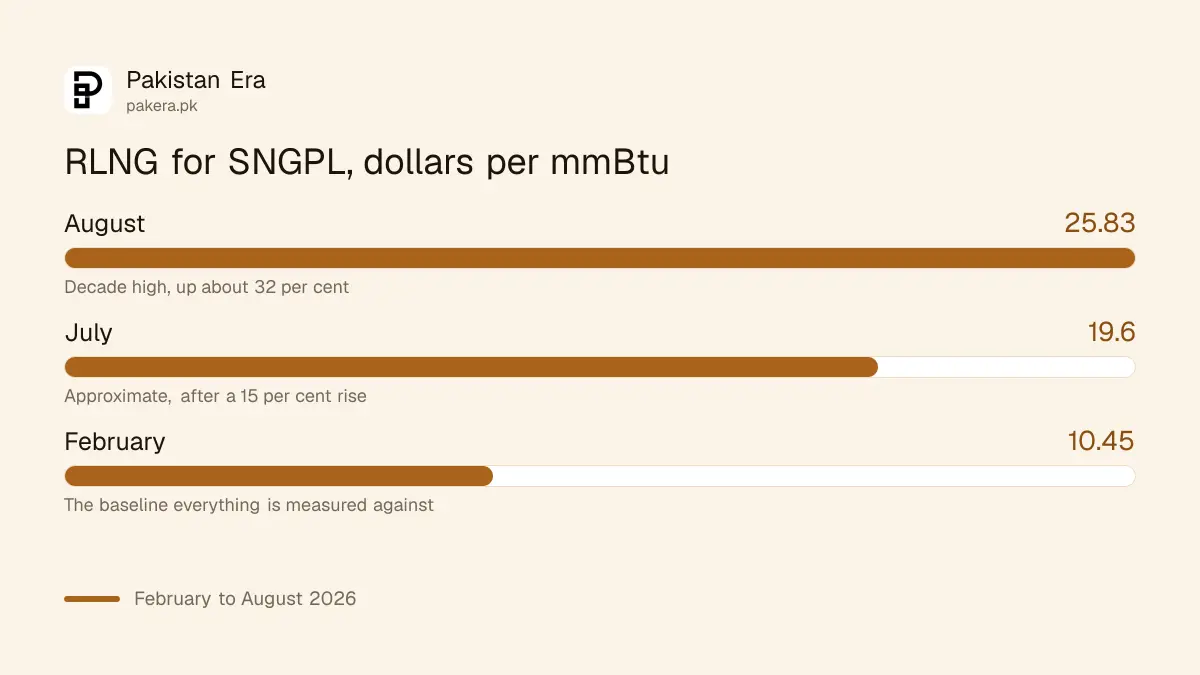
The number nobody disputes is the trajectory. February's rate was 10.45 dollars per mmBtu. Today's is 25.83. That is about 148 per cent higher in six months, and it follows a 15 per cent rise already applied the month before.
Qatar is the reason, and the reason behind Qatar is a war
Pakistan buys most of its LNG on long term contracts, principally from Qatar. Contract cargoes are cheaper and predictable, which is the entire point of signing one.
This month Pakistan could not secure those shipments, and the cause given is the US and Iran conflict. So five cargoes were bought on the spot market instead. Spot LNG is the open market: you buy what is available at whatever the world is paying that week, and in a disrupted market that is a great deal more than a contract rate.
That single substitution is most of the increase. It is not a tax decision, a subsidy withdrawal or a regulator being difficult. It is what happens to an importing country when a shipping route it depends on becomes unreliable.
The route from a cargo price to your electricity bill
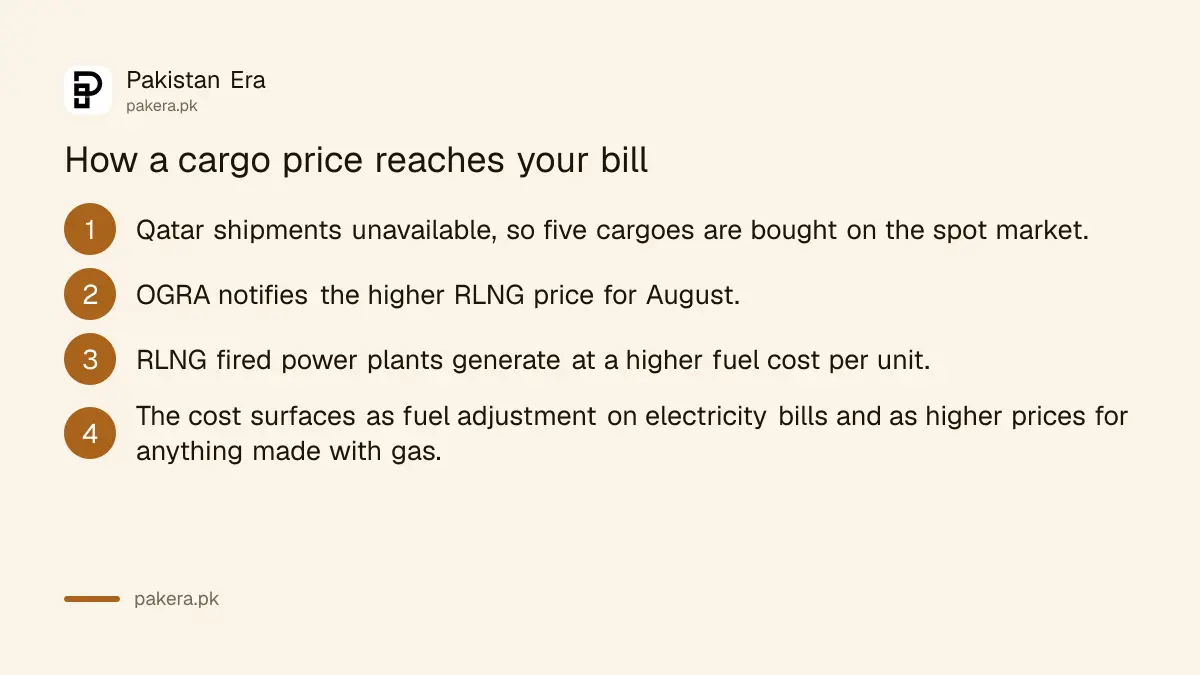
Gas in Pakistan is not mostly a cooking story. A large share of it is burned to generate electricity, so the price of a cargo landing at Port Qasim becomes the fuel cost of a power plant, and that becomes a line on a bill.
The scale of that is already visible. Fuel cost for RLNG based generation had risen to Rs 31 per unit in May, against Rs 13.72 per unit in April. That is the same unit of electricity costing more than twice as much to produce, before a single wire or meter is paid for.
It reaches households three ways.
- Fuel price adjustment on your electricity bill. This is the mechanism that passes generation costs through, usually a month or two behind the event.
- Gas tariffs for connected households and commercial users, decided separately but pushed by the same input cost.
- The price of everything made with heat. Cement, fertiliser, textiles, glass, steel and food processing all run on gas. Their costs move first and their prices follow.
If you want to watch the first one land, our guides to checking your electricity bill online and checking a Sui gas bill show you where the adjustment appears, and the overbilling piece covers what to do if the number looks wrong rather than merely high.
LPG rose too, and the relief went somewhere else
LPG, which is what most households outside the pipeline network actually cook on, went up 5.4 per cent to Rs 254.32 per kilogram.
Separately, and this is the part worth noticing, roughly Rs 50 billion of regulatory relief was directed at the gas sector's circular debt rather than passed to consumers. The gas circular debt stands at about Rs 3.5 trillion.
That is a defensible decision. Circular debt left to compound eventually stops the sector functioning at all, and someone pays for it either way. It does mean that a month in which some relief existed was not a month in which bills got smaller.
What a household can actually do about it
Very little about the cargo price, and rather more about exposure to it.
Solar is the obvious lever and it has stopped being exotic here. Panel prices have fallen far enough that the arithmetic works for a lot of homes, and there are provincial schemes worth checking eligibility for: our guides cover the Punjab scheme and the Sindh one. Where solar gets genuinely interesting is when it is paired with storage, because that is what covers the evening peak, and battery storage economics have shifted this year too.
The one caution: net metering terms have been changing, so run the numbers on current rules rather than on what a neighbour was offered two years ago.
The power sector has already started moving off it
The clearest evidence that these prices are not survivable is what generators have done about them. RLNG based electricity generation has fallen to an eight year low, with coal absorbing much of the shortfall. We have written that up separately in how the power mix changed without anyone deciding it, because it is a different story from this one and it has different consequences.
What to watch next
The single question is whether contract cargoes resume. If Qatar shipments come back to normal, the following months should fall a long way from this level, because the spot purchases are what did the damage. If they do not, the winter months are when this gets expensive in a way people feel directly, since that is when gas demand peaks.
The second thing to watch is whether the increase is passed through in full or absorbed for a period and recovered later. Deferred cost is still cost, and it usually arrives with company.
Questions readers are asking
What is the RLNG price for August 2026?
$25.83 per mmBtu for SNGPL and $25.09 for SSGCL, roughly Rs 7,204 per mmBtu at retail. It is the highest level since Pakistan began LNG imports.
By how much did RLNG go up?
32.35 per cent for SNGPL in the north and 34.6 per cent for SSGC in the south. Both figures are correct, they simply describe different utilities. Against February's $10.45, the rate is about 148 per cent higher.
Why has generation moved away from RLNG?
Because at these prices it stopped making financial sense. RLNG based generation fell to an eight year low in FY26 as availability tightened and spot prices climbed, with coal picking up much of the difference.
Why did the price rise so sharply?
Pakistan could not secure its usual Qatar cargoes because of the US and Iran conflict and bought five on the spot market instead. Spot LNG costs whatever the open market is charging, which in a disrupted market is far above a contract rate.
Will electricity bills go up because of this?
A significant share of Pakistan's generation runs on RLNG, and the fuel price adjustment mechanism passes generation costs to consumers, typically with a lag of a month or two. Fuel cost for RLNG generation had already gone from Rs 13.72 per unit in April to Rs 31 in May.
Did LPG prices change as well?
Yes. LPG rose 5.4 per cent to Rs 254.32 per kilogram, which matters most for households not on the piped network.
Is this permanent?
It depends on whether contract cargoes resume. The increase is driven by emergency spot buying rather than by a structural change in tariffs, so it can fall back as quickly as it rose if supply normalises.
About the author

Senior Writer, Public Services and Technology
Shahid joined us in 2024 as an author. He is a senior contributor to Pakistan's leading technology websites. He writes detailed articles, mostly covering his expertise in the latest tech, mobiles, apps, gadgets, and step-by-step guides. His ideology is to help people understand the latest trends and explain complex methods through very easy-to-understand guides.