Pakistan Is Burning More Coal Because a Shipping Route Stopped Working
RLNG generation hit an eight year low and coal took the load. We looked at how a war rewrote the power mix without any policy decision.

Pakistan's electricity now comes from a noticeably different mix of fuels than it did a year ago. RLNG based generation fell to an eight year low in FY26, and coal picked up much of what it left behind.
What struck us while reading through this is that nobody appears to have decided it. There was no policy announcement, no target, no debate. A shipping route stopped working and the merit order rearranged itself.

How a war rewrote the fuel mix
The chain is short and each link is mechanical.
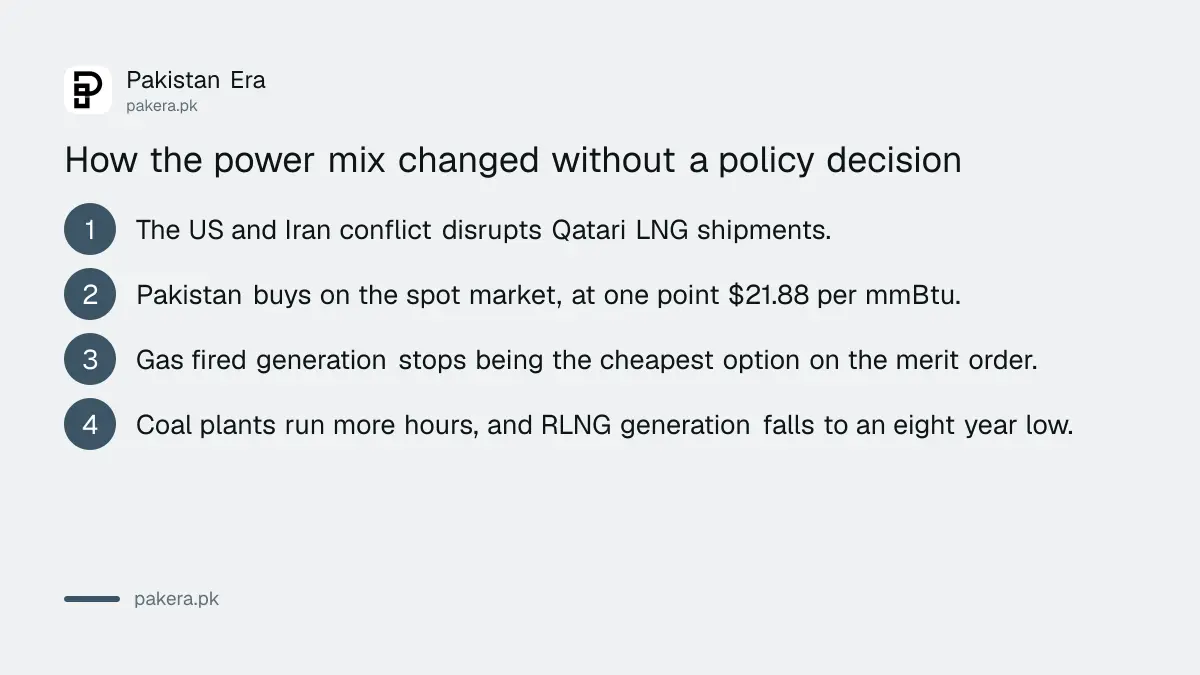
- The US and Iran conflict disrupted Qatari LNG shipments. Pakistan's long term contracts are largely with Qatar, and long term contracts are the cheap, predictable part of the supply.
- Pakistan bought on the spot market instead. On 20 July, Pakistan LNG accepted a cargo at $21.8800 per mmBtu, among the most expensive since the conflict began.
- Gas fired power stopped being competitive. Plants are dispatched roughly in order of running cost. When the fuel gets dear enough, a plant simply stops being called on.
- Coal ran more hours. RLNG generation fell to an eight year low, and the load went somewhere.
This is what an energy system does when an input price moves. It is not a decision so much as a consequence.
Why nobody stopped it
Because on the immediate numbers it is the right call, and the alternative is worse.
A grid that insisted on burning gas at these prices would either pass an enormous cost to consumers or fail to serve the load. Running coal instead keeps the lights on at a lower cost per unit. Every operator facing that choice makes the same one.
There is even an argument that this is good for energy security in the narrow sense. Some of Pakistan's coal is domestic, particularly Thar, and a fuel you dig up yourself is not vulnerable to a strait closing. Reducing dependence on imported gas has been an aim for years. It is arriving by accident rather than by plan.
What the swap actually costs
| What changes | Direction |
|---|---|
| Cost per unit generated | Lower, which is the reason it happened |
| Exposure to shipping disruption | Reduced |
| Import bill | Reduced where the coal is local |
| Emissions per unit | Higher, coal is the dirtier fuel |
| Speed of reversal | Slow, dispatch follows cost rather than intent |
The emissions line is the one worth sitting with. Pakistan is among the countries most exposed to climate damage and among the least responsible for causing it, and it has spent years arguing that case internationally while trying to move its own generation away from coal.
That effort has now been partly undone by a conflict it has no part in. We are not going to pretend that is a scandal, because the alternative on the table was not clean power, it was unserved load. But it is worth naming what happened rather than filing it as a technical adjustment.
The part that is genuinely encouraging
Solar is the reason this is a story about the fuel mix rather than about blackouts.
Pakistan's rooftop solar boom has been the largest and fastest in the region, driven by households and small businesses buying panels because grid power got expensive, not because anyone incentivised them. That capacity is now absorbing a meaningful share of daytime demand, which is exactly the load a gas plant would otherwise have been asked to serve.
The gap solar does not fill is the evening, which is why the Power Division is now proposing to pay a premium for stored power delivered between 5pm and 10pm. Those two stories are the same story: a system short of evening capacity, trying to buy it from wherever it can.
What this means for your bill
Less than you would think, and not in the direction you would expect.
Coal substitution is what has stopped this being far worse. A grid still burning gas at spot prices would be passing through fuel costs far above what coal delivers. The saving is invisible because it shows up as a bill that did not rise as much as it could have.
What you will feel is the gas side rather than the power side, and that is covered in our piece on the RLNG price increase, which is where the household numbers are. If you want to check what your own bill is doing, the online bill guide and the overbilling piece cover reading it and disputing it.
What we will be watching
Whether Qatari contract cargoes resume is the single variable. If they do, gas becomes competitive again and the mix drifts back, though slowly, because plants are dispatched on cost rather than on intention.
The second is whether any of this becomes deliberate. A shift that happened by accident could be locked in by choice, through new coal capacity or long term supply contracts. That would be a real decision with real consequences, and it deserves to be argued about in public rather than to arrive as a side effect of somebody else's war.
Questions readers are asking
Why has RLNG generation fallen so far?
Limited availability and high spot prices made gas fired power financially unattractive, so those plants were dispatched less. Generation from RLNG fell to an eight year low in FY26.
What replaced it?
Mostly coal, which absorbed much of the shortfall because it was cheaper to run at these fuel prices.
Was this a government decision?
Not as a stated policy. Plants are dispatched roughly in order of running cost, so when gas became expensive it dropped down the order on its own.
Does burning more coal make electricity cheaper?
Cheaper than continuing to burn gas at spot prices would have been. It has limited the increase rather than reduced bills.
Is this bad for emissions?
Yes. Coal is the dirtier fuel and this raises emissions per unit generated. The comparison being made at the time was against unserved load rather than against clean generation.
Will the mix go back to gas?
It depends on whether contract cargoes resume. Even then the shift back would be gradual, because dispatch follows running cost rather than policy preference.
About the author

Senior Writer, Public Services and Technology
Shahid joined us in 2024 as an author. He is a senior contributor to Pakistan's leading technology websites. He writes detailed articles, mostly covering his expertise in the latest tech, mobiles, apps, gadgets, and step-by-step guides. His ideology is to help people understand the latest trends and explain complex methods through very easy-to-understand guides.