Solar Owners Could Be Paid Rs 22 a Unit for Evening Power, and the Catch Is a Battery
A proposed time of use rate pays Rs 18 to 22 between 5pm and 10pm. We checked what it means against the Rs 11 buyback most people now get.
The Power Division has proposed paying solar owners an extra Rs 18 to 22 per unit for electricity supplied to the grid between 5pm and 10pm.
When we first saw the number we assumed it was a reversal of this year's cut to net metering. It is not, and the difference matters a great deal to anyone deciding whether to put panels on a roof.
What is being proposed
A time of use formula, applied to net metering or net billing, paying a premium for units delivered during the evening peak. The window is 5pm to 10pm. The premium is reported at Rs 18 to 22 per kWh.
The reason is straightforward. Evening peak demand has crossed 26,000 MW, and that is the hour when the grid struggles and when the most expensive generation has to be switched on. A unit delivered at 7pm is worth far more to the system than the same unit at noon, and the tariff has never reflected that.
We want to be clear about its status: this is a proposal from the Power Division. It is not approved, there is no notified rate, no eligibility criteria and no start date. Treat every number here as an indication of direction, not as something to sign a contract against.
Why this is not a reversal of the net metering cut
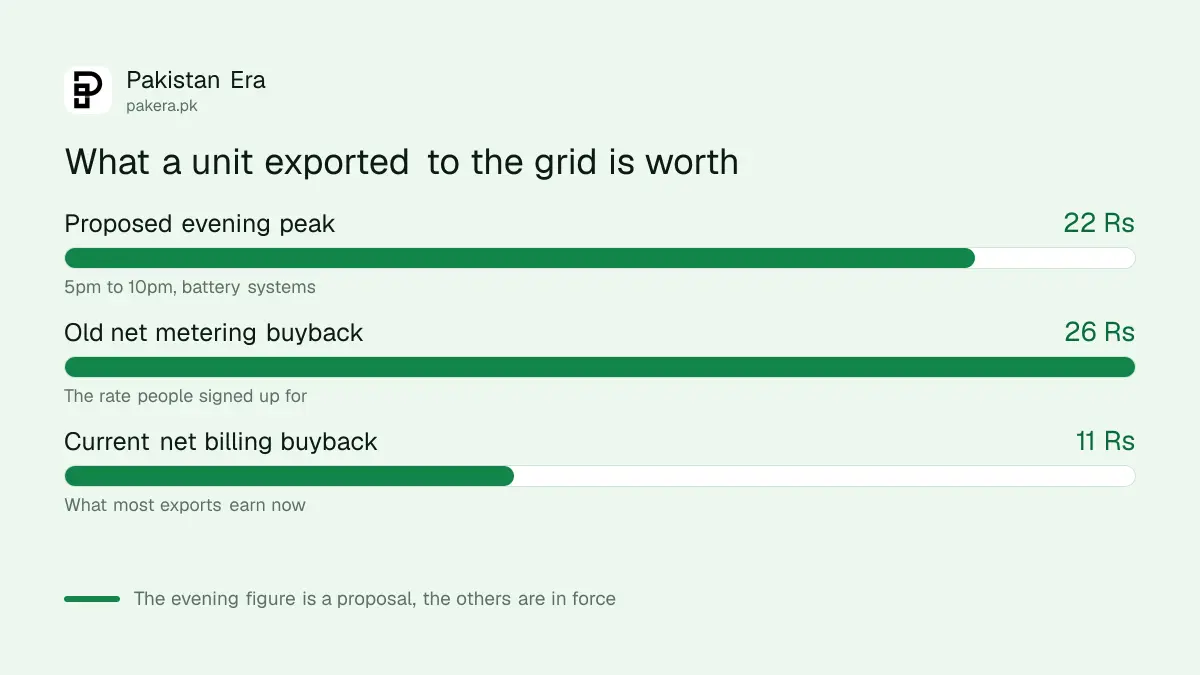
Earlier this year the buyback rate for units exported by solarised consumers was cut from Rs 26 to Rs 11 under the net billing regime. That was a large reduction and it changed the economics for everyone who had been planning around the old figure.
The Rs 22 being discussed now is not a return to that. It is a premium available in a five hour window, and only for supply during that window. Units exported at noon still earn the low rate.
| Rate | When it applies | Status |
|---|---|---|
| Rs 26 per unit | Old flat buyback, all hours | Withdrawn |
| Rs 11 per unit | Current net billing buyback | In force |
| Rs 18 to 22 per unit | 5pm to 10pm only | Proposed |
So a household exporting all day at Rs 11 is not suddenly earning Rs 22. It would earn Rs 11 for most of what it sends and the premium only for what it can deliver in the evening.
The catch is that solar does not generate in the evening
This is the part that decides whether the proposal is worth anything to you.
Between 5pm and 10pm in Pakistan, the sun is setting or gone. Panels produce little at the start of that window and nothing by the middle of it. A plain grid tied solar system, with no storage, has almost nothing to sell during the exact hours the premium covers.
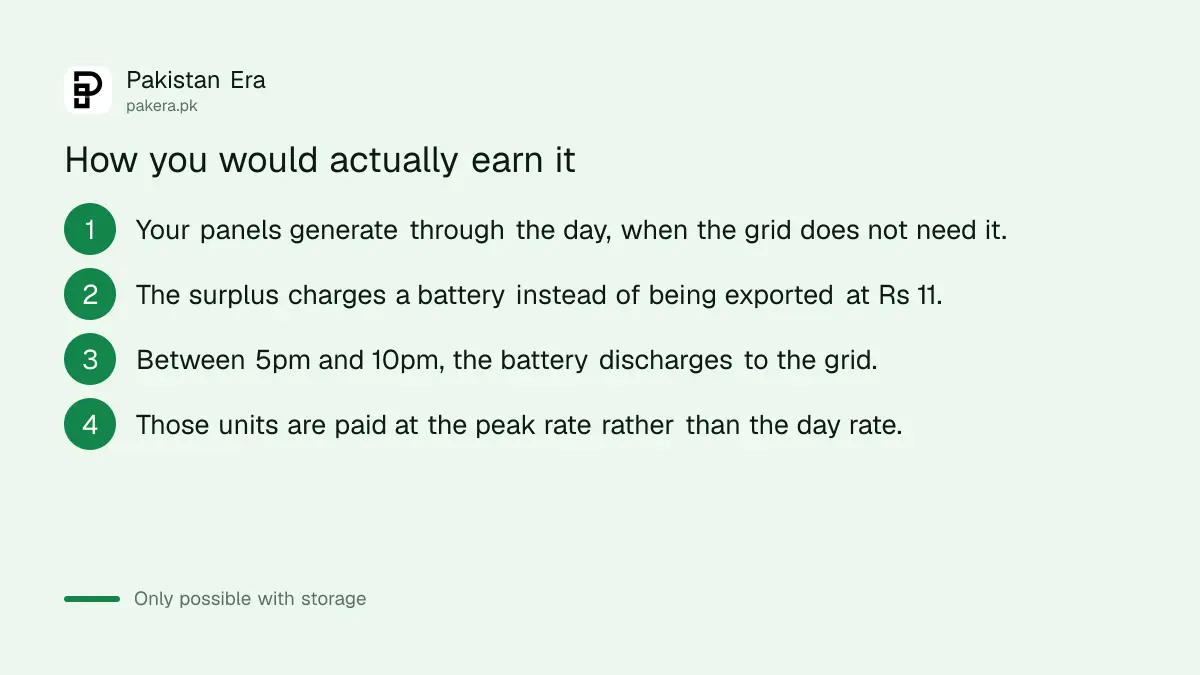
To earn it you need a battery. Your panels charge it through the day with power you would otherwise have exported at Rs 11, and the battery discharges to the grid in the evening at the peak rate. The proposal is described as a mechanism for battery backed systems, and the arithmetic explains why.
That means this is, in substance, a subsidy for storage rather than for solar. Which is coherent policy: Pakistan does not have a shortage of daytime solar generation, it has a shortage of evening capacity, and paying people to shift energy across time is cheaper than building peaker plants.
What we are not going to tell you
We are not going to give you a payback period, and we would be sceptical of anyone who does.
A payback calculation needs an approved rate, eligibility rules, a battery price, a cycle life and an export limit. Of those five, the proposal supplies none. Any figure published today about how fast a battery pays for itself under this scheme is built on numbers nobody has notified.
What we can say is which way it moves the decision. Battery storage in Pakistan has until now been bought for backup during load shedding, and its value was measured in inconvenience avoided. If this proposal is approved, a battery would also earn revenue, which is a different kind of case entirely. Our piece on battery storage economics covers where those costs currently sit.
What to do while it is still a proposal
- Do not buy a battery on the strength of this. No rate is approved. Buy storage if backup alone justifies it, and treat any future export revenue as an upside you were not counting on.
- Check what regime you are actually on. Net metering and net billing are different, and which one applies to you depends on when you connected. It changes what your exports are worth today.
- Watch NEPRA rather than the news. A tariff becomes real when it is notified by the regulator. NEPRA is where that appears.
- If you are only now installing, size for self consumption. With exports at Rs 11 and grid units far dearer, the money is in using your own generation, not selling it.
If you are still at the stage of getting panels on the roof, the provincial schemes are worth checking eligibility for first: our guides cover the Punjab scheme and the Sindh scheme. And if you have already been caught by the change in export rates, what happened to net metering users explains how that arrived.
Why the grid is asking for help at 7pm
It is worth understanding the pressure behind this, because it explains why a premium of this size is even being contemplated.
Evening peak is when air conditioning, lighting and cooking overlap. Meeting it means running the most expensive plants on the system, and those are increasingly the ones burning imported fuel. With RLNG at a decade high, every unit generated at peak is costing the system more than it did a year ago.
Paying households Rs 22 for a unit that would otherwise cost more than that to generate is not generosity. It is arithmetic.
Questions readers are asking
Is the Rs 22 rate approved?
No. It is a Power Division proposal, reported at Rs 18 to 22 per kWh for the 5pm to 10pm window. No rate has been notified and no start date exists.
Does this replace the Rs 11 net billing rate?
No. It would sit alongside it as a premium for evening supply. Units exported outside the window would still earn the standard rate.
Can I earn it without a battery?
Realistically no. Solar generates little or nothing between 5pm and 10pm, so without storage you have almost nothing to sell in the window the premium covers.
Why is the government offering more for evening power?
Because evening peak demand has crossed 26,000 MW and serving it means running the most expensive plants on the system. Buying stored solar at Rs 22 can be cheaper than generating it.
Should I install solar now or wait?
Waiting for this proposal is not a reason to delay, because it may change or not arrive. Size a system for your own consumption, since with exports at Rs 11 the value is in the units you use rather than the ones you sell.
Where will the final rate be announced?
Through NEPRA, which notifies tariffs. A rate reported in the news is not a rate until it appears there.
About the author

Public Services and Education Journalist
Fajr Riaz is a journalist and content writer at Pakistan Era, based in Lahore. She covers the questions people meet in everyday life in Pakistan: how a public service works, what a change in the rules means, and where to find a reliable answer.