Pakistan Bought 4.6 GWh of Batteries in a Year
Battery imports rose 220% in a year as solar households look for storage. What is driving it and what a battery actually costs you.
Pakistan put solar panels on roofs faster than almost anywhere on earth. It is now buying the batteries, and that is a different decision entirely.
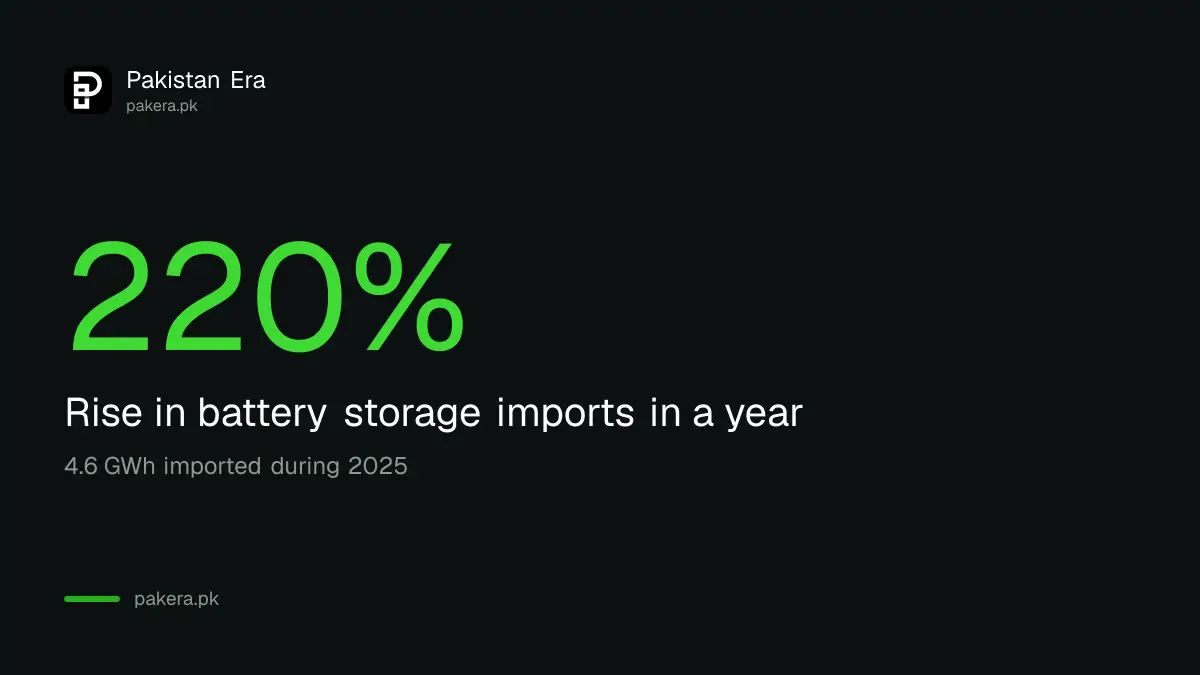
Lithium battery storage imports reached 4.6 GWh during 2025, a rise of 220 percent in a year. Solar battery storage in Pakistan has moved from a niche add-on for people who could afford it to something closer to standard, and the reason is not environmental.
It is that a solar panel without a battery stops working at sunset, which is exactly when your bill is worst.
How much storage has Pakistan bought?
4.6 GWh during 2025 alone, taking cumulative imports to around 7.6 GWh by the end of that year. For scale, Pakistan had roughly 51 GW of solar deployed by March 2026.
| Measure | Figure |
|---|---|
| Imported during 2025 | 4.6 GWh |
| Year on year growth | 220% |
| Cumulative to end 2025 | About 7.6 GWh |
| Solar deployed by March 2026 | About 51 GW |
| Projected annual imports by 2030 | 8.75 GWh |
One note on the figures. A different number, 652 MWh, appeared in coverage this week and we have left it out, because it could not be reconciled with these and mixing measurement periods produces nonsense. The 4.6 GWh and 7.6 GWh figures are consistent with each other, so those are the ones used here.
Why are people adding batteries now?
Four things at once, and the last one is the one most people miss.
Electricity prices kept climbing, which improves the payback on anything that reduces grid consumption. Solar households multiplied, and every one of them eventually notices their panels do nothing in the evening. Battery costs fell globally, so the maths that failed three years ago now works.
And net billing reforms changed what your surplus is worth. When exporting daytime solar to the grid pays well, a battery is optional. When the terms get worse, storing your own power and using it at night becomes the better deal. That reform did more to sell batteries in Pakistan than any marketing did.
Is a battery worth it for a household?
It depends almost entirely on when you use electricity, not how much.
A battery is worth it if:
- Your heaviest use is in the evening, after the panels have stopped producing.
- You already have solar and are exporting surplus for less than you pay to buy it back.
- Load shedding in your area is long enough that a UPS is not sufficient.
- You plan to stay in the property long enough to see the payback, which is measured in years not months.
It is not worth it if you use most of your power during daylight, because you are already consuming what the panels make, and a battery would spend its life half empty.
What should you check before buying one?
The market has expanded faster than its quality control, which always produces problems.
- Match the battery to your actual evening consumption, not to your panel capacity. Oversizing is the most common and most expensive mistake.
- Check the cycle rating, which is how many charges the battery is rated for. That number, not the price, decides the real cost per unit stored.
- Confirm the warranty is honoured in Pakistan by someone who will still exist in five years.
- Ask whether the inverter you already own supports the battery chemistry, since a mismatch means replacing both.
- Get the installation done by someone who will return, because a battery is a fire risk when installed badly.
If you are earlier in this process, our guides to the Punjab free solar scheme and the Sindh scheme cover the panel side, and what is happening to net metering explains the reform that made batteries attractive in the first place.
Where does this go next?
Analysts project imports reaching 8.75 GWh a year by 2030, which would be around 26 percent of projected peak demand. That is no longer a rooftop story, it is a grid one.
The interesting consequence is what happens to the utilities. Every household that adds storage stops buying evening electricity, which is the most profitable power the distribution companies sell. A grid losing its best customers while carrying the same fixed costs raises prices for whoever is left, which pushes more people to solar and storage. Nobody has explained how that ends well.
Frequently asked questions
How much battery storage did Pakistan import?
4.6 GWh during 2025, a 220 percent increase year on year, bringing cumulative imports to around 7.6 GWh.
Why are batteries selling now rather than earlier?
Rising electricity prices, many more solar households, falling global battery costs, and net billing reforms that made storing your own power better value than exporting it.
Do I need a battery if I have solar panels?
Only if you use most of your electricity in the evening. If your consumption is during daylight, the panels already cover it.
How long does a solar battery last?
Check the cycle rating rather than a headline year figure. Cycles, not age, determine the real cost per unit of stored electricity.
What size battery should I buy?
Size it to your evening consumption, not your panel capacity. Oversizing is the most common expensive mistake in this market.
Is battery storage safe?
Properly installed, yes. Badly installed lithium storage is a genuine fire risk, so use an installer who will still be around to answer for the work.
Work out your own figure
Working out whether the payback is affordable? Start with what actually reaches your account each month.
Salary Tax Calculator →About the author

Public Services and Education Journalist
Fajr Riaz is a journalist and content writer at Pakistan Era, based in Lahore. She covers the questions people meet in everyday life in Pakistan: how a public service works, what a change in the rules means, and where to find a reliable answer.