Net Metering Is Gone: What Solar Export Pays in Pakistan Now
NEPRA repealed net metering on 9 February 2026 and replaced it with net billing. What your exported units earn now, and who is protected.
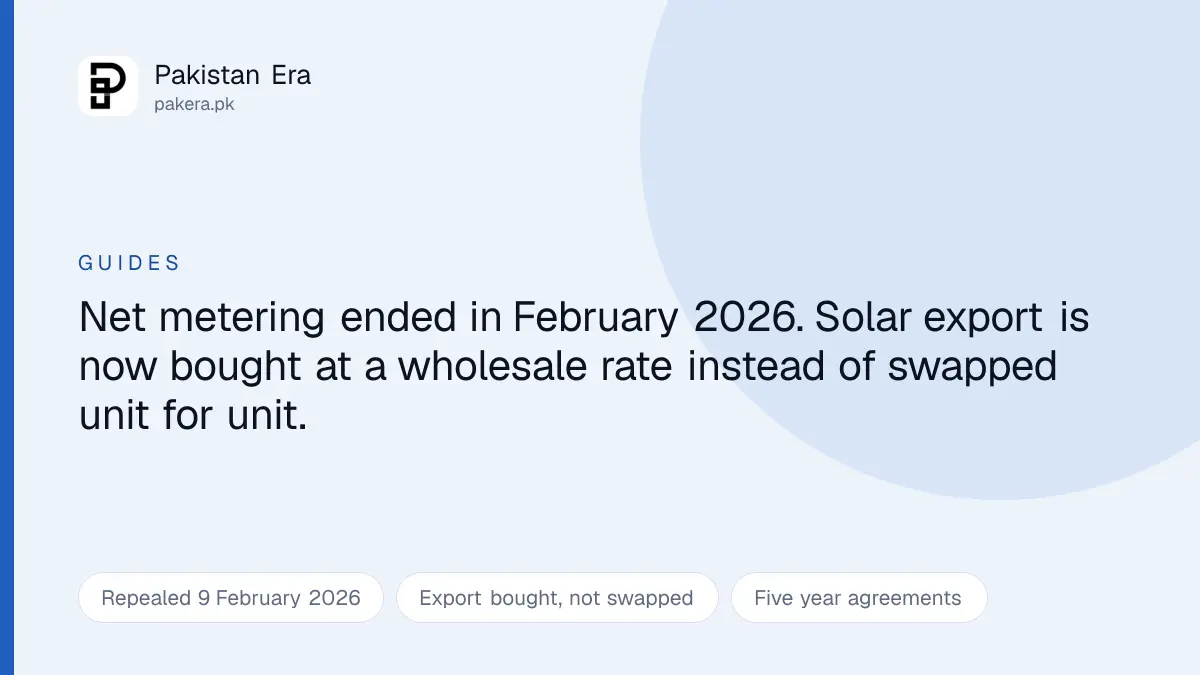
Pakistan does not have net metering any more. NEPRA repealed it on 9 February 2026 and replaced it with a system called net billing.
The difference is simple to state and expensive to ignore. Under net metering, a unit you exported cancelled a unit you imported. One for one. Under net billing, you buy your electricity at the full retail tariff and you sell your surplus at a much lower wholesale rate.
We downloaded the notification from NEPRA's own website and read it clause by clause, because the reporting around this has been inconsistent. This is what the rules actually say.
The 2015 net metering rules were repealed outright
Regulation 21 of the new Prosumer Regulations says the 2015 Distributed Generation and Net Metering Regulations "shall stand repealed upon coming into force of these regulations". The new regulations came into force at once, on the day they were notified.
So net metering was not paused or reduced. It was removed from the law.
How net billing calculates your bill
Regulation 14 sets out the arithmetic in two lines. Units flowing to you are billed at one price, units flowing from you are bought at another.
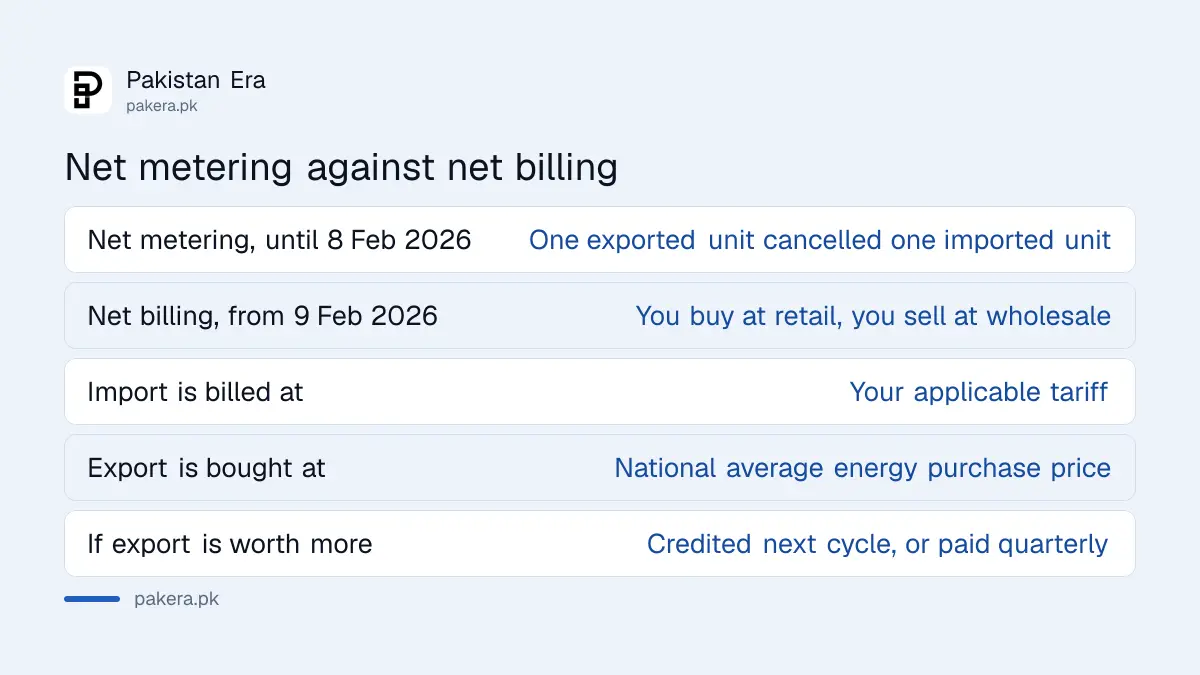
| Direction | What it is priced at |
|---|---|
| Units the DISCO supplies to you | Your applicable tariff, the normal retail rate |
| Units you supply to the DISCO | The national average energy purchase price |
If the value of what you exported is greater than the value of what you imported, regulation 14(2) says the difference is either credited against your next billing cycle or paid to you by the DISCO every quarter. You do not lose it, but you are not swapping units any more.
The rules name a price and do not print a number
Here is where we have to be careful with you, because a lot of published figures are being quoted with more confidence than they deserve.
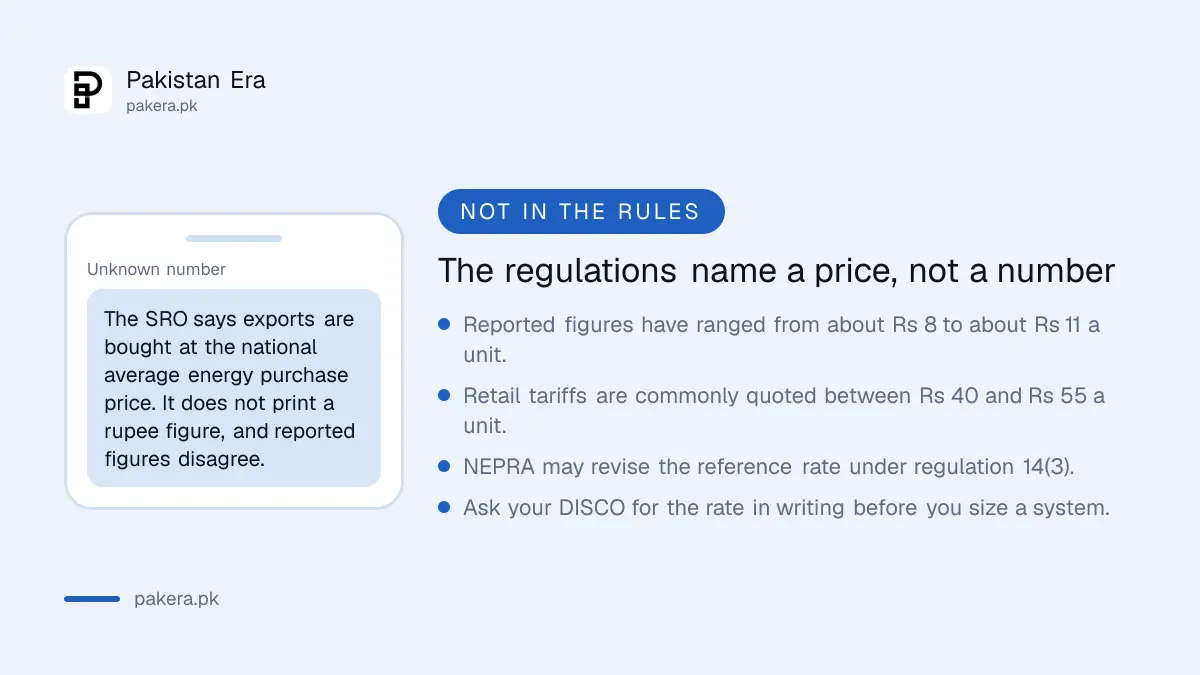
The notification says exports are bought at the national average energy purchase price. It does not state that price in rupees. The figure is set separately, and regulation 14(3) allows NEPRA to revise it.
Reported values have ranged from roughly Rs 8 a unit to roughly Rs 11 a unit depending on the outlet and the month. Retail tariffs are commonly quoted between Rs 40 and Rs 55 a unit depending on your slab and your area. We are not going to hand you a single number and pretend it is settled, because the sources disagree and the rate can move.
What is not in dispute is the shape of it. You are buying high and selling low, where before you were swapping at par. That changes the payback period on a solar system substantially, and it changes the design logic too: every unit you use yourself while the sun is up is now worth several times more than a unit you export.
People who signed before 9 February 2026 are treated differently
The regulations as notified said existing agreement holders would keep being billed on a different reference price until their agreement expired, and would move to the new price only on renewal.
After objections from the solar industry and an intervention by the Prime Minister, NEPRA issued a further amendment on 2 April 2026. That amendment is reported to preserve the terms of agreements executed before 9 February 2026 until those agreements run out, with retrospective effect from 9 February.
We have to flag a limit here. That amendment is published on NEPRA's site as a scanned image with no readable text layer, so unlike the other notifications we could not extract and read its exact wording ourselves. We are reporting what it does on the strength of press coverage, not our own reading of the instrument. If you hold a pre February agreement and the outcome matters to you in rupees, ask your DISCO to confirm in writing which reference price they are applying to you.
Which rules apply to you
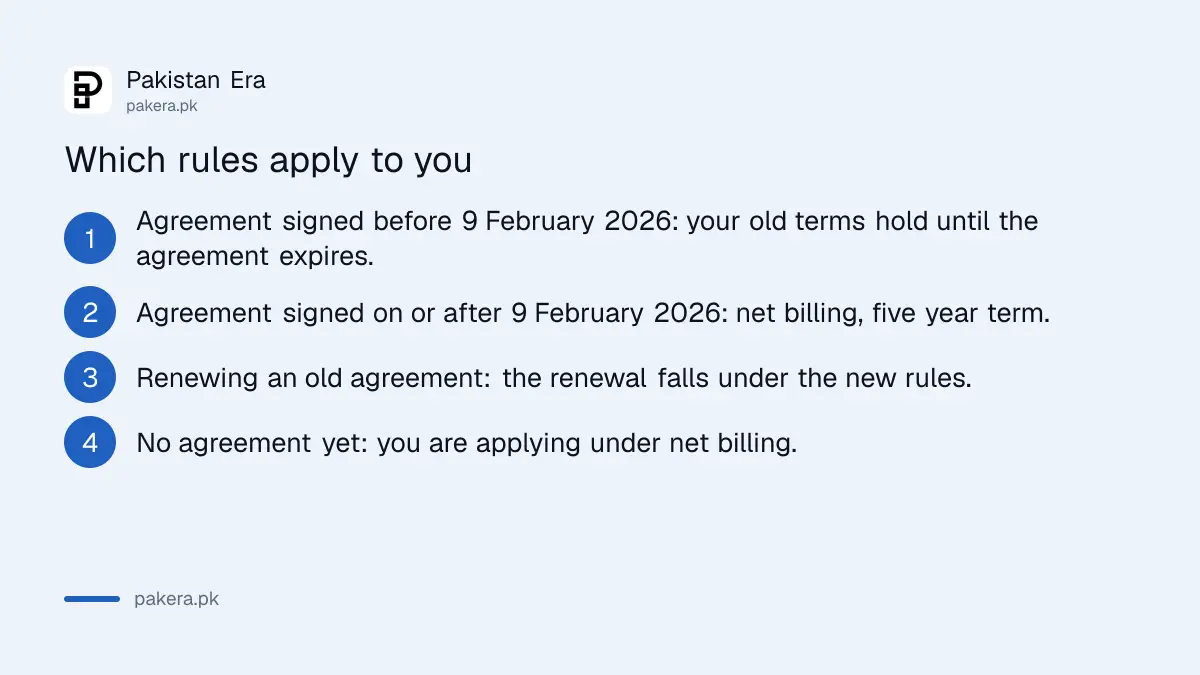
- Agreement signed before 9 February 2026. Your existing terms hold until the agreement expires.
- Agreement signed on or after 9 February 2026. Net billing, on a five year term.
- Renewing an old agreement. The renewal falls under the new rules, not the old ones.
- No agreement yet. You are applying under net billing from the start.
The other conditions that come with an agreement
Several rules sit alongside the pricing and catch people out.
- Term. Five years from the date your system is commissioned, renewable for another five by mutual consent. The old regime ran for seven.
- Size. Your generation capacity cannot exceed the sanctioned load of your premises.
- Connection. You must be a three phase consumer at 400V or 11kV.
- What counts. Solar, wind or biogas, up to 1 MW.
- Large systems. At 250 kW and above you need a load flow study, done through your DISCO or a consultant registered with the Pakistan Engineering Council.
Approval got easier in August 2026
On 6 August 2026, NEPRA dropped the requirement for systems of 25 kW or below to seek its concurrence at all. Your DISCO now approves those directly, and there is no fee. Above 25 kW, NEPRA concurrence is still needed and the fee is Rs 1,000 per kW as a one time payment. We covered that change and the exact wording in our report on the 25 kW approval exemption.
That makes the process shorter. It does not make the export rate better.
There is one proposal that would pay considerably more, but only for power delivered in the evening peak and only if you have storage to shift it there. We looked at the numbers on that in the piece on the proposed evening export tariff.
What to do before you sign anything
- Get the export rate in writing from your DISCO before you size a system. Do not accept an installer's figure.
- Size for self consumption first. Under net billing the unit you use yourself is worth far more than the unit you export.
- Check your sanctioned load on your bill. It is the ceiling on system size.
- Note the date on your agreement. It decides which rule set governs you.
- Treat any one for one swap claim as a warning sign. That system was repealed in February 2026.
If your bill is the thing you are actually trying to bring down, solar is one lever among several, and it is not always the fastest one. Reading your bill properly comes first, and we walked through every distribution company's portal in the guide to checking your electricity bill online.
Questions readers are asking
Is net metering still available in Pakistan?
No. The 2015 net metering regulations were repealed on 9 February 2026 and replaced by net billing under the Prosumer Regulations 2026.
What is the difference between net metering and net billing?
Net metering swapped an exported unit for an imported unit at par. Net billing bills your imports at the retail tariff and buys your exports at a lower wholesale reference price.
How much does the DISCO pay for exported solar units?
At the national average energy purchase price. The regulations name that reference price but do not print a rupee figure, and reported values have ranged from about Rs 8 to about Rs 11 a unit. Ask your DISCO for the current rate in writing.
I already have net metering. Do I lose it?
An amendment notified on 2 April 2026 is reported to preserve agreements executed before 9 February 2026 until they expire, retrospectively from 9 February. Confirm with your DISCO, because we could not read that notification directly.
How long does a net billing agreement last?
Five years from commissioning, renewable for another five by mutual consent.
Does solar still make financial sense in Pakistan?
It depends far more on self consumption than it used to. Units you use during daylight avoid a retail tariff of Rs 40 or more. Units you export earn a wholesale rate. A system designed around daytime use pays back considerably faster than one designed to export.
About the author

Tax, Bills and Technology Writer
Ali Akhtar is a young and curious voice here at Pakistan Era. He is currently pursuing his A-Levels and has a growing interest in Pakistan’s changing industrial landscape and educational trends. Ali likes to write in a way that helps him explain and explore the world around him. His writing reflects the perspective of the new generation navigating the evolving trends of Pakistan where technology, youth innovation, and shifting opportunities are reshaping the country’s future.