How a Widow Claims the Punjab Benevolent Fund Grant
A Punjab government servant's widow can claim a Rs 35,000 funeral grant and a monthly Benevolent Fund payment. See the scales, documents and where to file.
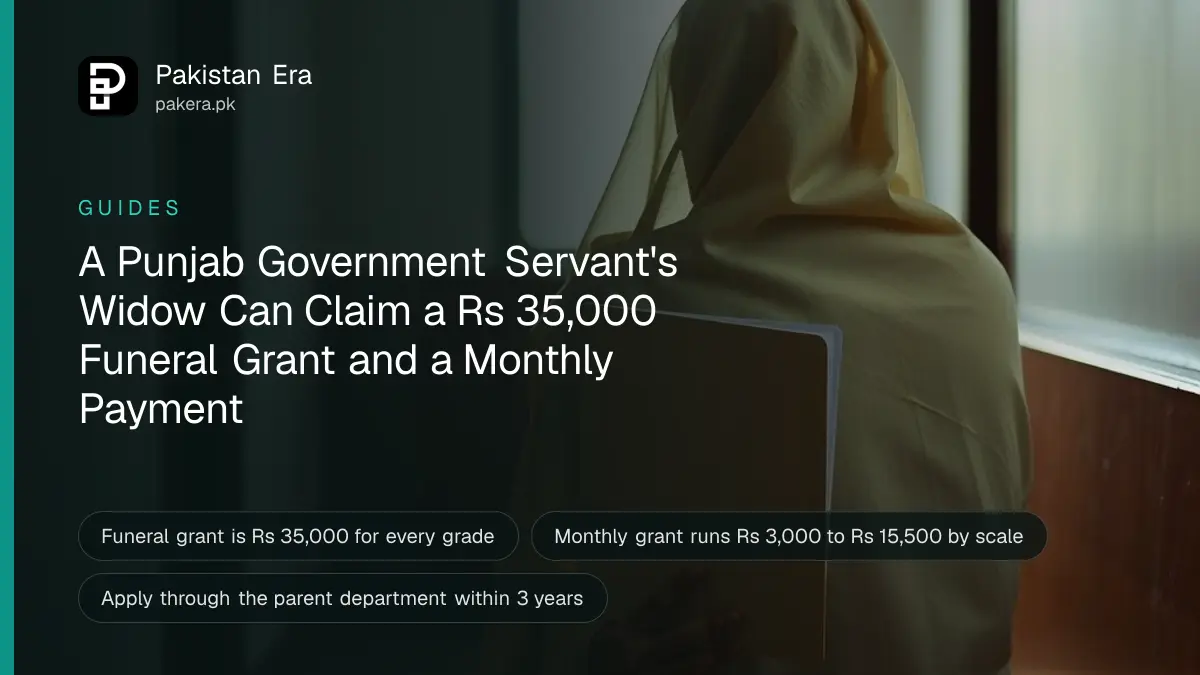
A Punjab government servant's widow can claim three separate payments from the Punjab Benevolent Fund: a one time funeral grant of Rs 35,000, a monthly grant of Rs 3,000 to Rs 15,500 depending on the deceased's pay scale, and later a marriage grant for a daughter. The claim goes through the deceased's own department, not directly to the Fund, and must reach the Benevolent Fund Board within three years.
We read the Punjab Benevolent Fund's own pages on pbf.punjab.gov.pk on 5 October 2026, the monthly grant rates, the funeral grant, the marriage grant, the FAQ on documents, and the forms page. The Fund sits under the Government of Punjab and pays out under the Punjab Government Servants Benevolent Fund Disbursement Rules of 1965 and 1966. It is a different body from the federal fund that covers central government staff, so a Punjab employee's family files here, not there.
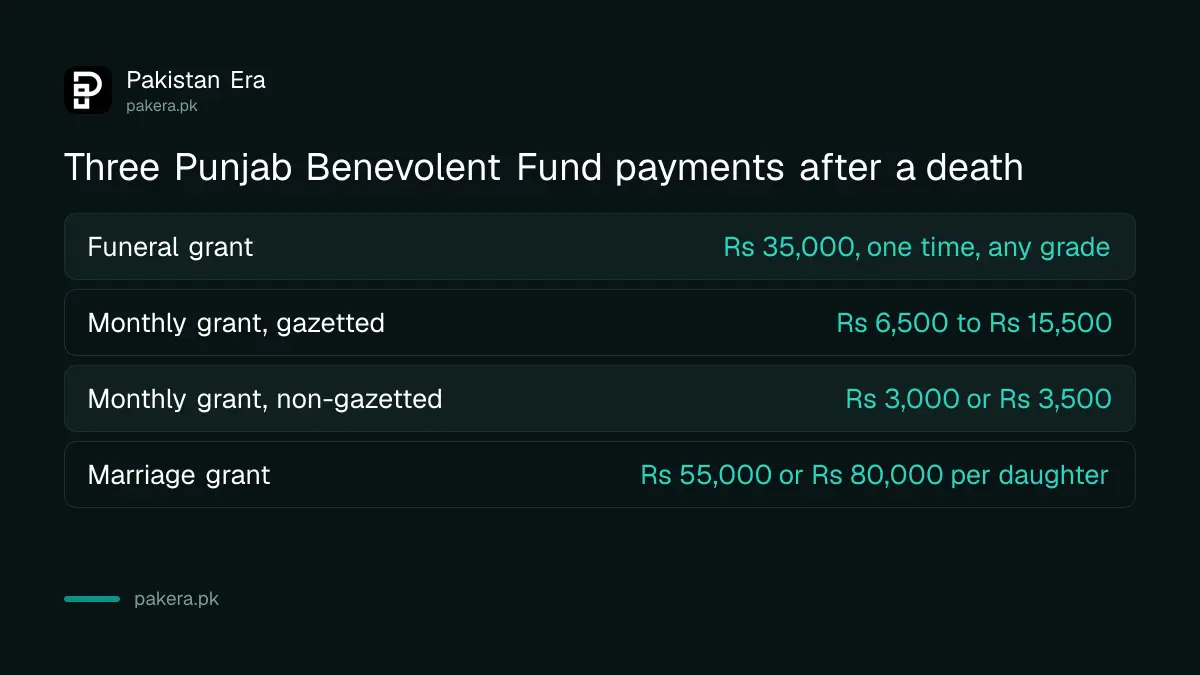
The Punjab Benevolent Fund pays three things after a death
It pays a flat Rs 35,000 funeral grant to any grade, a monthly grant that rises with the deceased's pay scale, and a marriage grant for each daughter when she marries. The funeral grant and the first monthly payment are claimed together.
| Grant | Amount | Who gets it |
|---|---|---|
| Funeral grant | Rs 35,000, one time | Same for gazetted and non-gazetted staff |
| Monthly grant, gazetted | Rs 6,500 (BS 16-17), Rs 11,500 (BS 18-19), Rs 15,500 (BS 20 and above) | Widow, for life if death was in service |
| Monthly grant, non-gazetted | Rs 3,000 (BS 1-10), Rs 3,500 (BS 11-15) | Widow, same terms |
| Marriage grant | Rs 80,000 (gazetted), Rs 55,000 (non-gazetted) | Each daughter, once |
None of this is a pension. A pension is a separate payment worked out by the Accountant General, and a government pension case follows its own set of papers and a different office entirely. The Benevolent Fund grant comes on top of that, not instead of it.
The monthly grant depends on when the death happened
A widow of a servant who died while still serving gets the monthly grant for life, as long as she does not remarry. A widow of a servant who died after retirement gets it only for the unexpired part of fifteen years counted from the date he retired.
If a deceased servant left more than one widow, the Fund splits the monthly amount equally between them. For a daughter in place of a widow, payment runs until marriage or age twenty one, whichever comes first. A son or a brother draws it for fifteen years, or until the youngest sibling turns twenty one.
- Work out whether the death happened in service or after retirement, since the two pay on different terms.
- If the widow later dies, her minor or unmarried daughter can keep drawing the grant on the same papers, as the guardian.
- File within three years of the death, or of retirement on invalidation grounds. The Fund's own forms state this deadline on more than one page.
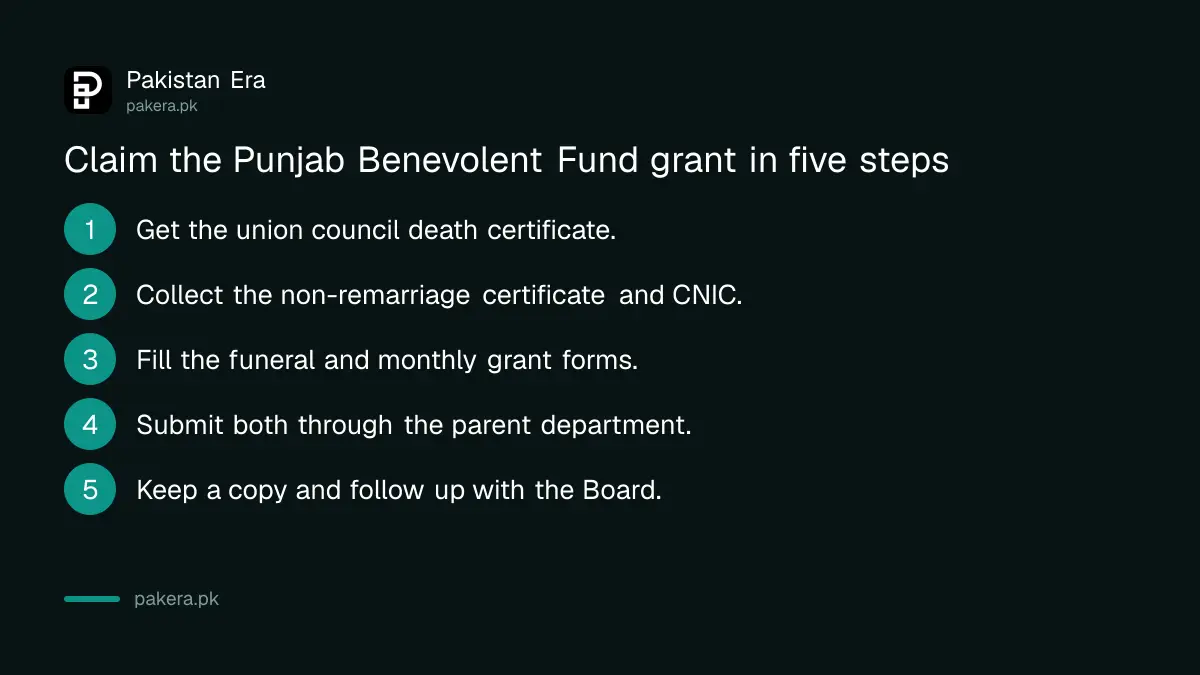
Five papers get the claim moving
The Fund's FAQ and its own forms list the same documents for the monthly grant: a non-remarriage certificate, the death certificate, the deceased's CNIC and pay slip, proof that Benevolent Fund money was actually deducted from his pay, and a list of family members.
- A death certificate from the Union Council or Town Committee where the death was registered.
- A non-remarriage certificate for the widow, attested by the Union Council Nazim.
- CNIC and a photograph of the widow or whoever is applying as guardian.
- The deceased's computerised pay slip, showing the Benevolent Fund deduction was actually made.
- A family members list, attested by the Head of Department where the deceased worked.
Get the pay slip early. Offices sometimes take a few days to pull an old payroll record, and the claim form will not move without it.
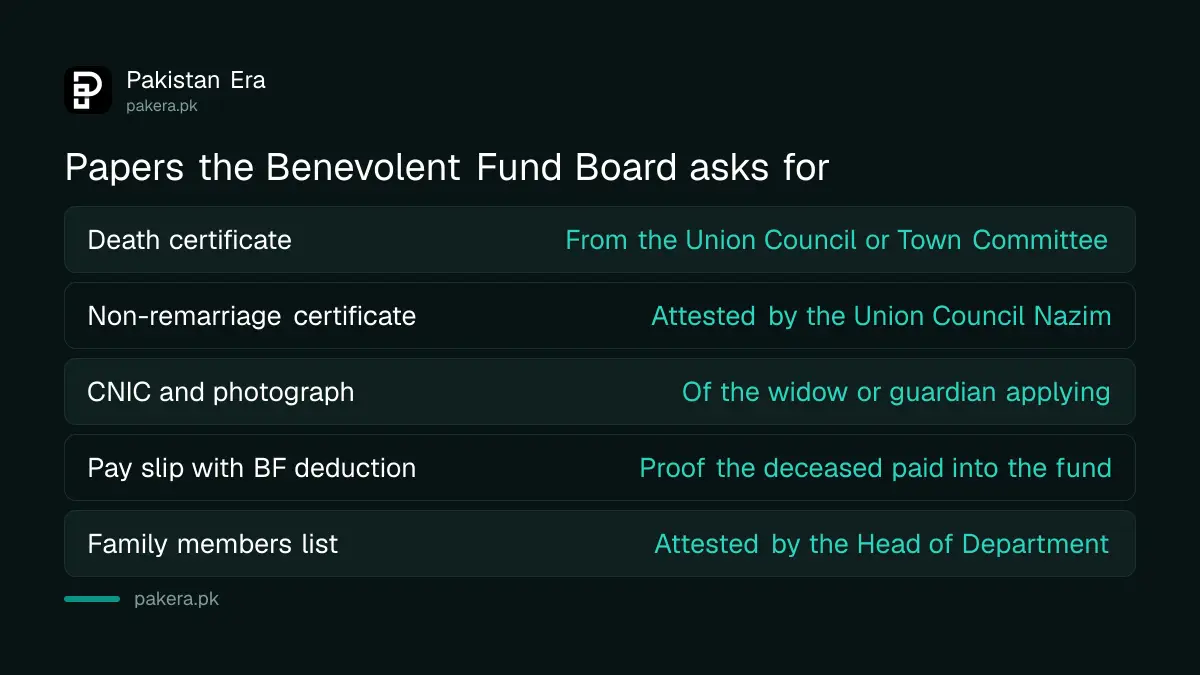
The claim goes through the parent department, not straight to the Fund
A widow does not send the form to Lahore herself. She hands it, with the documents, to the deceased's own office, and that office forwards it to the Punjab Benevolent Fund Board with a gazetted officer's attestation on every paper.
The Fund publishes separate forms for the funeral grant, the monthly grant and the marriage grant on its Forms and Instructions page, and each one needs to be filled in completely. An incomplete form is rejected rather than sent back for correction, so check every field before it leaves the department.
Once the papers reach the Board, the case is processed centrally. The Fund's main office is at the 1st Floor, Alfalah Building, The Mall, Lahore, reachable on 042-99204035 or 042-36284877. We did not find a published processing time on the site, so budget for some weeks rather than days.
A federal employee's family claims somewhere else entirely
If the deceased worked for the federal government rather than the Government of Punjab, this Fund does not apply at all. Federal staff are covered by a separate body, the Federal Employees Benevolent and Group Insurance Funds, which pays a group insurance sum assured on top of its own monthly grant, and a family in that position should claim the federal group insurance instead.
Punjab government employees also have a separate group life insurance policy, run through State Life rather than this Fund, so a widow may end up filing in two places: the Benevolent Fund Board for the grants on this page, and State Life's Group and Pensions office for the insurance payout. Neither office processes the other's claim.
Common questions
Is the Punjab Benevolent Fund grant the same as a pension?
No. The pension comes from the Accountant General on its own schedule. The Benevolent Fund grant is a separate payment on top of it, with its own forms and its own three year deadline.
How much is the Punjab funeral grant?
Rs 35,000, the same amount whether the deceased was gazetted or non-gazetted staff. It is a one time payment, separate from the monthly grant.
Does the monthly grant stop if the widow remarries?
Yes. The Fund's own rules say the monthly grant to a widow continues only as long as she does not remarry.
Where does the widow submit the claim?
Through the deceased's own department, which attests the papers and forwards them to the Punjab Benevolent Fund Board in Lahore. The widow does not file directly with the Fund.
Can a federal government employee's widow use this fund?
No. A federal employee's family claims from the Federal Employees Benevolent and Group Insurance Funds, a separate body with its own rates and its own Form B.
What happens if the widow herself dies later?
Her minor or unmarried daughter, through a guardian, can keep drawing the monthly grant on the same set of documents.
How we verified this
What we checked, where we read it, and what we could not confirm.
Last checked on 5 October 2026. The Rs 35,000 funeral grant, the monthly grant scales from Rs 3,000 to Rs 15,500, the rules on life payment after an in-service death and the fifteen year limit after a retirement death, the marriage grant amounts, the document list, the three year filing deadline, and the Lahore office address and phone numbers are read on the Punjab Benevolent Fund's own site, pbf.punjab.gov.pk, on its monthly grant, death and funeral grant, marriage grant, FAQ and forms pages. The legal basis named on the Fund's pages is the Punjab Government Servants Benevolent Fund Disbursement Rules of 1965 and 1966. We did not find a published processing time for a claim once it reaches the Board.
About the author

Tax, Bills and Technology Writer
Ali Akhtar is a young and curious voice here at Pakistan Era. He is currently pursuing his A-Levels and has a growing interest in Pakistan’s changing industrial landscape and educational trends. Ali likes to write in a way that helps him explain and explore the world around him. His writing reflects the perspective of the new generation navigating the evolving trends of Pakistan where technology, youth innovation, and shifting opportunities are reshaping the country’s future.