How to Get Halal Certification for a Food Business in Pakistan
A food business gets halal certified by a PNAC-accredited body, not by applying to a ministry. See the standards, the steps and the new federal authority.
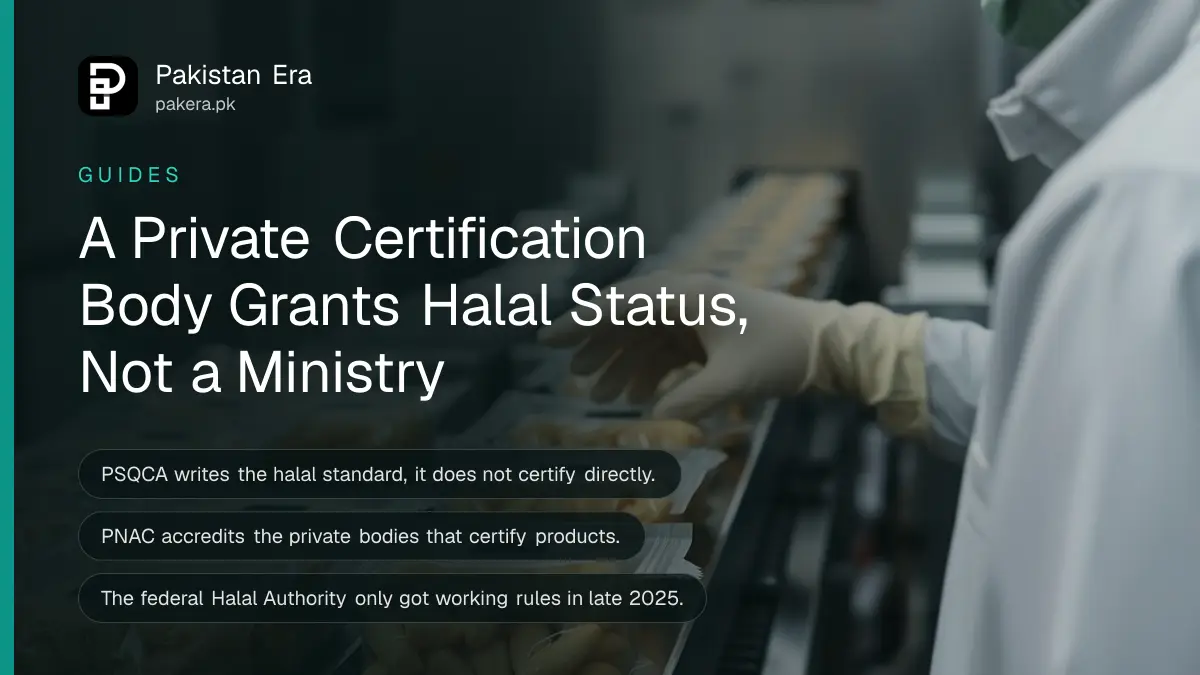
No single government office hands out halal certificates in Pakistan. A food business gets certified by a private body that the state has accredited for the job, working to a standard the state has written.
That three-layer structure trips up most business owners starting halal certification in Pakistan, because the intuitive move is to call a ministry and ask for a form. There isn't one, and calling the wrong office wastes weeks.
We checked PSQCA's own Halal Division pages and PNAC's own accreditation listing on 5 October 2026, and read a state news agency report on the federal Halal Authority's current standing.
Three bodies share the job, and none of them does all of it alone
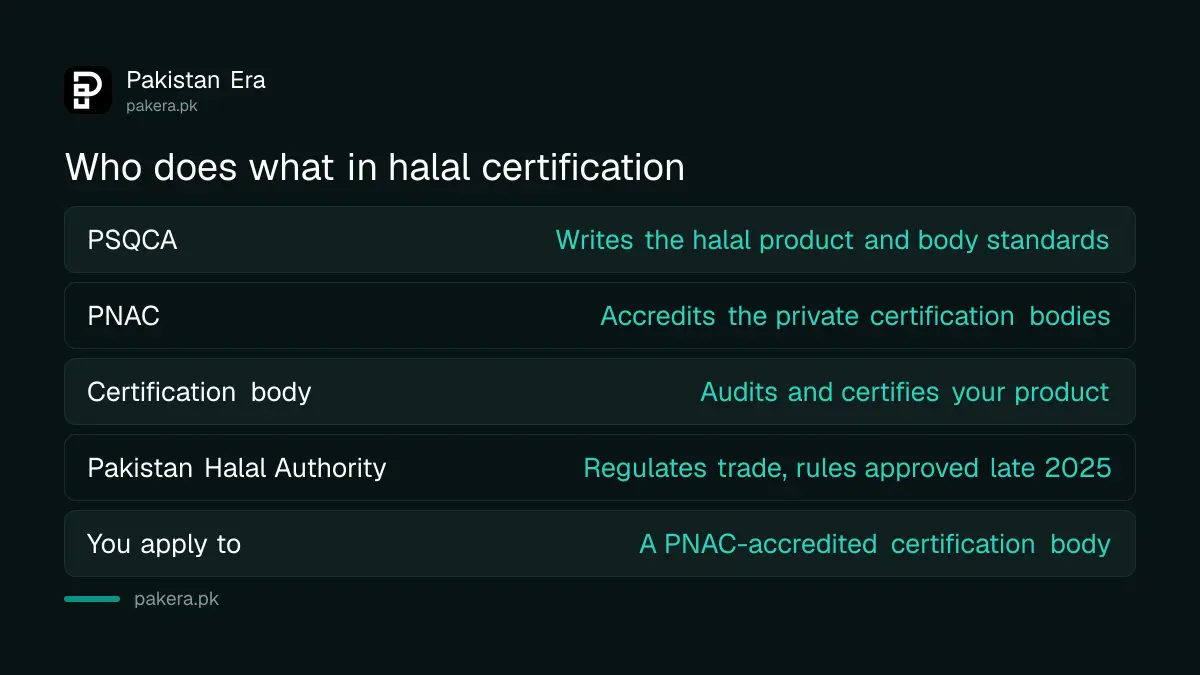
Think of it as a chain rather than a single counter. One body writes the rulebook, one body checks who is allowed to apply the rulebook, and a third body actually applies it to your product.
| Body | What it actually does |
|---|---|
| PSQCA, Halal Division | Writes the halal standards, does not certify directly |
| PNAC | Accredits the private certification bodies against those standards |
| Halal Certification Body | Audits your product and issues the certificate |
| Pakistan Halal Authority | Federal regulator, rules only approved in December 2025 |
PSQCA's Halal Division, set up in 2016, maintains Pakistan Standard PS:3733 for halal food generally and PS:4992 for the bodies that certify it. A business applies to the certification body, not to PSQCA, and definitely not to PNAC.
PSQCA sets the standard your product is measured against
PS:3733 covers what counts as halal food in Pakistan: ingredient sourcing, slaughter method where meat is involved, cross-contamination controls, and traceability through the supply chain. Your certification body audits against this standard, so it pays to read it before you apply rather than after an audit flags a gap.
Pharmaceuticals, cosmetics and a few other sectors have their own halal standards under the same division, so a food manufacturer and a cosmetics brand are not reading the same document.
PNAC decides which certification bodies are credible
PNAC, the Pakistan National Accreditation Council, does not certify your product. It accredits the certification bodies themselves against PS:4992, which sets out how a credible certifier must operate: its competence, its auditing procedure, its independence from the businesses it certifies.
Named accredited bodies include SANHA Halal Associates Pakistan, based in Karachi, and Minhaj Halal Certification, based in Lahore, among others PNAC lists on its own accreditation page. Pick from that list rather than a certifier that simply advertises the word halal on its own letterhead.
Here is the actual sequence a business follows
- Pick a PNAC-accredited halal certification body from its published list.
- Submit your product formulation, ingredient sources and supplier declarations.
- Host the certification body's audit of your production site.
- Close out any non-conformity the audit raises, with evidence.
- Receive the certificate, then renew it before it lapses.
Before any of that, your business needs the ordinary paperwork of operating legally. A food manufacturer usually registers as a private limited company, covered in our guide to setting up a company with SECP, alongside tax registration in our guide to FBR sales tax registration and, depending on your setup, the local council trade license. A certifier is unlikely to take an unregistered business seriously.
The federal Halal Authority exists on paper longer than it has worked
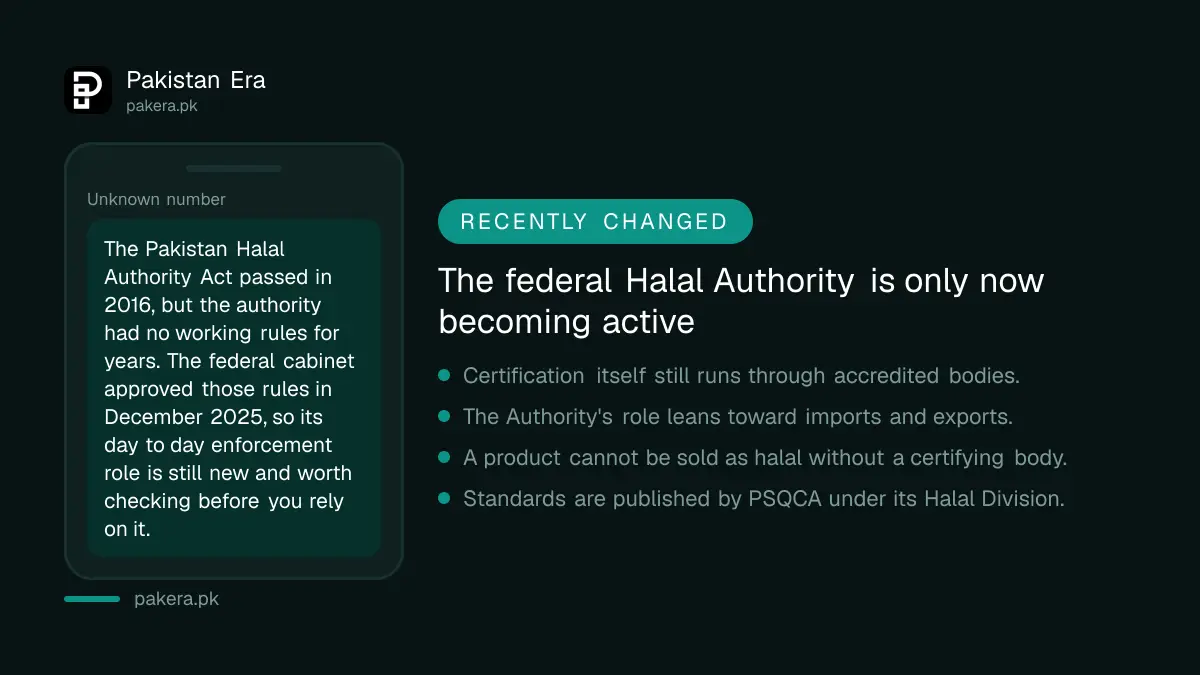
The Pakistan Halal Authority Act passed in 2016 under the Ministry of Science and Technology, with a mandate to promote trade in halal articles and to require that no transaction happens without certification by an accredited body. For years after that, the Authority had no rules of business, no service rules and effectively no staff to act on that mandate.
The federal cabinet approved those long-pending rules in December 2025, which is recent enough that the Authority's day to day enforcement presence is still settling in. Certification itself, in the meantime, continued to run through the PNAC-accredited bodies described above, so a business applying today still follows that route rather than waiting on the Authority directly.
Exporters face an extra layer the domestic market does not
If your halal product is headed abroad, the importing country may run its own recognition list of acceptable certifiers, separate from Pakistan's domestic accreditation. A certificate valid for sale inside Pakistan is not automatically accepted at a foreign port.
Check the destination market's own import requirements for halal goods before you commit to a certification body, because switching certifiers after the fact means a second audit and a second cost.
What this does not cover
We have not read a current, published fee schedule or processing timeline from any certification body, since these vary by product category and company size and are not fixed by the regulations we read. Ask the certification body you choose for its own quotation rather than relying on a figure you see elsewhere.
Common questions
Which government body issues halal certificates in Pakistan?
None directly. A PNAC-accredited private Halal Certification Body issues the certificate, working to a standard PSQCA writes.
Does PSQCA certify my product itself?
No. PSQCA's Halal Division writes the standards, PS:3733 for products and PS:4992 for certifying bodies, but it does not audit or certify businesses directly.
What does PNAC do in this process?
PNAC accredits the private certification bodies, confirming they are competent and independent, so a business should choose a certifier from PNAC's own list.
Is the Pakistan Halal Authority who I apply to?
No, not for day to day certification. It is the federal regulator, and its own working rules were only approved by the cabinet in December 2025.
Does PCSIR issue halal certificates?
No. PCSIR provides halal testing and laboratory support, based on its own published activities, rather than issuing certificates itself.
Is a Pakistani halal certificate valid for export automatically?
Not necessarily. Many importing countries keep their own recognition list of acceptable certifiers, so check the destination market before you choose one.
How we verified this
What we checked, where we read it, and what we could not confirm.
Last checked 5 October 2026. We read PSQCA's Halal Division overview at psqca.com.pk, confirming the division's 2016 establishment and its PS:3733 and PS:4992 standards and their respective scope. We read PNAC's halal certification body listing at pnac.gov.pk, confirming its accreditation role under PS:4992 and named accredited bodies including SANHA Halal Associates Pakistan and Minhaj Halal Certification. We read a report from the Associated Press of Pakistan on the Pakistan Halal Authority's mandate and the requirement that certification by an accredited body is needed before a halal transaction, and a trade press report, cross-checked against a second trade outlet, that the federal cabinet approved the Authority's rules of business in December 2025 after years without them. PCSIR's role was checked against its own event listings and described here only as testing support. No certification fee or processing timeline is stated as fact, since none of the sources read published a current figure. Nothing on this page is legal advice.
About the author

Tax, Bills and Technology Writer
Ali Akhtar is a young and curious voice here at Pakistan Era. He is currently pursuing his A-Levels and has a growing interest in Pakistan’s changing industrial landscape and educational trends. Ali likes to write in a way that helps him explain and explore the world around him. His writing reflects the perspective of the new generation navigating the evolving trends of Pakistan where technology, youth innovation, and shifting opportunities are reshaping the country’s future.