Sales Tax Registration With FBR in Pakistan: Documents FBR Can Ask For
FBR sales tax registration needs a bank certificate, GPS-tagged premises photos and meter details on IRIS, then NADRA biometrics in 30 days.
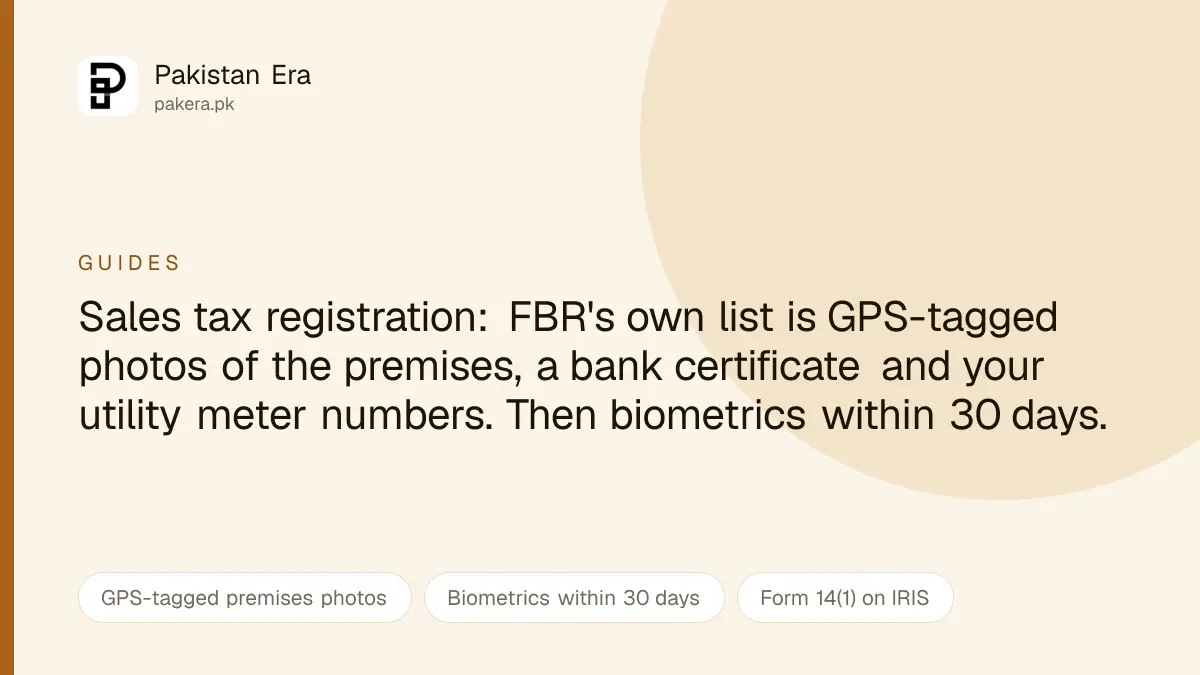
To register for sales tax with FBR in Pakistan, log in to IRIS, open Form 14(1), and attach a bank account certificate in the business name, GPS-tagged photographs of your premises, and your electricity and gas consumer numbers with meter photos. Then complete biometric verification at a NADRA e-Sahulat centre within 30 days, or your name is taken off the sales tax Active Taxpayers List.
The useful thing about it is that it is finite. Knowing what is on it tells you what is not.
| What | Detail |
|---|---|
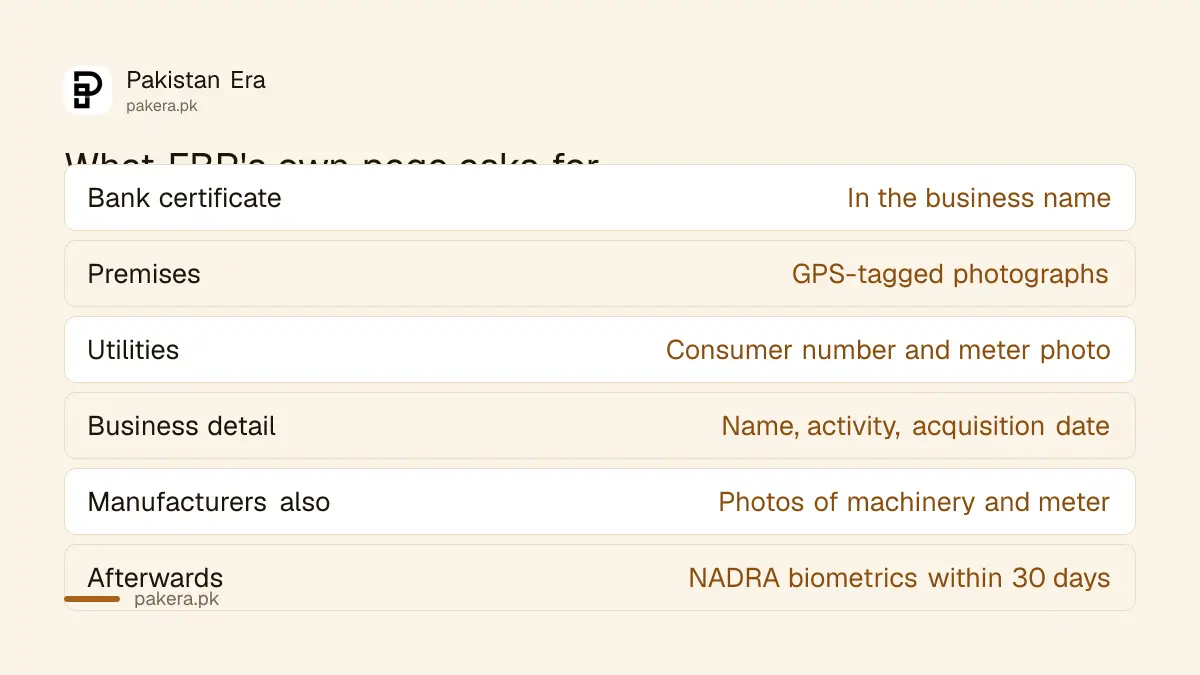
| Bank account certificate | Issued by the bank, in the name of the business |
| GPS-tagged photographs | Of the business premises |
| Utility details | Gas and electricity consumer number, plus pictures of the meter |
| Business details | Name, acquisition date, capacity and business activity |
| Registration type | Manufacturer or non-manufacturer |
| AOP or company | CNIC of the member, director or principal officer |
| Branches | Particulars of every branch, if you have more than one location |
| Tax period | Stated on the form |
| Manufacturers, additionally | GPS-tagged photos of machinery and the industrial electricity or gas meter |
GPS-tagged photographs are not ordinary photographs
A GPS-tagged photograph carries the location where it was taken inside the image file. FBR asks for these of the business premises, and manufacturers must also supply them of the machinery and the industrial meter.
In practice that means taking the photographs on a phone at the premises, with location services switched on, and not stripping that data out afterwards. A picture sent through some messaging apps loses it, because those apps remove location data by design.
The point of the requirement is obvious enough: it establishes that the business exists where it says it does. Which is also why a photograph taken somewhere else, or an old one from the gallery, defeats the purpose and is likely to be rejected.
The step people miss entirely
Submitting the form is not the end of it.
Biometric verification has to be completed at a NADRA e-Sahulat centre within 30 days. That is FBR's own condition on its registration page.
FBR's page also says what happens if you miss it. If you fail to visit, or the verification fails, your name is taken off the sales tax Active Taxpayers List. Your buyers then cannot rely on your invoices, so the cost lands on your sales, not just your paperwork.
Thirty days sounds generous and is the single commonest way an application dies quietly. The form goes in, the business owner assumes the process is running, and the window closes while they wait for an email.
Manufacturers have one more step. FBR may check the documents after registration through its field offices or a third party. If a document is found to be fake or wrong, the system asks for it again, and you have fifteen days to provide it or you are taken off the list.
Treat it as the second half of the same task, not as a follow-up.
The order it actually happens in
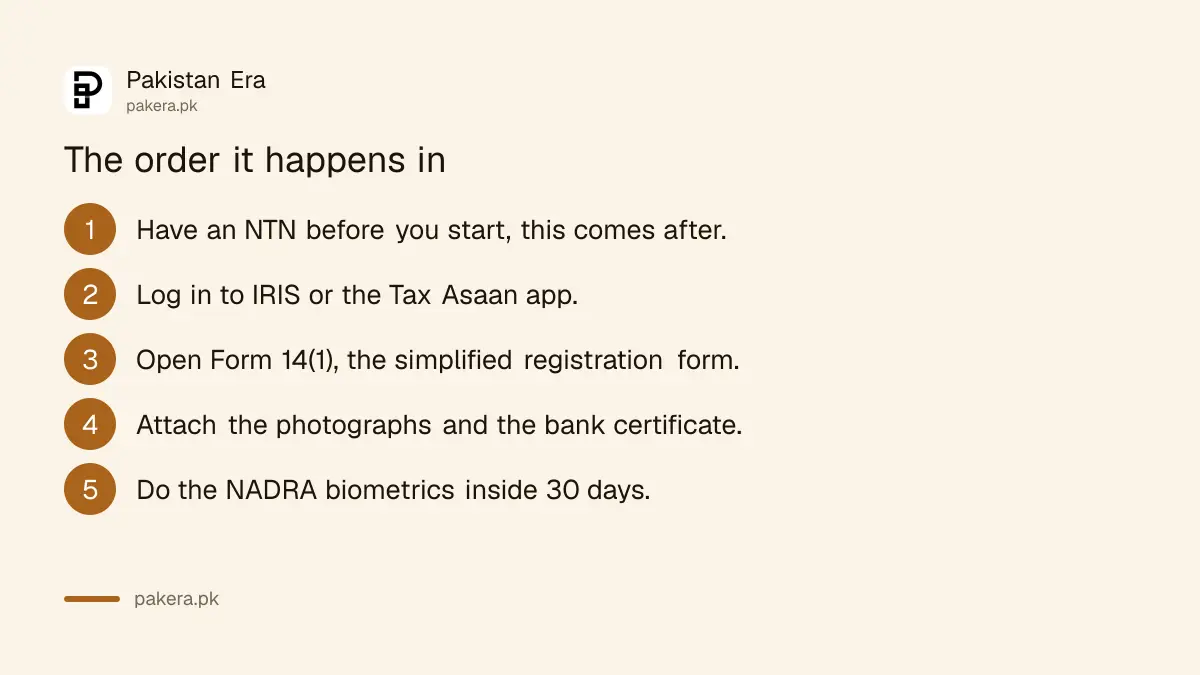
- Have an NTN first. Sales tax registration comes after income tax registration, not instead of it. If you do not have one, start with getting an NTN.
- Log in to IRIS, or use the Tax Asaan mobile application. Both are routes to the same system.
- Open Form 14(1), which FBR calls the Form of Registration filed voluntarily through Simplified, Sales Tax. That exact name matters, because there is more than one registration form.
- Attach everything, including the photographs and the bank certificate, before submitting rather than promising them later.
- Do the biometrics at a NADRA e-Sahulat centre inside 30 days.
If you are registering a business rather than adding sales tax to one, our guide to registering a sole proprietorship with FBR covers the step before this one.
If an office asks for something not on the list
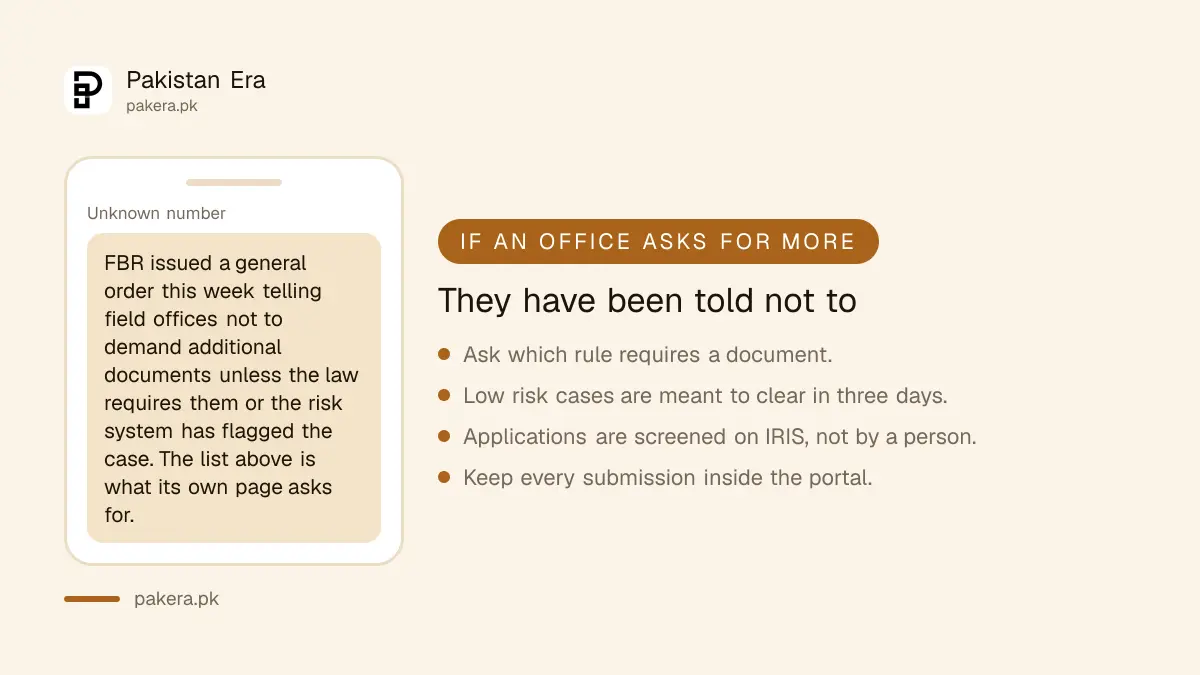
This is where the list above earns its keep.
On 24 August 2026, FBR issued Sales Tax General Order No. 20 of 2026. Under it, field formations were directed not to demand additional documents unless those documents are legally required, or the case has been flagged by the risk based system.
Two other things were announced alongside it. Applications filed through IRIS are screened by risk based checks rather than by an officer's discretion, and applicants in the low risk category are to be processed within three working days where the documents are complete. FBR also asked sectoral associations under the FPCCI to issue pre-registration certificates to their members.
The requirement list above is on FBR's own registration page. So the practical position is this. If you are asked for a document that is not on that list, the reasonable question is which rule requires it. Ask it politely, in writing, inside the portal.
Who has to register at all
FBR's page on persons to be registered lists these groups:
- All importers.
- All wholesalers, including dealers, and distributors.
- Manufacturers, unless they are a cottage industry.
- Tier-1 retailers, such as a unit of a national chain, a shop in an air-conditioned mall, or a retailer whose electricity bills in the last twelve months exceeded Rs 600,000.
- Persons who must register under a federal or provincial law for a tax collected like sales tax.
- Persons making zero-rated supplies, including exporters who want refunds.
The cottage industry limit needs care. FBR's guidance page still says a turnover of up to Rs 10 million. Section 2(5AB) of the Sales Tax Act, 1990 as updated up to 30 June 2026 says Rs 8 million, and adds three more tests: no industrial gas or electricity connection, a location in a residential area, and no more than ten workers. The Act is the law, so use Rs 8 million. Our guide to who must register for sales tax sets out section 14 in full.
A person who should register but does not can be registered compulsorily by FBR after an enquiry, under rule 6 of the Sales Tax Rules, 2006, according to the same page. There is no processing time on FBR's page. The three working days above comes from the general order, not from the standing published process.
After you are registered
A sales tax registration number changes what your invoices must look like and brings you into the POS and invoicing regime, which has its own rules and its own penalties.
It also creates a filing obligation that does not pause when business is slow. A registered person files every month, whether or not there was activity, and our guide to filing the monthly sales tax return sets out the 10th, 15th and 18th dates. Large buyers will also deduct income tax from your invoices, which our guide to tax deducted from supplier payments explains. If FBR later suspends a registration, our guide to what to do if FBR suspends or blacklists you covers it.
If you want to check whether a business you are dealing with is genuinely registered, that is a separate lookup, and we cover it in verifying an NTN online.
Questions readers are asking
What documents does FBR need for sales tax registration?
A bank account certificate in the business name, GPS-tagged photographs of the premises, gas and electricity consumer numbers with meter photos, and your business details. Manufacturers also supply photos of machinery and the industrial meter.
Which form is it on IRIS?
Form 14(1), the Form of Registration filed voluntarily through Simplified, Sales Tax. It can also be done through the Tax Asaan app.
Do I need biometrics?
Yes. At a NADRA e-Sahulat centre within 30 days of applying. Missing that window is the commonest way an application lapses.
Can an FBR office demand extra documents?
FBR's Sales Tax General Order No. 20 of 2026, issued on 24 August 2026, tells field offices not to, unless the law requires the document or the risk system has flagged the case.
How long does registration take?
Under the general order, low risk applications are to be processed within three working days. FBR's own registration page states no processing time.
What is the turnover threshold?
There is no general one. Importers, wholesalers and distributors must register at any size. A manufacturer can stay out only as a cottage industry, with turnover up to Rs 8 million under the Act and three other tests.
How we verified this
What we checked and where we read it.
We read this list on FBR's own registration procedure page on 8 November 2026.
Last checked 8 November 2026. We read the Form 14(1) requirement list, the 30 day NADRA biometric condition and its consequence, and the manufacturer post verification rule on FBR's procedure of registration page, the list of persons to be registered on FBR's register for sales tax page, and the cottage industry definition in section 2(5AB) of the Sales Tax Act, 1990 updated up to 30 June 2026. Nothing here is tax advice.
About the author

Senior Writer, Public Services and Technology
Shahid joined us in 2024 as an author. He is a senior contributor to Pakistan's leading technology websites. He writes detailed articles, mostly covering his expertise in the latest tech, mobiles, apps, gadgets, and step-by-step guides. His ideology is to help people understand the latest trends and explain complex methods through very easy-to-understand guides.