How to Inspect a Used Car Before Buying It in Pakistan
Inspecting a used car in Pakistan: match the chassis number, verify it on your province's portal, and get a mechanic to check for accident or flood damage.
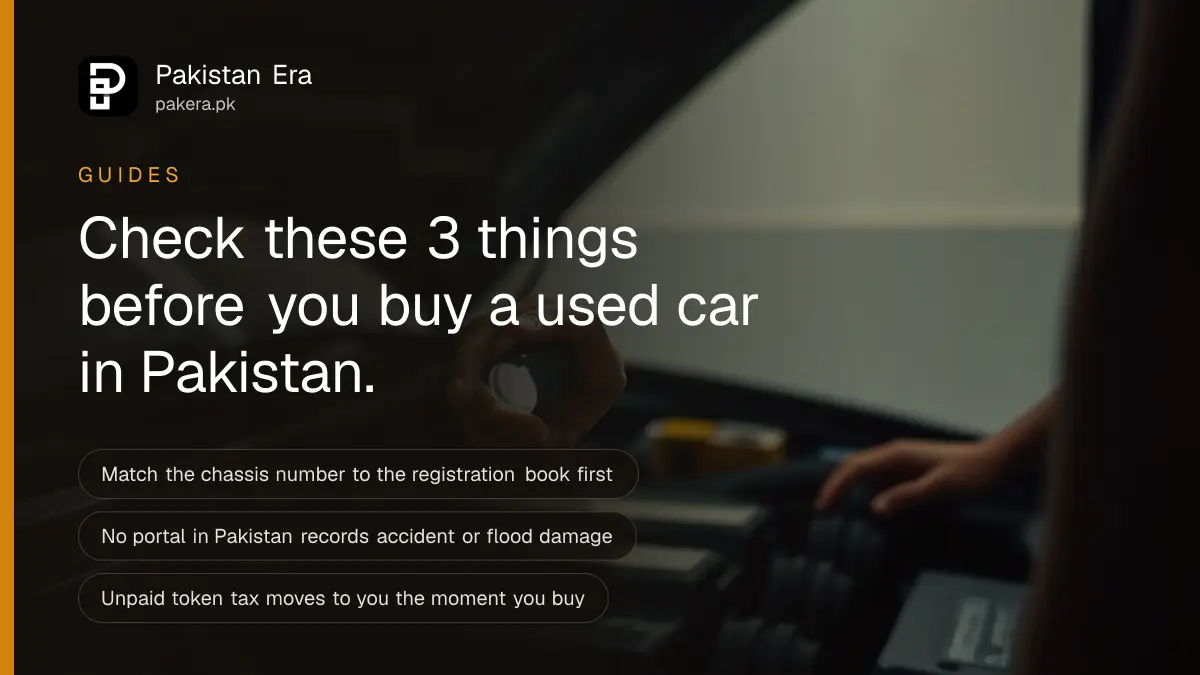
Before you buy a used car in Pakistan, match the chassis and engine numbers stamped on the car against the registration book, check the vehicle's record on your province's online verification portal, and have a mechanic inspect it on a ramp for accident or flood damage. A seller's word covers none of these three checks; only the metal, the government record and a workshop do.
Most buyers do one of these three and skip the other two. That is how a flood car with a clean-looking book ends up parked outside a house in Lahore six months later, rusting from the inside. We pulled apart what each check actually catches, and what it never will, because no single check in Pakistan covers all of it.
Three checks catch three different problems
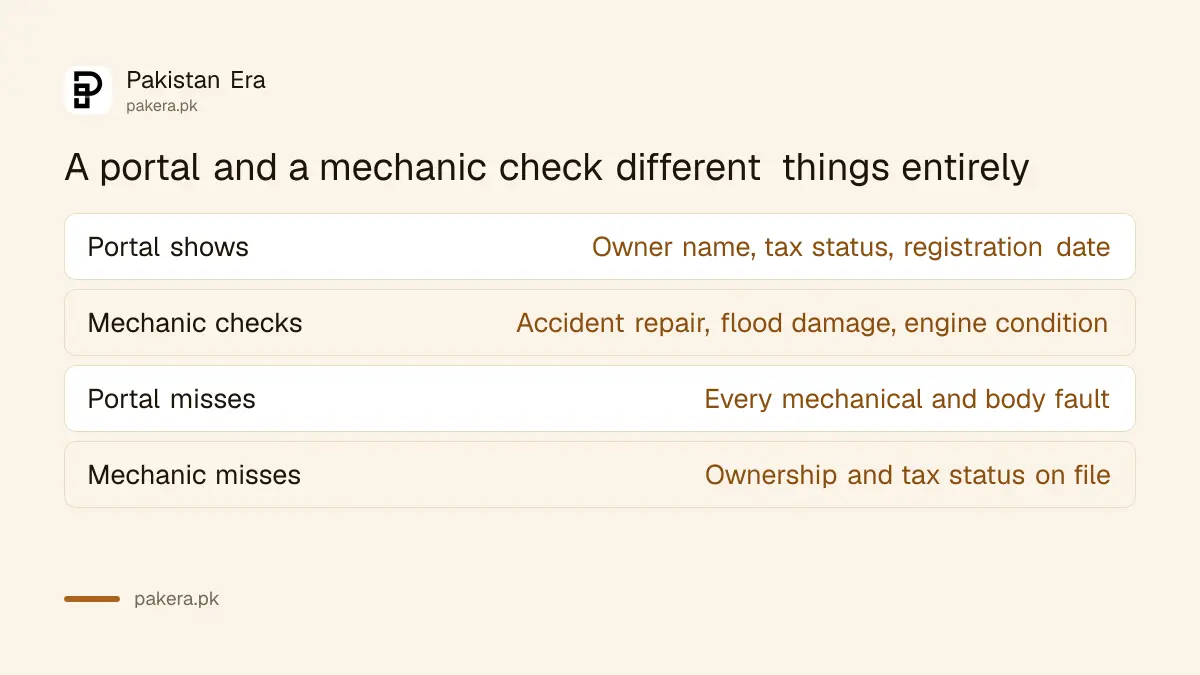
A government portal confirms who owns the car and whether its tax is paid. A chassis number match confirms the car in front of you is the car on paper. A mechanic's inspection catches damage nobody writes down anywhere. Skip one and you are blind to whatever only it would have shown.
Sellers rely on buyers doing just one. A smooth-talking seller who waves a clean registration book at you has told you nothing about the gearbox or whether the car sat in floodwater for three days.
Match the chassis and engine numbers to the registration book yourself
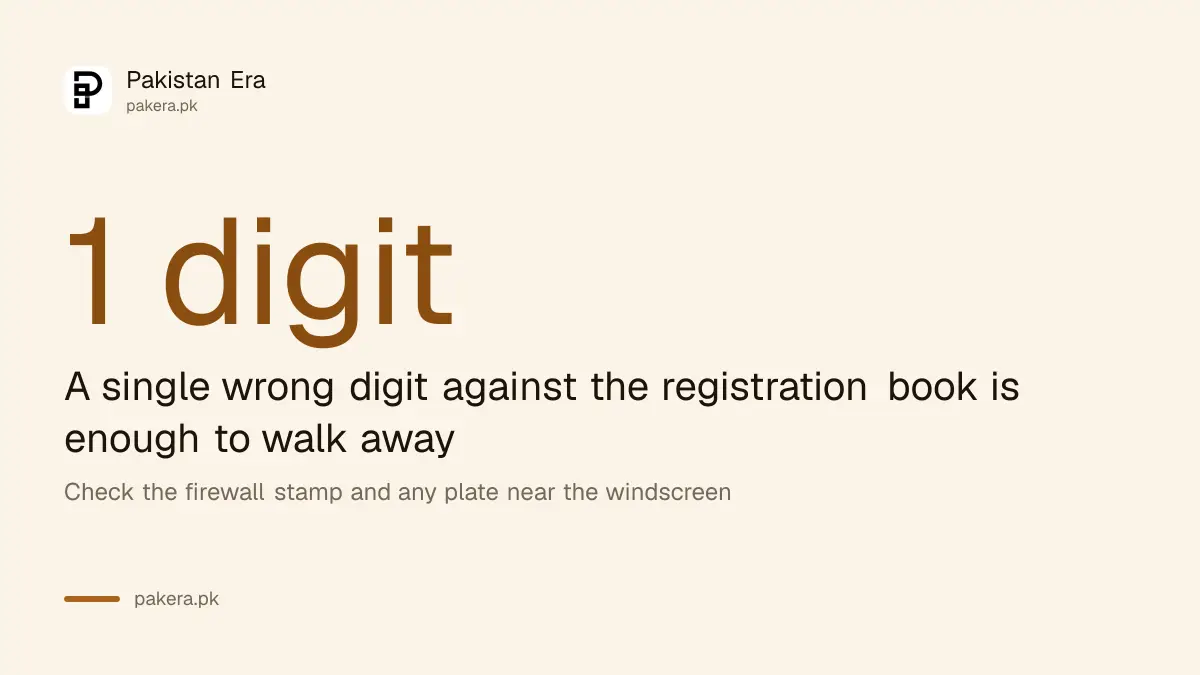
Every car has its chassis number stamped into the body, usually on the engine bay firewall, and sometimes repeated on a plate near the windscreen. The engine number sits stamped on the engine block itself. Both numbers are printed in the registration book.
Stand at the car and read the stamped numbers character by character against the book. A single digit out is not a typo; a mismatched chassis number is the single clearest sign of a car built from two wrecks welded together, known locally as a "cut and paste" car, or one running on a cloned or fake book altogether.
- Chassis number on the firewall inside the engine bay, and often again on a small metal plate.
- Engine number stamped directly on the engine block, usually near the gearbox mount.
- Look for grinding or re-stamping marks around either number. Factory stamping is even and uniform; a re-stamped number looks shallower or crooked under a torch light.
If either number does not match the book, or looks tampered with, stop there. No price discount makes that car worth buying.
Run the registration number through your province's verification portal
Once the numbers on the car match the book, confirm the book itself matches government records. Punjab, Sindh, Khyber Pakhtunkhwa and Islamabad each run an excise and taxation portal where you enter the registration number and get back the registered owner's name, the make and model, and the token tax status on file.
A mismatch here is not always fraud. An unregistered transfer, where the previous owner never formally moved the car into your seller's name, shows up as the registered owner being someone other than who is selling you the car. Ask why before you pay, and insist the transfer chain is sorted before registration moves to you, not after.
We tested every provincial portal separately and found which ones actually load and which widely shared addresses are dead; that working portal for each province is worth opening before you go to see the car, not after you have already paid a token amount.
| What a portal shows | What a mechanic checks instead |
|---|---|
| Registered owner's name | Suspension, steering and brake condition |
| Make, model and registration date | Accident repair or repainting on body panels |
| Token tax paid or outstanding | Flood or water damage inside the cabin and electronics |
| Engine and chassis number on file | Engine compression and oil condition |
| Theft or legal hold flags, where listed | Whether airbags have deployed and been swapped |
No government portal checks for accident or flood damage
This is the gap that catches people. None of the provincial excise portals record whether a car was ever in an accident or sat in floodwater. That information lives nowhere official in Pakistan; it only shows up in the metal itself, under paint, under carpet, and inside the electronics.
A flood car dries out, gets a fresh interior and a good detailing job, and looks better than a genuine low-mileage car to an untrained eye. The only real defence is a paid inspection at an independent workshop, not the seller's own mechanic, before you commit any money.
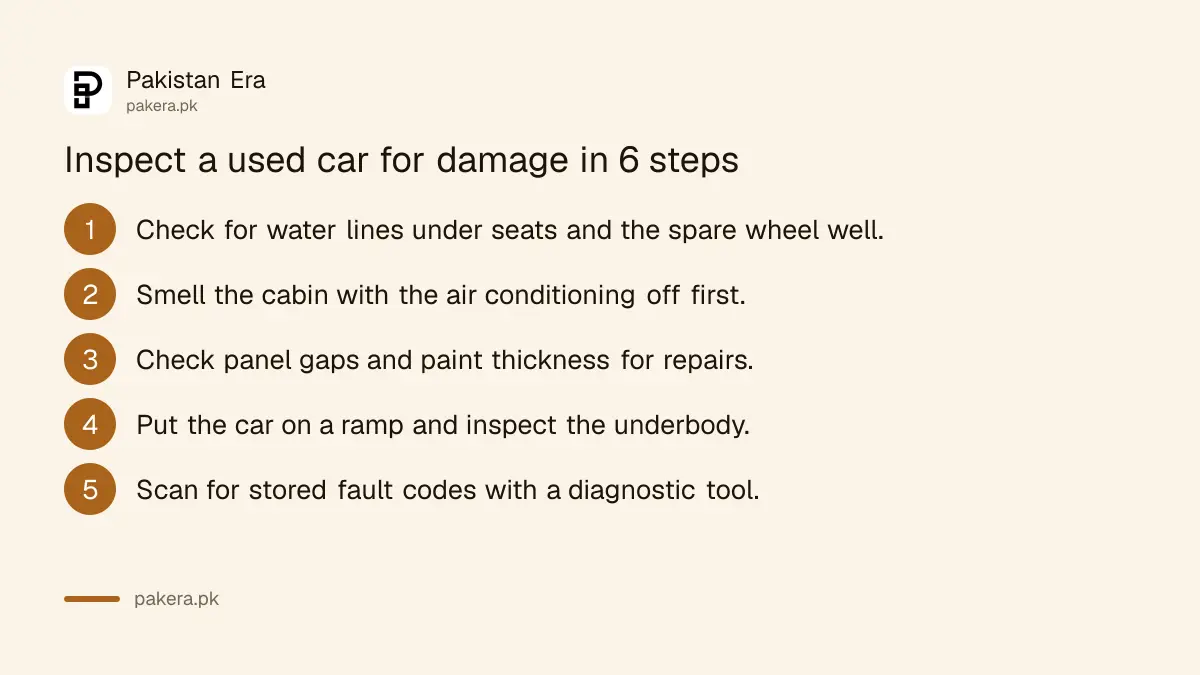
- Check for water lines under the seats, inside the glove box hinges and under the spare wheel well, where a wash cannot reach but floodwater pools.
- Smell the cabin with the air conditioning off and windows shut for a minute first. A musty, damp smell under heavy air freshener is a flag, not a coincidence.
- Check panel gaps and paint thickness with a paint depth gauge if the workshop has one. Uneven gaps or thick paint on one panel only points to a repaint after a dent or a collision.
- Put it on a ramp and look at the underbody for fresh welding, uneven rust, or a chassis rail that looks straightened rather than factory-pressed.
- Scan for stored fault codes with a diagnostic tool, since a cleared dashboard warning light does not mean the fault is gone.
- Take it on a real test drive, not around the block, including a stretch fast enough to feel steering pull or a vibration that only shows up above city speed.
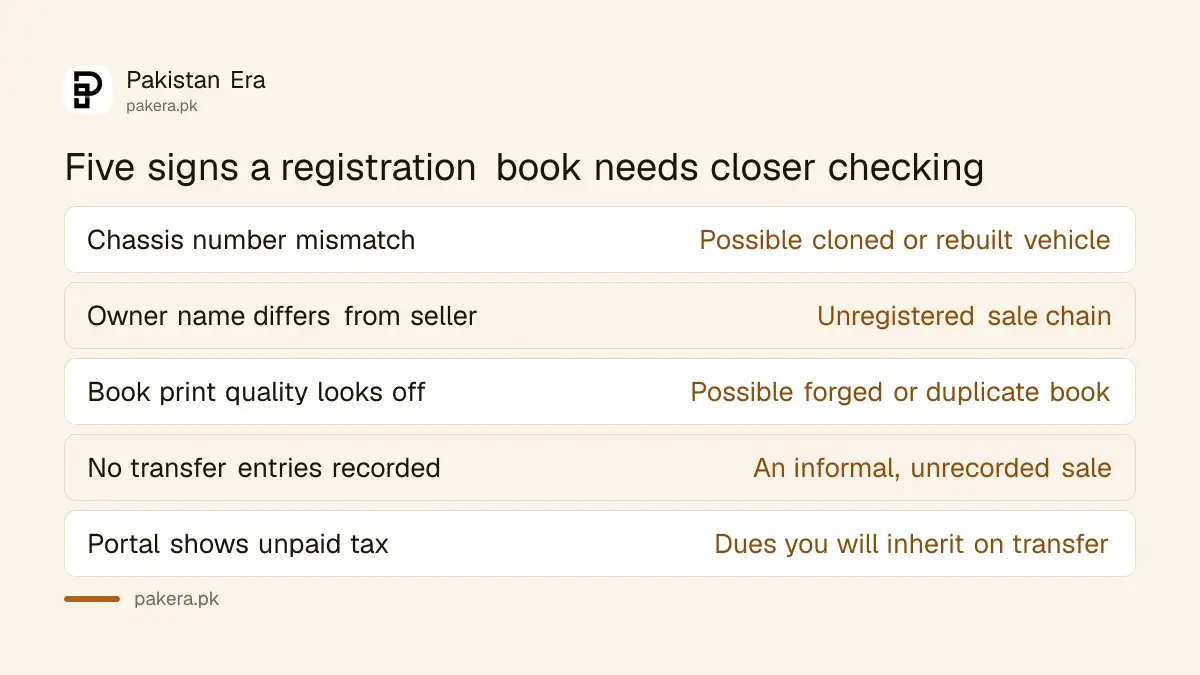
A genuine registration book has specific, checkable features
A book that is photocopied, laminated differently from the original, or missing the transfer history pages is worth more suspicion than most buyers give it. Compare it against a friend's genuine book from the same province if you have one handy, since formatting changes between provinces and over the years.
| Sign | What it usually means |
|---|---|
| Chassis or engine number does not match the car | Possible cloned book, rebuilt car, or two vehicles merged into one |
| Owner name on the book differs from the seller | An unregistered sale chain; insist it is fixed before you pay |
| Book paper or print quality looks different from a known original | Possible duplicate or forged book; verify at the excise office directly |
| No transfer entries despite the seller saying it changed hands before | An informal transfer that was never recorded |
| Token tax portal shows dues the seller says are paid | Outstanding tax or challans you will inherit on transfer |
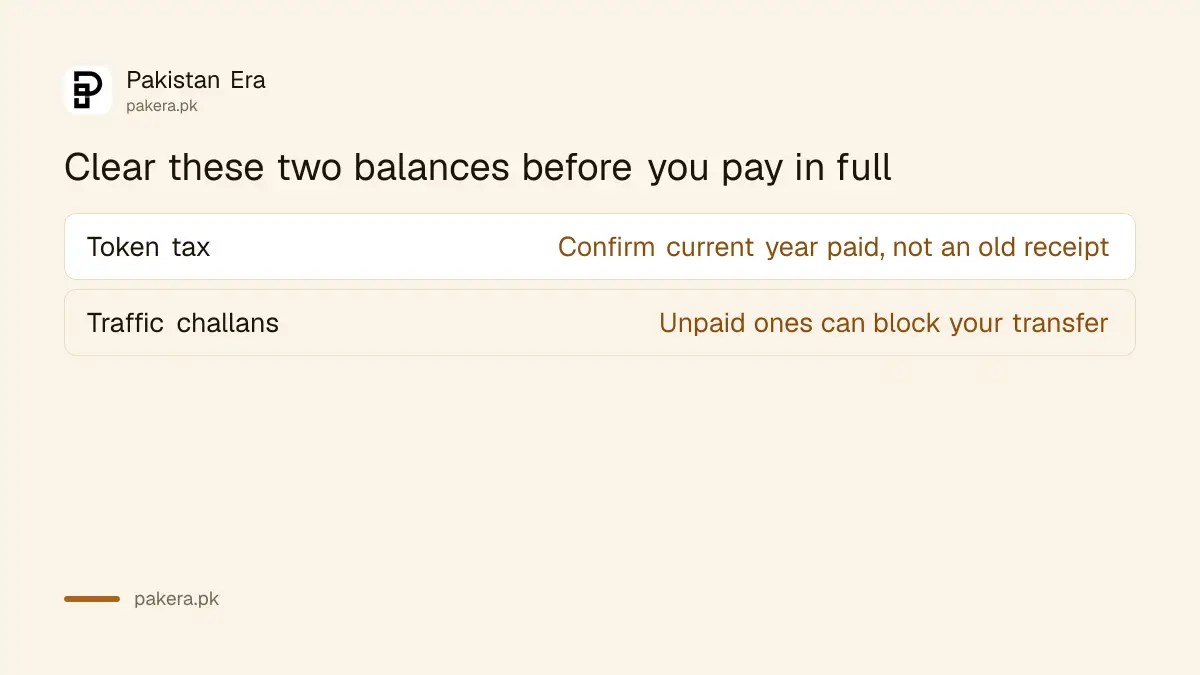
Clear the outstanding tax and challans before you pay the full price
Token tax and traffic challans attach to the vehicle, not the person who incurred them. Buy a car with unpaid dues and you inherit them the moment the registration moves to your name, even though you never drove it with that history.
Check both before finalising the price, not after. If the seller insists the token tax is current, confirm it yourself rather than taking the receipt at face value, since a receipt from two years ago is not the same as paid for this year. The same applies to traffic challans; unpaid ones can block your ownership transfer until they are cleared.
Clearing outstanding dues before transfer is simpler than fighting about them afterward. Most provinces now let you pay token tax online rather than at a counter, and you can run the registration number through an online challan check covering every province before you commit to buying.
Common questions
What is the first thing to check on a used car in Pakistan?
The chassis number stamped in the engine bay, read against the registration book character by character. A mismatch there is the clearest sign of a tampered or cloned vehicle.
Can I check accident or flood damage online?
No. No government portal in Pakistan records accident or flood history. That only shows up on a physical inspection by an independent mechanic, not the seller's own workshop.
How do I know if a car's registration book is genuine?
Match the chassis and engine numbers on the book against the car itself, and run the registration number through your province's online verification portal to confirm the owner and vehicle details on file.
Who pays outstanding token tax on a used car, the buyer or the seller?
Whoever holds the registration when it falls due. Dues attach to the vehicle, so an unpaid balance passes to you once the transfer completes, regardless of who drove the car when it built up.
Should I use the seller's recommended mechanic for the inspection?
No. Pay for an independent inspection at a workshop you chose, not one the seller suggested, since a mechanic who works with the seller has no reason to flag a problem that could kill the sale.
Does a clean dashboard with no warning lights mean the car has no faults?
Not necessarily. Fault codes can be cleared without fixing the underlying problem. A diagnostic scan reads stored codes that a cleared dashboard will not show.
How we verified this
What we checked, where we read it, and what we could not confirm.
Last checked 5 October 2026. Provincial vehicle verification portals were tested and reported separately; see that article for which ones load today. No provincial excise department publishes an accident or flood damage record for individual vehicles, confirmed by searching each department's own site for such a feature; this is reported as an absence, not asserted beyond what we could confirm was missing. The mechanical inspection points reflect standard workshop practice and are not tied to a specific official source, since no government body publishes a used-car inspection checklist for buyers.
About the author

Tax, Bills and Technology Writer
Ali Akhtar is a young and curious voice here at Pakistan Era. He is currently pursuing his A-Levels and has a growing interest in Pakistan’s changing industrial landscape and educational trends. Ali likes to write in a way that helps him explain and explore the world around him. His writing reflects the perspective of the new generation navigating the evolving trends of Pakistan where technology, youth innovation, and shifting opportunities are reshaping the country’s future.