Probation Period Rights for Employees in Pakistan
Pakistani labour law caps a worker's probation at three months under the Standing Orders. See confirmation rights and notice rules for the probation period.
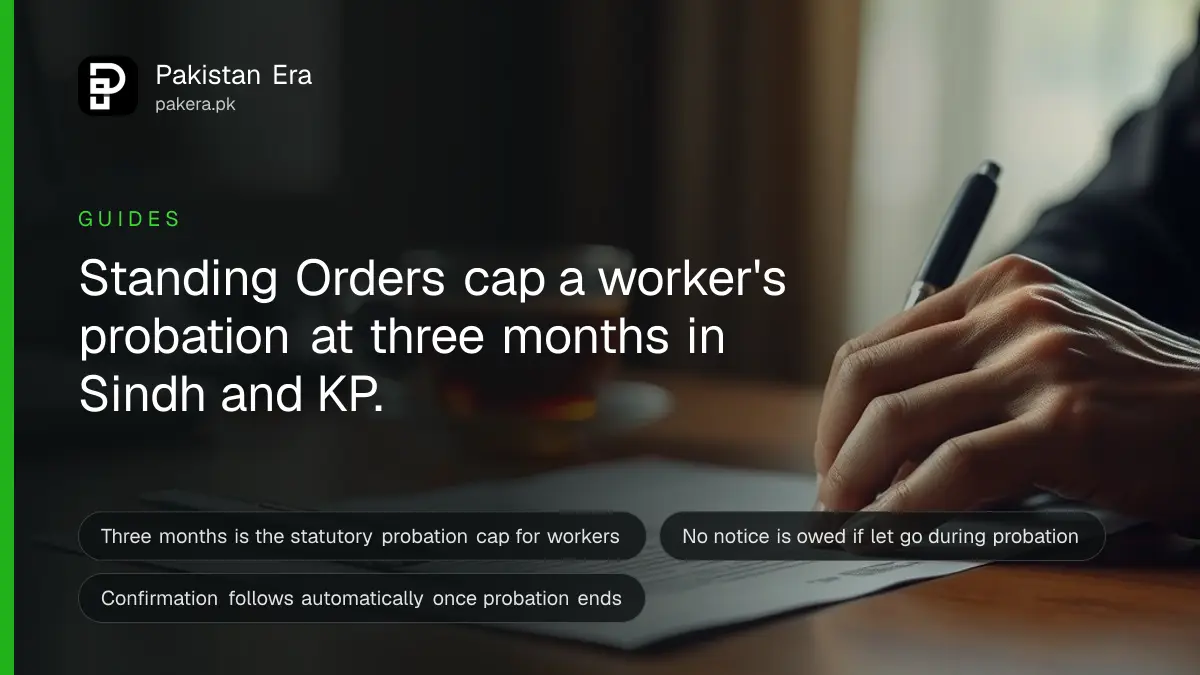
For most workers in Pakistan, probation cannot legally run longer than three months under the Standing Orders laws, and neither side owes the other notice if the job ends during that window. Once you pass three months and keep working, the law treats you as a permanent worker, whether or not anyone hands you a confirmation letter.
A lot of appointment letters in Pakistan quietly stretch probation to six months, sometimes longer, and new hires rarely push back. That is understandable. Nobody wants to start a job by arguing with HR. But probation period rights Pakistan law actually grants are narrower and clearer than most offer letters suggest, and knowing them changes how you read your own paperwork.
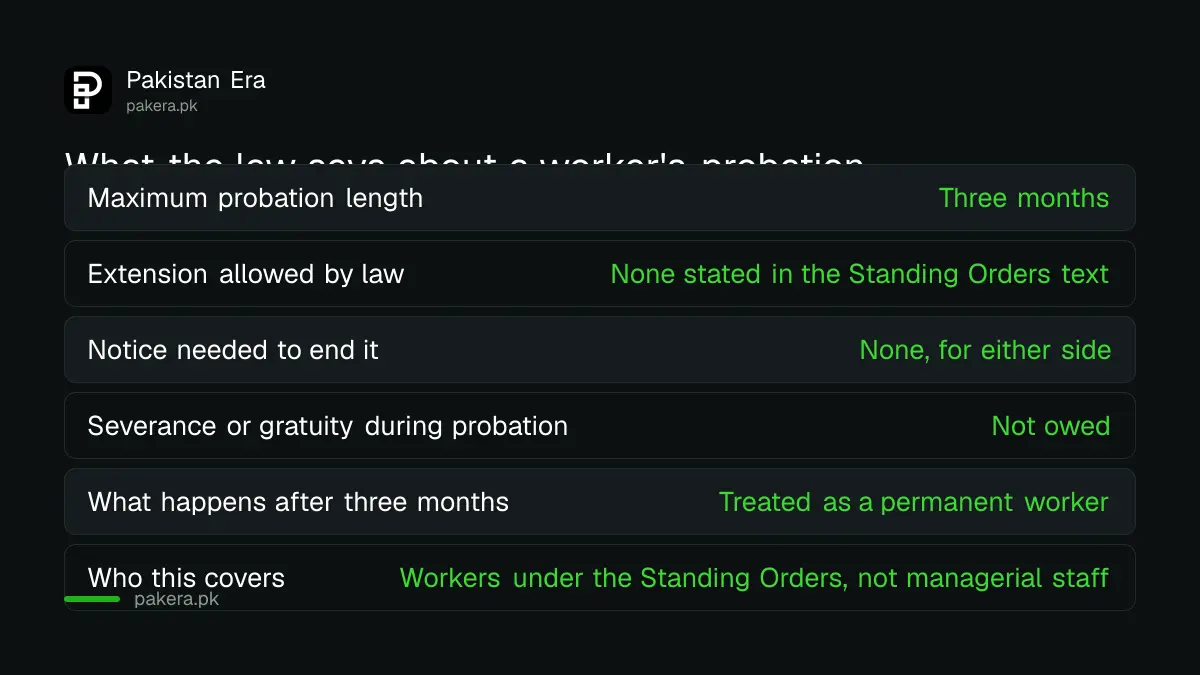
We read the primary legislation directly for this guide rather than repeat what HR blogs say about it. The Sindh Terms of Employment (Standing Orders) Act 2015 and the Khyber Pakhtunkhwa Industrial and Commercial Employment (Standing Orders) Act 2013 use near-identical wording, and the older Industrial and Commercial Employment (Standing Orders) Ordinance 1968, which still governs Punjab, Balochistan and Islamabad Capital Territory, says the same thing again.
Three months is the legal cap on probation for a worker under the Standing Orders
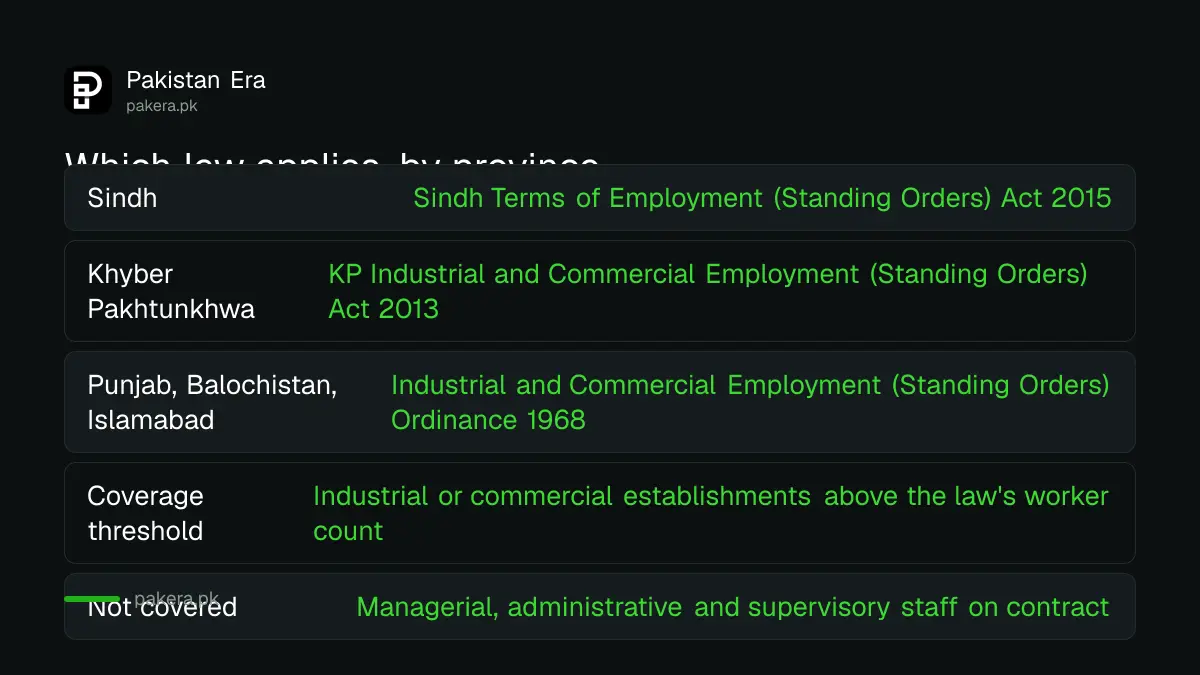
A probationer, under every version of the Standing Orders we checked, is a worker who has not yet completed three months in the permanent post they were hired to fill. Once that period passes and the work has been satisfactory, the law calls them a permanent worker.
None of the three texts we read gives the employer a right to extend that three months. That surprised us, since a widely repeated figure online claims Punjab allows six months, extendable to a year. We could not trace that claim to any legislative text, and it contradicts every primary source we did verify, so we are not printing it as fact.
Which law applies depends on where you work, not just the country
Labour law in Pakistan split along provincial lines after the 18th Amendment, and the Standing Orders followed. Sindh runs on its own 2015 Act, Khyber Pakhtunkhwa on its 2013 Act, and Punjab, Balochistan and Islamabad Capital Territory on the original 1968 Ordinance, since neither has replaced it with a provincial law of its own.
That matters because a worker in Lahore and a worker in Karachi are, in practice, reading different statutes, even though both land on the same three-month figure right now. If a provincial assembly amends its own Act later, the figures could diverge, and a worker should check the Act that actually covers their establishment rather than assume the others match forever.
Neither side owes notice or severance if a probationer is let go
This is the part that catches people off guard. Under the Standing Orders, a probationer, like a temporary worker, badli or contract worker, is not entitled to any notice if the employer ends the job, and does not have to give notice either if they leave on their own.
Compare that with what happens once someone is confirmed. A permanent worker's termination carries a real process, a written order stating the reason and notice or pay in lieu, which we cover in full in the guide to the rules when a job in Pakistan ends. Probation sits outside that protection entirely. It is the trade-off for a position that has not yet become permanent.
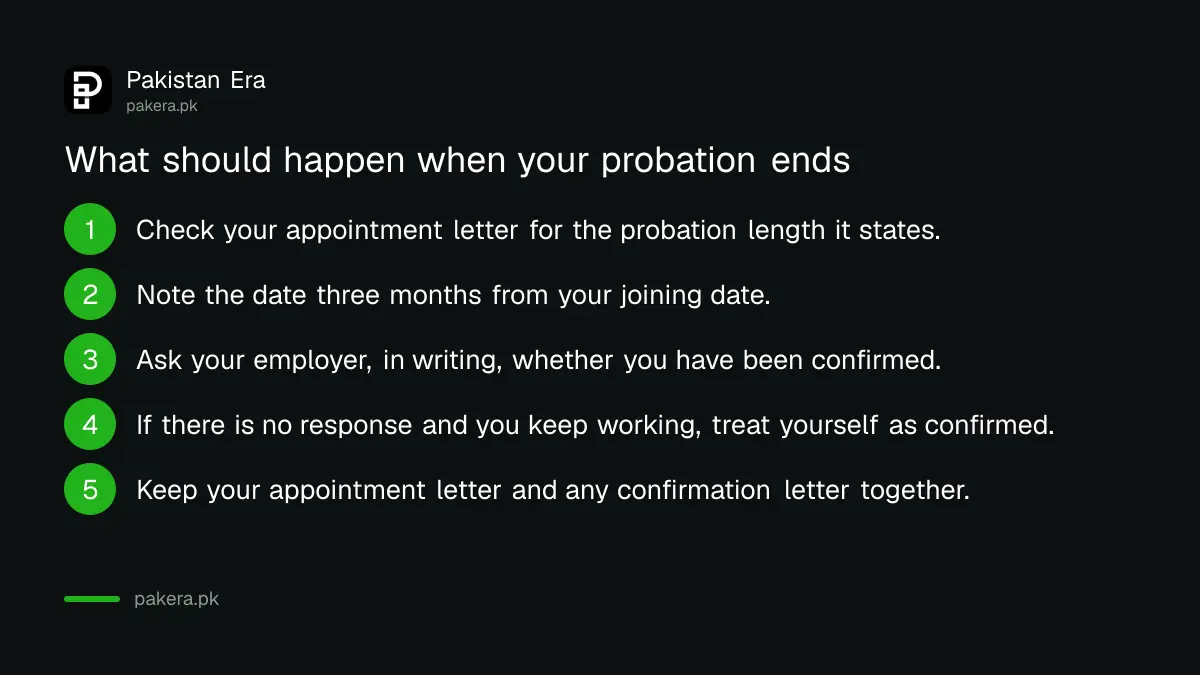
- Check your appointment letter for the exact probation length it states.
- Mark the date three months from your joining date on a calendar.
- If nothing is said or signed by that date and you are still working, you are effectively confirmed.
- Ask HR in writing for confirmation if you want it on paper for your own record.
- Keep every letter from the job, appointment and confirmation together, in case you ever need them.
Confirmation follows automatically once probation is satisfactorily completed
None of the texts we read require a separate ceremony, letter or sign-off to make a worker permanent. The definition of a permanent worker is simply someone who has completed three months of probation satisfactorily. Continued employment past that date is, in effect, the confirmation.
That does not mean a confirmation letter is worthless. It gives you a dated document that removes any argument later about whether you were still on probation when a dispute arose. Ask for one. Just do not assume you remain a probationer forever because nobody ever gave you the letter.
| Stage | Notice owed | Written order required to end it |
|---|---|---|
| During probation | None, either side | Not required under the Standing Orders |
| After confirmation | One month, or pay in lieu | Yes, stating the reason |
The three-month rule protects workers, and the law draws that line narrowly
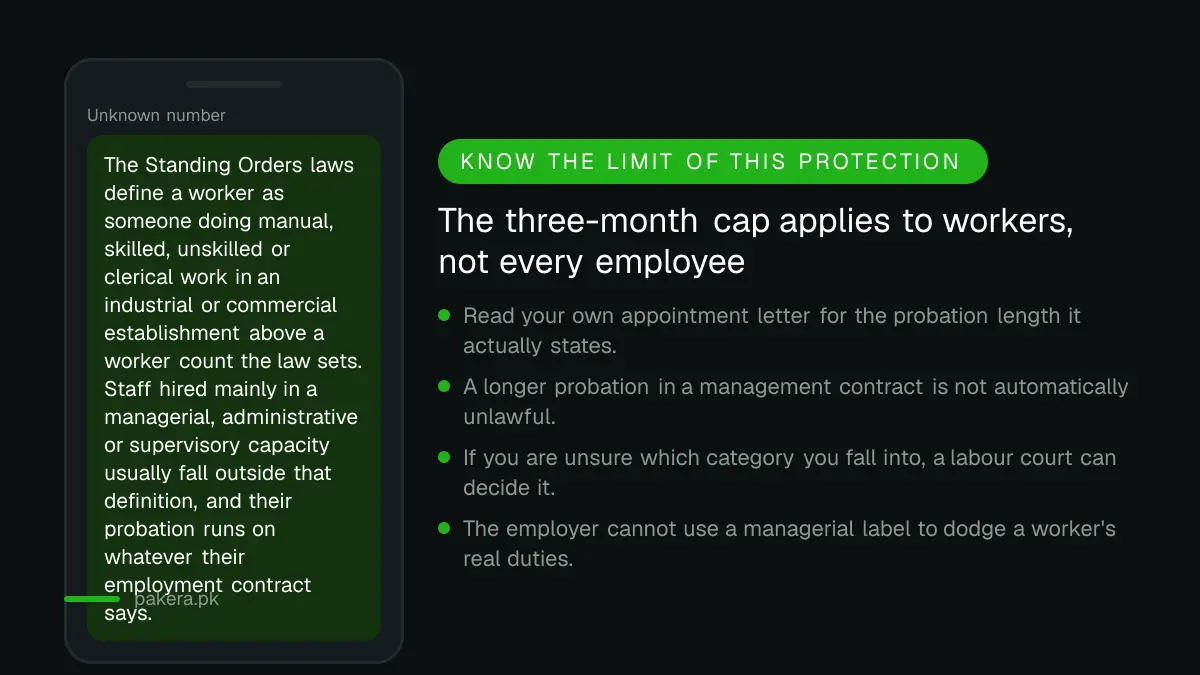
The Standing Orders define a worker as someone doing manual, skilled, unskilled or clerical work, in an industrial or commercial establishment that employs enough workers to fall under the law. Staff hired mainly for management, administration or supervision generally sit outside that definition, and their probation runs on whatever the employment contract says instead.
A long probation clause in a managerial contract is not automatically unlawful for that reason. The real question is whether the job, in substance, is a worker's job regardless of the title on the business card, and that is ultimately a question a labour court can settle if it is ever disputed.
A dispute over probation or confirmation still goes through the labour forum, not a civil court
If an employer disputes whether you were ever confirmed, or claims you remained a probationer for months past the three-month mark to avoid paying notice, that is a grievance the labour machinery in your province is built to handle, not a matter for an ordinary civil suit. We set out that full process, including appeals, in the guide to when a wage dispute goes to a labour court.
Start by putting the dispute in writing to your employer first. A labour court expects to see that you raised the issue before you escalated it, and a dated letter is worth more at that stage than a verbal complaint ever will be.
Common questions
What is the maximum legal probation period in Pakistan?
Three months, under the Standing Orders laws that apply to workers in industrial and commercial establishments, with no extension stated in the texts we checked.
Can my employer extend my probation beyond three months?
Not under the Standing Orders as we read them. A longer period in a contract for managerial or administrative staff outside that law's coverage is a separate question.
Do I get notice if I am terminated during probation?
No. A probationer is not entitled to any notice under the Standing Orders, and does not have to give notice when resigning either.
Am I automatically confirmed after three months on probation?
Effectively yes, if your work was satisfactory and you keep working past that date. The law defines a permanent worker as one who has completed probation, without requiring a separate confirmation letter.
Does the same three-month rule apply to managers and office staff?
Usually not. The Standing Orders cover workers doing manual, skilled, unskilled or clerical work. Managerial and administrative staff typically follow whatever their own contract states.
Which law covers my probation if I work in Punjab?
The Industrial and Commercial Employment (Standing Orders) Ordinance 1968, which still applies in Punjab, Balochistan and Islamabad Capital Territory.
About the author

Public Services and Education Journalist
Fajr Riaz is a journalist and content writer at Pakistan Era, based in Lahore. She covers the questions people meet in everyday life in Pakistan: how a public service works, what a change in the rules means, and where to find a reliable answer.