Pakistan Customs Duty-Free Baggage Allowance: What You Can Bring In
Pakistan's customs allowance covers clothes, one laptop and limited gifts duty free. See the currency declaration limits and what still gets taxed on arrival.
Pakistan lets a returning traveller bring in clothes and one laptop duty free on any trip, and adds narrower allowances for gifts and professional tools on the first visit of the calendar year. Cash is a separate matter: declare anything over US$10,000 coming in, and file a declaration before you leave with any foreign currency at all, since the duty-free goods allowance and the currency rule do not share one limit.
Most travellers only think about customs duty free allowance Pakistan rules when they are already standing at the Red or Green Channel with a bag full of gifts. By then it is too late to plan, and it is a different problem from how much your checked bag can weigh at the departure counter. Pakistan Customs runs on the Baggage Rules 2006, amended several times since, and the Federal Board of Revenue has published more than one draft change that never quite settled into the figure people now repeat online.
We read FBR's own notifications directly rather than take a travel forum's word for it. SRO 2201(I)/2022, finalised on 12 December 2022, is the current word on how much foreign currency you can carry out of the country, and it has not been replaced since. That is the kind of detail worth getting right before you pack.
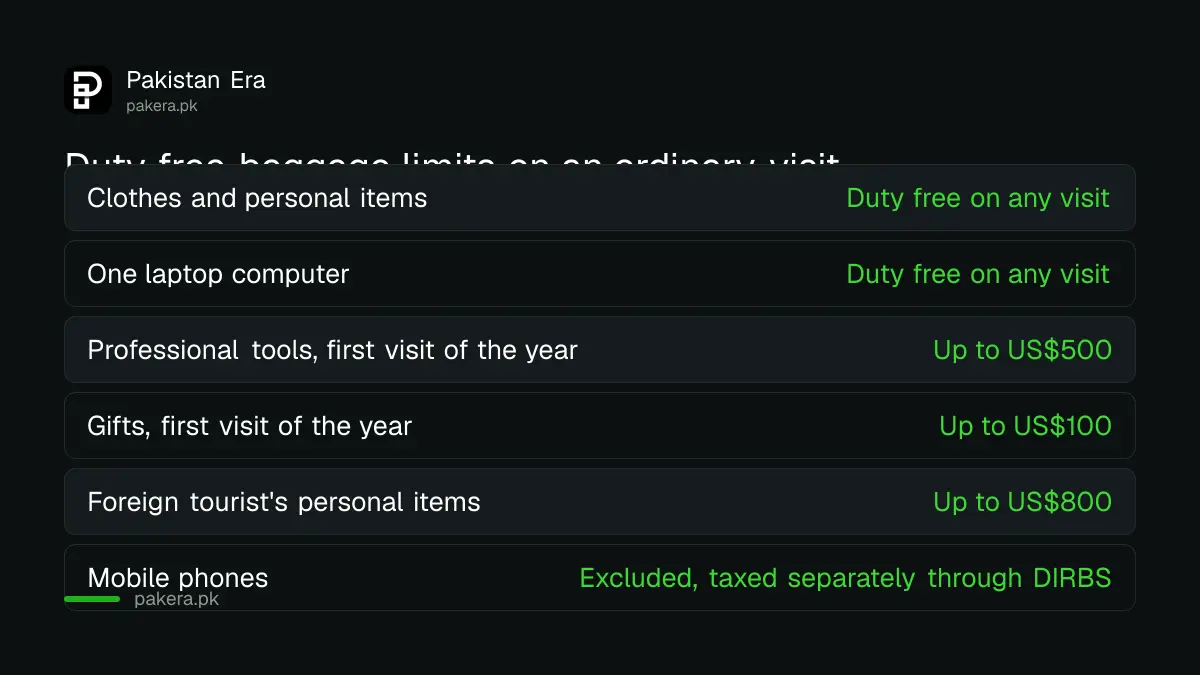
Clothes, one laptop and a short list of personal items travel duty free
Every returning passenger can bring personal wearing apparel and one laptop computer into Pakistan without paying a cent of duty, on any visit, any time of year. A handful of single-use electronics, a mobile phone, a wrist watch, an iron, a hair dryer, ride along in the same category.
This basic allowance has no dollar ceiling attached to it in the rules Islamabad International Airport publishes to travellers. It is meant for what a person actually wears and carries, not a shopping trip packed into a suitcase.
A once-a-year allowance covers gifts and professional tools, not general shopping
On the first visit of a calendar year, after at least seven days abroad, a passenger gets extra room: professional tools up to US$500, gifts up to US$100, and other items in aggregate up to US$500. That is three separate pools, not one combined figure, and each is meant for a specific kind of item.
A worker bringing home a laptop stand or a set of tools for their trade fits the professional tools line. A box of chocolates or a watch for a relative fits the gift line. Everything else, electronics, clothes bought abroad, souvenirs, sits in the general pool, and once any of the three runs out, duty applies to what is left.
- Keep receipts for anything bought abroad that is not clearly personal wear.
- Separate gifts from general purchases before you reach the counter.
- Check whether this is your first entry of the calendar year, since the allowance resets annually, not per trip.
- Declare anything you are not sure about rather than risk the Green Channel.
- Ask for a written receipt if customs assesses duty, so you have a record of what was charged.
Foreign tourists get a flat allowance instead of the local traveller's categories
A foreign national or tourist entering Pakistan is allowed personal wearing apparel plus other items, excluding mobile phones, up to a reported US$800 in value. That single figure replaces the layered local traveller categories above.
Someone moving to Pakistan permanently, under what the rules call transfer of residence, gets a different and larger allowance again, including used household goods and duty free shop purchases up to US$1,000, plus a 50 per cent duty concession on one major appliance such as a television or refrigerator. That category exists for people relocating, not for a two-week visit.
Carrying foreign currency runs on its own limits, separate from the goods allowance
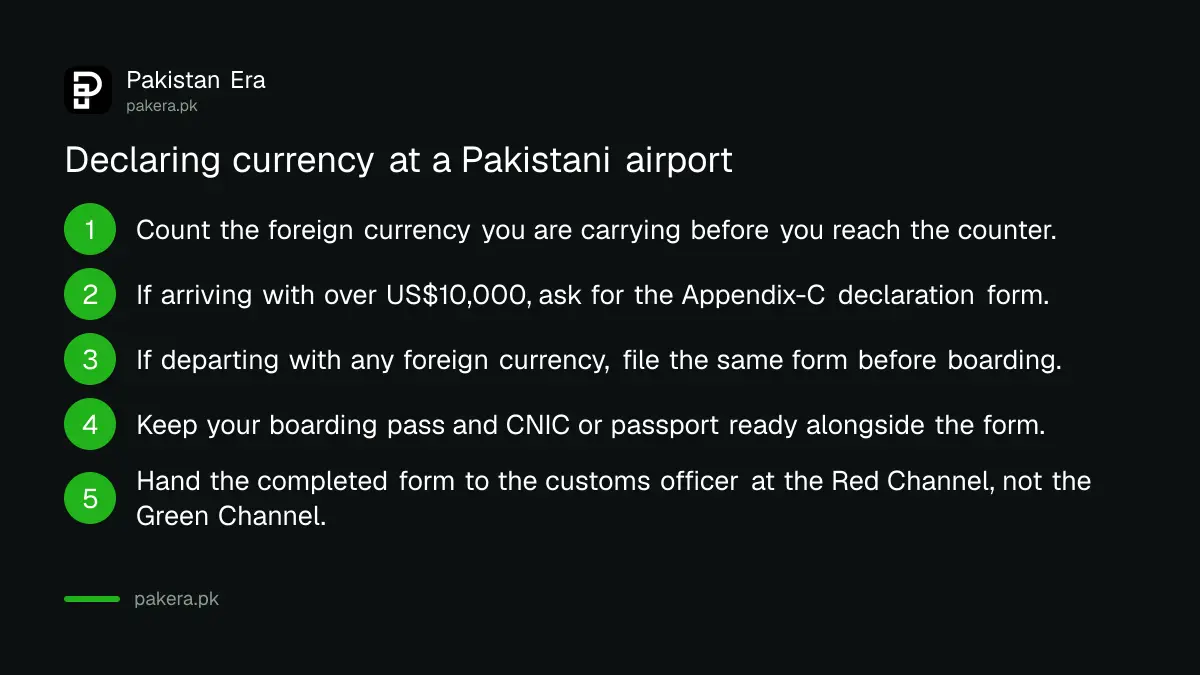
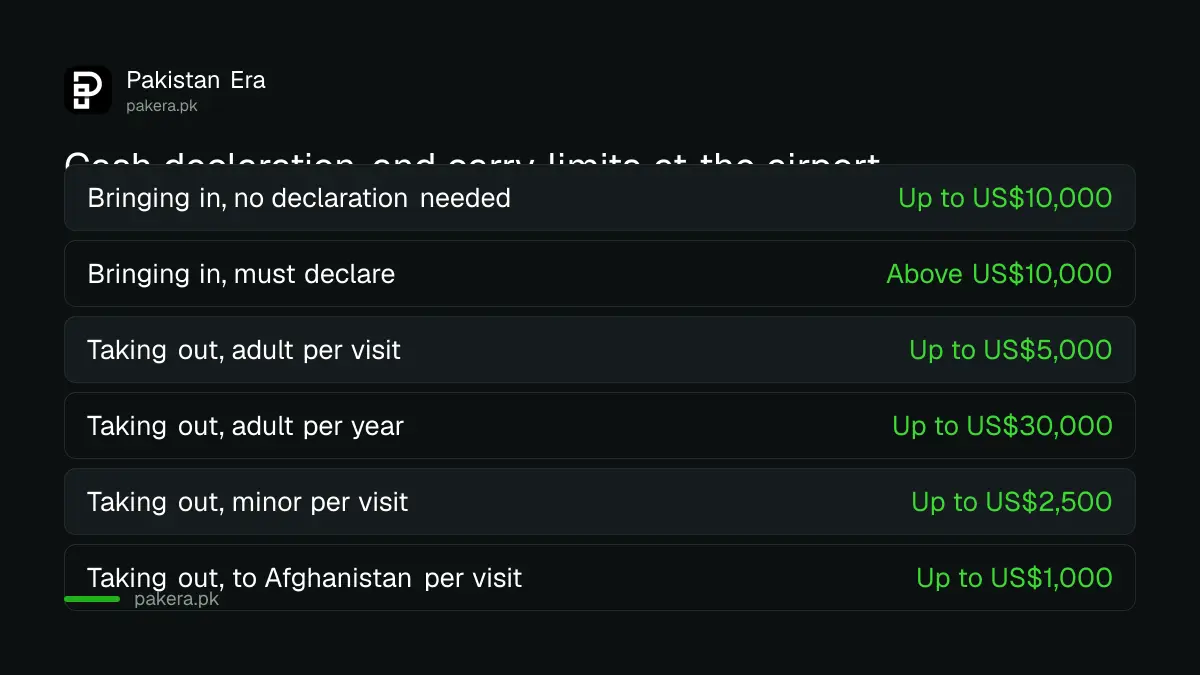
An incoming passenger does not need to declare foreign currency at all unless the amount passes US$10,000. Above that figure, declaration is compulsory, using the Appendix-C form FBR sets out in the Baggage Rules.
Leaving the country works differently. FBR's own SRO 2201(I)/2022 requires anyone taking foreign currency out of Pakistan, in any amount, to file the same declaration before departure. On top of the declaration duty, there is a hard carry limit: an adult can take out up to US$5,000 per visit and up to US$30,000 across a year, a minor up to US$2,500 per visit and US$15,000 a year, and anyone travelling to Afghanistan only US$1,000 per visit and US$6,000 a year.
| Situation | Rule | Source |
|---|---|---|
| Arriving with cash | No declaration below US$10,000; compulsory above it | SRO 1864(I)/2022, SRO 2201(I)/2022 |
| Departing with cash, adult | Declare any amount; carry cap US$5,000 a visit, US$30,000 a year | SRO 2201(I)/2022 |
| Departing with cash, minor | Carry cap US$2,500 a visit, US$15,000 a year | SRO 2201(I)/2022 |
| Departing to Afghanistan | Carry cap US$1,000 a visit, US$6,000 a year | SRO 2201(I)/2022 |
A 2024 proposal to cap personal baggage at US$1,200 caused confusion and was withdrawn
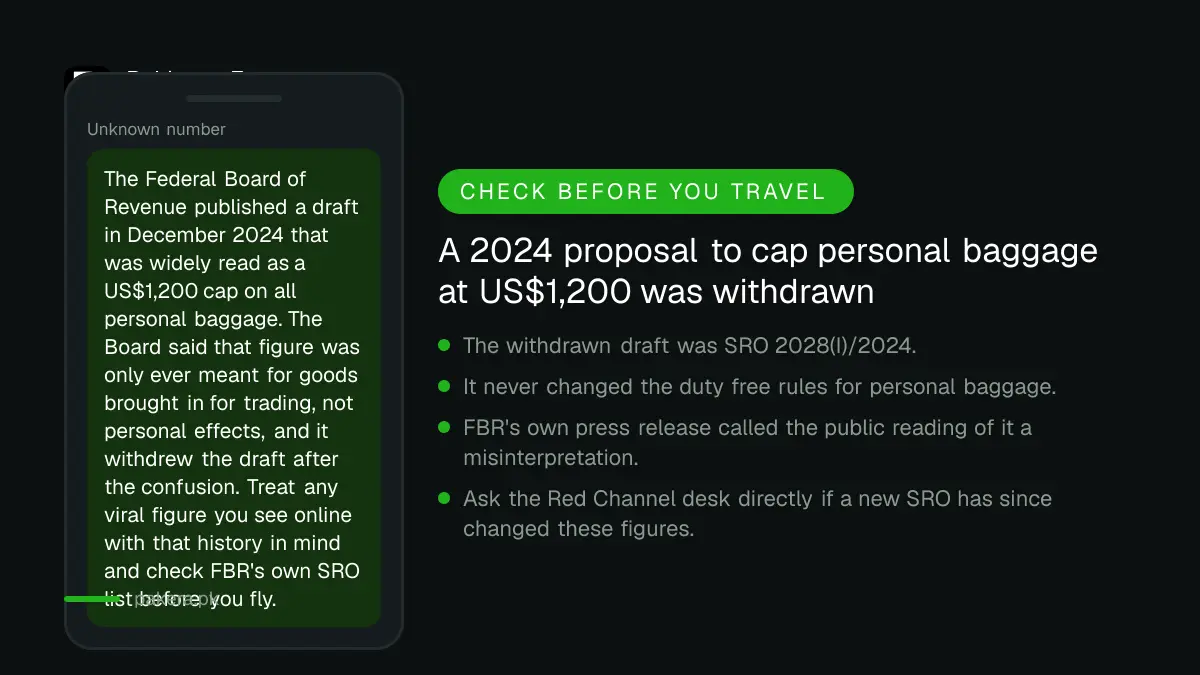
In December 2024, FBR published a draft, SRO 2028(I)/2024, that the public read as a US$1,200 ceiling on all personal baggage. That is not what the Board says it meant. Its own press release states plainly that the figure was intended for goods brought in for trading or pecuniary gain, not for a traveller's personal effects, and the Board pulled the draft after the misreading spread.
That history matters because the same figure keeps resurfacing in forwarded messages and old articles as if it were settled law. It never took effect. If you see it quoted as current policy, it is worth a second look rather than a straight repeat.
Skipping a declaration or exceeding the allowance has real consequences
Undeclared currency above the threshold, or goods carried through the Green Channel that should have gone through the Red Channel, can be seized on the spot, and the passenger can face a penalty under the Customs Act 1969 on top of losing the item or the cash temporarily while the case is reviewed. Electronics are a separate trap: a phone brought in without later registering it on DIRBS gets blocked from local networks, a point we cover in full in the guide to bringing a laptop or phone into Pakistan.
None of this is designed to catch an honest traveller carrying normal luggage. It exists for currency smuggling and undeclared commercial imports dressed up as personal baggage. A traveller who declares honestly and keeps receipts rarely has a problem at the counter.
Common questions
What is the duty-free baggage allowance for Pakistani travellers?
Clothes and one laptop are duty free on any visit. A once-a-year allowance adds professional tools up to US$500, gifts up to US$100, and other items up to US$500 in aggregate.
How much foreign currency can I bring into Pakistan without declaring it?
Up to US$10,000. Above that figure, declaration on the Appendix-C form is compulsory on arrival.
How much cash can I take out of Pakistan?
An adult can take out up to US$5,000 per visit and US$30,000 a year. Minors are capped at US$2,500 a visit and US$15,000 a year, and travel to Afghanistan is capped at US$1,000 a visit.
Do foreign tourists get the same baggage allowance as Pakistani nationals?
No. A foreign national or tourist gets a flat allowance, reported at US$800 for personal items excluding mobile phones, rather than the layered categories local travellers use.
Is there a US$1,200 limit on personal baggage?
No. FBR proposed that figure in a December 2024 draft for goods brought in for trading, the public read it as a general cap, and the Board withdrew the draft once the confusion became clear.
What happens if I don't declare currency above the limit?
Customs can seize the undeclared amount and the passenger can face a penalty under the Customs Act 1969. Declaring honestly at the counter avoids both.
About the author

Senior Writer, Public Services and Technology
Shahid joined us in 2024 as an author. He is a senior contributor to Pakistan's leading technology websites. He writes detailed articles, mostly covering his expertise in the latest tech, mobiles, apps, gadgets, and step-by-step guides. His ideology is to help people understand the latest trends and explain complex methods through very easy-to-understand guides.