How to Get a Trade License From Your Local Council in Pakistan
A trade license from your union council or corporation is separate from FBR tax registration. See who issues it, what it needs, and why the fee is set locally.
Opening a shop in Pakistan needs a trade license from your local council, the body that governs the street your shop sits on, not from FBR. Basic trades go through your union council, municipal committee or municipal corporation. The fee is set by that council, not fixed nationally, so the right move is to ask your council for its own schedule in writing before paying anyone.
A lot of new shopkeepers skip this step entirely, because the word "registration" in Pakistan gets used for three or four different things at once. You can have an FBR tax number, a trade name, and still be operating without the one document that actually lets the council treat your shop as legal on that street.
We checked the Punjab Local Governments Fee for Licensing of Professions and Vocations Rules 2017, published on the Local Government and Community Development Department's own site, on 5 October 2026. That is where the authority structure below comes from.
A trade license comes from your local council, not FBR
Your union council, municipal committee or corporation issues the trade license. FBR issues your National Tax Number. They are two separate systems run by two separate governments, and a shop realistically needs both, one to operate legally on its street and one to file tax returns every year.
This split confuses people because both get casually called "registering a business." They aren't the same registration, and getting one doesn't excuse you from the other. A shopkeeper with a spotless FBR filing record can still be operating without a valid trade license, and the reverse happens just as often.
Which council you go to depends on your trade
Basic retail and service trades, a grocer, a barber, a tailor, a small restaurant, are licensed by the union council, municipal committee or corporation nearest the shop. Trades the rules treat as hazardous or industrial, like timber storage or electroplating, go through the district or metropolitan corporation instead.
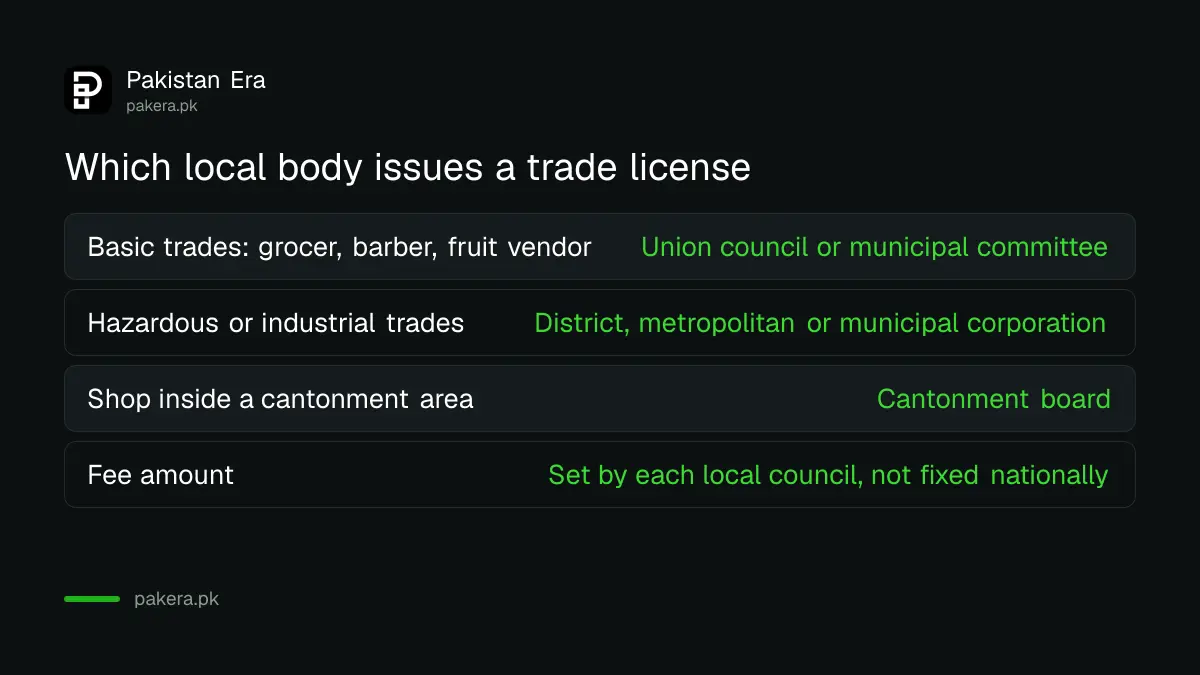
If your shop sits inside a cantonment area, the cantonment board runs its own licensing under a separate law, not the civilian council system. That's worth checking early, because the office you'd otherwise assume handles it simply doesn't have jurisdiction there.
A corner shop selling groceries and a workshop running machinery are not the same case under these rules, even if they sit on the same street. Know which category your trade falls into before you walk into an office that can't actually license it.
Provinces run this differently in detail
Punjab operates under its own Local Government Act and the 2017 licensing fee rules. Sindh runs licensing through its Local Government Act, and Khyber Pakhtunkhwa and Balochistan each have their own local government laws again. The basic shape, a council issues the license and sets the fee through its own approved schedule, repeats across all of them, but the exact office names differ.
The fee is set by your own council, so there's no single national number
This is the part that trips people up most. The rules state plainly that a local government may charge a fee for the license it grants, and that fee has to be approved by the council's own House before it's charged. Punjab's framework doesn't print one fee for the whole province; it hands that decision to each local council.
That's why you'll see wildly different numbers quoted for Lahore versus a small town council, and why we're not printing a rupee figure here. Any number you read online, including ones from news reports, is a snapshot of one council at one point in time, not a national rate. Get your own council's current schedule in writing instead of trusting a figure that travelled through two or three retellings before it reached you.
| Question | Where the answer lives |
|---|---|
| What does the license cost? | Your council's own approved fee schedule, not a national rate |
| Who issues it for my trade? | Union council or corporation for basic trades, corporation for hazardous ones |
| Does paying FBR cover this? | No, FBR registration and the trade license are separate |
| Does it need renewing? | Yes, councils renew licenses periodically; ask yours for its cycle |
Applying means paperwork at your council office, not a portal
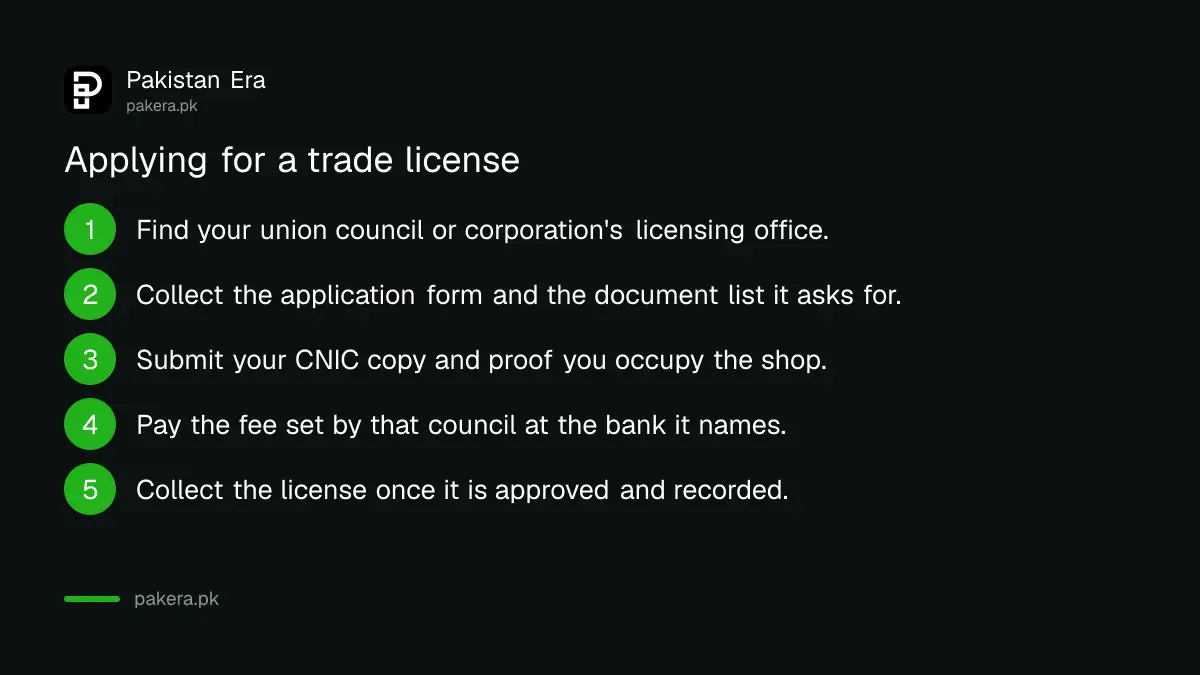
Most councils still run this as an in-person process: a form, your CNIC, and proof that you occupy the shop, usually a rent agreement or ownership document. Some ask for photographs of the shop front or a no-objection certificate from the building owner. The exact list varies by council, so confirm it before you make the trip.
- Find your union council, municipal committee or corporation's licensing counter.
- Ask for the current application form and document checklist.
- Submit your CNIC copy and proof you occupy the shop.
- Pay the fee only at the bank or counter the council names.
- Collect the license once the council approves and records it.
Keep the receipt and the license together. If an inspector ever asks to see it, a verbal "we paid" means nothing without paper to back it.
A trade license and FBR registration are not interchangeable
Separately from all of this, most shopkeepers still need an FBR National Tax Number to file an income tax return, and registering a sole proprietorship with FBR follows its own process on IRIS with no council involved at all. We've laid that one out on its own, because the two systems don't talk to each other and skipping either one leaves a gap.
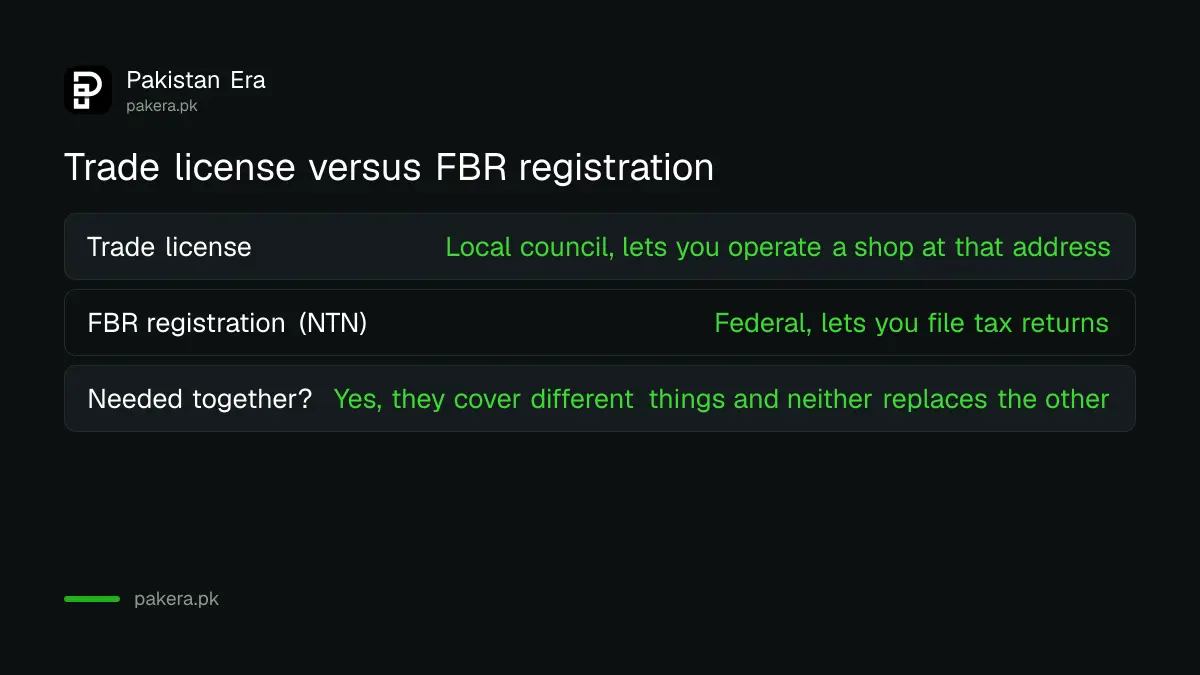
If you've already registered as a sole proprietor with FBR, that covers your tax side, but it does nothing for your council's licensing requirement. The two have to be done separately, and neither office will chase the other for you.
Checking your own NTN status online before you start is a quick way to confirm where you actually stand on the federal side, so you know exactly which of the two gaps you still need to close.
Common questions
Do I need a trade license if I already have an NTN?
Yes. An NTN is for FBR tax filing. A trade license is a separate requirement from your local council to legally run the shop.
Who issues a trade license for a small grocery shop?
Your union council, municipal committee or corporation, whichever covers that address for basic trades.
Is the trade license fee the same across Pakistan?
No. Each local council approves its own fee schedule, so the amount differs from one council to another.
What happens if I operate without a trade license?
Councils can take action against unlicensed shops under their local government laws, which can include fines.
Does a trade license from a cantonment board work the same way?
Not exactly. Cantonment areas are licensed by the cantonment board under its own law, separate from civilian councils.
How we verified this
What we checked, where we read it, and what we could not confirm.
We read the Punjab Local Governments Fee for Licensing of Professions and Vocations Rules 2017 as listed on lgcd.punjab.gov.pk, and the rules summary on compendium.lgpunjab.org.pk, on 5 October 2026, for the licensing authority structure and the statement that each council sets its own fee subject to its House's approval. We could not extract a numeric fee table from the scanned PDF on the department's site, so we have not stated one here. Specific rupee figures reported for individual cities come from secondary coverage we could not confirm on a council's own page, so we have left them out and told readers to get their own council's current schedule instead.
About the author
Public Services and Education Journalist
Fajr Riaz is a journalist and content writer at Pakistan Era, based in Lahore. She covers the questions people meet in everyday life in Pakistan: how a public service works, what a change in the rules means, and where to find a reliable answer.