LPR Encashment for Federal Employees in Pakistan: 365 Days, Apply 15 Months Before Retirement, and How Leave Pay Is Worked Out
LPR encashment rules for federal employees in Pakistan: up to 365 days, option 15 months before retirement, default to cash, and how leave pay is worked out.
Short answer: A federal civil servant in Pakistan can take up to 365 days of leave preparatory to retirement (LPR), or keep working and encash it instead. Under Rule 18-A of the Revised Leave Rules 1980, the option is given 15 months before retirement. If you do not choose, you are treated as having chosen encashment. Leave pay is capped at 365 days and worked out on the pay shown in your last pay certificate.
These rules come from the Finance Division's updated edition of the Revised Leave Rules 1980. On 13 November 2026 a cabinet committee approved a separate LPR proposal for the Armed Forces, as reported in our cabinet committee decisions of 13 November. This guide covers federal civil servants.
LPR is up to 365 days of leave just before retirement
Leave preparatory to retirement (LPR) is leave taken right before your retirement date. Rule 16 caps it at 365 days. You can take it all on full pay, part on full pay and part on half pay, or all on half pay, as long as the leave is in your account.
Leave builds up through your career. Under Rule 3, a civil servant earns 4 days of leave on full pay for every month of duty, and there is no upper limit on how much can be saved. A long career usually leaves far more than 365 days in the account, but only 365 days count for LPR.
Senior officers have one special case. An officer in BPS-21 or BPS-22 who retires voluntarily after 25 years of pensionable service can take LPR equal to all leave on full pay in the account, or until age 60, whichever comes first. That leave cannot be converted to half pay.
You have two choices: take the leave or encash it
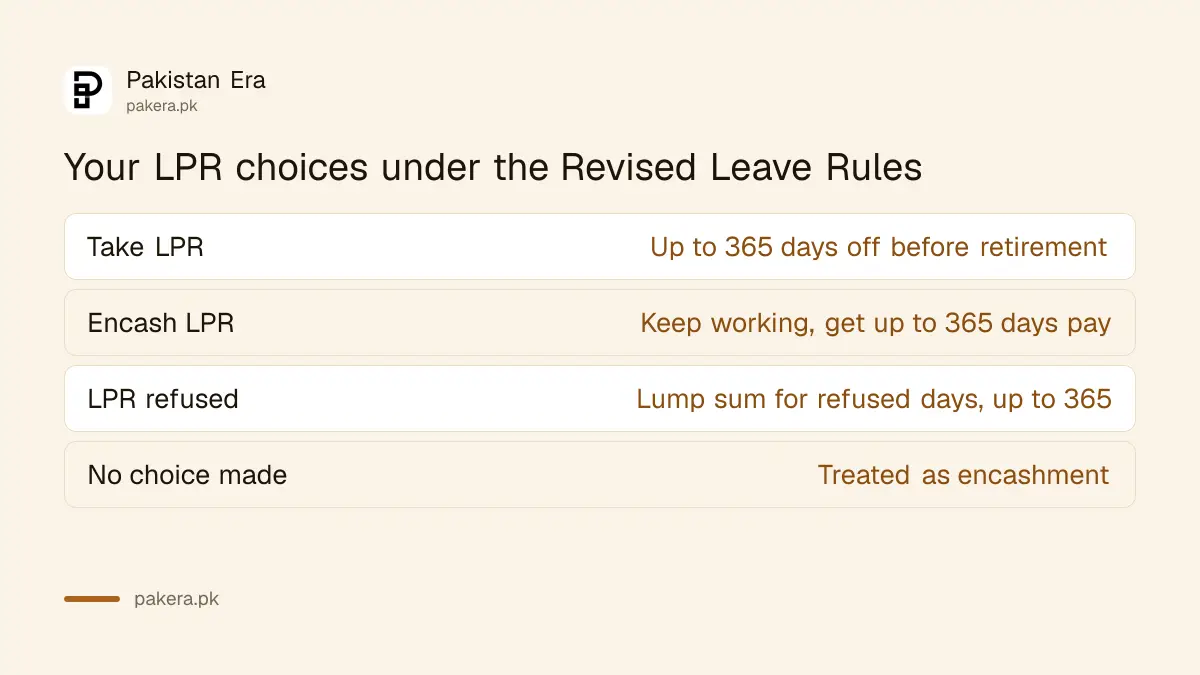
Every retiring civil servant chooses between going on LPR or working through it and getting cash. Encashment is the default. If you say nothing in time, Rule 18-A treats you as having chosen to encash.
| Choice | What happens | Rule |
|---|---|---|
| Take LPR | You stop work up to 365 days before retirement and draw leave pay | Rule 16 |
| Encash LPR | You keep working and get leave pay for up to 365 days as cash | Rule 18-A |
| LPR refused by the department | You get lump-sum leave pay for the refused leave, up to 365 days | Rule 17 |
| No choice made | Treated as having opted for encashment | Rule 18-A(1) proviso |
Officers posted as Officer on Special Duty (OSD), with or without work, are treated as having performed duty in lieu of LPR. So they too can encash it.
How to apply for LPR encashment
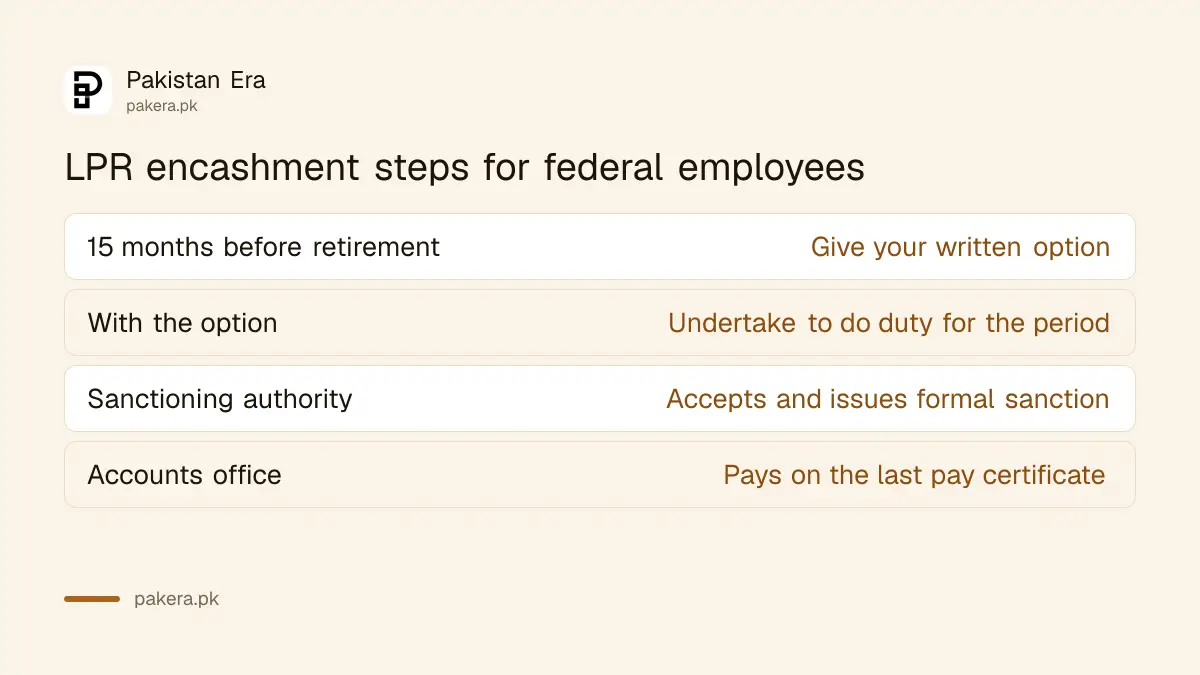
The window opens 15 months before your date of superannuation, or 15 months before you complete 30 years of qualifying service if you plan to retire then. Mark the date early, because a missed choice is read as encashment anyway.
- Find your retirement date and count back 15 months. That is when you can give the option.
- Write to the authority that sanctions your LPR, choosing encashment. Undertake in writing to perform duty for the whole 365 days, or the shorter period due to you.
- Ask the office to confirm your leave balance from your leave account.
- The sanctioning authority accepts the option and issues a formal sanction for the cash payment, under Rule 18-A(4).
- Claim the leave pay through your accounts office. Under Rule 18-A(5)(b), you can draw it for the period of duty already done.
How LPR encashment is worked out
Leave pay for encashment is based on the pay and allowances that count towards pension, as shown in your last pay certificate, under Rule 18-A(6). It is paid at the rate in force when the leave pay is drawn. The cap is 365 days, which is about 12 months of that pay.
Here is a rough example, using our own sums. If the pay that counts towards your pension is Rs 150,000 a month, 365 days of leave pay comes to about Rs 1.8 million. Your accounts office will work out the exact figure from your last pay certificate.
- Medical or Hajj leave reduces it. If you take leave for illness with a medical certificate, or for Hajj, during the encashment period, the cash is cut by the leave pay for those days, under Rule 18-A(3).
- Allowances: Rule 18-A(5)(c) says only the Senior Post Allowance is included with leave pay, alongside the pay counted under Rule 18-A(6).
- Autonomous bodies: employees of federal autonomous and semi-autonomous bodies that have adopted the basic pay scales and these rules in full also get LPR encashment.
How your pension itself is worked out is in our guide to federal pension calculation.
Who can refuse LPR, and what you get if it is refused
Rule 18 says LPR should not normally be refused. Only named authorities can refuse it, and they cannot hand that power to anyone else. If LPR is refused for reasons of public service, Rule 17 gives you cash instead.
| Your grade | Who can refuse or recall you from LPR |
|---|---|
| BPS-20 and above | The Chief Executive |
| BPS-17 to BPS-19 | The appointing authority under Rule 6 of the Civil Servants (Appointment, Promotion and Transfer) Rules 1973 |
| BPS-16 and below | The appointing authority under the same rule |
For officers in BPS-17 and above, a proposal to refuse LPR must reach the appointing authority with full reasons at least three months before the officer is due to go on leave. If your LPR is refused, you get lump-sum leave pay for the refused days, up to 365 days. You can take it at once on retirement or month by month.
Voluntary retirement has its own pension rules, covered in our page on voluntary retirement for federal employees.
What the family gets if a civil servant dies
If a civil servant dies while on LPR before using all 365 days, the family gets a lump sum for the days left, under Rule 17(5). If a civil servant dies in service, or a Medical Board declares them permanently unable to work, the family or the employee gets a lump sum of leave pay for up to 365 days from the leave account, under Rule 19.
Common questions
How many days of LPR can a federal employee get in Pakistan?
Up to 365 days, under Rule 16 of the Revised Leave Rules 1980, as long as that much leave is in the account.
When should I apply for LPR encashment?
Fifteen months before your date of superannuation, or before completing 30 years of qualifying service, under Rule 18-A.
What if I forget to choose between LPR and encashment?
You are treated as having chosen encashment. This rule has applied since 5 March 1990.
Is LPR encashment more than 365 days possible?
No. The cap is 365 days for both encashment and refused LPR, since the 2012 amendment raised it from 180 days.
Does Hajj leave reduce LPR encashment?
Yes. Leave granted for Hajj, or on medical grounds, during the period cuts the cash by the leave pay for those days.
Do the new armed forces LPR changes apply to civil servants?
No. The 13 November 2026 proposal concerns the Armed Forces. Civil servants stay under the Revised Leave Rules 1980.
How we verified this
What we checked and where we read it.
We checked these rules on 14 November 2026 in the Finance Division's updated edition of the Revised Leave Rules 1980 (dated 4 May 2018): Rules 3, 16, 17, 18, 18-A and 19, including the 365-day changes made by S.R.O. 70(KE)/2012 of 29 August 2012. The armed forces proposal is from the Press Information Department release of 13 November 2026 on the Cabinet Committee for Disposal of Legislative Cases.
About the author

Global Affairs & Political Economy Writer
Muhammad Hatim is a book lover who started writing because he enjoys it. At Pakistan Era he writes about international relations, geopolitics and the global economy, with a particular interest in South Asia and the forces behind current events.