Voluntary Retirement Rules for Federal Employees in Pakistan: 25 Years, 3 Months' Notice and a 3% a Year Pension Cut
Federal employees in Pakistan can retire after 25 years, but pension is cut 3% a year to age 60, up to 20%. See the cut by year, notice rule and who is exempt.
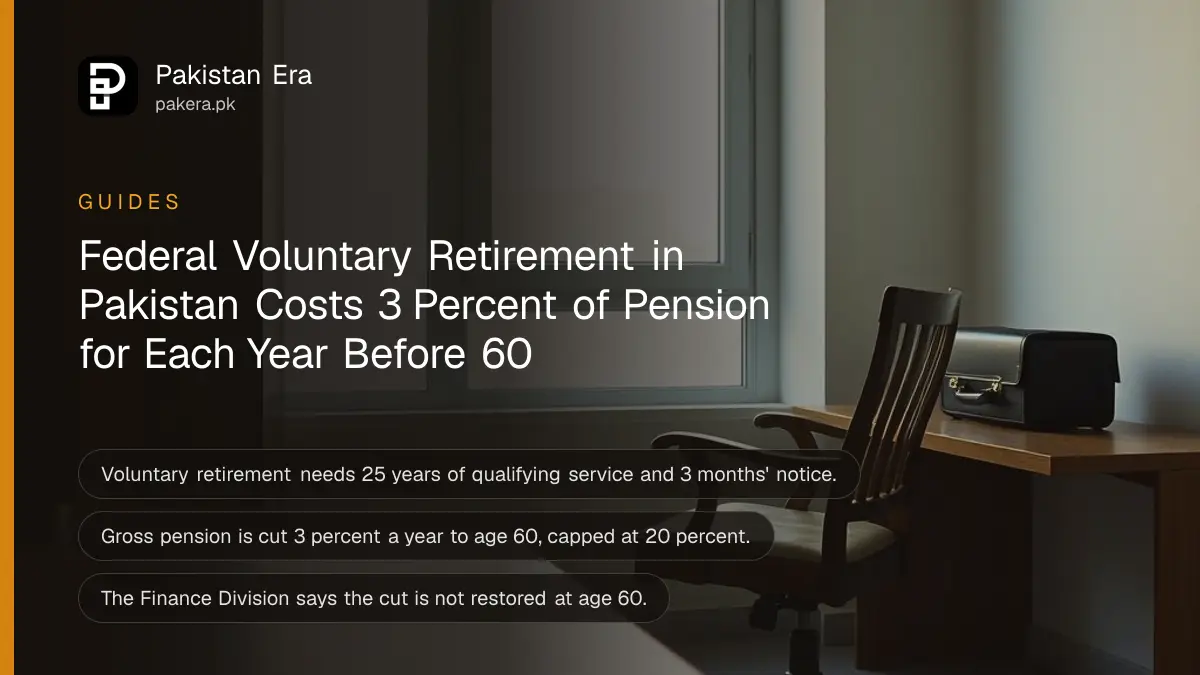
A federal government employee in Pakistan can take voluntary retirement after 25 years of qualifying service, with three months' written notice. Since 10 September 2024, the gross pension is cut by 3 per cent for every year left until age 60, capped at 20 per cent, and the cut is never restored.
We read the Finance Division's memoranda on voluntary retirement on its circulars page on 7 November 2026: the notice rules of 16 April 2024, the penalty order of 10 September 2024 and the clarifications of 3 January 2025. Below is what you lose for each year you leave early, worked out on a sample pension, and the three mistakes that can cost you the whole pension.
You can retire voluntarily after 25 years of qualifying service
Every federal government servant has the right to seek voluntary or retiring pension after 25 years of qualifying service. The Finance Division cites Article 465-B of the Civil Service Regulations, Note 1, for this right. Qualifying service is the service that counts for pension.
Qualifying service is not the same as the years since you joined. Extraordinary leave, meaning unpaid leave, does not count. The Finance Division's memorandum of 16 April 2024 records cases where staff retired, and then found their 25 years were short because extraordinary leave had not been taken out. Those people became altogether ineligible for pension.
The same memorandum closes one escape route. Under CSR 423, a shortfall of up to six months in qualifying service can normally be condoned, meaning excused. That relief does not apply to voluntary or retiring pension. So if your count is 24 years and 8 months, you cannot retire voluntarily.
Three months' notice is required, and it cannot be taken back
You must give written notice at least three months before the date you want to retire. It goes to the authority competent to fill your post. Once submitted, the intimation is final and cannot be changed or withdrawn.
That last rule catches people out. If you send the notice in anger after a transfer, or because you expect a job offer that later falls through, you cannot cancel it. Decide first, then write.
- Ask your accounts office for a written statement of qualifying service, with extraordinary leave taken out.
- Check the total is at least 25 years on the date you plan to retire, not on the date you apply.
- Work out the pension cut using the table below.
- Write to the authority competent to fill your post, naming the exact retirement date, at least three months ahead.
- Keep a receiving copy, and start the pension case papers straight away.
The 16 April 2024 memorandum also tells the principal accounting officer to make sure the three months' notice is observed. If a retiring officer suffers a loss because a notification was issued without checking the length of service, an inquiry must fix responsibility. That helps after the fact. It does not give you the pension back.
The cut is 3 per cent a year of gross pension, capped at 20 per cent
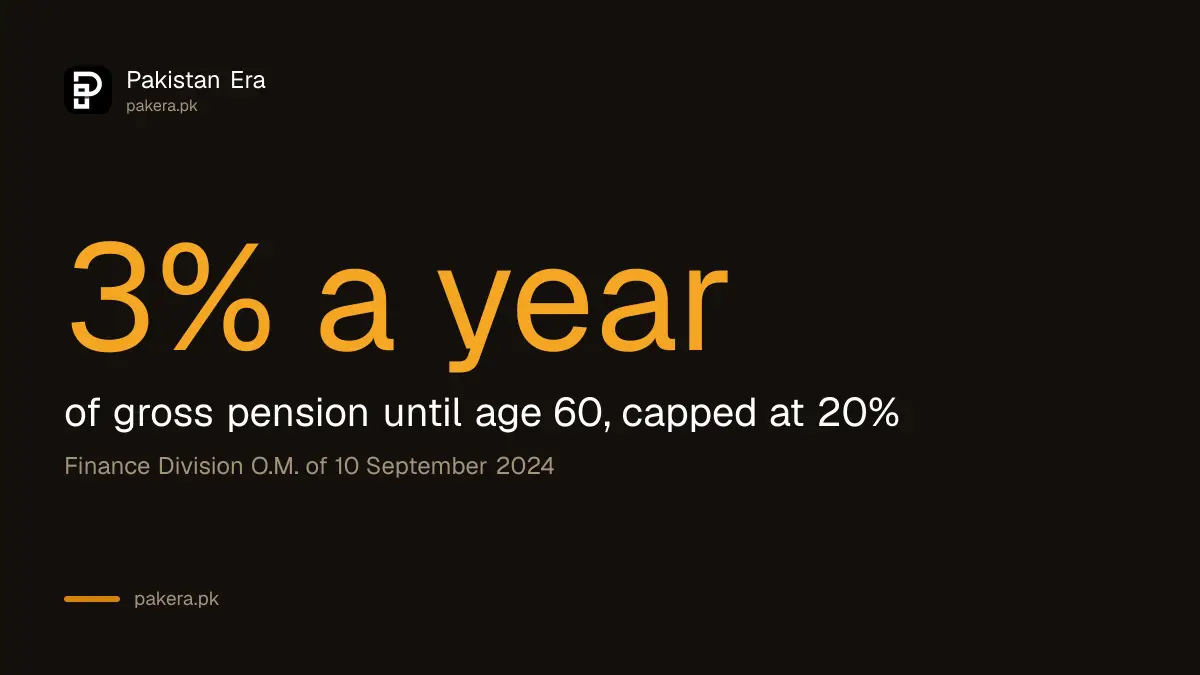
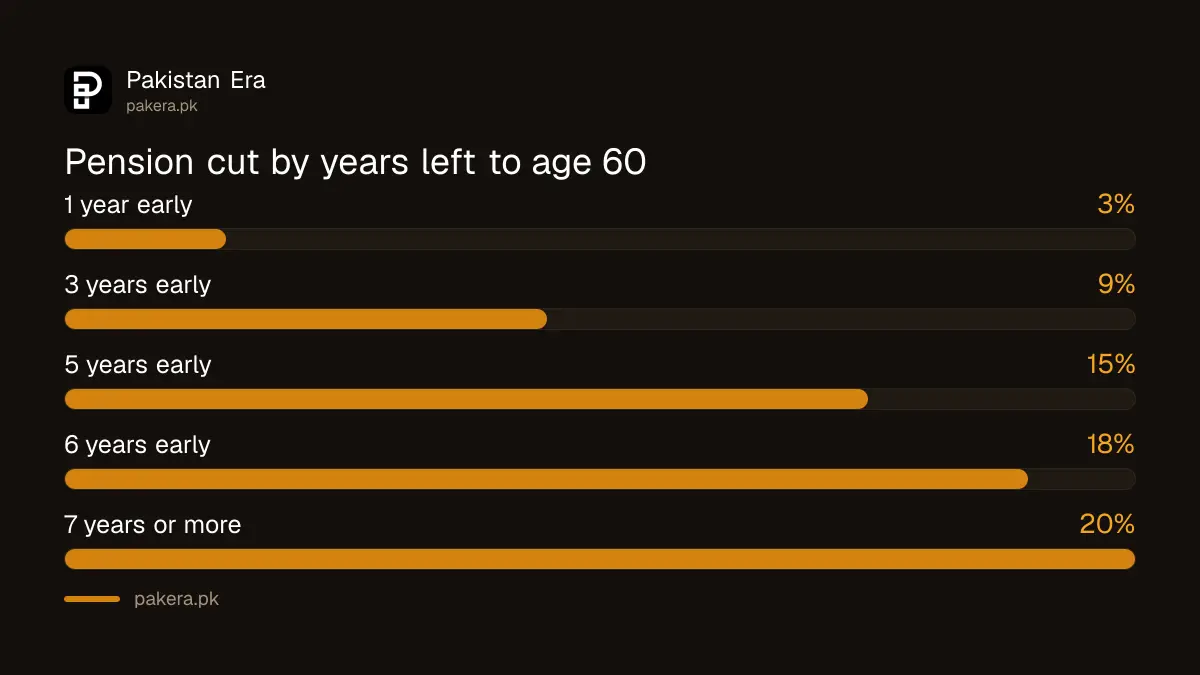
For anyone who applied for voluntary retirement on or after 10 September 2024, gross pension is reduced at a flat 3 per cent a year. The reduction counts the completed months from your retirement date to your superannuation date, which is age 60. It stops at 20 per cent.
Gross pension is the pension before any part is commuted, which means swapped for a lump sum. The table uses a sample gross pension of Rs 100,000 a month. The arithmetic is ours. We read "based on the number of completed months" as 0.25 per cent for each completed month, which is 3 per cent divided by 12. Your accounts office may round differently.
| Years left to age 60 | Cut in gross pension | Rs 100,000 becomes |
|---|---|---|
| 1 year | 3% | Rs 97,000 |
| 2 years | 6% | Rs 94,000 |
| 3 years | 9% | Rs 91,000 |
| 4 years 6 months | 13.5% | Rs 86,500 |
| 5 years | 15% | Rs 85,000 |
| 6 years | 18% | Rs 82,000 |
| 7 years or more | 20% (cap) | Rs 80,000 |
The cap means the penalty stops growing after six years and eight months. Somebody who joined at 22 reaches 25 years of service at 47, thirteen years before 60. That person loses the full 20 per cent, the same as somebody leaving at 53.
How the gross pension itself is worked out, from the average of your last 24 months' pay, is set out in the federal pension calculation.
The cut stays after age 60 and applies after 30 years too
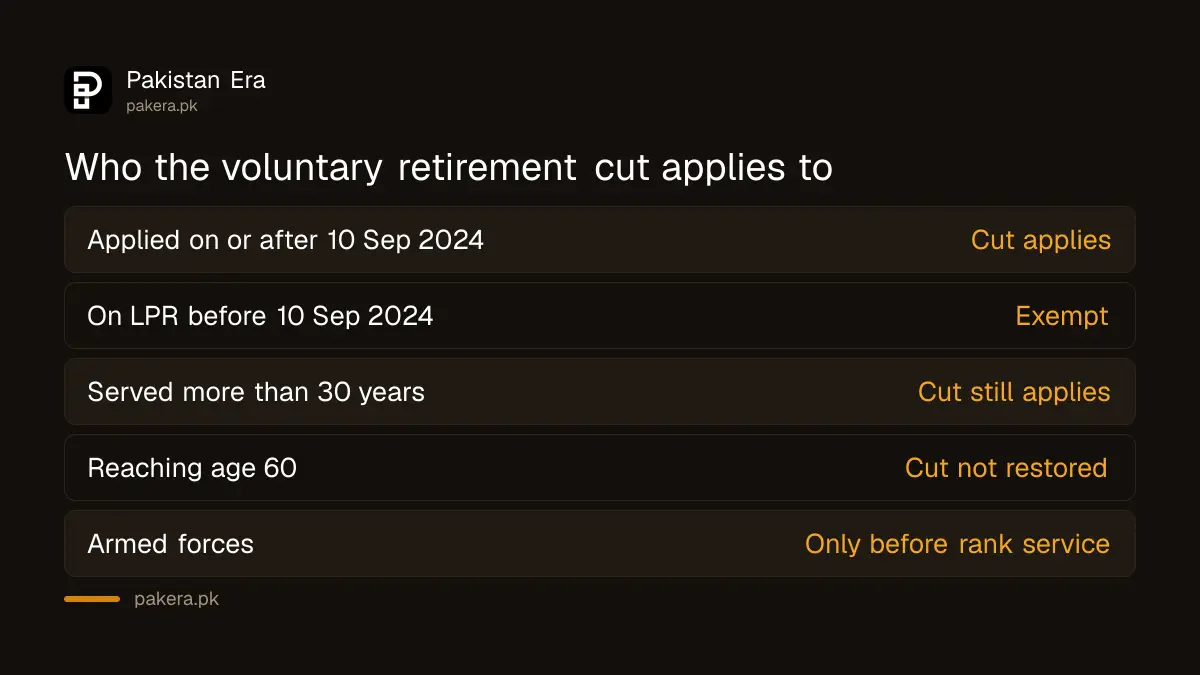
The Finance Division clarified on 3 January 2025 that the reduction is not restored when you reach 60. It also said the 3 per cent cut applies even if you have served more than 30 years. A long career does not exempt you.
That second point drew an objection that the Finance Division recorded in its own table. The department asking noted that the pension formula counts service only up to 30 years, so a person with 33 years gets no extra pension for the last three. A department asked whether the cut should then be limited, or the extra service counted. The Finance Division's answer was "Noted", and to the direct question of whether the 3 per cent applies after 30 years, "Yes".
The penalty was announced on the recommendation of the Pay and Pension Commission 2020. For armed forces and civil armed forces, the penalty applies only if retirement is sought or granted before the prescribed rank service.
Staff already on LPR before 10 September 2024 are exempt
The penalty does not apply to anybody who, before 10 September 2024, was already on leave preparatory to retirement, was drawing encashment of that leave, or was serving a notice period for voluntary retirement. Everyone who applied on or after that date is covered.
Leave preparatory to retirement, or LPR, is leave taken at the end of service before the retirement date. The 3 January 2025 memorandum says the reduction applies to all employees who have applied, or would apply, for premature voluntary retirement on or after 10 September 2024. So the date that matters is when you applied, not when you joined.
If you plan to leave and take a private job, two other rules may affect you. The pension and salary rule for re-employment was withdrawn, as explained in the re-employed pensioner rule. And if you will draw more than one pension, the Finance Division now lets you keep only one, apart from a spouse's family pension.
Common questions
After how many years can a federal employee take voluntary retirement in Pakistan?
After 25 years of qualifying service. Extraordinary leave does not count, and the six month condonation under CSR 423 does not apply to voluntary pension.
How much pension is cut on voluntary retirement?
3 per cent of gross pension for each year left until age 60, counted by completed months, with a maximum cut of 20 per cent.
Is the voluntary retirement cut restored at 60?
No. The Finance Division said on 3 January 2025 that the deduction will not be restored on completion of 60 years.
Can I withdraw my voluntary retirement notice?
No. Under the 16 April 2024 memorandum, the intimation is final once submitted and cannot be modified or withdrawn.
Does the penalty apply if I applied before September 2024?
No, if you were already on LPR, drawing LPR encashment or serving a notice period before 10 September 2024. It applies to applications made on or after that date.
Does the cut apply to provincial employees?
These memoranda are federal. Provinces issue their own pension orders, so a provincial employee should check with the provincial finance department and accountant general.
What we read
We read the Finance Division's memoranda on its circulars page on 7 November 2026: F.No.1(1)R-6/2018 of 16 April 2024 on voluntary and retiring pension, F.No.9(3)R-6/2024-264 of 10 September 2024 on voluntary retirement penalties, and the clarification of 3 January 2025, Annex II. The documents are scans. The cut table is our own arithmetic on a sample pension. Your accounts office makes the final calculation.
About the author

Tax, Bills and Technology Writer
Ali Akhtar is a young and curious voice here at Pakistan Era. He is currently pursuing his A-Levels and has a growing interest in Pakistan’s changing industrial landscape and educational trends. Ali likes to write in a way that helps him explain and explore the world around him. His writing reflects the perspective of the new generation navigating the evolving trends of Pakistan where technology, youth innovation, and shifting opportunities are reshaping the country’s future.