How a Government Pension Case Is Filed
Seven pension types, and a family pension worked out two different ways depending on when the death happened. The papers an office needs.
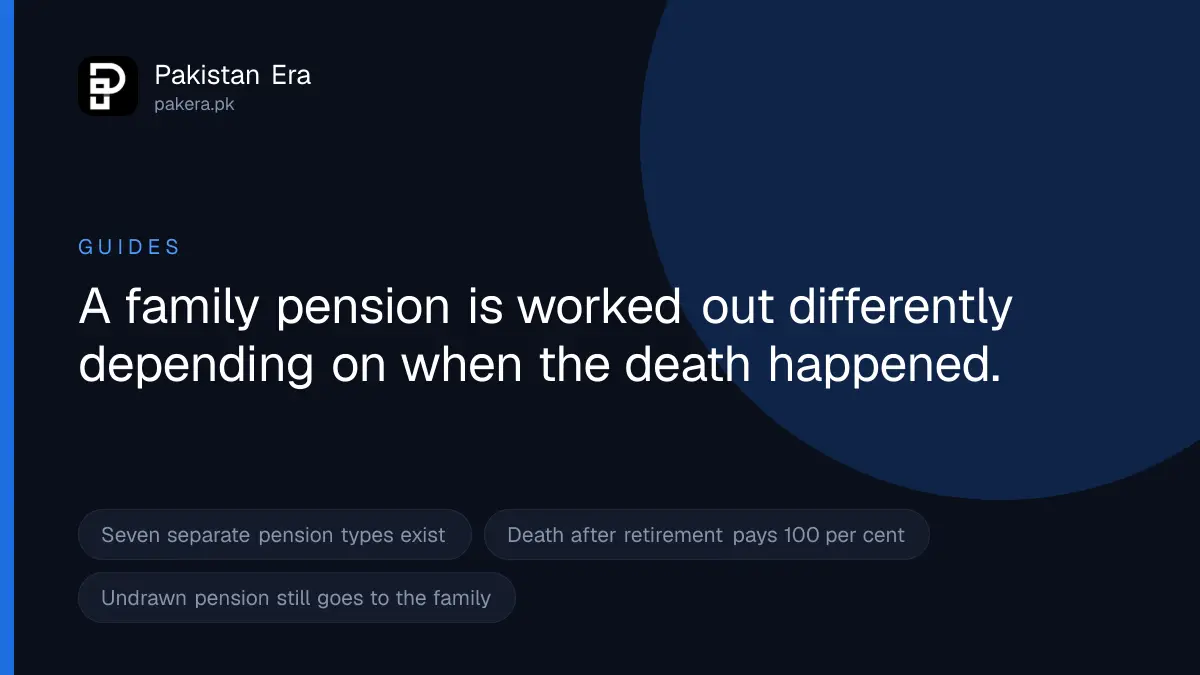
A family pension is worked out two completely different ways depending on whether the death happened before or after retirement. Families rarely know that until the papers are already filed, and it changes what should be claimed.
We read the pension pages published by the Accountant General Khyber Pakhtunkhwa on 29 August 2026. That office administers pensions for KP government servants, so the detail below is theirs. The federal government and the other provinces run their own rules, and we say more about that at the end.
The two family pension scenarios
This is the part worth understanding first, because it decides what a widow or an heir is owed.
| When the death happened | What the family receives |
|---|---|
| Before retirement | 25 per cent of the gross pension as gratuity |
| Before retirement | 75 per cent of the gross pension monthly |
| After retirement | 100 per cent of the net pension the deceased was drawing, monthly |
So a death in service produces a lump sum plus three quarters of the pension. A death after retirement produces no lump sum but the whole of what was being drawn. Neither is better in every case, and neither is a choice, but knowing which one applies tells you what figure to expect before an office quotes one.
Undrawn pension is not lost
The same page names something called Life Time Arrears. If a pensioner dies and could not draw the monthly pension for some period, that undrawn pension is paid to the family.
That matters where somebody was ill for months before dying, or where a payment problem stopped the pension and was never resolved. The money did not lapse because it went unclaimed. Ask about Life Time Arrears by name, because a family that does not know the term will not be offered it.
Seven pension types, and which one you are
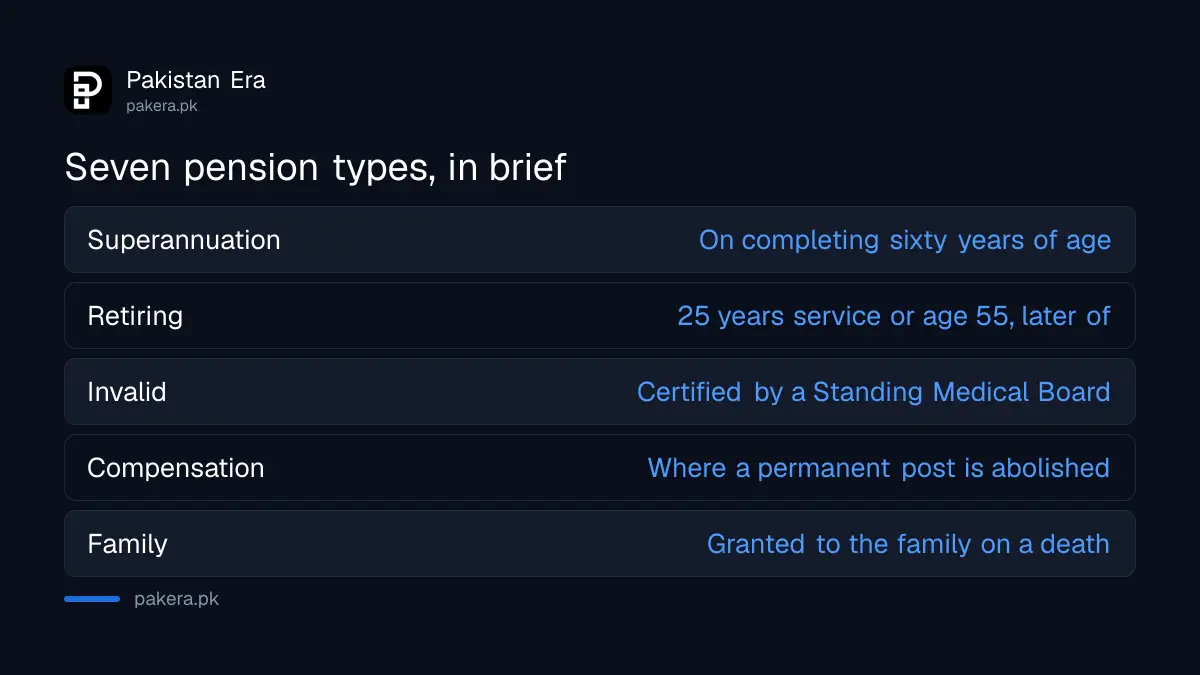
The office lists seven. Getting the label right matters because the eligibility test differs for each.
- Superannuation, granted on completing sixty years of age.
- Retiring, where a civil servant opts to go after twenty five years qualifying service or on reaching fifty five, whichever is later.
- Invalid, where infirmity permanently incapacitates a servant for further service.
- Compensation, where a permanent post is abolished and the servant is discharged.
- Family pension, granted to the family of a government servant who dies.
Two more sit alongside those. A special additional pension goes to retiring civil servants in basic pay scales 20, 21 and 22 who were eligible for orderly allowance, equal to the pre-retirement orderly allowance that was admissible. An anticipatory pension can be sanctioned where a servant is likely to retire before the pension can be finally assessed, after a summary investigation by the audit office.
Retiring pension also covers compulsory retirement, whether directed in the public interest or ordered on grounds of inefficiency, misconduct or corruption. An invalid pension is not granted on a doctor's note alone: the infirmity has to be certified by a duly constituted Standing Medical Board.
The papers an accounts office actually wants
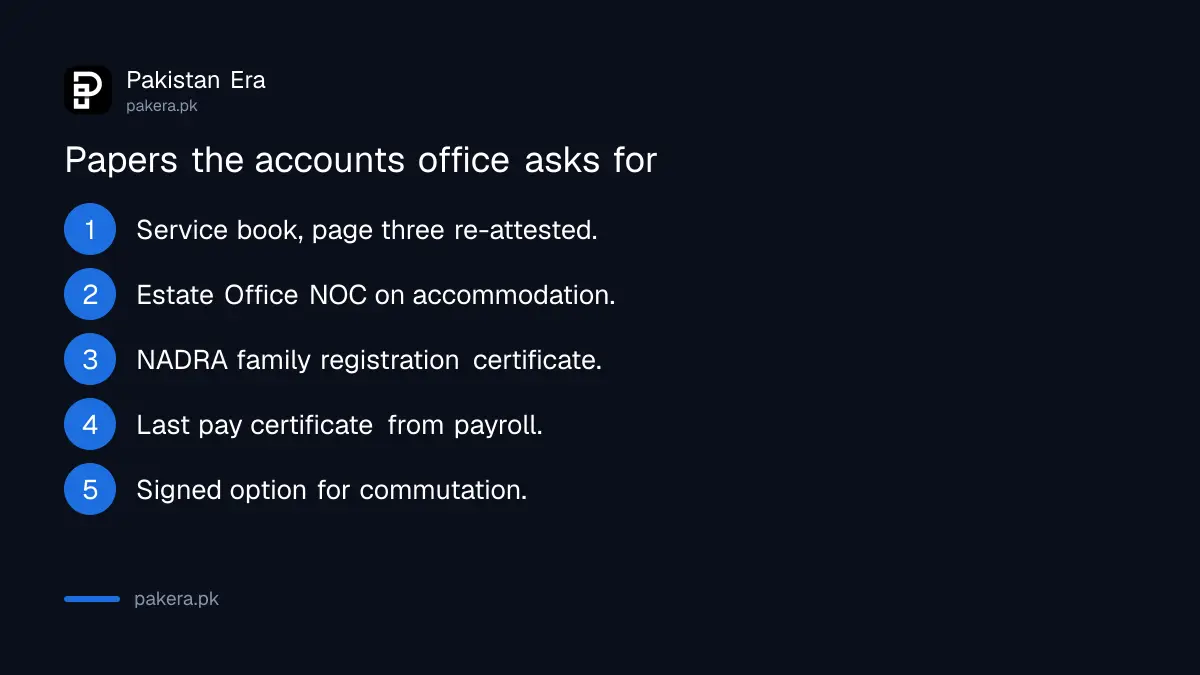
The list for a superannuation, retiring, invalid, compensation or compulsory retirement case is long, and the file goes back if anything is missing. The items below are the ones people are least ready for.
The original service book is required, with page three re-attested by the current drawing and disbursing officer, along with an attested copy. Officers may provide a service statement instead. Chase that attestation early, because it depends on somebody who may have changed post.
A no objection certificate from the Estate Office is required where the civil servant was given government accommodation. Where none was provided, a certificate saying so is needed instead. Either way it is a separate office and a separate wait.
A list of dependent family members is required as per a family registration certificate issued by NADRA, and our guide to getting an FRC covers that. Three attested photographs are needed, three attested CNIC copies of the pensioner and spouse or spouses, specimen signatures, and left and right hand thumb and finger impressions.
Also required are the forwarding memo from the department, the pension application, pension papers signed by the head of department and the sanctioning authority, the notification of retirement, the last pay certificate verified by the payroll section, bank account details on the revised option form, and the option for commutation. Physical verification of the pensioner is required, along with a focal person to hand over the case and act as a witness.
Commutation is a decision, and we are not quoting a percentage
The document list includes an option for commutation, which is the choice to take part of the pension as a lump sum now in exchange for a reduced monthly pension afterwards.
We are not stating the percentage here. Published figures we found disagree with one another, some saying a quarter and some saying more, and the office's own page names the option without setting out the rate. Commuting is close to irreversible and the reduction lasts for years, so this is exactly the number to confirm with your own accounts office rather than take from a website.
Ask three things before signing: what percentage you may commute, what the monthly pension becomes afterwards, and how long the reduction runs before restoration. Get the answers in writing.
When a pensioner dies
A family pension case has its own document list, and it differs again depending on whether the death was in service or after retirement. Both need the death certificate, a covering letter from the department, three attested photographs, and three specimen signatures, thumb and finger impressions and CNIC copies of each family pensioner.
Our guides to applying for a death certificate and to how inheritance shares are worked out cover the documents a family will be assembling at the same time. A pension is not inheritance and does not follow the same shares, so keep the two claims separate.
This is KP, and the private sector is a different system
Pension rules for government servants are set separately by the federal government and by each province. The office we read is the Accountant General Khyber Pakhtunkhwa, which also publishes the Khyber Pakhtunkhwa Civil Servants Pension Rules, 2021 and its own pension calculators.
The broad structure is similar across the country, but do not assume a percentage or a document list transfers. Confirm with the accounts office that handles your own department. If you worked in the private sector rather than government service, the system is EOBI instead, and our guide to checking and applying for an EOBI pension covers that.
Common questions about government pension
At what age does a civil servant retire?
Superannuation pension is granted on completing sixty years of age. A retiring pension is possible after twenty five years qualifying service or at fifty five, whichever is later.
What does a widow receive?
Where the death is in service, 25 per cent of the gross pension as gratuity and 75 per cent monthly. Where it is after retirement, 100 per cent of the net pension the deceased was drawing.
Is unpaid pension lost when a pensioner dies?
No. Pension that could not be drawn is paid to the family as Life Time Arrears.
What holds up a pension file most often?
Missing attestation on the service book, and the Estate Office certificate where government accommodation was involved.
How much of my pension can I commute?
Confirm it with your own accounts office. Published figures disagree and we are not quoting one.
How we verified this
What we checked, where we read it, and what we could not confirm.
Last checked 29 August 2026. We read the pension pages published by the Accountant General Khyber Pakhtunkhwa at agkhyberpakhtunkhwa.gov.pk on that date. The seven pension types and their definitions, the sixty year superannuation age, the twenty five years or fifty five years test for a retiring pension, the Standing Medical Board certification for an invalid pension, the special additional pension for basic pay scales 20, 21 and 22 equal to the pre-retirement orderly allowance, the anticipatory pension, the family pension split of 25 per cent gratuity and 75 per cent monthly on death before retirement, the 100 per cent of net pension on death after retirement, Life Time Arrears, and the document lists including the re-attested service book page, the Estate Office no objection certificate, the NADRA family registration certificate, the last pay certificate and the option for commutation are all taken from those pages. That office administers pensions for Khyber Pakhtunkhwa government servants. The federal government and the other provinces set their own rules, and this page should not be treated as national. We deliberately quote no commutation percentage, because published figures disagree with each other and the office's own page names the option without stating a rate. No rupee amount appears here, because a pension is calculated from your own service and pay.
About the author

Senior Writer, Public Services and Technology
Shahid joined us in 2024 as an author. He is a senior contributor to Pakistan's leading technology websites. He writes detailed articles, mostly covering his expertise in the latest tech, mobiles, apps, gadgets, and step-by-step guides. His ideology is to help people understand the latest trends and explain complex methods through very easy-to-understand guides.