How to Buy Regular Income Certificates in Pakistan: Rs 980 a Month per Rs 100,000
Buy a National Savings Regular Income Certificate in Pakistan: Rs 50,000 minimum, 11.76% monthly profit, 15% or 30% tax, five year term and early exit charges.
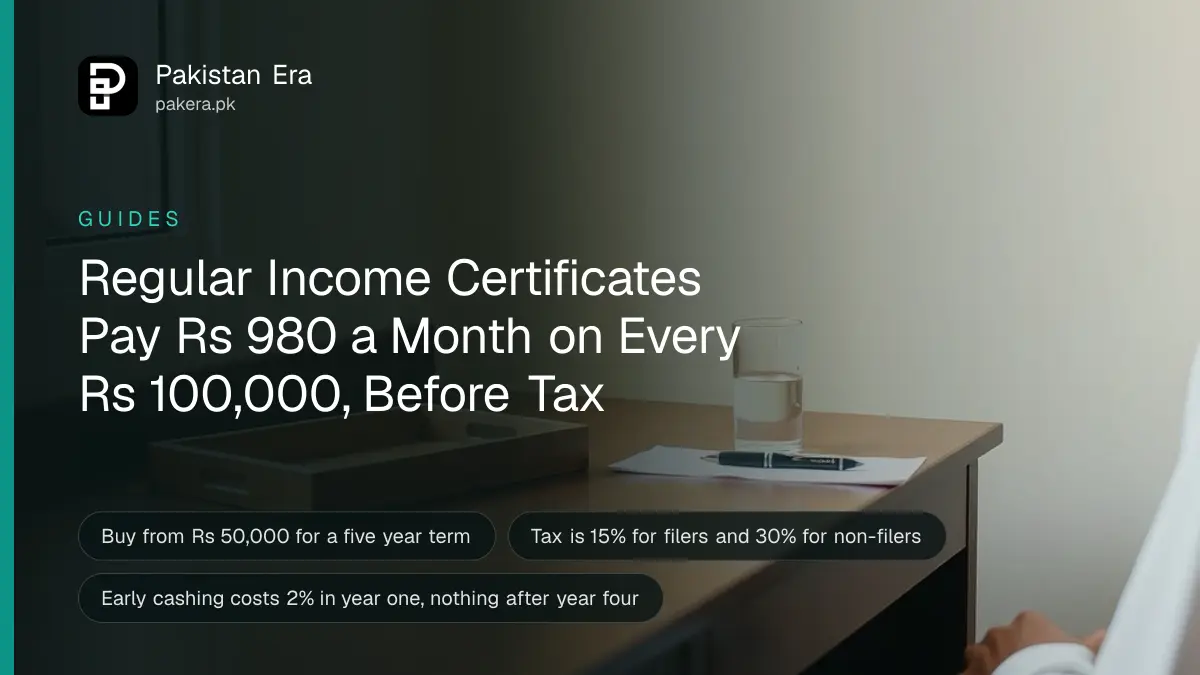
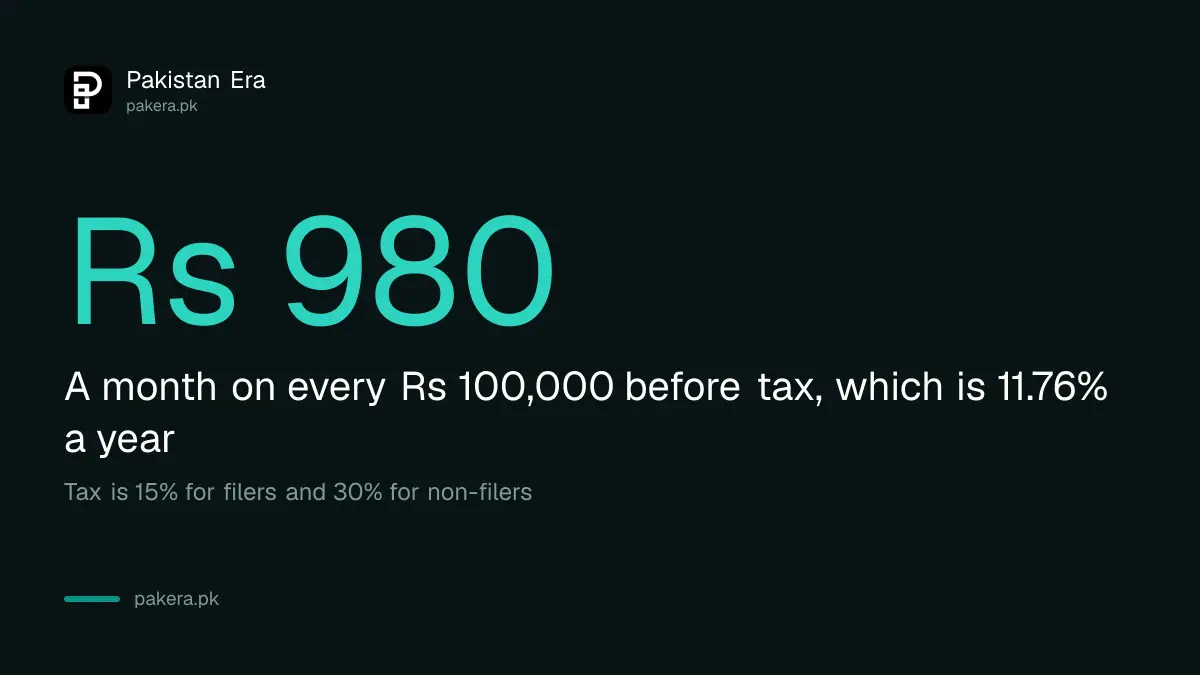
A Regular Income Certificate pays 11.76% a year as monthly profit, which is Rs 980 a month on every Rs 100,000, before tax. The minimum is Rs 50,000, the term is five years, and anyone with a CNIC can buy one. Filers lose 15% of the profit to withholding tax and non-filers lose 30%.
Regular Income Certificates (RICs) are the National Savings product for people who want a steady monthly payment rather than one lump sum at the end. They suit a retired person, a widow or a family that wants rent-like income from savings. This guide covers who can buy, the denominations, the tax, and what leaving early costs.
See who can buy and how much you need
All Pakistani nationals and overseas Pakistanis can buy RICs. You can buy as a single adult, jointly with another adult, or for a minor. The minimum is Rs 50,000. National Savings lists no maximum.
Certificates come in fixed sizes: Rs 50,000, Rs 100,000, Rs 500,000, Rs 1,000,000, Rs 5,000,000 and Rs 10,000,000. You pick the mix that adds up to your amount. If you plan to cash part of the money early, several small certificates give you more control than one big one.
Pensioners and senior citizens have other options with higher rates and no withholding tax. The guides to the Pensioners' Benefit Account and to Behbood Savings Certificates show who qualifies. A person who qualifies for those will usually compare them before choosing an RIC.
Work out the monthly income and the tax
The profit is paid every month from the date of issue. The National Savings rate sheets show 11.76% a year from 1 October 2026, which is Rs 980 a month on each Rs 100,000. The tax is taken from that profit before you get it.
| Amount | Monthly profit before tax | After 15% tax (filer) | After 30% tax (non-filer) |
|---|---|---|---|
| Rs 100,000 | Rs 980 | Rs 833 | Rs 686 |
| Rs 500,000 | Rs 4,900 | Rs 4,165 | Rs 3,430 |
| Rs 1,000,000 | Rs 9,800 | Rs 8,330 | Rs 6,860 |
| Rs 5,000,000 | Rs 49,000 | Rs 41,650 | Rs 34,300 |
Only the Rs 980 line is a National Savings figure. We worked out the after-tax columns ourselves and rounded to the nearest rupee, so they are a guide and not a printed statement. Being a filer saves about Rs 147 a month per Rs 100,000. The guide to the tax on bank and savings profit explains how the filer and non-filer rates work.
The scheme page says RICs are exempt from zakat deduction. It also says the rate can change, so the rate you earn is the rate printed on the day of issue. Our story on October 2026 National Savings rates follows the changes.
Bring the right papers for your type of buyer
Adults bring a CNIC copy. Overseas Pakistanis bring a NICOP or Pakistan Origin Card copy. A minor needs Form B or a Child Registration Certificate from NADRA. Take the originals as well, so the counter can match them.
You can buy at a National Savings Centre, at authorised branches of scheduled banks, or at the State Bank of Pakistan. A cash payment gets you the certificate straight away. A cheque, draft or pay order gets you the certificate once the money clears.
If an overseas Pakistani has no NICOP yet, the guide to applying for a NICOP online explains how to get one before the purchase.
Know what early encashment costs
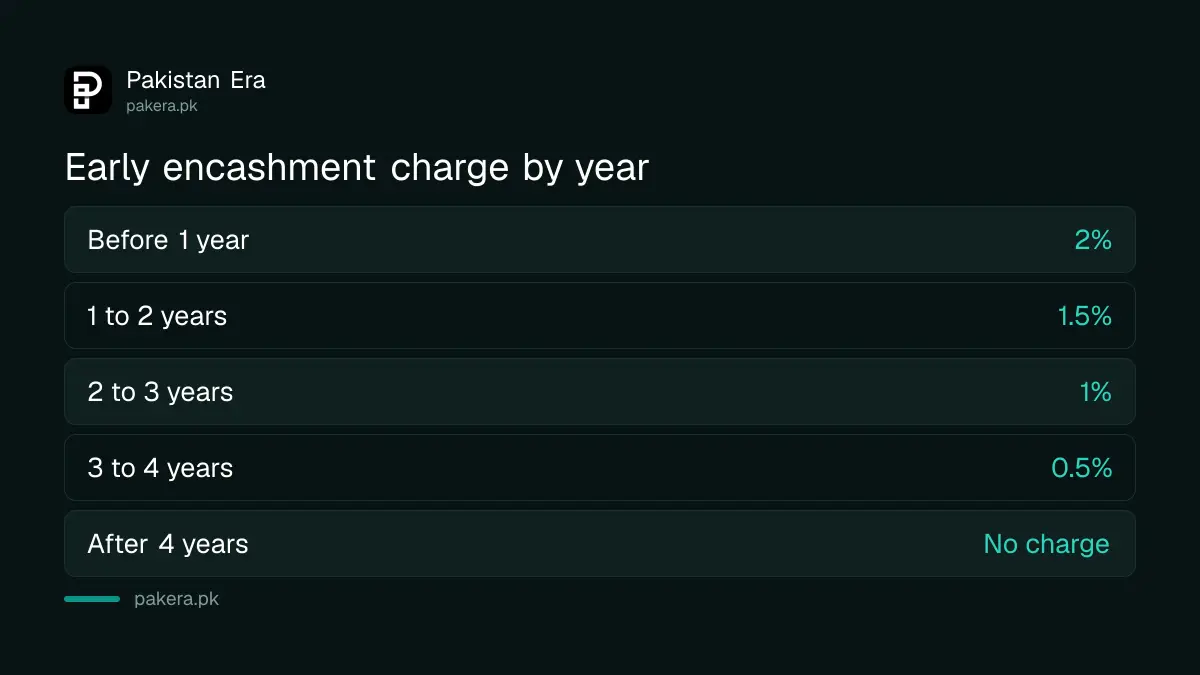
You can cash an RIC before the five years end, but National Savings deducts a service charge. It starts at 2% in the first year and drops by half a point each year until it reaches zero after year four.
| When you cash it | Service charge |
|---|---|
| Before 1 year | 2% |
| Between 1 and 2 years | 1.5% |
| Between 2 and 3 years | 1% |
| Between 3 and 4 years | 0.5% |
| After 4 years | No charge |
On a Rs 1,000,000 certificate, cashing in the first year costs Rs 20,000, by our arithmetic. That is about two months of the profit, so it hurts. The guide to encashing National Savings certificates early compares the charges across schemes.
Reinvestment was stopped for certificates issued after 15 November 2010. That means an RIC cannot be rolled over automatically at maturity. At the end of the five years you collect the money and buy a new one at the rate of that day.
Buy a certificate in six steps
The purchase takes one visit. Decide the amount first, since the denominations are fixed.
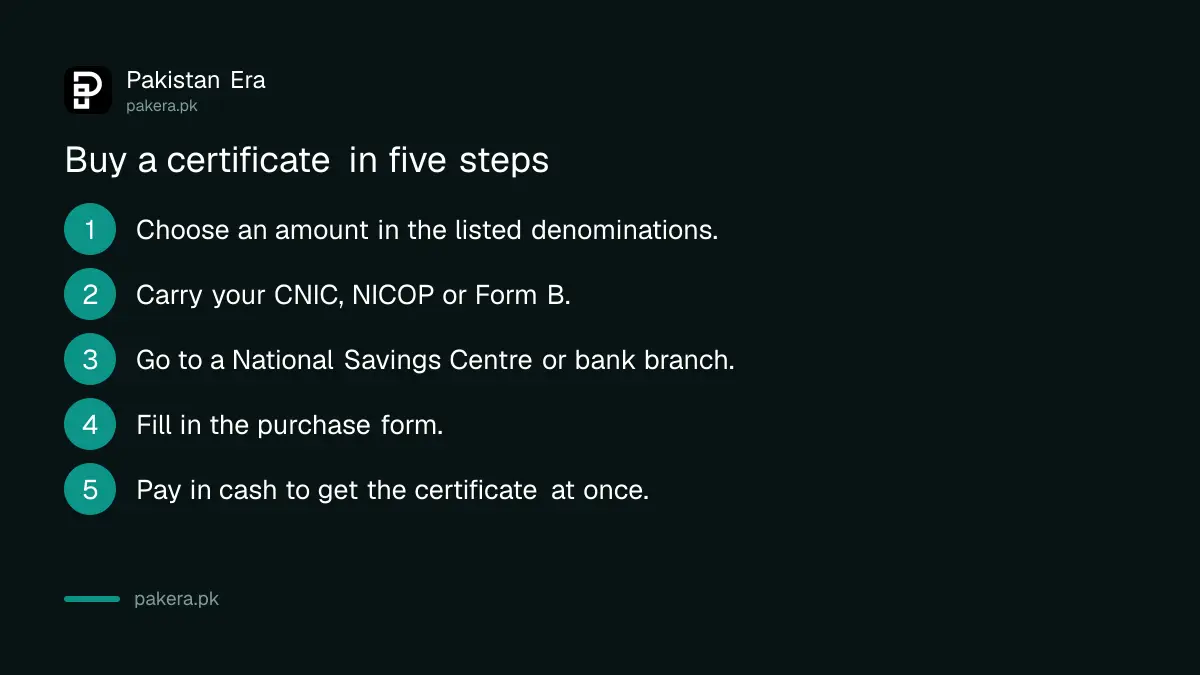
- Decide your amount and split it into the listed denominations.
- Collect your CNIC, NICOP or the child's Form B, with copies.
- Go to a National Savings Centre or an authorised bank branch.
- Fill in the purchase form the counter gives you.
- Pay in cash for same day issue, or by cheque, draft or pay order.
- Keep the certificate safe and note the date of issue.
If a certificate is lost, do not panic. The process for a replacement is in the guide to getting a duplicate National Savings certificate.
Common questions about Regular Income Certificates
What is the minimum for a Regular Income Certificate?
Rs 50,000. National Savings lists the denominations as Rs 50,000, 100,000, 500,000, 1,000,000, 5,000,000 and 10,000,000, with no maximum stated.
How much tax is taken from the profit?
The scheme page lists 15% for filers on the active taxpayer list and 30% for non-filers. The tax is taken at source.
Is the monthly profit fixed for five years?
Not necessarily. National Savings says rates are updated periodically, and the rate has changed many times in 2026. Check what is printed on your certificate.
Can I buy it at a bank?
Yes. Authorised branches of scheduled banks and the State Bank of Pakistan also sell RICs, according to the scheme page. A National Savings Centre is the main place.
Can I buy one for my child?
Yes. An adult can buy for a minor with Form B or a Child Registration Certificate. Adults can also buy jointly with another adult.
How we verified this
What we checked, where we read it, and what we could not confirm.
Last checked 8 October 2026. Eligibility, denominations, the five year term, purchase places, encashment charges, withholding tax and the zakat statement come from the Regular Income Certificates page on the National Savings website, which we read on 8 October 2026. The summary page on the same site dates its rates from 1 October 2026. The 11.76% rate and the Rs 980 monthly profit come from the rate sheets we read on 3 October 2026. We did not visit a centre or a bank branch.
About the author

Tax, Bills and Technology Writer
Ali Akhtar is a young and curious voice here at Pakistan Era. He is currently pursuing his A-Levels and has a growing interest in Pakistan’s changing industrial landscape and educational trends. Ali likes to write in a way that helps him explain and explore the world around him. His writing reflects the perspective of the new generation navigating the evolving trends of Pakistan where technology, youth innovation, and shifting opportunities are reshaping the country’s future.