Encash National Savings Certificates Early in Pakistan: Charges by Scheme
Cashing National Savings certificates early? RIC loses 2% of face value in year one, Behbood 1%, and DSC pays no profit before a year. Steps and rules inside.
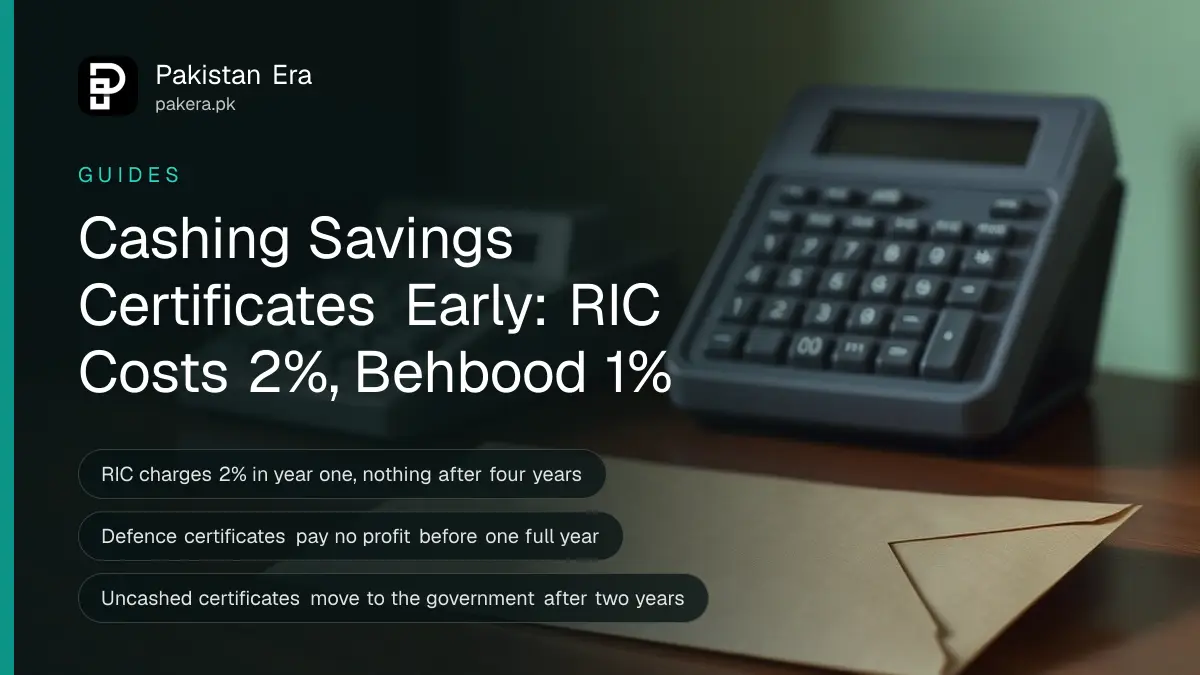
You can cash most National Savings certificates before maturity, but the cost depends on the scheme. Regular Income Certificates lose up to 2% of the face value in the first year. Behbood loses up to 1%. Defence and Special Savings certificates have no charge, but you lose the profit if you cash them too soon.
We read every product page and the FAQs of the Central Directorate of National Savings (CDNS), plus the Defence Savings Certificates Rules 1966 that it publishes. The rules below are copied from those pages. The table is the part to check before you walk into a National Savings Centre.
Early encashment rules for each National Savings scheme
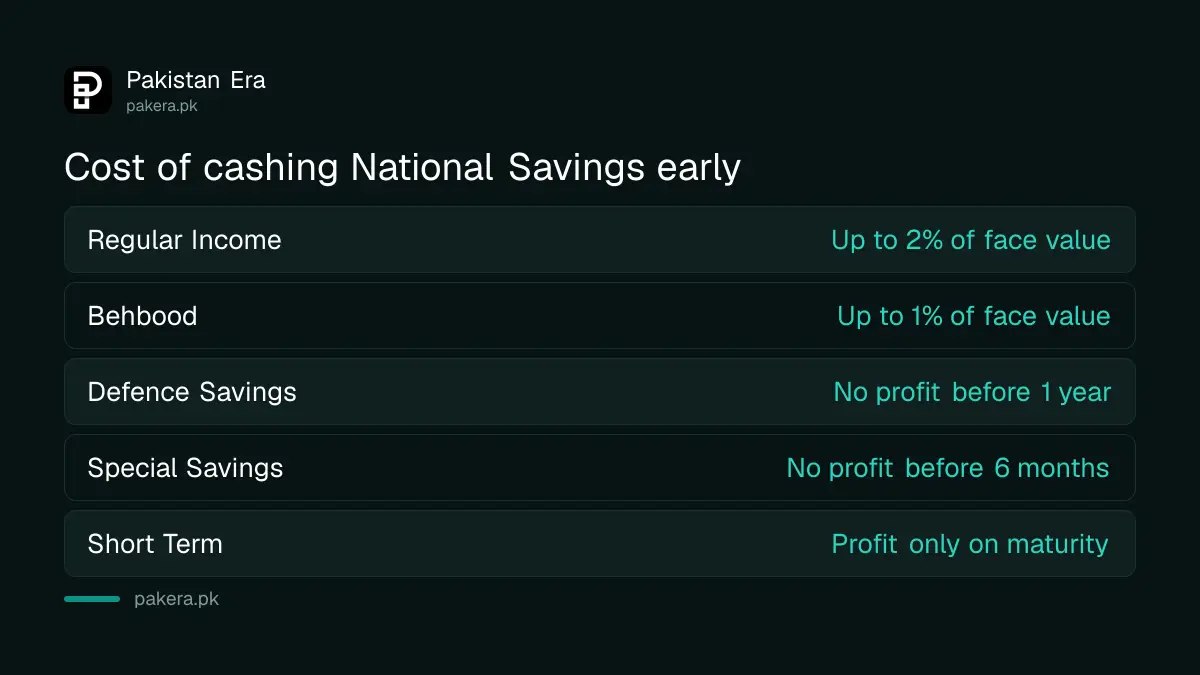
Each scheme has its own rule. Regular Income and Behbood certificates charge a percentage of face value for four years. Defence, Special Savings and Short Term certificates have no charge but withhold profit if cashed too early. The Savings Account lets you withdraw any time.
| Scheme | Can you cash early? | What it costs |
|---|---|---|
| Regular Income Certificate (RIC) | Yes, any time | 2% of face value in year 1, 1.5% in year 2, 1% in year 3, 0.5% in year 4, nothing after |
| Behbood Savings Certificate (BSC) | Yes, any time | 1%, 0.75%, 0.50% and 0.25% in years 1 to 4, nothing after |
| Pensioners' Benefit Account | Yes, in multiples of Rs 1,000 | 1%, 0.75%, 0.5% and 0.25% of the principal in years 1 to 4 |
| Defence Savings Certificate (DSC) | Yes, at par | No charge, but no profit before one full year |
| Special Savings Certificate (SSC) | Yes, at par | No charge, but no profit before six months |
| Short Term Savings Certificate (STSC) | After one month, at the office of issue | Profit is due only on maturity |
| Savings Account | Yes, up to three times a week | No charge |
"At par" means you get back the face value you paid. So a Defence certificate cashed after ten months returns your money and nothing more. For a Short Term certificate, CDNS says profit "shall be due on completion of the maturity period". Cash a 12-month certificate at month eleven and expect principal only.
Regular Income Certificates carry the highest charge
Regular Income Certificates (RIC) charge 2% of face value if cashed in the first year, falling to 0.5% in the fourth year. On Rs 1 million in year one, that is Rs 20,000. The charge is on face value, not on profit, so it bites even after months of payments.
RIC pays Rs 980 a month on every Rs 100,000 from 1 October 2026, or 11.76% a year, according to the CDNS rate card. Twelve monthly payments on Rs 1 million add up to Rs 117,600 before tax. The 2% charge takes Rs 20,000 back. You still come out ahead, but the gap is smaller than people expect.
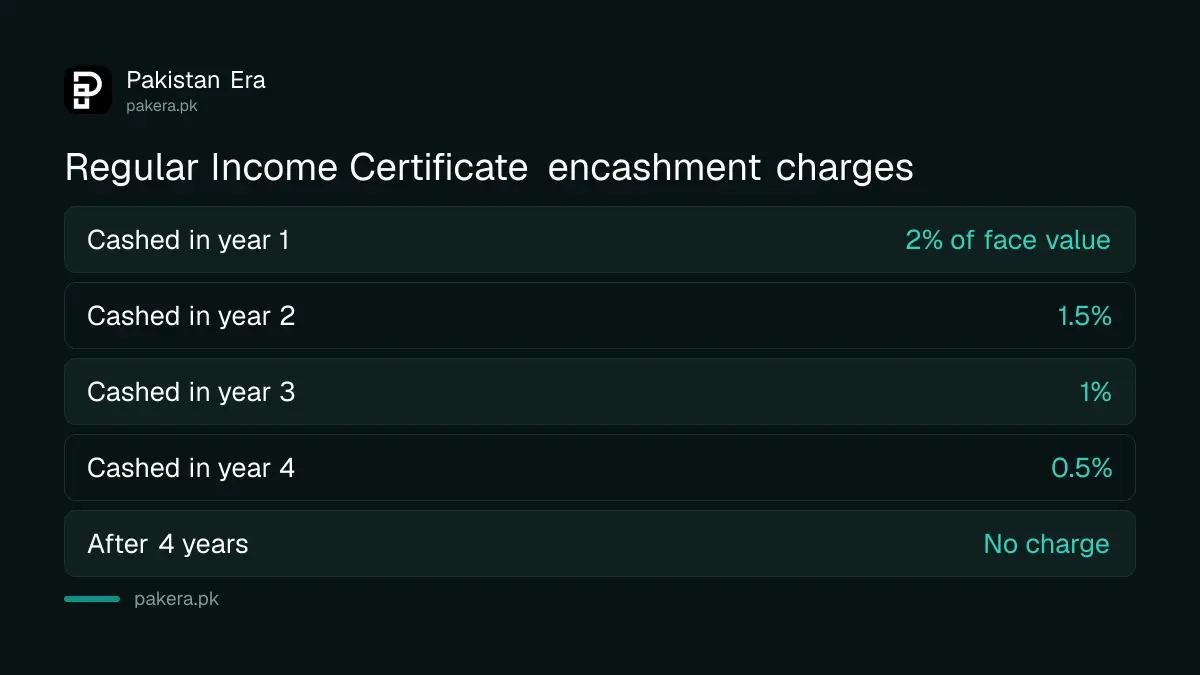
Behbood certificates follow the same pattern at half the rate: 1% in year one, falling to 0.25% in year four. Our tracker of National Savings profit rates shows what each scheme pays now.
Cash a National Savings certificate in five steps
Take the original certificates and your CNIC to the National Savings Centre that issued them. Certificates from a centre can also be cashed at other designated centres, under rule 31 of the Defence Savings Certificates Rules. The centre pays you after taking any service charge.
- Find your office of issue. It is printed on the certificate. Joint holders under Joint-A must both sign or one must give written consent. Under Joint-B either can encash.
- Take the originals and your CNIC. Bring the profit coupon book if you were given one. Overseas holders use a NICOP or POC.
- Ask whether notice is needed. CDNS publishes a "form for giving advance notice of encashment" on its forms page. Large amounts may need notice, so call ahead.
- Check the deduction. Ask the counter to show the service charge and any withholding tax before you sign.
- Keep the discharge record. Note the date and amount paid for your tax return.
If you moved city, you can transfer the registration to another office of issue first. Rule 34 allows this on a prescribed form, and the certificates are handed back after the transfer is recorded.
Tax is still taken from the profit you have earned
Encashing early does not cancel tax on profit already paid. Withholding tax is deducted on Regular Income, Defence, Special Savings and Short Term profit. Behbood and the Pensioners' Benefit Account are the exceptions, with no withholding tax collected on their profit.
The CDNS scheme pages and the 1 October 2026 rate card list the rate as 15% for people on the Active Taxpayers List and 30% for those who are not. Rates are set by the Finance Act each year, so check your own certificate statement for what was actually deducted. The wider rules on tax on bank and savings profit explain how it reaches your return.
Zakat works the same way. Defence and Special Savings certificates have Zakat deducted at source as per rules. Regular Income, Behbood and Short Term certificates are exempt, the scheme pages say.
Certificates left uncashed after maturity stop earning
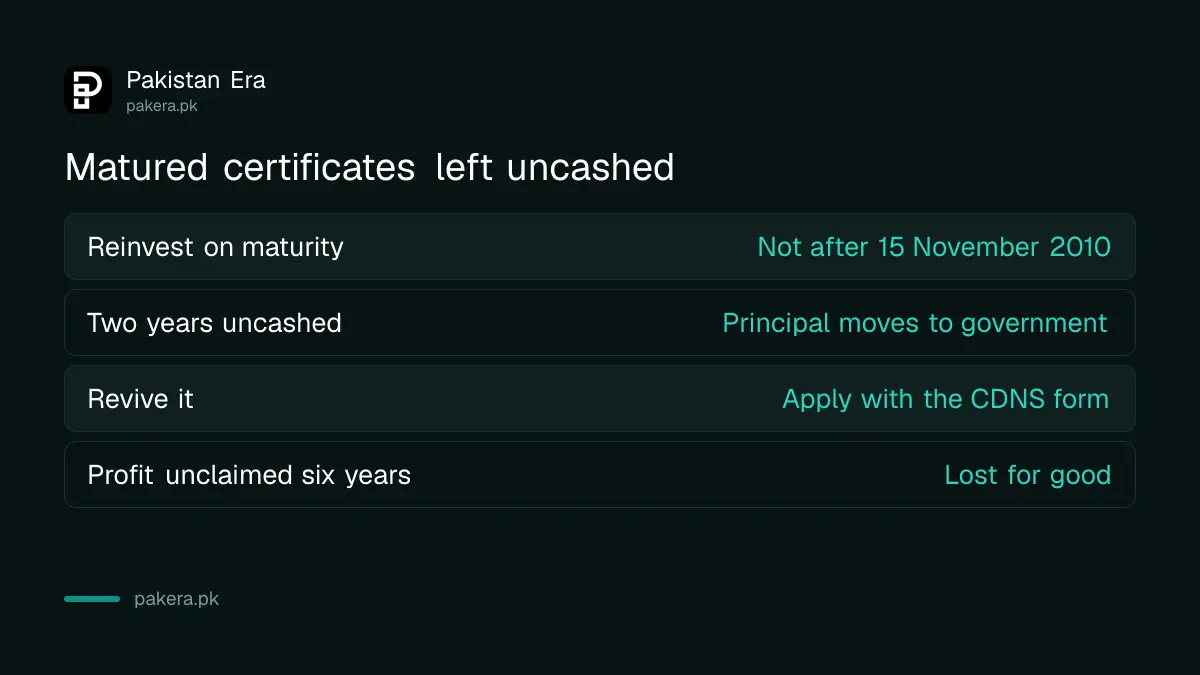
Certificates bought or reinvested on or after 15 November 2010 cannot be reinvested on maturity. If you do not cash them for two years after maturity, the principal moves to the Federal Government account. You can still revive it, but unclaimed profit lapses after six years.
That comes from rule 36A of the Defence Savings Certificates Rules. The certificate is marked "dead" on the centre's records. You, a nominee or a successor can apply to revive it, using the "Proforma for request of revival" on the CDNS forms page. The certificate is then cashed with profit up to maturity, not beyond.
So an old envelope of certificates in a drawer is worth opening. For that case, the process is different, and the succession certificate from NADRA may be needed.
Lost certificates cannot be cashed until a duplicate is issued
If a certificate is lost or stolen, you cannot encash it as normal. You apply to the office of issue, file a police report for values above Rs 10,000, sign an indemnity bond and wait at least one month for a duplicate.
A duplicate is encashable only at the office that issued it. CDNS says payment on a duplicate is made only by account payee crossed government cheque. Keep the originals somewhere safe, and keep photocopies separately.
Common questions
Can I cash National Savings certificates before maturity?
Yes. Every certificate scheme allows early encashment. Short Term certificates need at least one month, and the cost differs by scheme.
How much is deducted if I cash RIC in the first year?
2% of the face value. On Rs 500,000 that is Rs 10,000. The charge drops each year and ends after four years.
Is there a charge for cashing Defence Savings Certificates early?
No service charge. They are paid at par, but no profit is paid if you cash them before one complete year.
Can I cash my certificates at any National Savings Centre?
At the office of issue, or another designated National Savings Centre for certificates a centre issued. Duplicates are cashed only at the office of issue.
Can I reinvest my certificates when they mature?
No, not for certificates bought or reinvested on or after 15 November 2010. You cash them and buy new ones at the current rate.
What happens if I forget to cash a matured certificate?
After two years the principal moves to the government account. You can revive it, but profit unclaimed for six years is lost.
How we verified this
What we checked, where we read it, and what we could not confirm.
Last checked at about 2 am PKT on 3 October 2026. We read the CDNS pages for Regular Income, Defence, Special Savings, Short Term and Behbood certificates, the Savings Account and the Pensioners' Benefit Account, the CDNS FAQs, the public forms page, the 1 October 2026 rate card, and rules 31, 34, 36A and 62 to 64 of the Defence Savings Certificates Rules 1966 in the CDNS version with amendments to May 2021. We could not read the advance notice form, which is a scanned file, so we do not say when notice is required.
About the author

Senior Writer, Public Services and Technology
Shahid joined us in 2024 as an author. He is a senior contributor to Pakistan's leading technology websites. He writes detailed articles, mostly covering his expertise in the latest tech, mobiles, apps, gadgets, and step-by-step guides. His ideology is to help people understand the latest trends and explain complex methods through very easy-to-understand guides.