Buy Behbood Savings Certificates in Pakistan: 12.72% Profit, Who Qualifies
Behbood Savings Certificates pay 12.72% from 1 October 2026. Who can buy them, the papers a widow needs, the Rs 7.5 million cap and the early encashment charge.
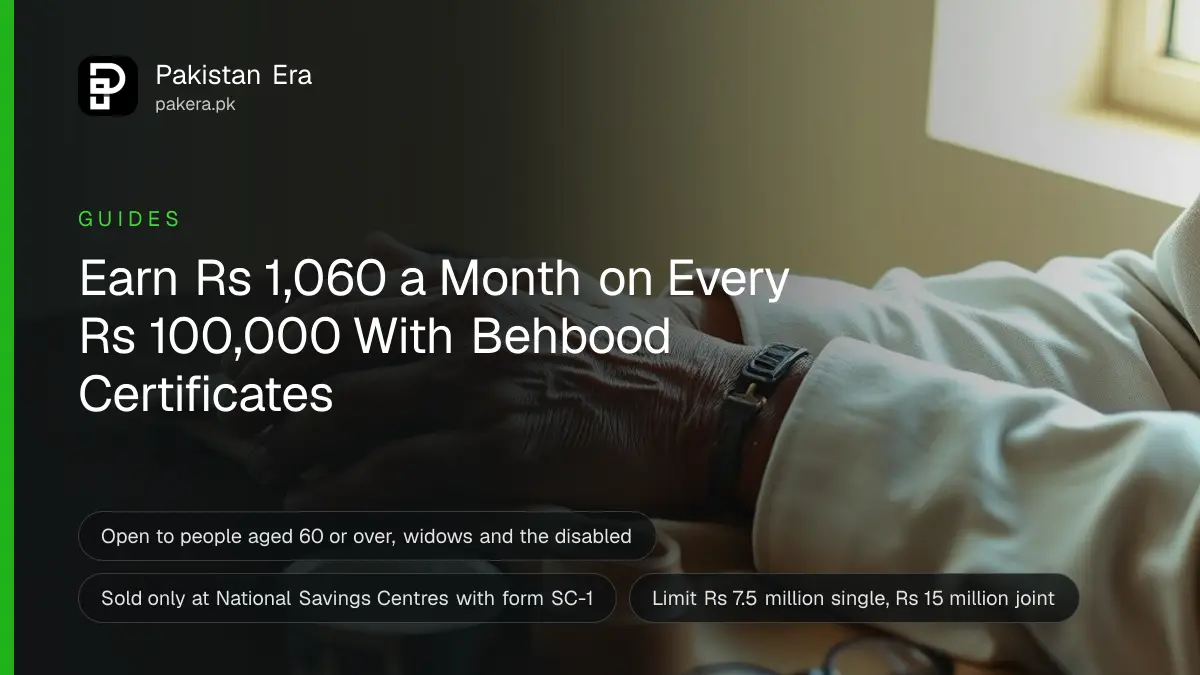
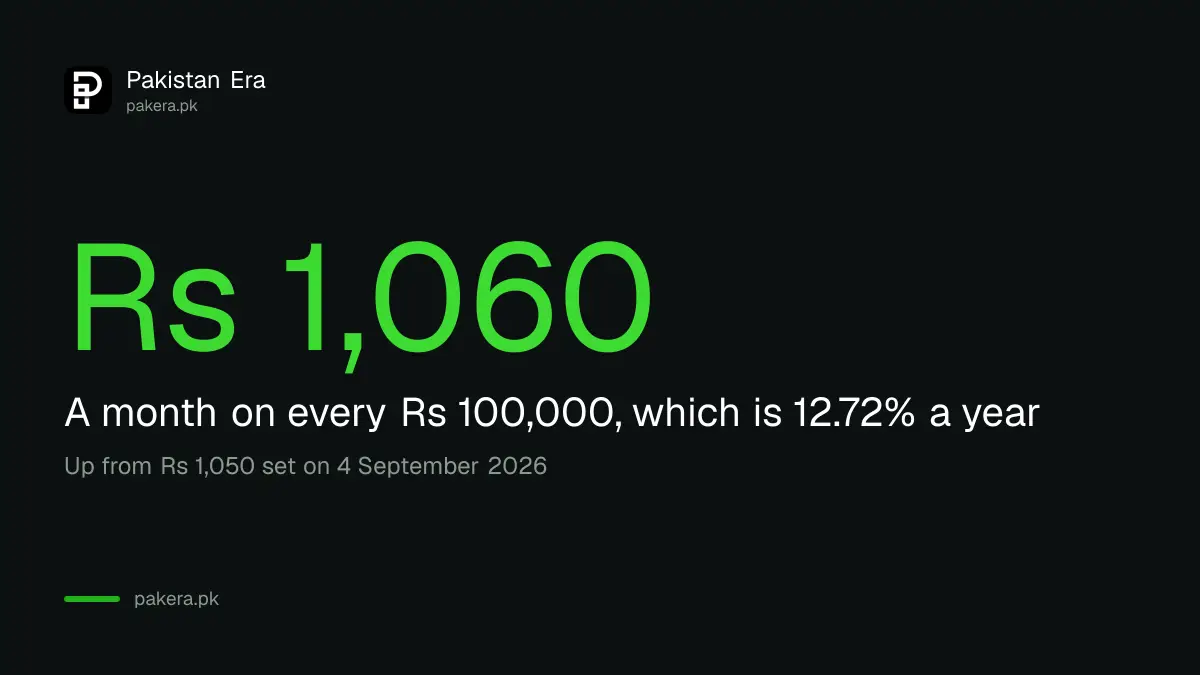
You can buy Behbood Savings Certificates only at a National Savings Centre, with form SC-1 and your CNIC. From 1 October 2026 they pay Rs 1,060 a month on every Rs 100,000, which is 12.72% a year. Only three groups can buy: people aged 60 or over, widows who have not remarried, and people with a disability logo on their CNIC.
We read the Central Directorate of National Savings (CDNS) product page, its FAQs and the new rate card dated 1 October 2026 before writing this. Behbood is the best paying ordinary scheme National Savings sells right now, and it carries no withholding tax on the profit. That is why the eligibility rules are strict, and why a mistake on them can cost you the profit later.
Three groups of people can buy Behbood certificates
Behbood certificates are for senior citizens aged 60 or above, widows who have not remarried, and disabled people whose CNIC carries the disability logo. A special minor with a disability can hold them through a guardian. Two eligible people can also buy jointly.
The scheme started in 2003 for widows and the elderly. CDNS says it was extended to disabled persons and special minors from 1 January 2018. Its FAQ is blunt on one point that surprises many families: widowers cannot invest at present. A man whose wife has died qualifies only once he turns 60.
A widow stays eligible "as long as she does not re-marry". If CDNS later learns she remarried, the product page says the money she received must be refunded under the rules. So the undertaking she signs is not a formality.
If the disability logo is missing from your card, sort that out first. The disability certificate and special CNIC come before the investment, not after.
Behbood pays 12.72% a year from 1 October 2026
The CDNS rate card effective 1 October 2026 lists Behbood at Rs 1,060 a month for each Rs 100,000, or 12.72% a year. That is up from Rs 1,050 (12.60%) set on 4 September. Profit is paid every month from the date of purchase.
The rate is not fixed for ten years. CDNS revises it often, and it changed at least five times in 2026. The CDNS rate sheet lists the monthly profit period by period, so treat Rs 1,060 as today's figure, not a promise. The full history sits in the Behbood rate sheet on the CDNS latest profit rates page, and our tracker of National Savings profit rates compares it with the other schemes.
| Item | Behbood Savings Certificate |
|---|---|
| Profit from 1 October 2026 | Rs 1,060 a month per Rs 100,000 (12.72% a year) |
| Minimum | Rs 5,000 |
| Maximum | Rs 7.5 million single, Rs 15 million joint |
| Term | 10 years, no reinvestment for certificates bought after 15 November 2010 |
| Denominations | Rs 5,000, 10,000, 50,000, 100,000, 500,000 and 1,000,000 |
| Withholding tax and Zakat | Not collected on the profit; exempt from Zakat |
| Where to buy | National Savings Centres only |
One number needs care. The CDNS FAQ still says the limit is Rs 5 million single and Rs 10 million joint. The product page and the 1 October rate card both say Rs 7.5 million. We used the newer figure, but ask the counter before you deposit close to the limit.
Buy Behbood certificates at a National Savings Centre in five steps
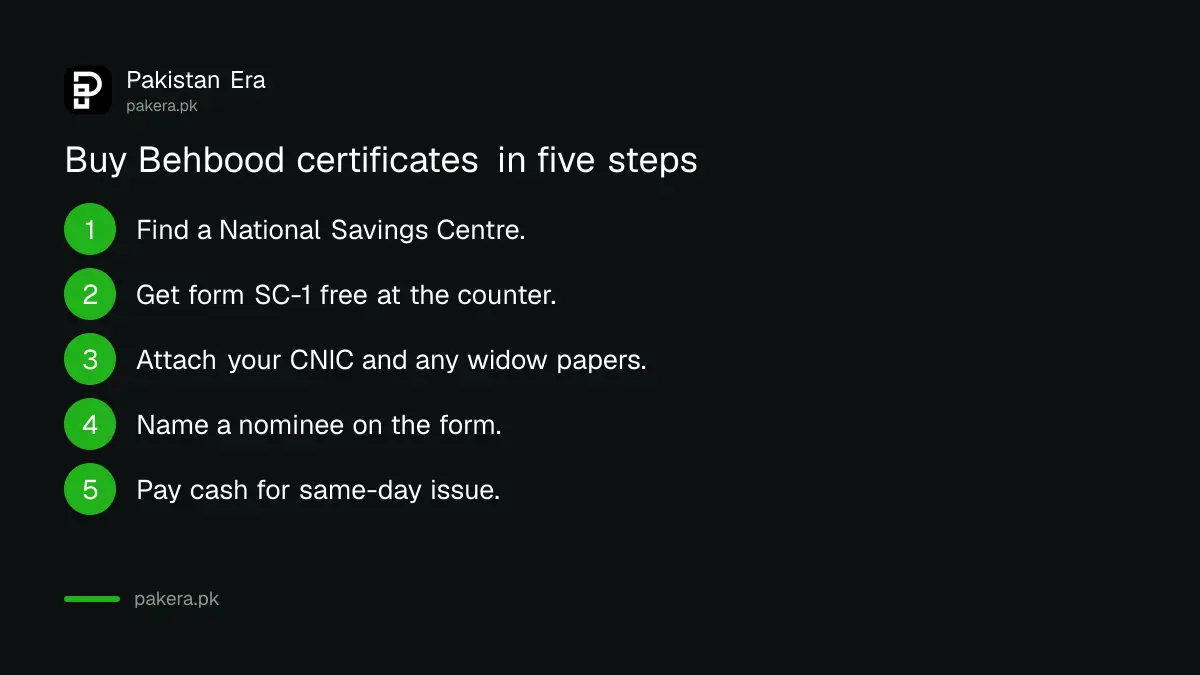
Behbood is sold only at National Savings Centres, not at banks or the State Bank. You fill in form SC-1, attach your CNIC copy and pay by cash or cheque. Cash buys the certificate the same day. A cheque buys it from the day the cheque clears.
- Find your nearest centre. CDNS lists its regional directorates and centres on savings.gov.pk. The helpline is 051 111 267 268.
- Get form SC-1. It is free at the counter and can be downloaded from the CDNS public forms page.
- Add your papers. A senior citizen needs a CNIC copy. An overseas Pakistani needs a NICOP. A widow needs more, listed below.
- Name a nominee. The form asks who receives the money if you die. Fill it in. It saves your family a long process later.
- Pay and collect. Pay cash for same-day issue, or a cheque, draft or pay order that dates the certificate from clearance.
Senior citizens and women can go straight to the counter. The CDNS FAQ asks them to contact the counter official without waiting their turn.
Widows need two extra documents
A widow must attach her husband's death certificate and an undertaking that she has not remarried. CDNS wants the undertaking on stamp paper, attested by a notary public or oath commissioner with seal and stamp. CDNS also publishes an affidavit format for this.
The death certificate must come from the department that issued it, usually the union council. If you do not have one yet, the union council death certificate process comes first. The affidavit on the CDNS forms page names the widow, her CNIC, her husband and the date he died, and is verified by a class-I gazetted officer or oath commissioner.
Keep copies of everything. The same papers may be asked for again if you add money years later.
Pensioners have a second option, the Pensioners' Benefit Account
Retired government employees can use the Pensioners' Benefit Account instead. It pays the same Rs 1,060 a month per Rs 100,000 from 1 October 2026. It needs a pension payment order or proof of retirement, and allows one account per person across Pakistan.
The CDNS page for the account says it is open to pensioners of the federal and provincial governments, AJK, the armed forces, and semi-government and autonomous bodies. After a pensioner dies, an eligible family member can invest. The minimum is Rs 10,000.
Its rules are tighter than Behbood's. You may make the opening deposit and only seven more. Going past eight deposits, past the Rs 7.5 million cap or opening a second account makes the account irregular with zero profit, and CDNS can recover profit already paid. A pensioner who is also 60 or over can choose either scheme.
Neither scheme has withholding tax deducted on profit, according to CDNS. That does not make the profit vanish from your tax return, so a pensioner filing this year should list it. Our steps for a tax return as a pensioner cover where it goes.
Early encashment costs up to 1% of the face value
You can cash Behbood certificates at any time, but CDNS deducts a service charge in the first four years. The charge is 1% in year one, 0.75% in year two, 0.50% in year three and 0.25% in year four. After four years there is no charge.
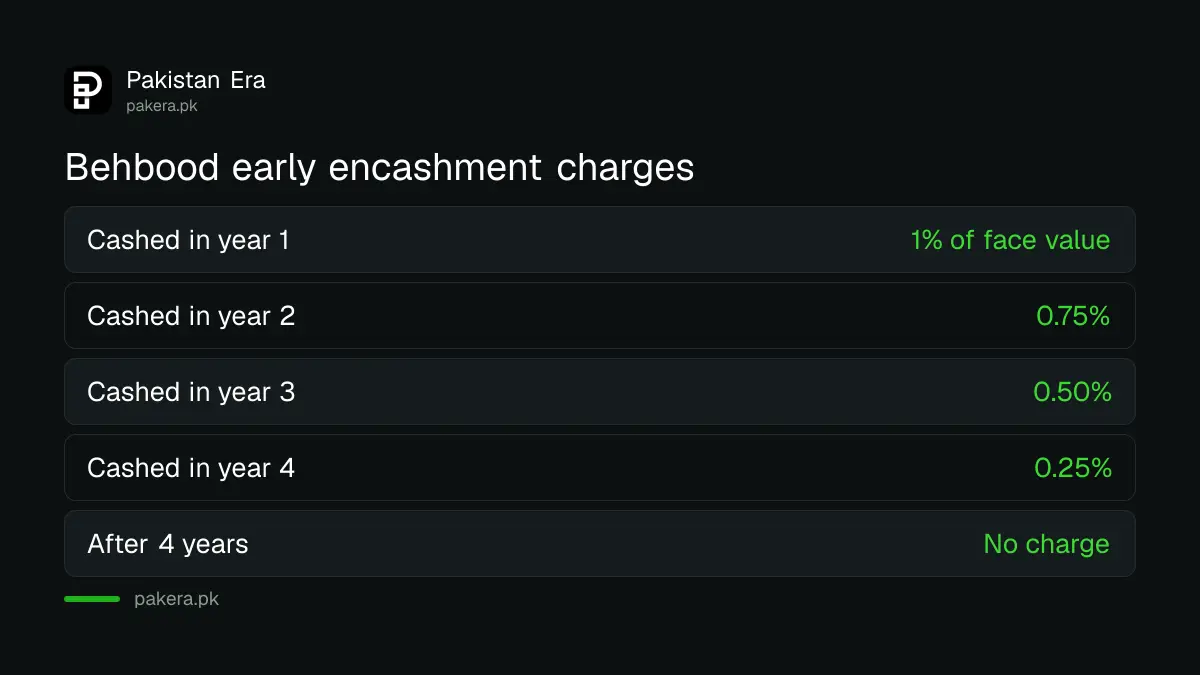
On Rs 1 million cashed in the first year, that is Rs 10,000 gone. Buy several smaller denominations rather than one large one. Then you can cash only what you need and leave the rest earning.
Behbood certificates cannot be pledged as security for a loan and cannot be transferred to another person, the FAQ says. They pass to your nominee or heirs on death, under the rules.
Common questions
Can a widower buy Behbood Savings Certificates?
No. CDNS says widowers cannot invest at present. A widower qualifies only as a senior citizen, once he is 60.
Can I buy Behbood certificates online or at a bank?
No. The CDNS product page says Behbood is sold only at National Savings Centres, with form SC-1.
Is tax deducted on Behbood profit?
No withholding tax is collected on Behbood profit, and the certificates are exempt from Zakat, according to CDNS.
How much do I earn on Rs 1 million in Behbood?
Rs 10,600 a month at the rate effective 1 October 2026. The rate can change at any CDNS revision.
Can overseas Pakistanis buy Behbood?
Yes, if they are eligible. A senior citizen living abroad uses a NICOP with the application.
What happens to Behbood if the holder dies?
The money goes to the nominee or legal heirs under the rules. Naming a nominee on form SC-1 makes this easier.
How we verified this
What we checked, where we read it, and what we could not confirm.
Last checked at about 2 am PKT on 3 October 2026. We read the CDNS Behbood Savings Certificate page, the Pensioners' Benefit Account page, the CDNS FAQs, the public forms page and the affidavit format, and the rate card on the latest profit rates page dated with effect from 1 October 2026, which lists Behbood and the Pensioners' Benefit Account at Rs 1,060 per Rs 100,000 a month (12.72%). The FAQ's older Rs 5 million limit conflicts with the Rs 7.5 million on the product page and rate card; we used the newer figure.
About the author

Senior Writer, Public Services and Technology
Shahid joined us in 2024 as an author. He is a senior contributor to Pakistan's leading technology websites. He writes detailed articles, mostly covering his expertise in the latest tech, mobiles, apps, gadgets, and step-by-step guides. His ideology is to help people understand the latest trends and explain complex methods through very easy-to-understand guides.