File a Tax Return as a Pensioner in Pakistan: Pension to Rs 10 Million Taxed at 0%
Pensioners must file the 2026 tax return by 15 October. Pension up to Rs 10 million is taxed at 0%, family pension is exempt. Steps to file it on FBR IRIS.
Pensioners in Pakistan file their tax year 2026 return on IRIS by 15 October 2026. Pension from a former employer now sits in the return: up to Rs 10 million a year is taxed at 0%, and 5% applies only above that. Family pension and commuted pension stay exempt.
Tax year 2026 is the first year this rule applies. The Finance Act 2025 removed the old blanket exemption for pension. In its place, the First Schedule now gives pension from a former employer its own rate table. For almost every retired person, the tax is still zero. But the pension is now income under the law, so it belongs in the return.
We read every rule here in FBR's copy of the Income Tax Ordinance 2001, amended up to 30 June 2026, on 2 October 2026. FBR has extended the due date to 15 October 2026 by Circular No. 3 of 2026-27, so there is still time.
Pension up to Rs 10 million a year is taxed at 0%
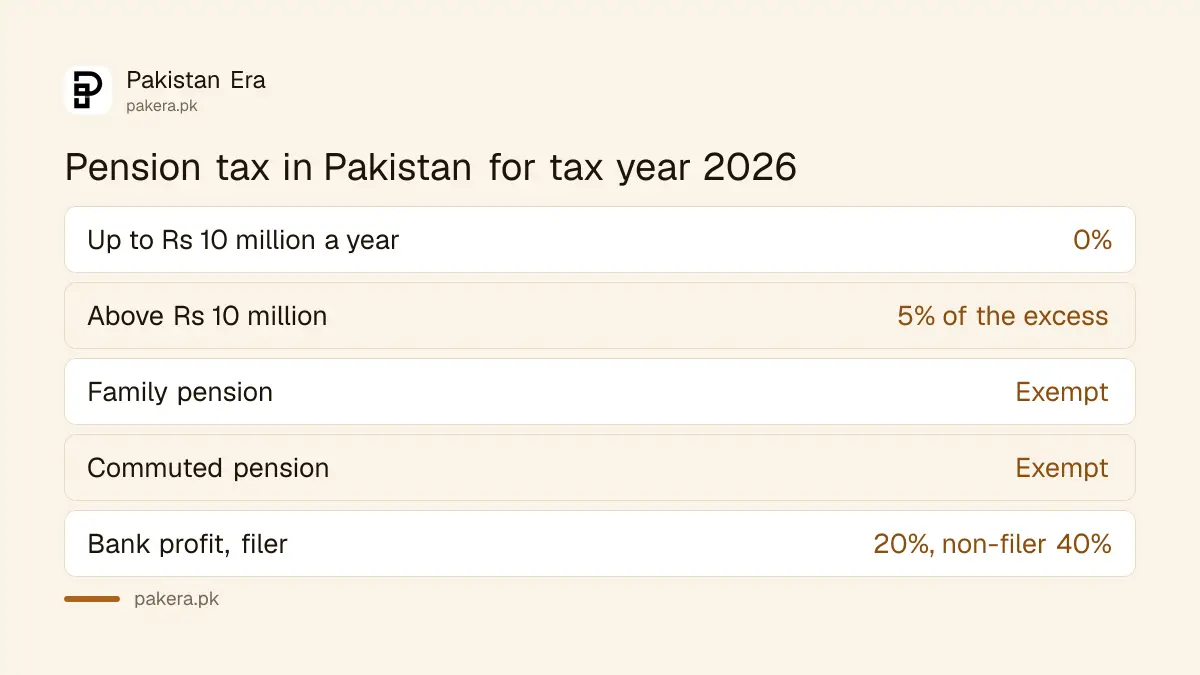
A proviso in Part I of the First Schedule sets a separate rate for pension received from a former employer. The first Rs 10 million in a tax year is taxed at 0%. Only the amount above Rs 10 million is taxed, at 5%.
That threshold is about Rs 833,000 a month. Few government or private pensions come near it. A retired grade 20 officer, a bank pensioner or an army pensioner will in most cases owe nothing on the pension itself.
| Yearly pension from a former employer | Tax on the pension |
|---|---|
| Rs 600,000 (Rs 50,000 a month) | Rs 0 |
| Rs 2,400,000 (Rs 200,000 a month) | Rs 0 |
| Rs 10,000,000 | Rs 0 |
| Rs 12,000,000 | Rs 100,000 (5% of Rs 2 million) |
The last row is our arithmetic from the table in the law. Your other income, such as rent or business profit, is still taxed at the normal rates. The salary tax slabs are a different table and do not apply to the pension.
Some pensions are still fully exempt
Three kinds of pension money remain exempt under Part I of the Second Schedule. Family pension paid to the dependants of a public servant or member of the Armed Forces who died, commuted pension from the government or an approved scheme, and some gratuity on retirement.
- Family pension: clause 9(ii) exempts pension granted under the rules to the families and dependants of public servants or Armed Forces members who die.
- Commutation: clause 12 exempts a commuted pension received from the government or under a pension scheme approved by FBR.
- Gratuity: clause 13 exempts gratuity or commutation on retirement up to set limits.
Widows and children receiving a family pension should still declare it, as exempt income. That keeps the money in the wealth statement and stops a mismatch later. If the family pension case itself is stuck, the steps for a government pension case come first.
A pensioner has to file if any of these apply
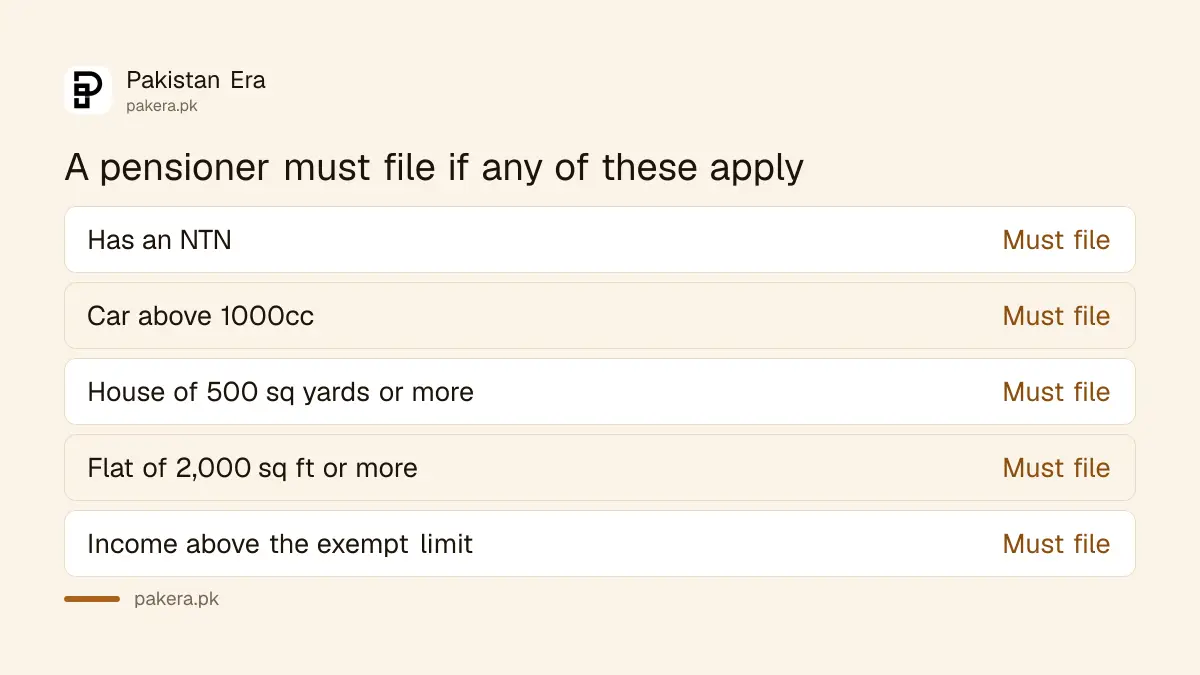
Section 114 requires a return from anyone with taxable income above the exempt limit. It also catches people with an NTN, a car above 1000cc, a house of 500 square yards or more, or a flat of 2,000 square feet or more, whatever their income.
That list covers most retired officers. Many have an NTN from their working years, and section 114(1)(b) lists having obtained an NTN as a reason to file on its own. If you have one, you are expected to file every year.
Even where the law does not require it, filing is worth it. A filer pays 20% tax on bank profit and a non-filer pays 40%. Pensioners often keep savings in the bank, so that gap alone can pay for the effort many times over. More detail is in the breakdown of tax on bank profit and savings.
File the pension return on IRIS in six steps
Gather your papers before you log in, because IRIS closes an idle session. You need your CNIC, your IRIS password, a pension statement for July 2025 to June 2026, bank profit certificates and the tax deducted on bills and phones.
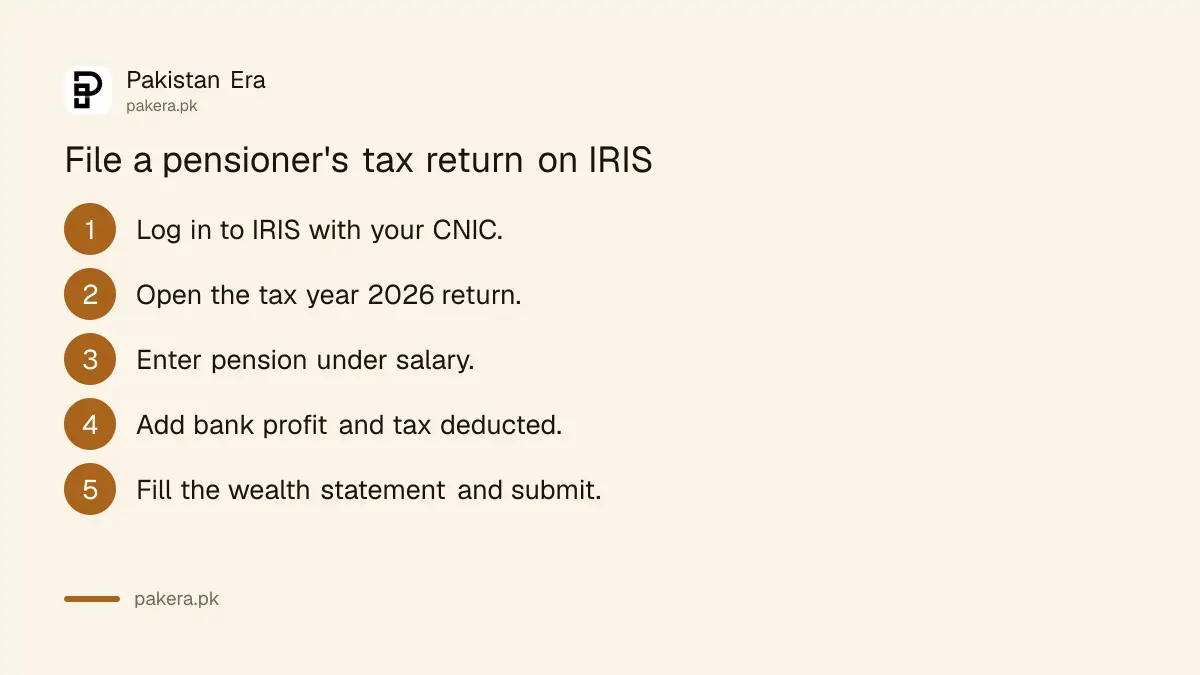
- Log in to IRIS, or the Tax Asaan app, with your CNIC and password.
- Open the return for tax year 2026, which covers 1 July 2025 to 30 June 2026.
- Enter the pension under the salary part of the return, because section 12 counts a pension as salary. Mark family pension and commutation as exempt.
- Enter bank profit and any rent, then the tax already deducted on them.
- Fill the wealth statement: house, car, bank balances, savings certificates and the pension you received.
- Submit, save the acknowledgement, and pay any tax due with a PSID.
We did not log in to a pensioner's IRIS account, so field names on your screen may differ slightly. If you prefer the phone, the Tax Asaan app asks the same questions in a shorter form.
Savings and bank profit decide most pensioners' tax
For most retired people, the real tax is on savings, not pension. Profit on bank deposits and National Savings is taxed when paid. A filer pays 20% on bank profit and a non-filer pays double. That deduction is usually final.
Profit on Behbood Savings Certificates and the Pensioners' Benefit Account has its own cap in clause 6 of Part III of the Second Schedule. Check the tax actually deducted on your NSS statement and enter that figure. Do not guess.
Some pensioners also hold extra tax that was deducted and not owed. If your return shows more tax paid than due, you can claim an income tax refund once you are on the Active Taxpayers List.
Miss 15 October and the costs start
File after 15 October 2026 and two costs apply. Section 182 charges a late penalty of Rs 1,000 a day or more, with a Rs 50,000 minimum for anyone whose income is not mainly salary. Section 182A adds a Rs 25,000 surcharge to get back on the Active Taxpayers List.
Pension counts as salary under section 12, so many pensioners may fall under the Rs 10,000 minimum for people with 75% or more salary income. The law does not say so directly for pension, so do not test it. File before the date.
The circular that moved the date is covered in the report on how FBR extended the deadline to 15 October.
Common questions
Is pension taxable in Pakistan in 2026?
Pension from a former employer is taxed at 0% up to Rs 10 million a year and 5% above that, from tax year 2026. For nearly all pensioners the tax is zero.
Do pensioners need to file an income tax return?
Yes, if they have an NTN, a car above 1000cc, a large house or flat, or taxable income above the limit. Filing also halves the tax on bank profit.
Is family pension taxable?
No. Clause 9(ii) of Part I of the Second Schedule exempts pension paid to the families and dependants of public servants and Armed Forces members who die.
Is commuted pension taxable?
No. Clause 12 exempts commutation of pension received from the government or under an approved pension scheme.
Where do I show pension in the IRIS return?
Under salary, because section 12 of the Ordinance counts any pension as salary. Mark any exempt part, such as family pension or commutation, as exempt income.
What is the last date for pensioners to file?
15 October 2026 for tax year 2026, after FBR's Circular No. 3 of 2026-27 extended the 30 September date.
How we verified this
What we checked, where we read it, and what we could not confirm.
Last checked on 2 October 2026. The 0% rate up to Rs 10 million and 5% above it is the proviso on pension from a former employer in Division I, Part I of the First Schedule. The removal of the old clause 8 and clause 9(i) exemptions by the Finance Act 2025, and the surviving clauses 9(ii), 12 and 13, are from Part I of the Second Schedule. The reasons to file are from section 114(1), and pension as salary is section 12(2)(f). All are read in FBR's Income Tax Ordinance 2001, amended up to 30 June 2026. The 15 October date is from FBR's Circular No. 3 of 2026-27. The bank profit rates are from the First Schedule as read on 21 September 2026. The table examples are our own arithmetic. Nothing here is tax advice for your own case.
About the author

Tax, Bills and Technology Writer
Ali Akhtar is a young and curious voice here at Pakistan Era. He is currently pursuing his A-Levels and has a growing interest in Pakistan’s changing industrial landscape and educational trends. Ali likes to write in a way that helps him explain and explore the world around him. His writing reflects the perspective of the new generation navigating the evolving trends of Pakistan where technology, youth innovation, and shifting opportunities are reshaping the country’s future.