How to Claim an Income Tax Refund From FBR in Pakistan
Paid more tax than you owe? Claim your FBR income tax refund on IRIS under section 170. See the three year limit, the IBAN step and the ATL rule that blocks it.
To claim an income tax refund from FBR, your e-filed return must show the refundable amount, and you then file a refund application under section 170 on IRIS. The law gives you three years to apply. You must also be on the Active Taxpayers List, because section 182A blocks refunds for anyone off it.
Update, 11 October 2026: Delays can go to the Federal Tax Ombudsman.
Refunds usually come from tax taken at source: on salary, a phone bill, bank profit or a car registration. If more was deducted than you owe for the year, the difference is yours. Getting it back takes a few steps, and one wrong detail, like a missing IBAN, can hold it up for months.
You get a refund when tax deducted is more than tax owed
Section 170 of the Income Tax Ordinance lets a taxpayer who paid more tax than the law charges apply to the Commissioner for the excess. The refund must show in your return's computation before you can claim it.
We read section 170 in FBR's consolidated copy of the Ordinance, amended up to 30 June 2026. FBR's refund page adds two practical conditions. The return must be filed electronically, because "a manual Return does not entitle you to a refund". And the refund amount "should be clearly reflected" in the return on IRIS.
So start with your return. Open the computation part of your tax year 2026 return and look at the last line. If it shows a refundable amount, you have a claim. If you are not sure the return went through, first check your return was filed on IRIS.
Not every deduction is refundable. Some taxes are final or minimum taxes and cannot come back. Only adjustable tax deductions count towards a refund.
The law gives you three years to apply
A refund application must be made within three years of the later of two dates: the date of the assessment order for that year, or the date the tax was paid. A filed return normally counts as the assessment order.
Section 170(2)(c) set the limit at two years until the Finance Act 2016 changed it to three. FBR's own refund page still says "within two years", but the Ordinance says three. The law is what counts. Still, there is no reason to wait.
Under section 120, a complete return is taken to be an assessment order issued on the day you filed it. So for a return filed on 30 September 2026, the three years run to about 30 September 2029, by our reading.
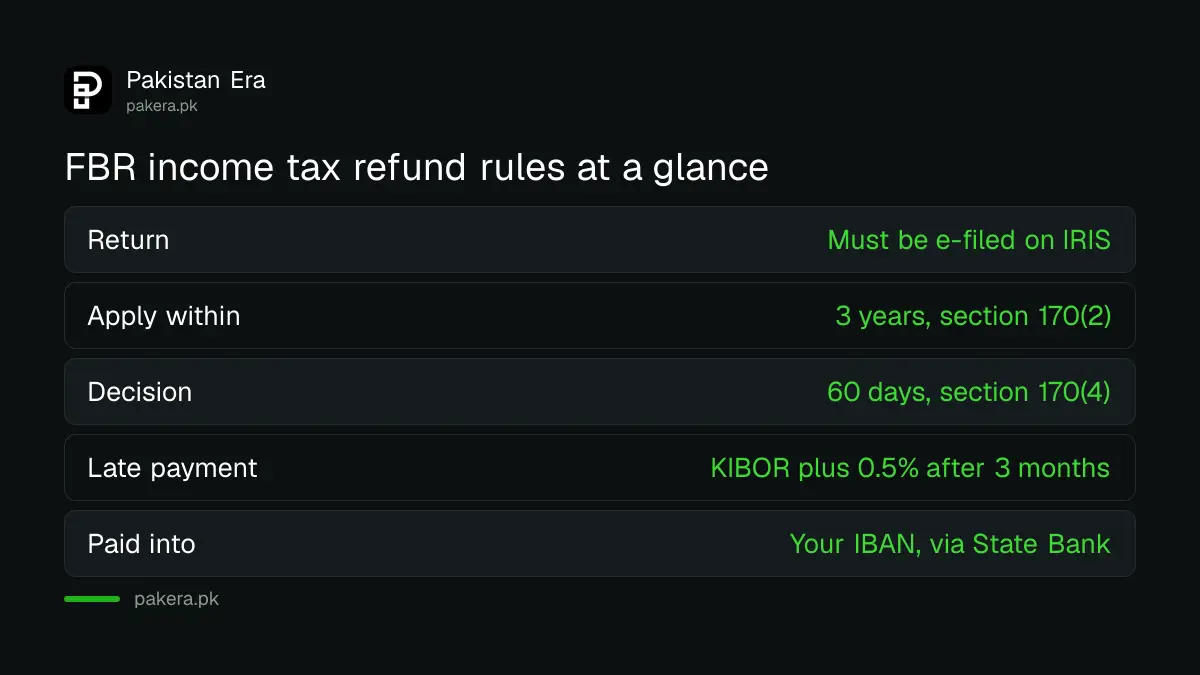
| Stage | What the law says | Section |
|---|---|---|
| Apply | Within 3 years of the assessment or tax payment, whichever is later | 170(2) |
| Decision | Commissioner's written order within 60 days, after hearing you | 170(4) |
| Set-off | Excess first cuts any other tax you owe, then the rest is paid | 170(3) |
| Late payment | Compensation at KIBOR plus 0.5% a year after 3 months | 171 |
| No decision | You can appeal to the Commissioner (Appeals) | 170(5) |
File the refund application on IRIS in six steps
On IRIS, open the Refund menu, choose the section 170 application, pick the tax year, write your claim in the Contents tab and submit. Make sure your bank IBAN is in your IRIS profile first, so the money can reach you.
- Add your IBAN to your IRIS profile. FBR asks taxpayers to add the full IBAN of the bank account already in their profile. Profile changes are made through the Form 181 modification on IRIS.
- Log in to IRIS at iris.fbr.gov.pk.
- Open the Refund menu and choose 170 (Application for refund of tax paid in excess).
- Pick the tax period. Click Period, enter the tax year, search and select the dates shown.
- Write your claim in the Contents tab: the tax year, the refundable amount in your return and where the tax was deducted.
- Submit and print the application. Keep the printout.
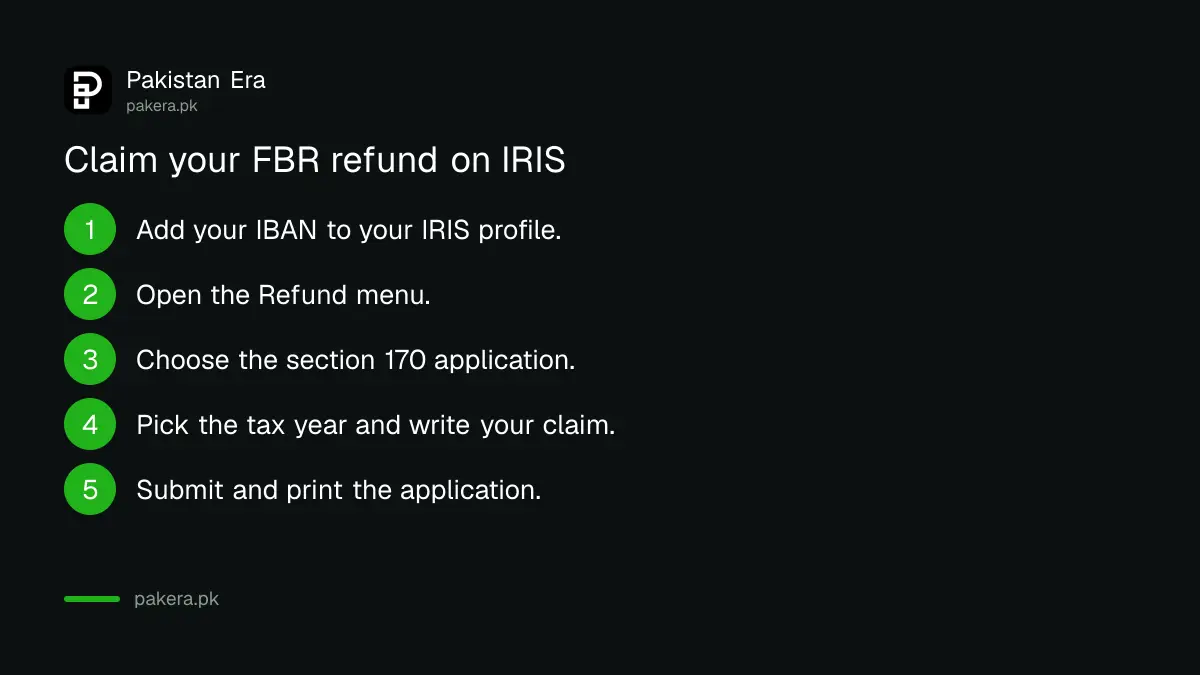
These menu names come from FBR's IRIS FAQs, which were written for the older IRIS screens. IRIS 2.0 may lay them out differently. If you cannot get in at all, the IRIS 2.0 login errors are the first thing to fix.
Keep your deduction certificates ready: the salary certificate from your employer, bank tax certificates and any other proof of tax taken. Rule 71 of the Income Tax Rules says the application must come with the documents the form asks for.
Refunds are paid straight into your bank account
Once the Commissioner passes the refund order, it goes to FBR's Centralized Income Tax Refund Office. That office sends the payment advice to the State Bank of Pakistan, which credits your bank account directly.
This is rule 210IC of the Income Tax Rules 2002, which we read in the version amended up to 15 September 2026. It is why the IBAN matters. A wrong or missing IBAN is the simplest way to lose weeks.
The law also allows FBR to issue refunds without any application, under section 170A, to the extent its computer system verifies your tax credit. But FBR's own refund page still tells taxpayers to file a separate application. File one.
To check progress, FBR's page says to contact your Regional Tax Office. If no order comes within 60 days, section 170(5) lets you appeal against the failure to decide.
Section 182A blocks refunds for anyone off the Active Taxpayers List
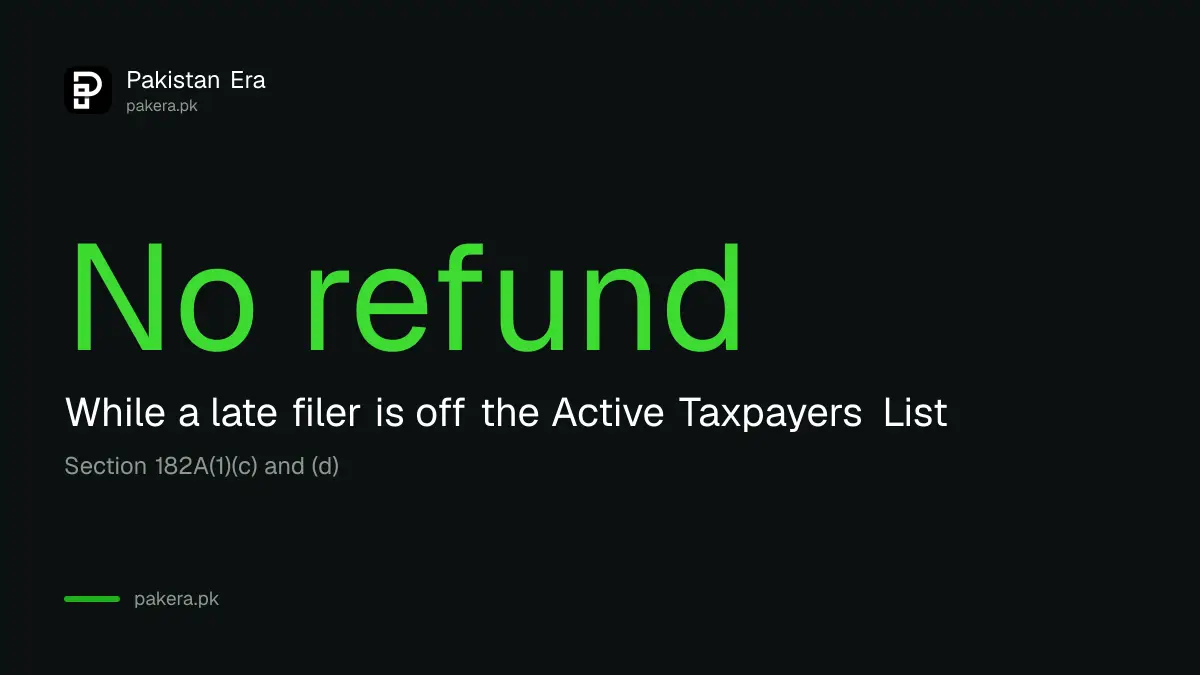
If you filed late and are not on the Active Taxpayers List, you get no refund for as long as you stay off it. That time also does not count towards the compensation FBR pays for late refunds.
Section 182A(1)(c) says a late filer shall "not be issued refund during the period the person is not included in the active taxpayers' list". Clause (d) removes the compensation for that period. FBR's refund page says the same.
For a late individual filer, getting back on the list means paying the Rs 25,000 ATL surcharge, or giving an undertaking under section 182A(3) not to buy any property for six months. If your refund is small, do the sums first: paying Rs 25,000 to unlock a Rs 8,000 refund makes no sense on its own, though the list brings lower tax rates elsewhere too. The late filing penalty under section 182 is a separate cost.
Common questions
How do I claim an income tax refund in Pakistan?
File your return on IRIS showing the refundable amount, then file an application under section 170 from the Refund menu. Add your IBAN to your IRIS profile first.
How long do I have to claim a refund from FBR?
Three years from the later of the assessment date or the date the tax was paid, under section 170(2). FBR's refund page still says two years, but the Ordinance was changed to three in 2016.
How long does FBR take to decide a refund?
The law gives the Commissioner 60 days from your application to pass a written order, under section 170(4).
Does FBR pay extra if my refund is late?
Yes. Section 171 adds compensation at KIBOR plus 0.5% a year if the refund is not paid within three months of becoming due. It does not apply while you are off the Active Taxpayers List.
Can I get a refund if I filed my return late?
Not while you are off the Active Taxpayers List. Once you are back on it, by paying the surcharge or giving the undertaking, the block lifts.
Can I get a refund on a paper return?
No. FBR's refund page says a manual return does not entitle you to a refund. The return must be filed electronically.
How we verified this
What we checked, where we read it, and what we could not confirm.
Last checked on 30 September 2026. We read sections 120, 170, 170A, 171 and 182A of the Income Tax Ordinance 2001 in FBR's consolidated copy amended up to 30 June 2026, and rules 71 and 210IC of the Income Tax Rules 2002 amended up to 15 September 2026. We read FBR's income tax refund page and its page on online refund payment, which asks for the IBAN. FBR's refund page gives two years to apply, while section 170(2) says three; we follow the law and point out the difference. The IRIS menu steps are from FBR's IRIS FAQs for the older interface, and we did not log in to test them on IRIS 2.0. The 2029 end date is our own reading. We could not find a published average time for refunds to arrive, so we do not give one.
About the author

Tax, Bills and Technology Writer
Ali Akhtar is a young and curious voice here at Pakistan Era. He is currently pursuing his A-Levels and has a growing interest in Pakistan’s changing industrial landscape and educational trends. Ali likes to write in a way that helps him explain and explore the world around him. His writing reflects the perspective of the new generation navigating the evolving trends of Pakistan where technology, youth innovation, and shifting opportunities are reshaping the country’s future.