Free Breast Cancer Check in Pakistan: Where to Go in October 2026 and What It Costs
Where women in Pakistan can get a free or low-cost breast check in October 2026, what a mammogram costs, WHO's five warning signs and a monthly self-check.
In October 2026 you can get a free breast check by a doctor at Pink Ribbon's hospital in Lahore, and a mammogram there costs Rs 6,000 for both sides. Shaukat Khanum runs walk-in clinics in Lahore, Peshawar and Karachi. No provincial health department had announced a free October screening programme when we checked.
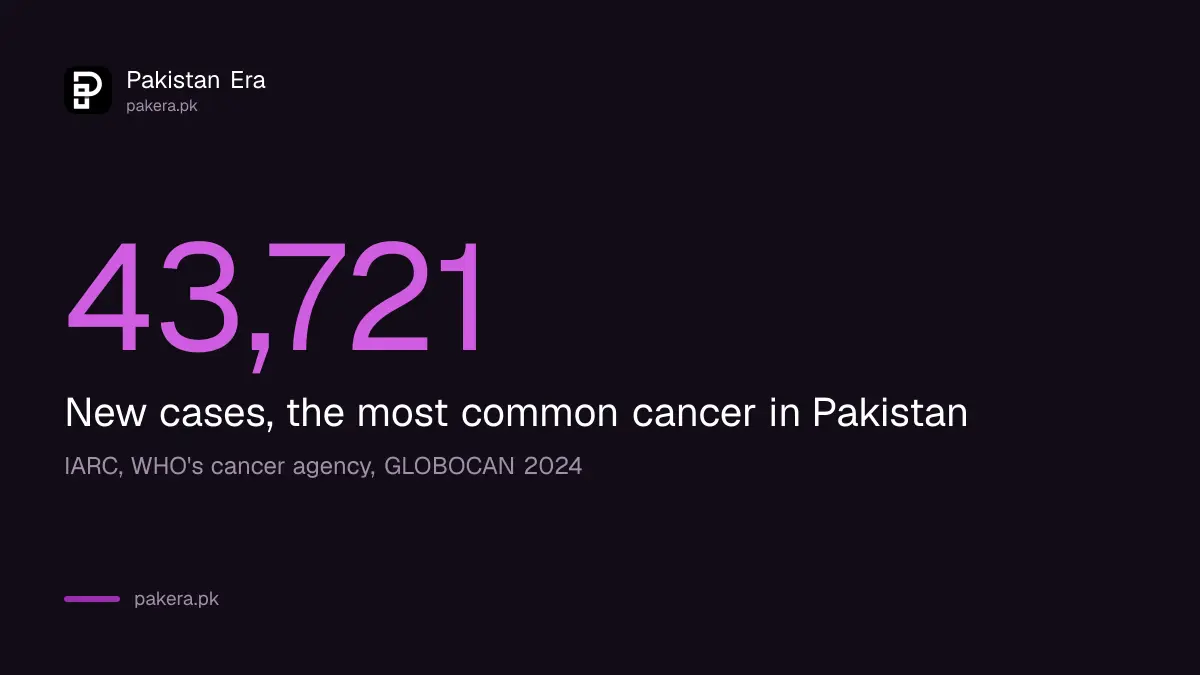
October is Breast Cancer Awareness Month, and the World Health Organization (WHO) lists it as a global event for 2026. In Pakistan the need is plain. Breast cancer is the most common cancer in the country, according to the 2024 estimates of the International Agency for Research on Cancer (IARC), WHO's cancer agency. It counted 43,721 new cases and 20,039 deaths in 2024.
We read the hospitals' own websites and the health departments' pages on 30 September 2026. This page lists what they actually offer, what it costs, the warning signs WHO names, and a simple monthly self-check.
Free and low-cost breast checks in Pakistan in October 2026
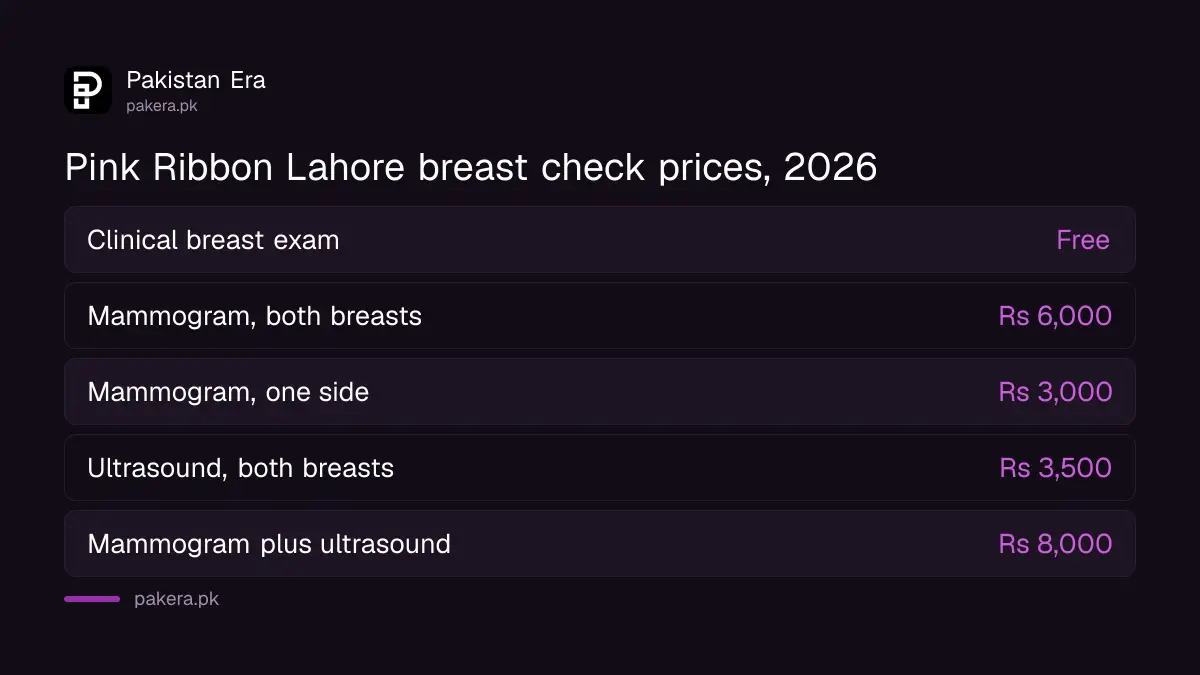
The only free service we could confirm is Pink Ribbon's clinical breast examination in Lahore, which is a check by a trained doctor. Mammograms were not free at any hospital whose own page we read. Pink Ribbon lists its prices openly.
| Place | What is offered | Cost, as listed |
|---|---|---|
| Pink Ribbon Breast Cancer Trust Hospital, Gulberg III, Lahore | Clinical breast examination by a doctor | Free |
| Pink Ribbon, Lahore | Mammogram, both breasts | Rs 6,000 |
| Pink Ribbon, Lahore | Ultrasound, both breasts | Rs 3,500 |
| Shaukat Khanum walk-in clinics, Lahore, Peshawar, Karachi | Walk-in consultation, tokens from 8 am | Fee not listed on its page |
| PIMS, Islamabad (federal hospital) | Mammography and breast surgery listed as services | Fee not listed on its page |
Pink Ribbon also lists a one-side mammogram at Rs 3,000, a single-breast ultrasound at Rs 2,000, and both breasts' mammogram with ultrasound together at Rs 8,000. It says its hospital gives free and subsidised care to patients who cannot pay.
How to book at Pink Ribbon and Shaukat Khanum
Call Pink Ribbon's doctor appointment line on 042 3588 3572 between 10 am and 8 pm. It is closed on Thursday and Sunday. Shaukat Khanum's walk-in clinics need no appointment, only a token taken before 4:30 pm.
- Pink Ribbon, Lahore: 2/12 M-Block, Gulberg III. Ask for the free breast clinical examination first. The doctor decides if you need a mammogram or ultrasound.
- Shaukat Khanum, Lahore: 7-A Block R-3, Johar Town. Phone 042 3590 5000, extension 8888. Open 8 am to 5 pm, Monday to Saturday.
- Shaukat Khanum, Peshawar: 5-B, Sector A-2, Phase 5, Hayatabad. Phone 091 588 5000, extension 5623 or 3781. Open 8 am to 5 pm, Monday to Saturday.
- Shaukat Khanum, Karachi: Plot DDCH-1, 1st Street, Phase VII Extension, DHA. Open 8 am to 5 pm, Monday to Friday only.
- Ask about the fee on the phone. Shaukat Khanum does not list a walk-in fee online. It runs a financial assistance programme for patients, and its toll-free number is 0800 11555.
Take your CNIC, any old reports and a list of your medicines. If you have a Sehat Card, ask at the counter whether your visit is covered. Coverage has changed, and the Sehat Card now pays half for most treatments. In Khyber Pakhtunkhwa, check your KP Sehat Card Plus eligibility before you go.
Government hospitals and provincial programmes
We found no free October 2026 breast screening campaign on the websites of the Punjab, Sindh or Khyber Pakhtunkhwa health departments on 30 September. No government hospital we checked posted an October offer online either.
You can still start at a big public hospital. The outpatient departments at Allied Hospital Faisalabad and Benazir Bhutto Hospital Rawalpindi open at 8 am under a Punjab order for teaching hospitals. A doctor there can examine you and refer you for a mammogram if needed.
Camps can still be announced during October. If you hear of a free camp, check that the health department or hospital itself announced it. A forwarded message is not enough. PIMS in Islamabad lists mammography and breast surgery among its services, so it is a real option in the capital. Call before you go, because its page does not give fees or timings.
Warning signs of breast cancer, as WHO lists them
WHO lists five signs: a lump or thickening, often painless; a change in the breast's size, shape or look; dimpling, redness or pitting of the skin; a change in the nipple or the skin around it; and unusual or bloody fluid from the nipple.
- A lump that does not hurt still matters. WHO says a person with an abnormal lump should see a doctor even if it is painless.
- Most lumps are not cancer. WHO says so plainly. But only a check can tell.
- Look under the arm. WHO says the lymph nodes under the arm are often the first place breast cancer spreads.
- A wound on the breast that will not heal needs a doctor, WHO says, and usually a biopsy, which is a small tissue sample.
WHO says being a woman is the strongest risk factor, and risk rises with age. About 80% of breast cancers happen in women with no risk factor other than their sex and being over 40. So "nobody in my family had it" is not a reason to skip a check. Men can get it too, but rarely: about 0.5% to 1% of cases.
A monthly breast self-check in five steps
A self-check helps you learn what is normal for your body, so you notice a change early. Do it once a month in private. It does not replace a doctor's exam or a mammogram. It only helps you know when to go.
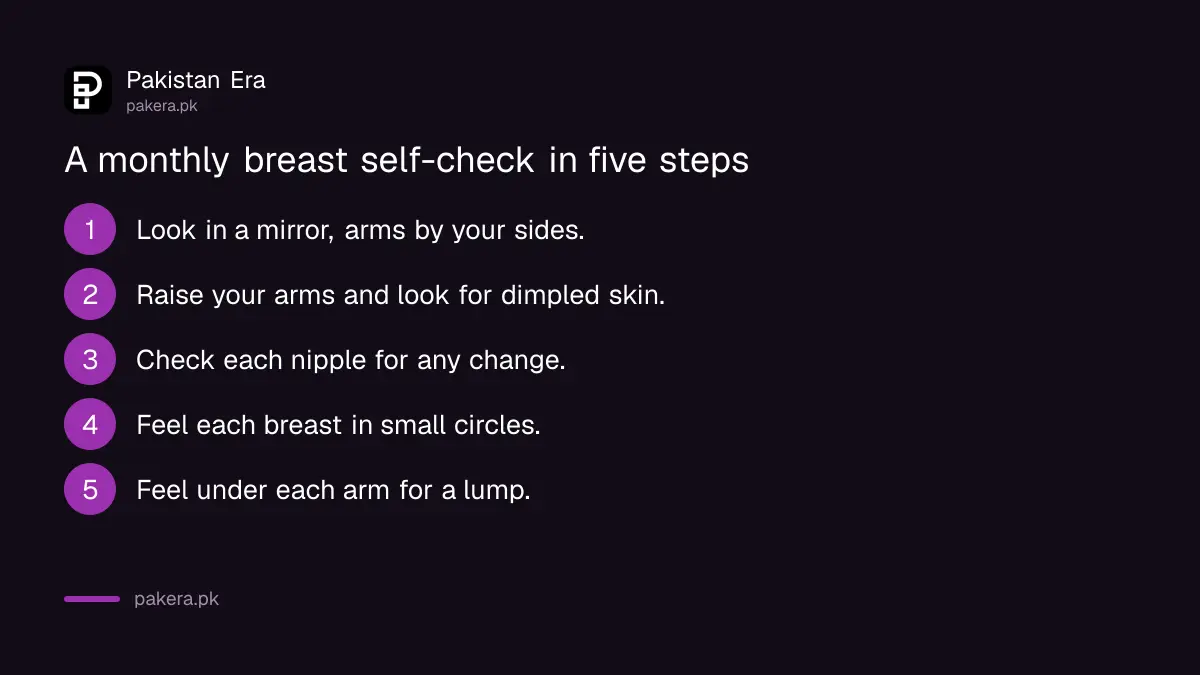
- Look in a mirror with your arms by your sides. Check the size and shape of each breast.
- Raise your arms and look again for dimpling, redness or pitted skin, like orange peel.
- Look at each nipple for any change in shape or in the skin around it.
- Feel each breast with the flat of your fingers, in small circles, for a lump or thick area.
- Feel under each arm in the same way. Note any fluid from the nipple.
If you find any of WHO's five signs, book a clinical check. Do not wait for the next October.
Who should get a mammogram, and when
WHO says breast cancer screening programmes usually offer mammograms to healthy women aged 50 to 69. Pink Ribbon recommends a yearly mammogram from 40, or earlier with a strong family history. The two advise different ages.
A mammogram is an X-ray of the breast. It can find a cancer before you can feel it. Your doctor will choose the test after the clinical exam. That is why the free exam is the right first step, and why it matters that it costs nothing.
Common questions
Where can I get a free mammogram in Pakistan in October 2026?
We could not confirm a free mammogram on any hospital's own page. Pink Ribbon in Lahore offers a free clinical exam and charges Rs 6,000 for a two-sided mammogram.
How much does a mammogram cost at Pink Ribbon?
Rs 6,000 for both breasts and Rs 3,000 for one side. With a two-sided ultrasound it is Rs 8,000.
Does Shaukat Khanum do free breast checks?
Its site does not say. It runs walk-in clinics in Lahore, Peshawar and Karachi and a financial assistance programme. Call 0800 11555 to ask.
What are the first signs of breast cancer?
WHO lists a lump or thickening, a change in size or shape, skin dimpling or redness, nipple changes, and unusual nipple fluid.
At what age should I get a mammogram?
WHO says screening programmes usually cover women aged 50 to 69. Pink Ribbon suggests yearly from 40. Ask a doctor if breast cancer runs in your family.
How we verified this
What we checked, where we read it, and what we could not confirm.
Last checked on 30 September 2026. We read WHO's breast cancer fact sheet and its Breast Cancer Awareness Month 2026 event page, IARC's GLOBOCAN 2024 fact sheet for Pakistan, Pink Ribbon's services, prices, contact and PINKtober pages, Shaukat Khanum's walk-in clinic page, and the PIMS services page. We checked the home pages of the Punjab, Sindh and Khyber Pakhtunkhwa health departments for an October campaign and found none. Prices are as listed on 30 September and can change.
Official sources: WHO breast cancer fact sheet and Pink Ribbon services' prices.
About the author
Public Services and Education Journalist
Fajr Riaz is a journalist and content writer at Pakistan Era, based in Lahore. She covers the questions people meet in everyday life in Pakistan: how a public service works, what a change in the rules means, and where to find a reliable answer.