Electricity Cost Per Unit by Company in Pakistan 2026: NEPRA's Rate for All 11 DISCOs, From IESCO to QESCO
NEPRA's 2026 cost per unit for all 11 electricity companies: Rs 27.11 at IESCO to Rs 54.08 at QESCO in the 201 to 300 slab, against one bill rate of Rs 33.10.
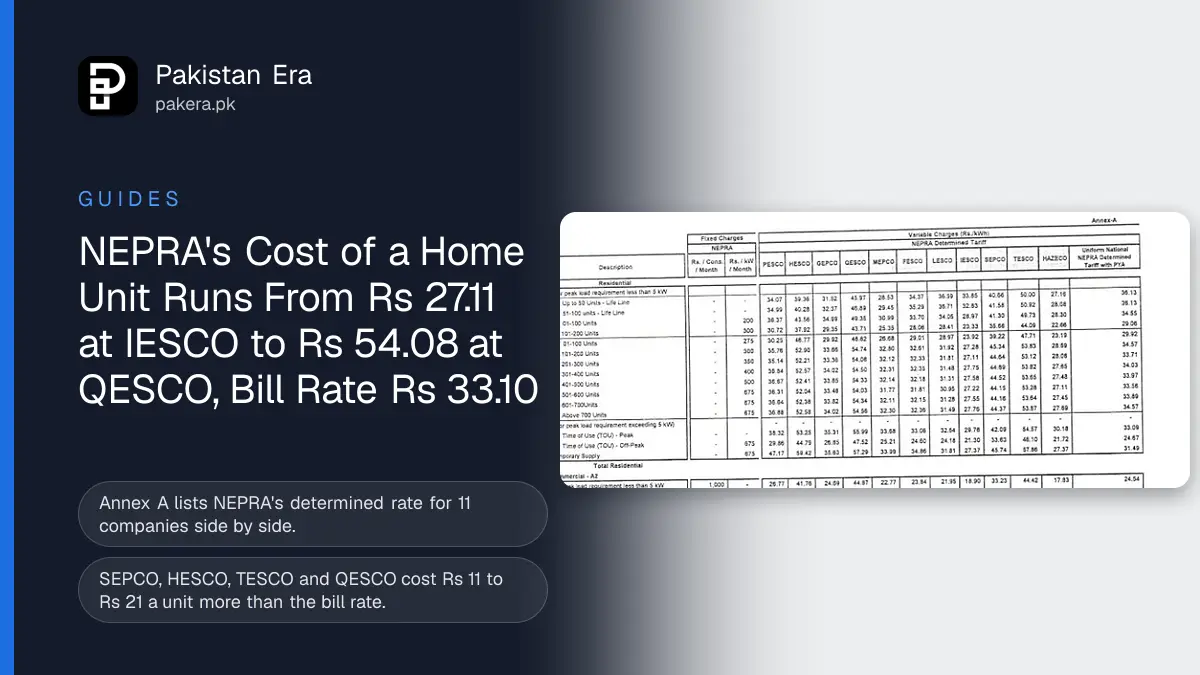
NEPRA's own cost of a home unit in the 201 to 300 slab ranges from Rs 27.11 at IESCO to Rs 54.08 at QESCO in 2026, but every home in that slab pays the same Rs 33.10. The difference between each company's cost and the single national rate is covered by the government's subsidy and by cheaper companies cross-subsidising costlier ones.
We read these figures in Annex A of S.R.O. 279(I)/2026, the Ministry of Energy notification dated 12 February 2026 that set the current electricity tariff. Annex A lists the "NEPRA Determined Tariff" for each of the 11 ex-WAPDA distribution companies, from PESCO to HAZECO, next to the uniform national rate. We opened it on 9 November 2026.
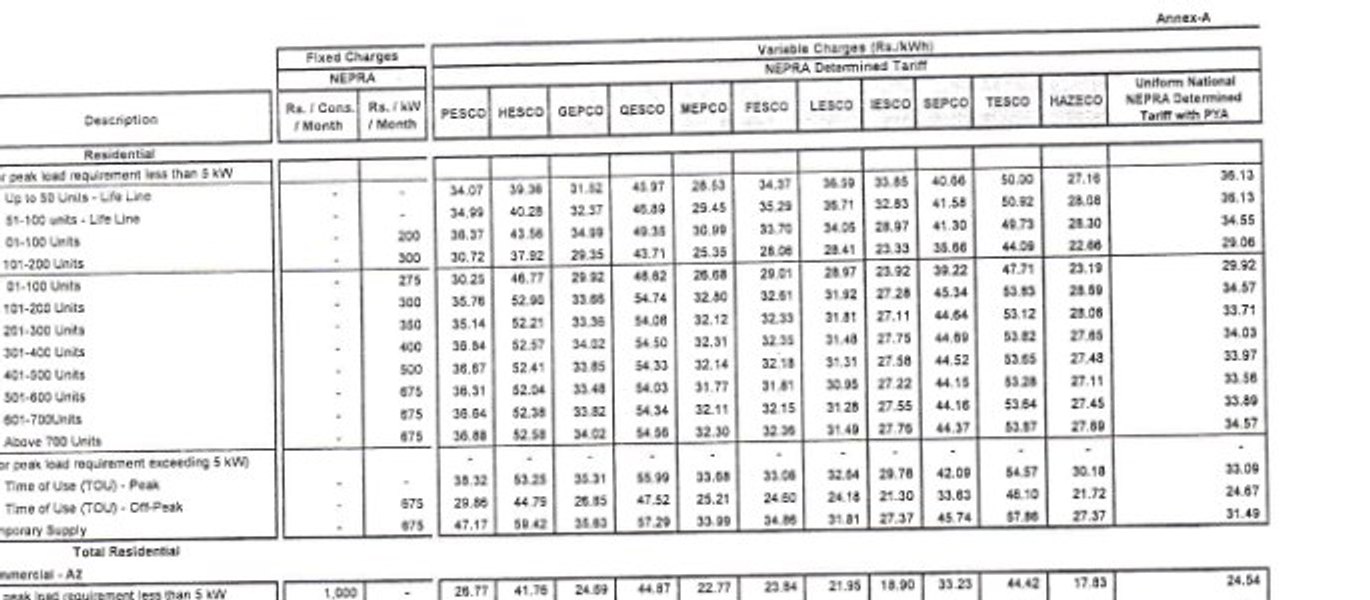
NEPRA's rate for every company in the 201 to 300 slab
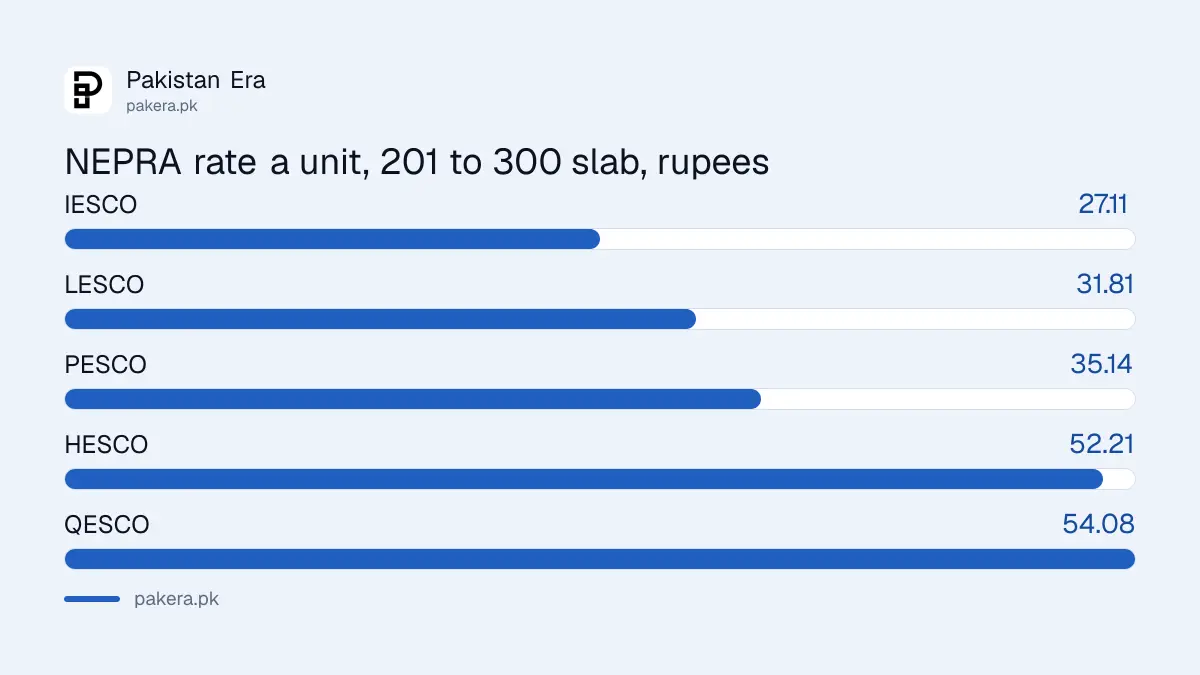
For a home using 201 to 300 units, NEPRA's determined rate is lowest at IESCO and HAZECO and highest at QESCO, TESCO and HESCO. The uniform national figure is Rs 33.71, and the government applicable rate on bills is Rs 33.10.
| Company | Area | NEPRA rate a unit | Against the Rs 33.10 bill rate |
|---|---|---|---|
| IESCO | Islamabad, Rawalpindi | Rs 27.11 | Rs 5.99 lower |
| HAZECO | Hazara | Rs 28.06 | Rs 5.04 lower |
| LESCO | Lahore | Rs 31.81 | Rs 1.29 lower |
| MEPCO | Multan, south Punjab | Rs 32.12 | Rs 0.98 lower |
| FESCO | Faisalabad | Rs 32.33 | Rs 0.77 lower |
| GEPCO | Gujranwala | Rs 33.36 | Rs 0.26 higher |
| PESCO | Peshawar | Rs 35.14 | Rs 2.04 higher |
| SEPCO | Sukkur | Rs 44.64 | Rs 11.54 higher |
| HESCO | Hyderabad | Rs 52.21 | Rs 19.11 higher |
| TESCO | Tribal districts | Rs 53.12 | Rs 20.02 higher |
| QESCO | Balochistan | Rs 54.08 | Rs 20.98 higher |
The gaps are our own arithmetic against the applicable rate in Annex C of the same notification. QESCO's cost is almost exactly double IESCO's: Rs 27.11 times 2 is Rs 54.22. To see what your own home pays in each slab, use our 2026 slab rates guide.
What NEPRA's determined rate means
The determined rate is the price NEPRA says each company needs to recover its own costs. It includes the power it buys, its allowed losses and its operating costs. The uniform rate is the national average of those company figures.
Annex A gives the determined rate "with PYA", the prior year adjustment, which adds or removes past under- or over-recovery for each company. The last column, "Uniform National NEPRA Determined Tariff with PYA", is one national figure for each category. Annex A-1 then sets the government applicable rate next to it. That is the figure printed on your bill.
- NEPRA works out each company's cost a unit, category by category.
- It combines them into one uniform national rate.
- The federal government proposes the applicable rate for consumers.
- NEPRA approves it, and the Ministry of Energy notifies it.
- Every ex-WAPDA company then bills that same rate.
K-Electric is billed at the same applicable rates under Annex C, which is why Karachi bills match Lahore's. Our explainer on the uniform tariff for Karachi covers that side.
Who pays the gap between cost and bill
The gap is filled in two ways: customers of low-cost companies pay more than their company needs, and the federal government pays a budgeted subsidy. NEPRA's decision puts that subsidy at Rs 249 billion for calendar year 2026.
In paragraph 20 of the decision, NEPRA records that the revised tariff "is within the determined requirement of XWDISCOs and already budgeted Tariff differential subsidy (TDS) of Rs.249 billion". In practice an IESCO home in the 201 to 300 slab pays almost Rs 6 a unit more than IESCO's own cost. A QESCO home pays about Rs 21 a unit less than QESCO's cost.
- Low-cost companies: IESCO, HAZECO, LESCO, MEPCO and FESCO sit below the bill rate.
- Near the rate: GEPCO and PESCO are within about Rs 2.
- High-cost companies: SEPCO, HESCO, TESCO and QESCO sit Rs 11 to Rs 21 above it.
Why some companies cost twice as much
The high-cost companies are the ones with the largest losses and the weakest bill recovery. A company that loses or cannot bill a large share of the power it buys needs a much higher rate on the units it does sell.
Our pages, drawn from NEPRA's own reports, on line losses by company and on cost recovery by company show where each company stands. For Hyderabad, see our page on HESCO's loss target.
The same pattern runs through every row of Annex A, not only the 201 to 300 slab. The scanned annex is small type, so check the original if you need a figure for a different category.
Common questions
Which electricity company has the highest cost per unit in Pakistan?
QESCO, at Rs 54.08 a unit for the 201 to 300 home slab in NEPRA's 2026 determined rates, followed by TESCO at Rs 53.12 and HESCO at Rs 52.21.
Which company has the lowest NEPRA determined rate?
IESCO, at Rs 27.11 a unit in the 201 to 300 slab, followed by HAZECO at Rs 28.06.
Do QESCO customers pay more for electricity than IESCO customers?
No. Both pay the same government applicable rate, Rs 33.10 a unit in the 201 to 300 slab, because the tariff is uniform.
What is the uniform national determined tariff?
It is NEPRA's national average cost for each category. For the 201 to 300 home slab it is Rs 33.71 a unit in Annex A.
How much is the electricity subsidy for 2026?
NEPRA's decision cites a budgeted tariff differential subsidy of Rs 249 billion for calendar year 2026.
Where can I read NEPRA's determined rate for my company?
In Annex A of S.R.O. 279(I)/2026, on NEPRA's tariff notifications page, which lists all 11 companies side by side.
What we checked and sources
We read Annex A (page 11 of 51), Annex A-1 and Annex C of S.R.O. 279(I)/2026 dated 12 February 2026, and paragraphs 19 to 22 of NEPRA's decision, from NEPRA's tariff notifications on 9 November 2026. Annex A is a scanned page in small type; we read each figure in an enlarged crop, and the uniform figure of Rs 33.71 matches Annex A-1. The applicable rate of Rs 33.10 was cross-checked against IESCO's tariff guide. Differences between rates are our own arithmetic.
About the author

Tax, Bills and Technology Writer
Ali Akhtar is a young and curious voice here at Pakistan Era. He is currently pursuing his A-Levels and has a growing interest in Pakistan’s changing industrial landscape and educational trends. Ali likes to write in a way that helps him explain and explore the world around him. His writing reflects the perspective of the new generation navigating the evolving trends of Pakistan where technology, youth innovation, and shifting opportunities are reshaping the country’s future.