Why Karachi Pays the Same Electricity Rate as the Rest of Pakistan: K-Electric's Uniform Tariff
K-Electric customers pay the national tariff, not K-Electric's own, and the government covers the gap. See what is shared, what differs and how to check a bill.
K-Electric customers in Karachi pay the same electricity tariff as customers of the government-owned companies in the rest of Pakistan. NEPRA works out a separate, cost-based tariff for K-Electric, but its own notification says Karachi consumers "shall not be charged" it. They pay the uniform national rate instead, under federal policy guidelines of 22 August 2023, and the government covers the difference.
That is why the Sindh High Court's 7 October 2026 order on K-Electric's tariff review does not change the rate on your bill. We read NEPRA's K-Electric notifications, its October fuel charge decision and its new grid charge decision to set out what is shared, what is not, and how to check your own bill.
Karachi is billed at the national rate, not K-Electric's own tariff
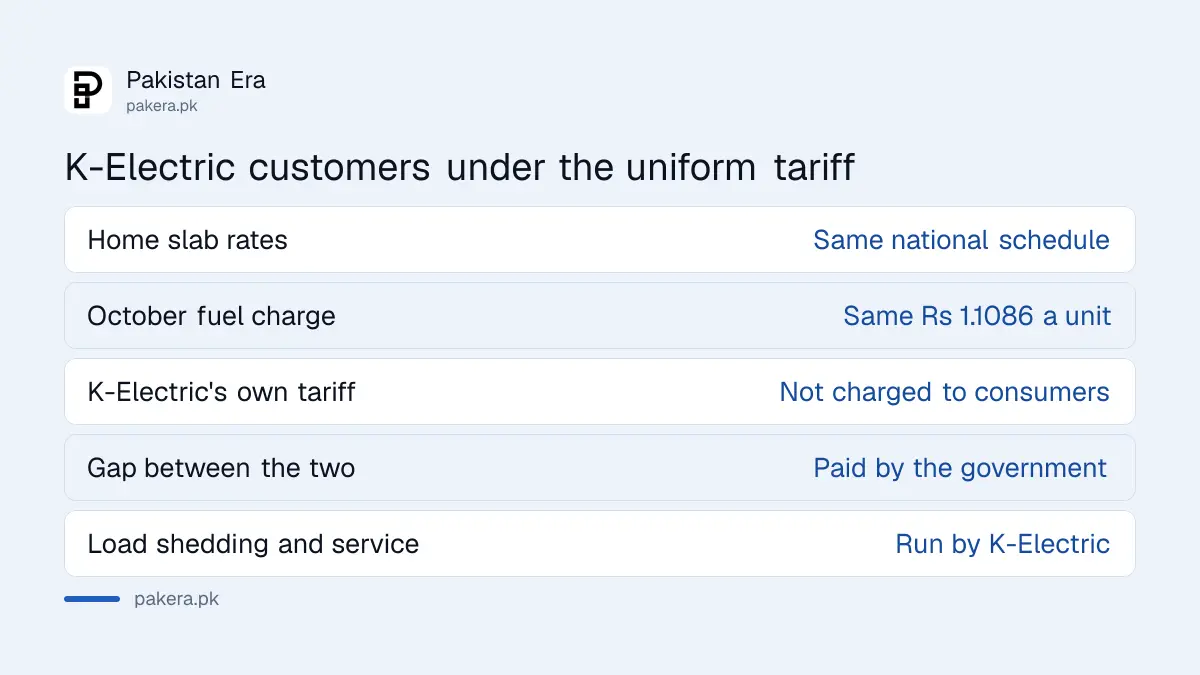
NEPRA sets K-Electric's tariff from its own costs, for the years FY 2024 to FY 2030. But the bill you get uses the tariff that applies to consumers of the former WAPDA companies, such as LESCO, MEPCO and IESCO. The rule comes from the federal government's policy guidelines.
NEPRA's supply review notification, S.R.O. 1643(I)/2026 of 23 September 2026, puts it directly. Notwithstanding the decision, K-Electric's consumers "will be charged tariff as applicable to consumers of XWAPDA DISCOs". It links this to para 5.6.3 of the National Electricity Policy, 2021, and to guidelines the government sent on 22 August 2023.
So the slab rates, fixed charges and protected categories you see on a Karachi bill match the national schedule in our page on home electricity slab rates for 2026.
The government pays the gap between the two tariffs
When K-Electric's own cost is higher than the national rate, someone must pay the difference. Under the uniform tariff, that is the federal government, through a subsidy. This is why the size of K-Electric's allowed costs matters to taxpayers even when it does not change Karachi bills.
NEPRA said so in its review of K-Electric's supply tariff. The Power Division and CPPA-G estimated that an allowance for unpaid bills would cost about Rs 36 billion for FY 2023-24 and could pass Rs 200 billion over the tariff period. NEPRA removed the allowance "considering application of uniform tariff across the country", so the burden would not fall on the federal budget.
That review is now suspended. The Sindh High Court froze it on 7 October 2026 after K-Electric challenged it, as our report on the court order on K-Electric's tariff review explains. Either way, the rate on your bill stays the national rate.
Monthly fuel charges are the same in Karachi too
The uniform rule covers the monthly fuel charge as well. NEPRA's fuel charge decision of 7 October 2026 says that, under the government's policy guidelines, the charge for the other companies "shall also be applicable on the consumers of KE with same applicability period".
That is why Karachi customers pay the same Rs 1.1086 a unit fuel charge on October bills. The charge is worked out on August units. A Karachi home that used 300 units in August pays about Rs 332.58 for that line before tax, exactly as a home in Lahore would. That figure is our own sum.
| Item | Karachi (K-Electric) | Rest of Pakistan |
|---|---|---|
| Home slab rates | National schedule | National schedule |
| Fuel charge on October 2026 bills | Rs 1.1086 a unit | Rs 1.1086 a unit |
| Tariff NEPRA sets from company costs | K-Electric's own, not charged | Each company's own, then made uniform |
| Complaint helpline | 118, then NEPRA | 118, then NEPRA |
| Load shedding schedule | Set by K-Electric | Set by each company |
What is not the same for Karachi
The price is shared, but the service is not. K-Electric runs its own network, its own load shedding plan and its own customer system. Its billing portal, its planned shutdown notices and its complaint records are separate from the other companies.
NEPRA treats K-Electric as a separate licensee for enforcement too. On 31 August 2026, NEPRA issued an order against K-Electric under section 27C of the NEPRA Act over unannounced and excessive load shedding in Karachi. That kind of order is about the company's conduct, not the price you pay.
One new cost could reach everyone. NEPRA's grid charge decision, notified on 9 October 2026, approved an "additional charge" to cover any gap from applying uniform grid charges in K-Electric's area. NEPRA ruled it should apply to all consumers, not only large open market buyers. No amount has been set, and the decision says the gap is "if any".
How to check your Karachi bill uses the national rate
You can check this yourself in about five minutes with your latest bill. Download it first through K-Electric's online bill check if you do not have the paper copy.
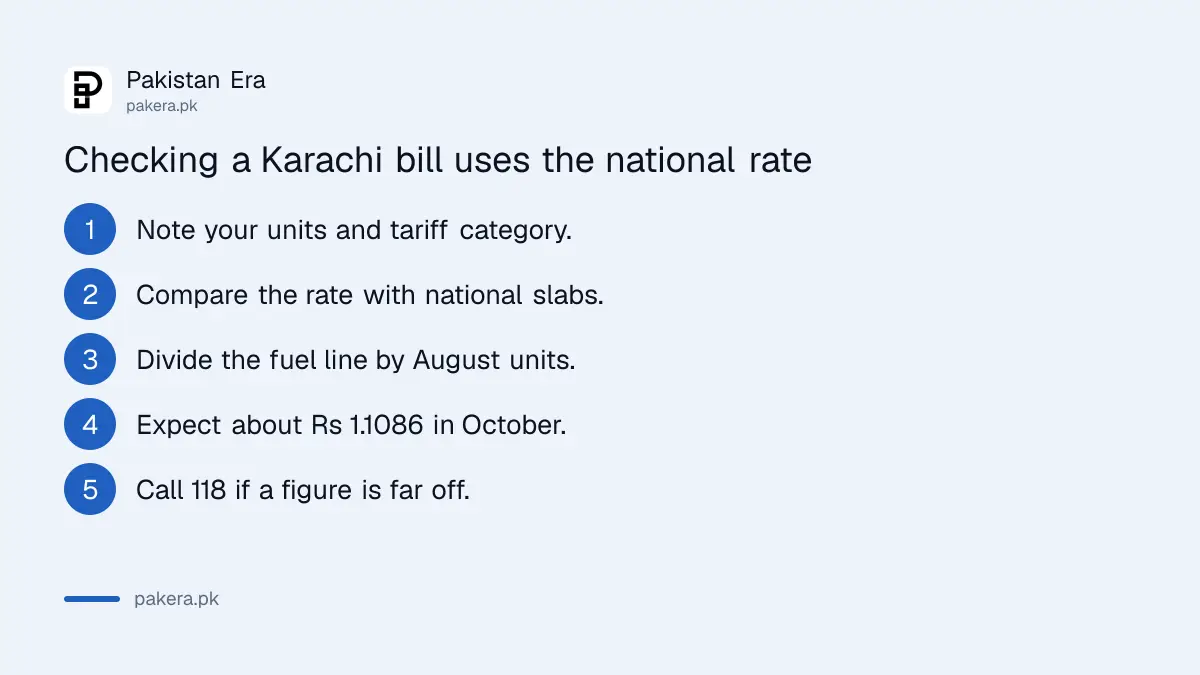
- Find your units for the month and your tariff category on the bill.
- Compare the per-unit rate charged with the national slab rate for those units.
- Find the fuel charge line and divide it by your August units.
- The answer should be about Rs 1.1086 on an October 2026 bill.
- If either figure is far off, call 118 and ask for the working.
Taxes are the one part that can differ, because provincial electricity duty is set separately. So compare the energy charge and the fuel line, not the final total.
Common questions
Do Karachi residents pay more for electricity than Lahore residents?
No. The per-unit tariff and the monthly fuel charge are the same, because K-Electric customers are billed at the uniform national rate. Taxes and duties can differ.
Why does NEPRA set a separate tariff for K-Electric?
K-Electric is a private company with its own costs. NEPRA sets its revenue from those costs, but consumers are billed at the national rate and the government covers the gap.
Does the Sindh High Court order change Karachi bills?
No. The suspended review was about K-Electric's own tariff, which is not charged to consumers.
Is the fuel charge the same in Karachi?
Yes. NEPRA's 7 October 2026 decision applies the same Rs 1.1086 a unit charge to K-Electric consumers for the same period.
What is the policy behind the uniform tariff?
Federal policy guidelines of 22 August 2023, linked by NEPRA to para 5.6.3 of the National Electricity Policy, 2021.
How we verified this
What we checked, where we read it, and what we could not confirm.
Last checked 10 October 2026. We read NEPRA's notification S.R.O. 1643(I)/2026 and the K-Electric supply review decision, the fuel charge decision for August 2026 dated 7 October 2026, and the grid charge decision notified as S.R.O. 1780(I)/2026, all on nepra.org.pk, and K-Electric's statement of 8 October 2026 on ke.com.pk. The comparison table and the bill check steps are our own summary.
About the author

Global Affairs & Political Economy Writer
Muhammad Hatim is a book lover who started writing because he enjoys it. At Pakistan Era he writes about international relations, geopolitics and the global economy, with a particular interest in South Asia and the forces behind current events.