NAB Law 2026 in Pakistan: Bail From the Accountability Court and a Second Appeal Within 30 Days
The NAB amendment of 2026 lets accountability courts grant bail, adds a 30 day second appeal to the Federal Constitutional Court and indexes NAB's threshold.
Short answer: The National Accountability (Amendment) Act, 2026 changed four things in Pakistan's NAB law. An accountability court can now grant bail itself. A person convicted in a NAB case can file a second appeal to the Federal Constitutional Court within 30 days of the High Court's decision. NAB's money threshold for cases now rises each year with inflation. And the NAB Chairman's three year term can be extended once. The Act took effect on 5 March 2026.
NAB, the National Accountability Bureau, works under the National Accountability Ordinance, 1999. Families usually meet it when a relative is arrested, summoned or convicted in a corruption case. This page sets out what the 2026 Act changed for them, in the order they are likely to need it.
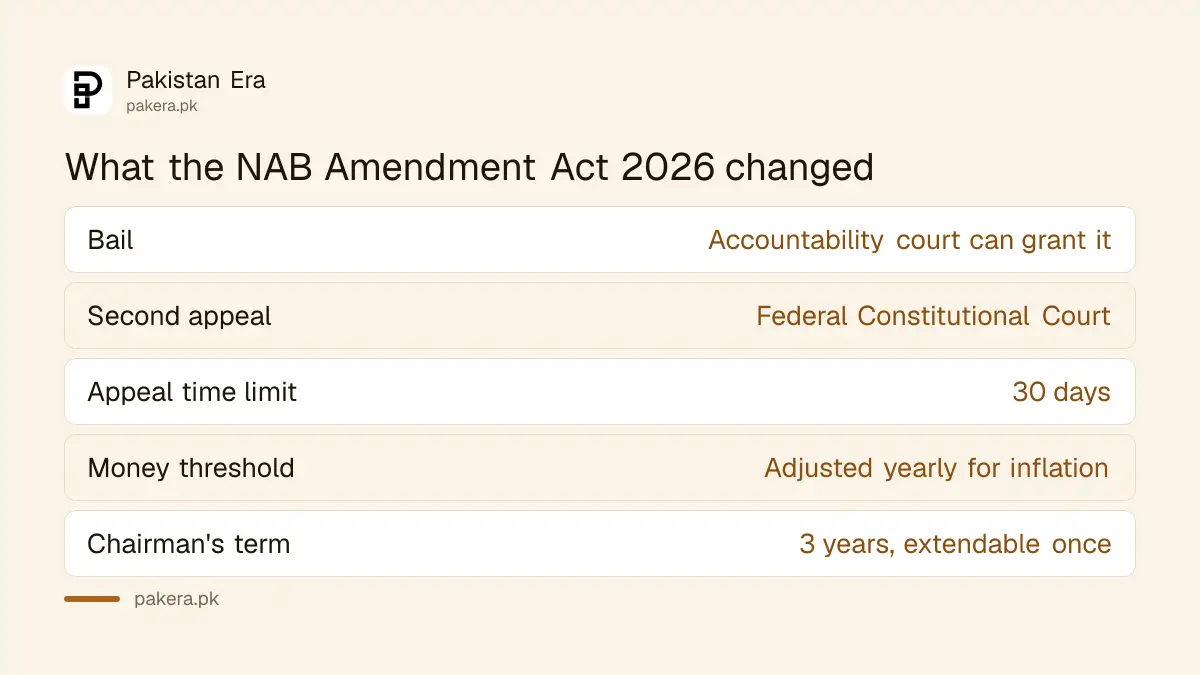
The 2026 Act made four changes to the NAB Ordinance
The Act is short, with six sections. It received the President's assent on 5 March 2026 and was published in the Gazette the same day. It came into force at once and is treated as part of the law from the day the Ordinance itself began in 1999.
| Section of the Ordinance | What changed in 2026 |
|---|---|
| Section 4 (application) | The words "appeals" added, so the Ordinance clearly covers appeals as well as trials |
| Section 5 (money threshold) | The rupee amount is now adjusted every financial year from 1 July 2022, using the Pakistan Bureau of Statistics inflation index |
| Section 6 (NAB Chairman) | Three year term, which the federal government may extend once for another three years |
| Section 9(b) (bail) | The accountability court and the High Court can grant bail or release under sections 439, 496, 497 and 498 of the Criminal Procedure Code |
| New section 32A | Second appeal to the Federal Constitutional Court within 30 days |
The bail and appeal changes matter most to an accused person and the family. The other two change how NAB itself works.
Bail in a NAB case can now come from the accountability court
Section 9(b) now says that a court set up under the Ordinance, and the High Court with jurisdiction in the area, have the power to grant bail or order release. That power works through sections 439, 496, 497 and 498 of the Criminal Procedure Code, 1898, the same sections used in ordinary criminal cases.
In plain terms, the family of an arrested person can apply to the accountability court trying the case, as well as to the High Court. The court still decides each application on its facts. Section 497, for example, sets out when bail may be refused in serious offences, and section 498 covers bail before arrest. The general rules on bail in Pakistan explain how those sections work.
If you or a relative stand surety, understand the duties first. A surety signs a bond and can be made to pay if the accused does not appear. Read about how to stand surety for a bail bond before signing.
A convicted person can file a second appeal within 30 days
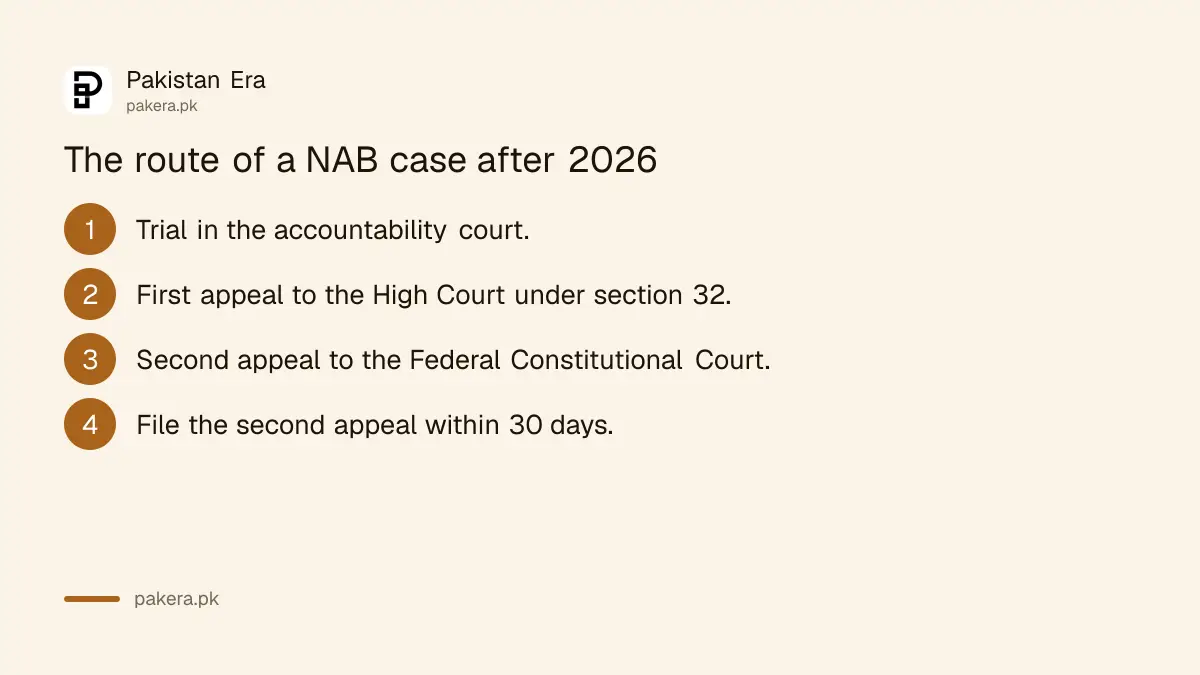
New section 32A allows a second appeal. It is against the High Court's decision on the first appeal under section 32 of the Ordinance. It goes to the Federal Constitutional Court and must be filed within 30 days.
- Trial. The accountability court tries the case and decides it.
- First appeal. An appeal against the trial court's decision goes to the High Court under section 32.
- Second appeal. Anyone convicted who is aggrieved by the High Court's decision can appeal to the Federal Constitutional Court under section 32A.
- Time limit. The second appeal must be filed within 30 days.
The prosecution can use section 32A too. The Prosecutor General Accountability may file a second appeal, but only if the NAB Chairman directs it. So an acquittal in the High Court can also be taken further.
Thirty days is short for a case file that may run to thousands of pages. Ask for a certified copy of the High Court judgment on the day it is announced. The Federal Constitutional Court began work in 2025, and its first year is covered in our report on the Federal Constitutional Court's first year.
NAB's money threshold now rises with inflation
Section 5 of the Ordinance sets a rupee amount that decides which cases fall to NAB. The 2026 Act adds that this amount is adjusted for each financial year starting from 1 July 2022. The adjustment uses the inflation index published by the Pakistan Bureau of Statistics.
This means the line does not stay fixed while prices rise. Each July, the threshold moves up with the official inflation figure. A case that sat just above the line in 2022 can fall below it later. For people filing a complaint, it is one more reason to check whether NAB is the right forum. Smaller matters may belong with the anti-corruption establishment of the province or the FIA instead. The steps to file a NAB complaint online include NAB's own conditions.
The NAB Chairman's term can be extended once
Before 2026, section 6 gave the NAB Chairman a non-extendable term of three years and barred a second appointment. The Act replaced that wording. The Chairman now holds office for three years, which the federal government may extend once for a further three years.
So one Chairman can now serve up to six years. This changes who leads NAB, not the rights of an accused person. Regional NAB offices and their numbers are listed in NAB office contact numbers.
Common questions
Can an accountability court grant bail in a NAB case?
Yes. Since the 2026 Act, section 9(b) lets the accountability court and the High Court grant bail or release under sections 439, 496, 497 and 498 of the Criminal Procedure Code.
Where does a second appeal in a NAB case go?
To the Federal Constitutional Court, against the High Court's decision under section 32.
What is the time limit for the second appeal?
Thirty days, under the new section 32A.
Can NAB appeal an acquittal to the Federal Constitutional Court?
Yes, through the Prosecutor General Accountability, if the NAB Chairman directs it.
When did the NAB amendment come into force?
At once on 5 March 2026. It is treated as effective from the start of the Ordinance in 1999.
How long can a NAB Chairman serve now?
Three years, extendable once by the federal government for three more, so six years at most.
How we verified this
What we checked and where we read it.
We checked the full text of the National Accountability (Amendment) Act, 2026 (Act No. XIV of 2026) on 15 November 2026, from the National Assembly's list of Acts. The Gazette of Pakistan copy is dated 5 March 2026 and records the President's assent the same day. Section 1(2) says it came into force at once and is deemed to have taken effect from the commencement of the 1999 Ordinance. The Ordinance itself is on NAB's own Ordinance page. The rupee amount in section 5 is set in the Ordinance; this Act adds only the yearly inflation adjustment.
About the author

Global Affairs & Political Economy Writer
Muhammad Hatim is a book lover who started writing because he enjoys it. At Pakistan Era he writes about international relations, geopolitics and the global economy, with a particular interest in South Asia and the forces behind current events.