Add Solar Panels to Your Net Metering System in Pakistan: DG Capacity Enhancement in 7 Steps, and the Old Rate Trap
Add solar panels to a net metered system in Pakistan: apply for DG capacity enhancement on PITC's portal in 7 steps. Old 2015 users move to net billing.
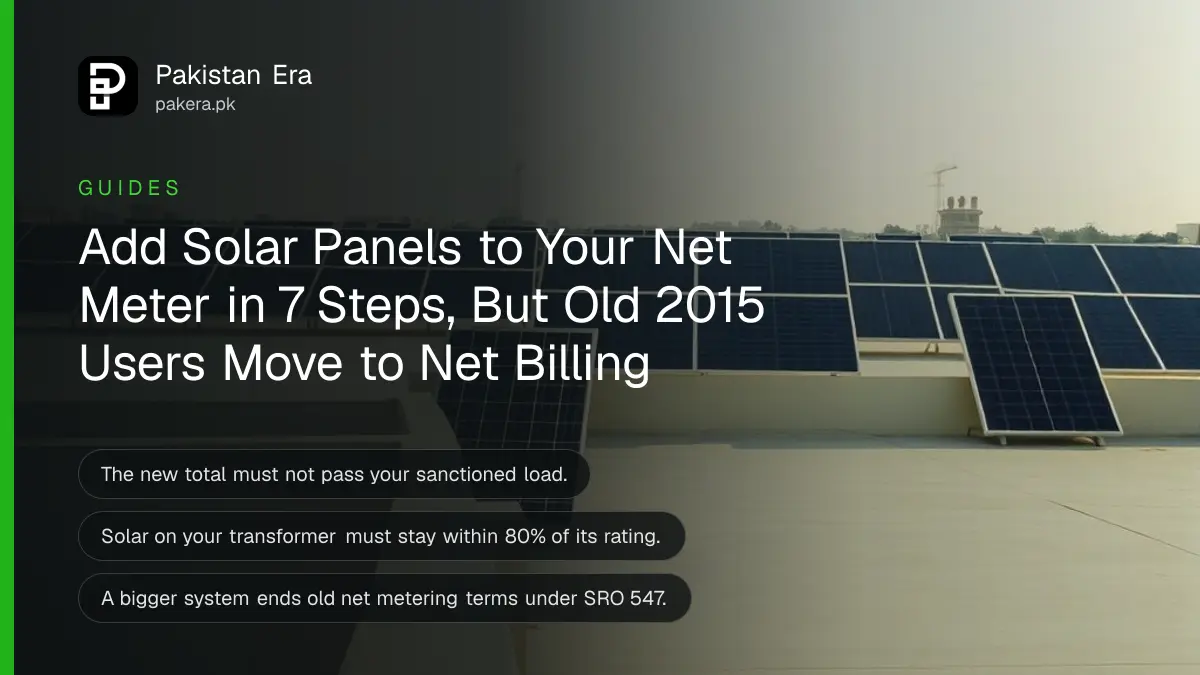
To add panels to a net metered solar system in Pakistan, apply on PITC's net billing portal with "Apply for DG Capacity Enhancement (Consumer)", enter your reference number, your previous solar size and the new total, and get your installer to verify it. The new total must still be no bigger than your sanctioned load and must fit within 80% of your transformer. One warning comes first: if you signed under the old 2015 net metering rules, a bigger system moves you to net billing.
DG stands for distributed generation, the rules' name for your rooftop system. "Capacity enhancement" is the portal's term for adding panels or fitting a bigger inverter to a system that already has a two-way meter. It is a separate form from a fresh application.
Adding panels can end your old net metering rate
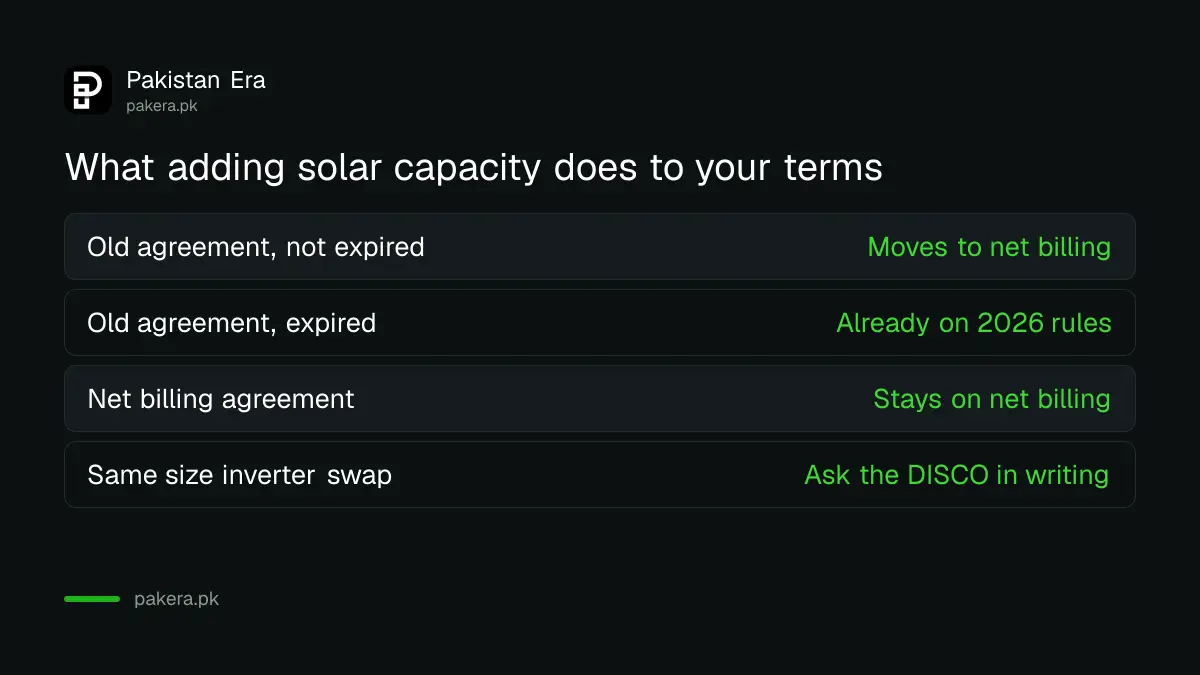
If your agreement was signed before 9 February 2026, you keep the old rate and billing until it expires. But S.R.O. 547(I)/2026 says that protection ends on any "material modification" that changes the system's maximum output. A capacity enhancement is exactly that, so the whole system moves to net billing.
Under net billing, units you take from the grid are charged at your normal tariff, while units you export are bought at the national average energy purchase price. That is a wholesale rate, well below the retail price you pay. So do the sums before you add panels, especially if your old agreement still has years to run.
| Your situation | Effect of adding capacity |
|---|---|
| Old agreement (before 9 February 2026), not expired | Old terms end; system moves to net billing |
| Old agreement already expired | Already on 2026 rules; enhancement follows them |
| Net billing agreement (after 9 February 2026) | Stays on net billing with the new size |
| Replacing a broken inverter with the same size | Maximum output unchanged; ask the DISCO in writing |
The pricing change itself is explained in what solar export pays now that net metering has ended.
The size limits still apply to the new total
The enhancement form checks the new total, not just the added part. The total must be no bigger than your sanctioned load, no more than 1,000 kW, and solar on your transformer, with yours, must stay within 80% of its rating. The form also needs a sanctioned load of at least 5 kW.
Take a home with a 10 kW sanctioned load and an 8 kW system. It can add up to 2 kW without touching the load. To reach 15 kW, it must first raise the sanctioned load to 15 kW, then apply for the enhancement. And if the transformer is full, neither step helps.
| Sanctioned load | Current system | Largest addition without a load change |
|---|---|---|
| 10 kW | 8 kW | 2 kW |
| 15 kW | 10 kW | 5 kW |
| 25 kW | 25 kW | 0, raise the load first |
Load changes are not made on the net billing portal. They go through ENC at enc.com.pk (or the FESCO and IESCO ENC sites), or the Power Smart app for MEPCO and some IESCO and FESCO areas. The deposit for a bigger load is covered in how to extend your electricity load. Run the transformer check on the portal before you buy any panels.
How to apply for DG capacity enhancement, step by step
The enhancement form looks like the main application, with one extra field for your previous solar size. If you changed your load or tariff first, keep the ENC or eOps tracking ID ready, as the form asks for it.
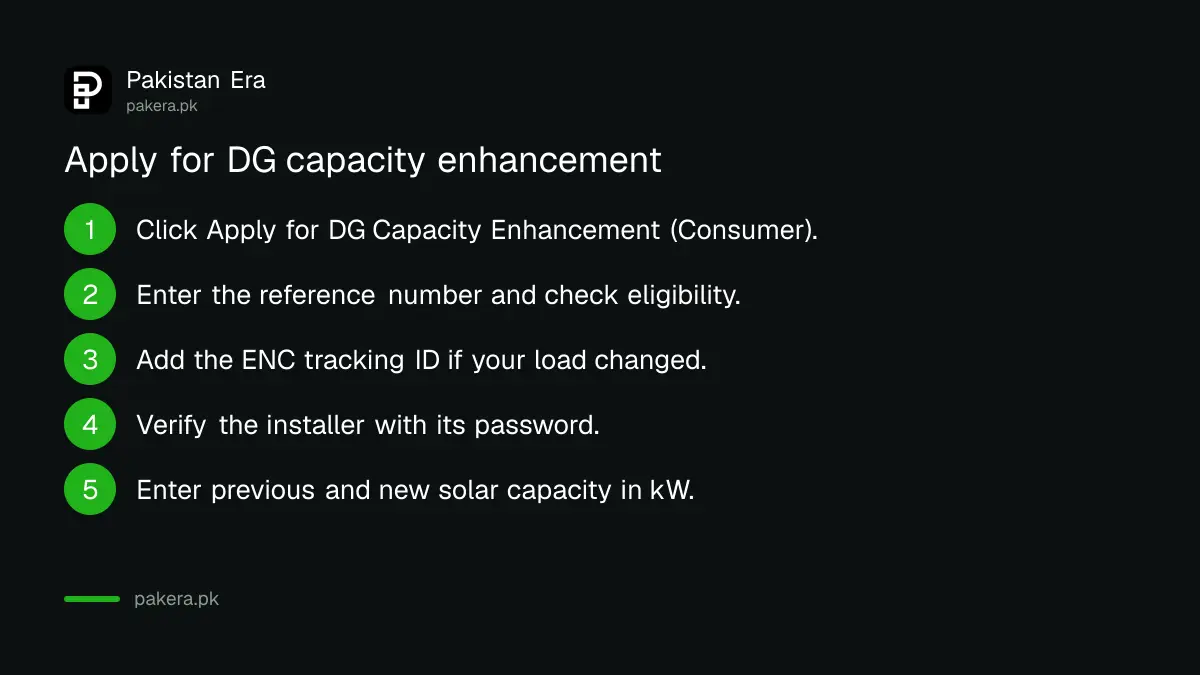
- Open nmp.pitc.com.pk and click Apply for DG Capacity Enhancement (Consumer). Your installer can use the (Installer) button instead.
- Enter the 14 digit reference number or the 10 digit consumer ID, choose your DISCO and click Check Eligibility for net metering.
- If your load or tariff changed, enter the tracking ID from ENC or eOps and click Check in ENC.
- Enter the installer's details. The installer types its password and you click Verify Installer.
- Type the Previous DG Capacity (kW) and the new total DG Installed Capacity (kW), then click Proceed.
- Fill in the NEPRA fee block if your new total is above 25 kW, then the feeder, tariff, CNIC, contacts and two witnesses.
- Add the new inverter and panel details, upload the documents (JPG, JPEG or PDF), tick the certificate, enter the captcha and submit.
Papers for an enhancement and who signs them
Use the same 2026 set as a new application: NEPRA Schedules II to V, the Schedule I interconnection agreement, the installer's customer agreement and the inspection certificate. The installer must be certified, and the inspection must cover the whole enlarged system.
- Installer: a company on PPIB's certified list, with your province in its area. Check its certificate number and validity date.
- Inverter data: make, model and rating of every inverter, new and old.
- Single line diagram and site plan: updated to show the added panels and the outside disconnect switch.
- Bill and CNIC: the bill must be in the applicant's name.
Systems above 25 kW also need NEPRA's concurrence. Regulation 4(1) of the Prosumer Regulations asks for fresh concurrence before any change to the technical parameters. At 25 kW or below, your DISCO approves it without NEPRA, and there is no NEPRA fee.
After you apply: tracking and deadlines
An enhancement is tracked like any net billing file, by tracking ID, CNIC or reference number. The DISCO's deadlines under the 2026 rules apply. If the new meter settings or billing are not updated, write to the SDO first, then go to NEPRA.
Use the net metering application status check to follow the file. If the export units go missing after the change, the crediting rules in what happens when a solar net meter stops working also apply.
Common questions
Can I add more solar panels to my net metering system?
Yes, through "Apply for DG Capacity Enhancement" on PITC's net billing portal. The new total must stay within your sanctioned load and the transformer's 80% limit.
Will I lose my old net metering rate if I add panels?
Yes, if your agreement predates 9 February 2026. A change to the system's maximum output ends the old terms under S.R.O. 547(I)/2026.
Do I need a new application for a bigger system?
No. Use the enhancement form, which records your previous capacity and the new total.
My sanctioned load is too low. What first?
Apply for a load extension through ENC or the Power Smart app, then file the enhancement with the tracking ID.
Is there a NEPRA fee for enhancement?
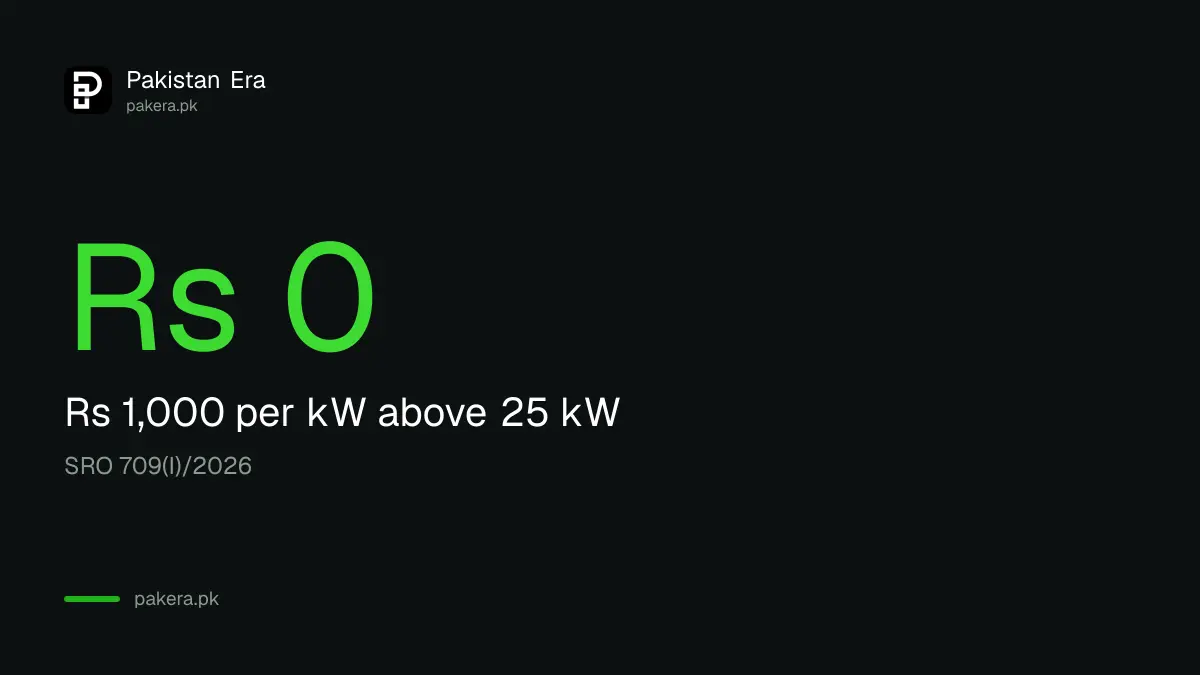
Not when the new total is 25 kW or below. Above 25 kW, NEPRA's fee is Rs 1,000 per kW and the form asks for the deposit details.
Can my installer apply for me?
Yes, with "Apply for DG Capacity Enhancement (Installer)" on the same portal.
How we verified this
What we checked and where we read it.
Checked on 15 November 2026 on PITC's Net Billing Portal: the "Net Billing Form for Enhancement of DG Capacity (By Consumer)", the home page messages and the installer guidelines. The rules on old agreements, fresh concurrence and fees come from the NEPRA (Prosumer) Regulations, 2026 (S.R.O. 251(I)/2026), S.R.O. 547(I)/2026, S.R.O. 709(I)/2026 and S.R.O. 1330(I)/2026 on nepra.org.pk. The tables of examples are our own sums.
About the author

Tax, Bills and Technology Writer
Ali Akhtar is a young and curious voice here at Pakistan Era. He is currently pursuing his A-Levels and has a growing interest in Pakistan’s changing industrial landscape and educational trends. Ali likes to write in a way that helps him explain and explore the world around him. His writing reflects the perspective of the new generation navigating the evolving trends of Pakistan where technology, youth innovation, and shifting opportunities are reshaping the country’s future.