Solar Net Meter Stopped Working in Pakistan: How Exported Units Are Credited
If your solar net metering meter fails, NEPRA's manual credits exports on the higher of last year's month or an 11 month average. See the 2 month limit and fix.
If the meter on your solar connection stops recording, NEPRA's Consumer Service Manual says your company must credit your exported units on an average basis for at most two months: the higher of the same month last year or the average of the last eleven months. It must replace the meter within two billing cycles and then correct your account from downloaded meter data.
A solar owner's bill depends on two numbers, the units imported and the units exported. When the meter fails, the export figure is the one that goes missing, and that is money. We read clause 4.3.1(d) and the nearby clauses of the revised 2025 Consumer Service Manual on NEPRA's website on 21 October 2026. The net metering rules have since changed in part, which we explain below.
The manual covers net metering meters that stop working
Clause 4.3.1(d) deals with a net metering meter that has become defective. It sits in the manual's chapter on meter replacement and bill adjustment. It applies where the meter was correct until the last billing cycle and then failed or burnt.
Clause 1.4 defines the net metering facility as one or two meters that measure what you import and export. If you hold such a connection, check the meter number on your bill against the one on the wall before you raise any complaint. The net metering rules in 2026 page explains how the rules changed this year.
Exported units are credited on average for two months at most
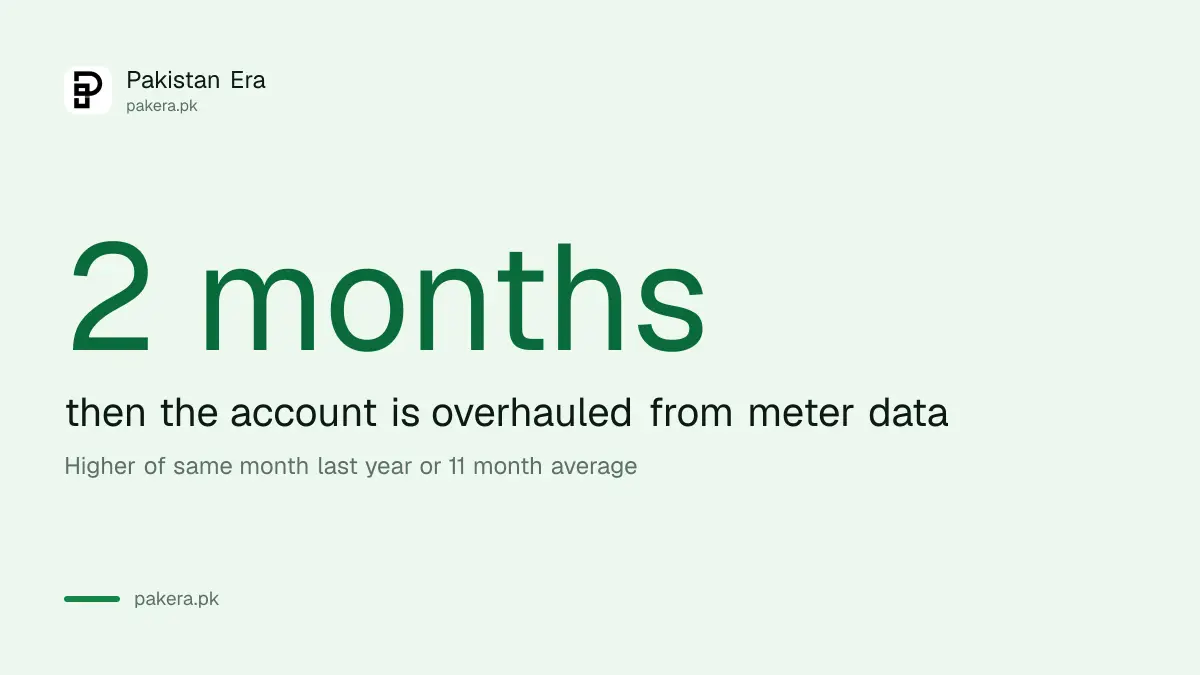
The manual says exported units are credited on average: 100 percent of the units exported in the same month of the previous year, or the average of the last eleven months, whichever is higher. This applies for a maximum of two months.
The word "higher" favours you. Say your export a year ago was 310 units in October and your eleven month average is 270. The manual credits 310. We made those numbers up to show the method; they are not an official example.
| Step | What the manual says | Clause |
|---|---|---|
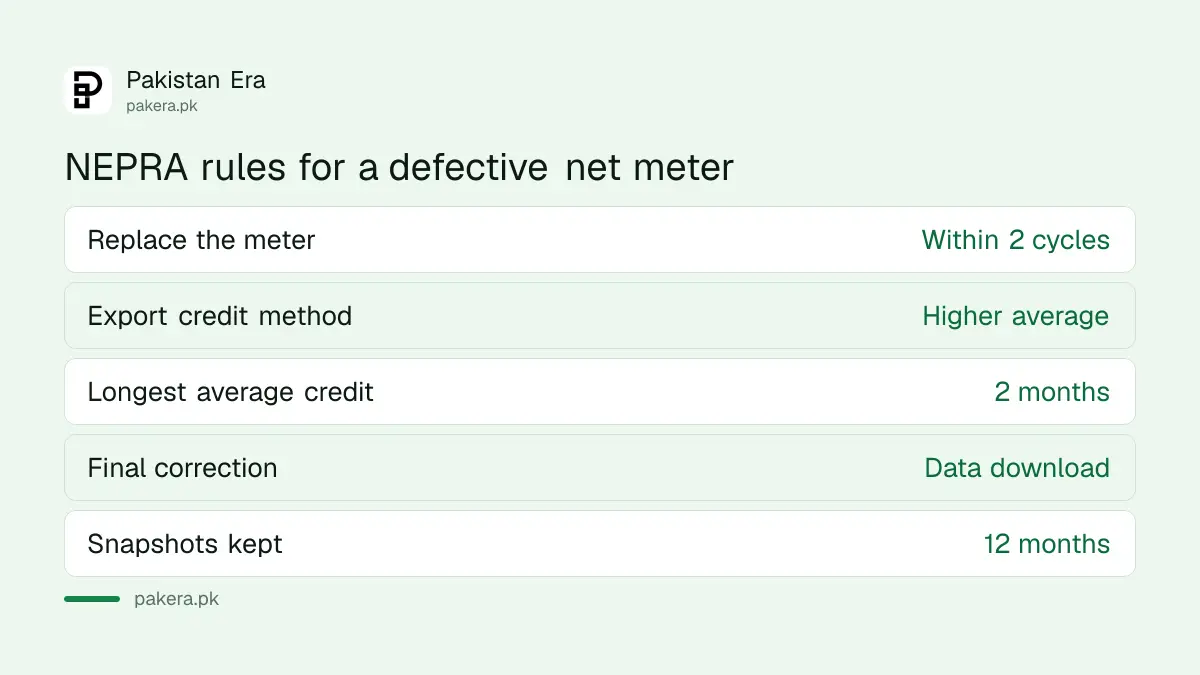
| Replace the meter | Immediately, and not later than 2 billing cycles | 4.3.1(d) |
| Credit for exports meanwhile | Higher of same month last year or last 11 month average | 4.3.1(d) |
| Longest period of average credit | Two months | 4.3.1(d) |
| Final correction | Account overhauled from the data download report | 4.3.1(d) |
| Earlier charges on a meter that was correct | None for the earlier period | 4.3.1(c) |
The company must replace the meter within two billing cycles
Clause 4.3.1(d) says the defective meter shall be replaced immediately, but not later than two billing cycles. If a meter is not in stock, the manual still sets that limit. Ask for the replacement date in writing.
The general rule on replacing a faulty meter uses the same two cycle limit for ordinary meters. For net metering, the average credit stops after two months, so a longer wait must be fixed through the corrected account.
The account is corrected from the downloaded meter data
The same clause says actual units exported and imported shall be retrieved through data downloading, and the consumer's account overhauled on the basis of the data downloading report. In plain words, the average credit is temporary. The true figures replace it later.
That cuts both ways. If you really exported more than the average, you gain the difference. If you exported less, the credit is reduced. Ask for a copy of the download report and compare it with the bill. A mismatch is a billing complaint, and the deadlines are in the NEPRA billing complaint deadlines.
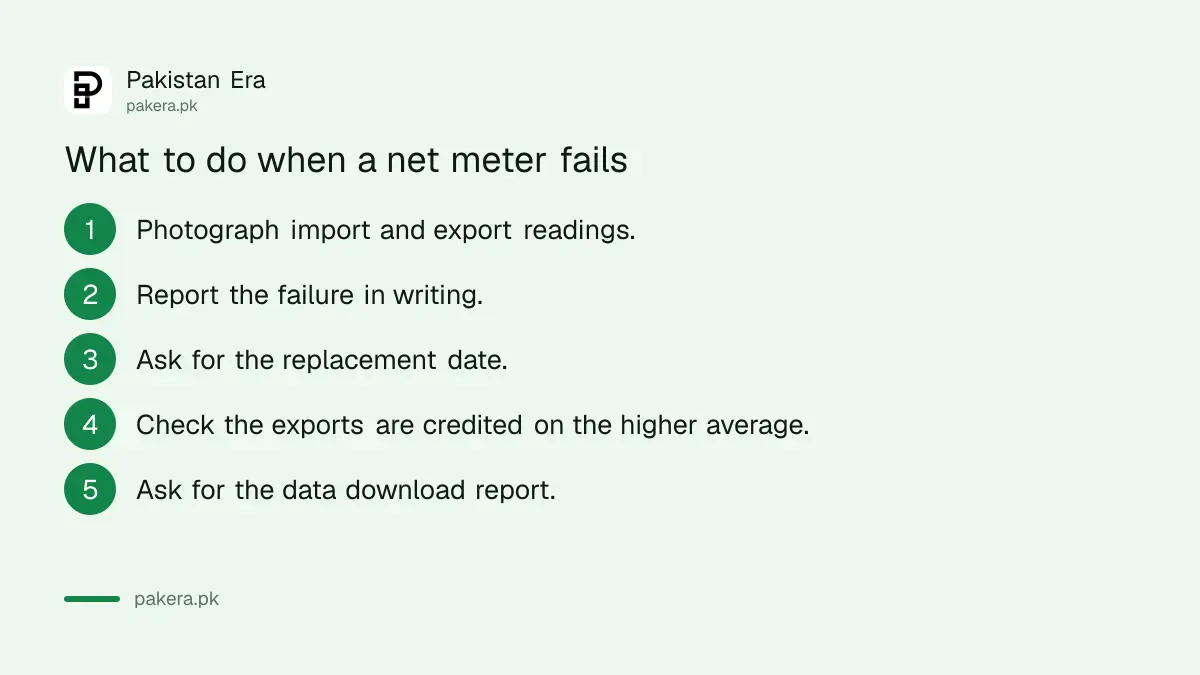
- Read your meter and take a dated photo of both import and export figures.
- Report the failure to the sub division in writing and keep the receipt.
- Ask for the replacement date and the credit method on the next bill.
- Check that the bill credits exports on the higher average.
- Request the data download report and check the final correction.
Snapshots on your bill show both import and export units
Clause 6.1.3 says the meter reading snapshot printed on your bill must show import and export units for net metering. The company must keep these snapshots for twelve months for use before NEPRA, the POI or a court if a dispute arises.
Your own photos back this up. A stuck or blank display shows up in the company's snapshot as an unchanged reading. For the method, see checking your meter reading snapshot.
The 2026 net billing rules may change this
The manual is dated November 2025, and the rules for solar consumers changed in 2026. We did not read the new prosumer regulations for this page, so we cannot say whether clause 4.3.1(d) still governs a net billing meter. Ask your company which clause it applies and get the answer in writing.
Common questions
How long can my company credit exports on average?
For a maximum of two months, under clause 4.3.1(d) of the manual.
Which average is used?
The higher of the same month last year or the average of the last eleven months.
How soon must the meter be replaced?
Immediately, and not later than two billing cycles.
Can the credit be changed later?
Yes. The account is overhauled using the data download report once the real figures are retrieved.
Does the company keep my meter readings?
Clause 6.1.3 says snapshots must be kept for twelve months for a billing dispute.
Does this apply to K-Electric?
We did not check. The manual binds the distribution companies, and K-Electric has its own net billing process.
How we verified this
What we checked, where we read it, and what we could not confirm.
Last checked 21 October 2026. We read clauses 1.4, 4.3.1 and 6.1.3 of the NEPRA Consumer Service Manual, revised 2025. The October export example is invented to show the method. We did not read NEPRA's 2026 prosumer regulations, so how this clause applies to net billing meters is not verified. We did not test any company's handling of a failed meter.
About the author

Senior Writer, Public Services and Technology
Shahid joined us in 2024 as an author. He is a senior contributor to Pakistan's leading technology websites. He writes detailed articles, mostly covering his expertise in the latest tech, mobiles, apps, gadgets, and step-by-step guides. His ideology is to help people understand the latest trends and explain complex methods through very easy-to-understand guides.