Net Metering Rules 2026 in Pakistan: How to Apply With Your DISCO
Apply for solar net billing in Pakistan under the 2026 NEPRA rules: every DISCO deadline, the papers, the nil fee up to 25 kW, and what ends old net metering.
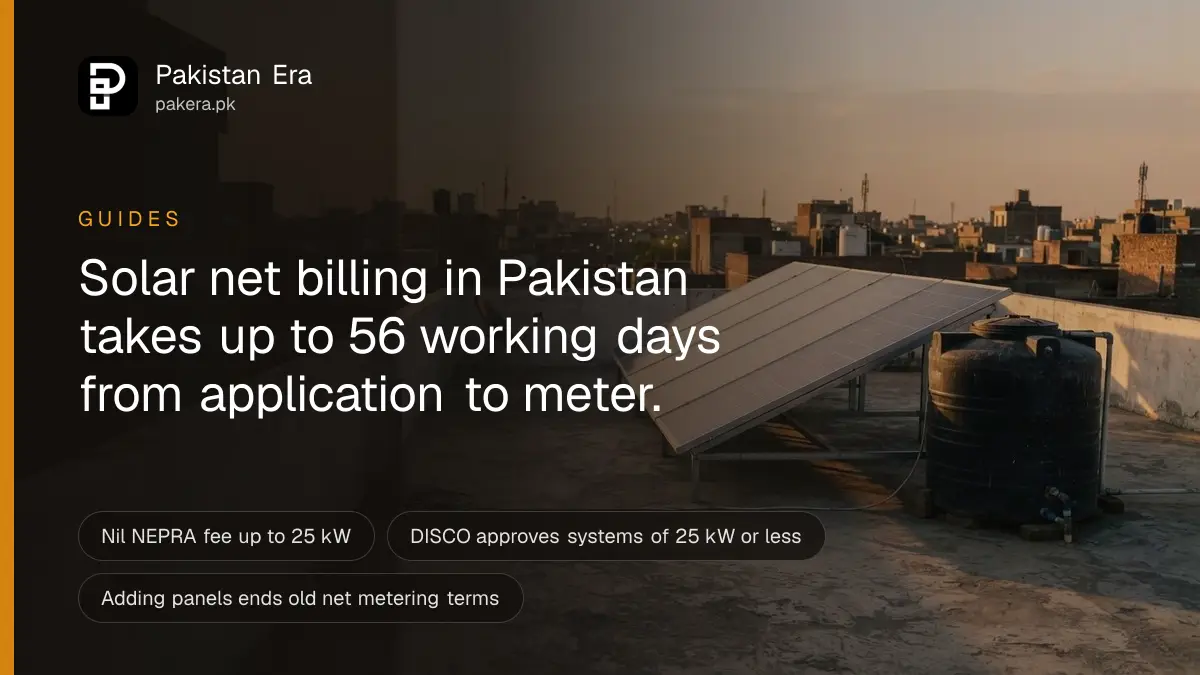
You apply for rooftop solar with your electricity company, not with NEPRA. The 2026 rules give your DISCO a deadline at every step, about 56 working days in total. A system of 25 kW or less needs no NEPRA fee and no NEPRA approval. Exports are bought under net billing.
Those are the net metering rules for 2026 in Pakistan, in short. They sit in the NEPRA (Prosumer) Regulations, 2026, S.R.O. 251(I)/2026 of 9 February 2026, and three amendments since. We downloaded all four from NEPRA's website on 28 September 2026 and read them page by page, including two scanned ones.
This guide covers the application, the papers, the fees and the waiting time. The pricing change itself is explained in what solar export pays now that net metering has ended.
The 2026 rules in one table
Four NEPRA notifications make up the current rules, and all four are in force. February replaced net metering with net billing. An April amendment protected older agreements. A second April notice set the fee. An August amendment removed NEPRA's approval for systems of 25 kW or less.
| Rule | What it says | Where it is |
|---|---|---|
| Who can apply | A 3 phase 400V or 11kV consumer | Regulation 2(1)(v) |
| What counts | Solar, wind or biogas, up to 1 MW | Regulation 2(1)(ix) |
| Maximum size | No more than your sanctioned load | Regulation 3(2) |
| Transformer limit | No new application once solar on your transformer reaches 80% of its capacity | Regulation 3(5) |
| Export price | National average energy purchase price | Regulation 14(1)(b) |
| Agreement term | Five years, renewable by mutual consent | Regulation 7 |
| NEPRA fee | Nil up to 25 kW, Rs 1,000 per kW above, one time | S.R.O. 709(I)/2026 |
| NEPRA approval | Not needed at 25 kW or below | S.R.O. 1330(I)/2026 |
The transformer rule is the one almost nobody mentions. If your street already has a lot of solar, the DISCO "shall not entertain" your application, whatever your sanctioned load says. Ask about your transformer before you pay an installer.
Net billing pays a wholesale rate for exported units
Units you take from the grid are charged at your normal tariff. Units you send to the grid are bought at the national average energy purchase price. The regulations name that price but print no rupee figure. It has been reported at about Rs 11 a unit.
We found no rupee figure on any NEPRA or DISCO page, so treat Rs 11 as reported, not confirmed. Regulation 14(3) also lets NEPRA change the rate during your agreement, and the new rate becomes part of your contract automatically.
If your exports are worth more than your bill, the difference moves to your next bill or is paid to you every quarter. So a unit you use yourself in daylight saves far more than a unit you export. That is why some owners now look at battery storage.
How to apply to your DISCO, step by step
Regulation 3 sets the process and a deadline for each step. You submit the Schedule-II form with your papers. The DISCO checks it, reviews it, signs an agreement, sends an estimate, and installs a two-way meter after you pay. Each deadline below is the maximum.
- Ask for the forms. The DISCO must give them free within two working days.
- Submit. The DISCO acknowledges within five working days and lists anything missing. You have three working days to supply it.
- Initial review. Up to 15 working days. If the system is not feasible, you get reasons within three working days.
- Agreement. Signed within seven working days.
- Estimate. Issued within seven working days, for the meter and connection work.
- Payment. You pay within seven working days.
- Installation. Within 15 working days of payment.
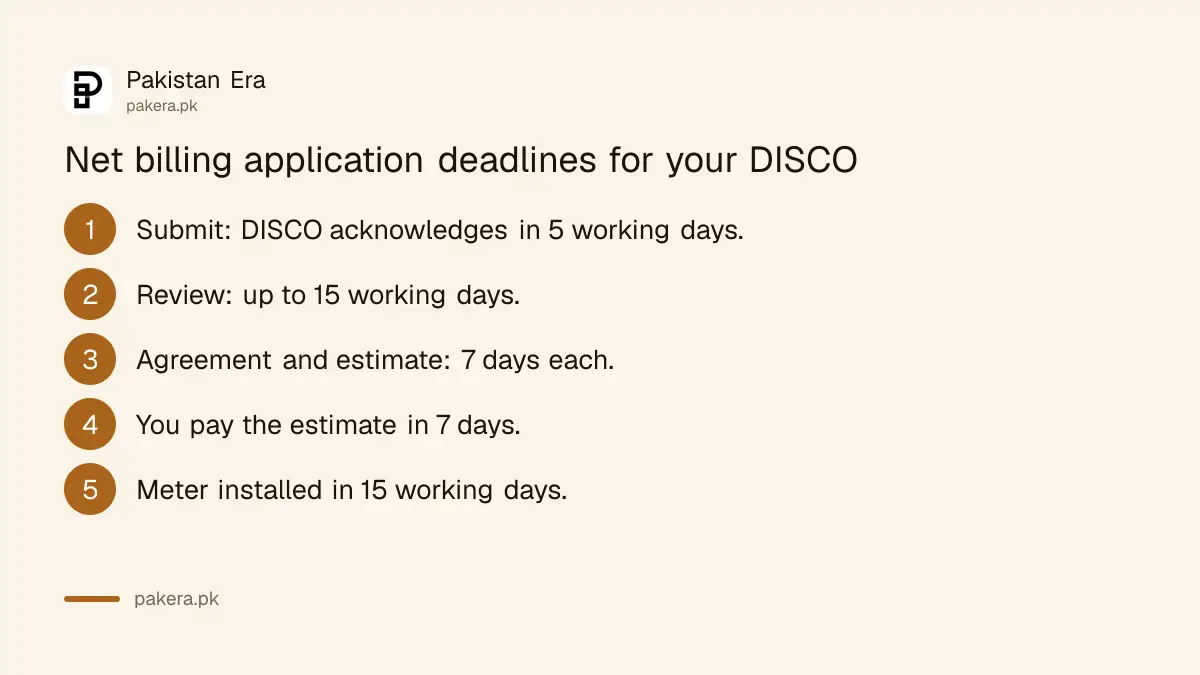
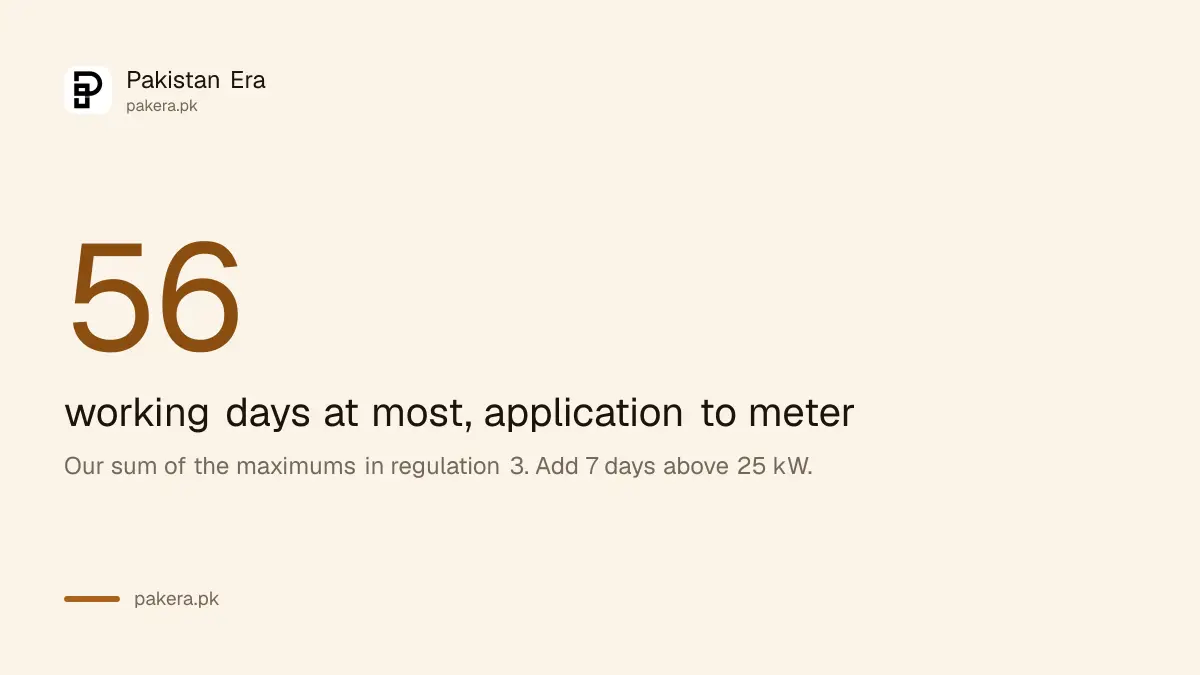
Add the limits and you get about 56 working days, roughly 11 to 12 weeks. That is our sum of the maximums, not a promise. The 2015 rules were slower on paper: 20 working days for review and 30 days to install. K-Electric's own guideline follows the new pattern, with installation within 15 working days of payment.
Billing starts only once approval is granted. Above 25 kW, the DISCO sends your file to NEPRA, which may grant concurrence within seven working days. Start generating within six months of that, or you need a fresh one.
Documents and fees for a net billing application
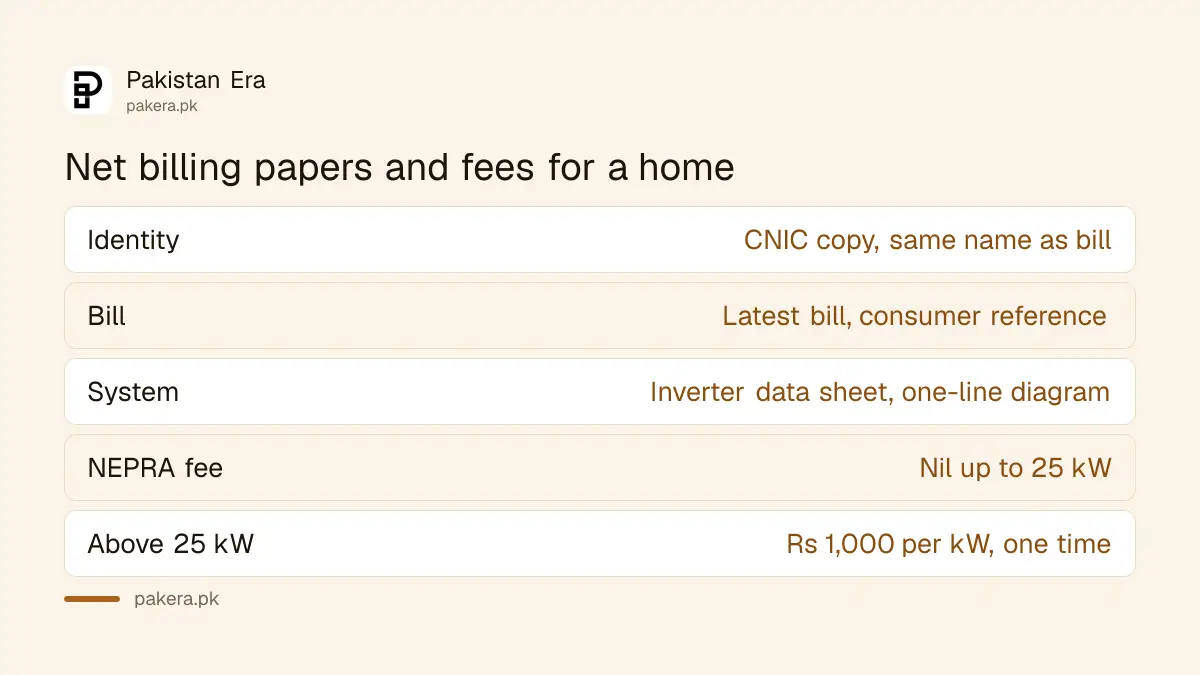
For a home you need your CNIC, a recent bill in the same name and address, the installer's papers, the inverter data sheet and a single line diagram. The NEPRA fee is nil up to 25 kW. You still pay the DISCO's estimate for the meter and connection.
The Schedule-II form asks for your CNIC copy, consumer reference number, ownership of the system, expected yearly use and generation, installer details, inverter make and model, and a site plan showing the outside disconnect switch. For NEPRA concurrence above 25 kW, the rules add an affidavit on Rs 50 non-judicial stamp paper, and an e-stamp paper is the usual way to get one.
K-Electric's checklist also asks for the vendor's certificate and inverter settings on the vendor's letterhead. The name and address on your CNIC and bill must match. If the bill is in a previous owner's name, change the name on the electricity bill first.
| Cost | 25 kW or below | Above 25 kW |
|---|---|---|
| NEPRA fee | Nil | Rs 1,000 per kW, one time |
| Who approves | Your DISCO | NEPRA, after your DISCO |
| Meter and connection | DISCO estimate | DISCO estimate |
| Load flow study | Not needed | Needed at 250 kW and above |
A 10 kW home pays NEPRA nothing. A 50 kW factory pays Rs 50,000. K-Electric's April guideline still lists a Rs 1,000 per kW pay order for every case, but NEPRA's fee notice makes it nil at 25 kW or below. If your DISCO has no meter in stock, you may buy one, and the DISCO must test it first.
Existing net metering users keep old terms, with one catch
If you signed before 9 February 2026, you keep the old rate and billing method until your agreement ends. S.R.O. 547(I)/2026 says so, backdated to 9 February. But the protection ends if you change your system in a way that changes its maximum output.
We read the amendment's full wording. It protects agreements made under the 2015 rules, billed "in accordance with the rate and mechanism provided in the repealed regulations till the expiry of the term". Then it adds that this "shall cease to be applicable in case of material modification" changing the maximum electrical output.
In plain words: add panels or a bigger inverter, and you move to net billing.
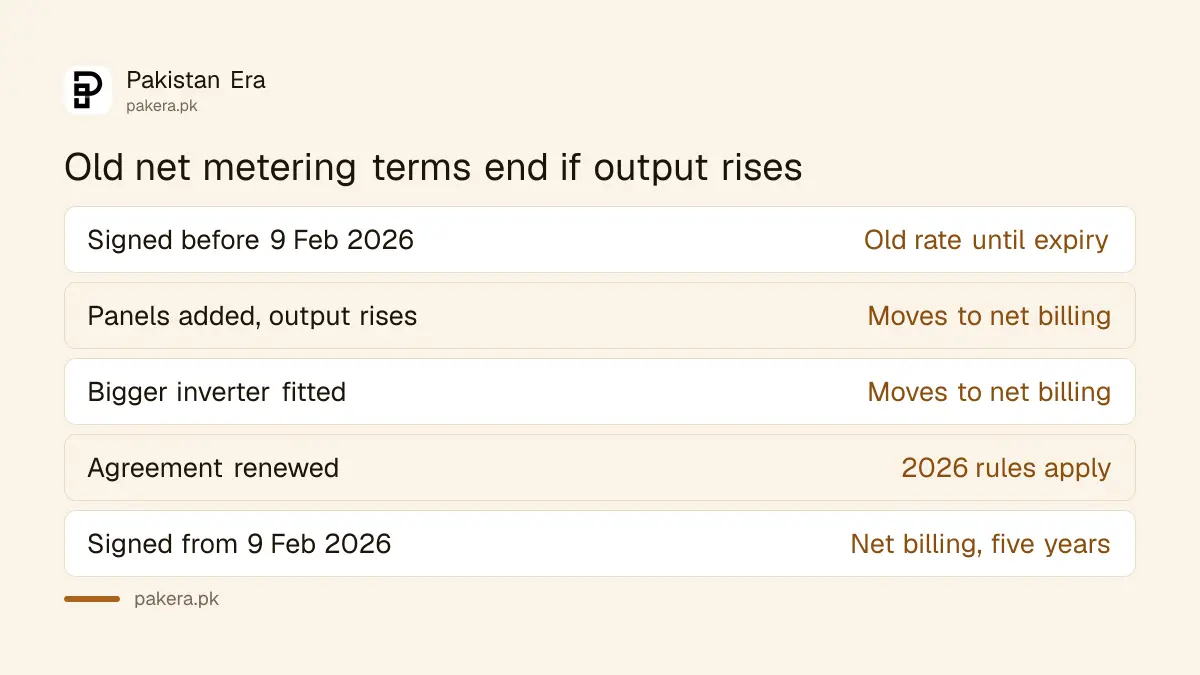
When your old agreement expires, any extension falls under the 2026 rules. Terms changed more than once under the old rules, so read the expiry date on your own agreement.
Where to complain if your DISCO misses a deadline
Regulation 17 sends any dispute between you and your DISCO to NEPRA for decision. Complain to the DISCO in writing first, quoting the regulation and the missed deadline. If that fails, take it to NEPRA with your acknowledgement receipt and the dates.
Keep every receipt with its date, because the deadlines only help if you can show when each step started. NEPRA's online route is set out in how to complain about a wrong electricity bill, and the exact wording of the 25 kW approval exemption is quoted in full there too.
One warning. When we checked LESCO's net metering page on 28 September 2026, it still listed the 2015 forms. Use the 2026 Schedule-II form, or ask the DISCO in writing which form it wants.
Common questions
Is net metering still available in Pakistan in 2026?
No, not for new users. The 2015 rules were repealed on 9 February 2026 and new connections get net billing. Agreements signed before that date keep the old terms until they expire.
Can I get net billing on a single phase connection?
No. The regulations define an applicant as a 3 phase 400V or 11kV consumer, so a single phase home would first need a 3 phase connection.
How long does a net billing connection take?
Up to about 56 working days if every step uses its full limit. Above 25 kW, add up to seven working days for NEPRA's concurrence.
Can I add more panels to my old net metering system?
You can, but a change that raises the system's maximum output ends your old net metering terms, and the system moves to net billing.
Can my DISCO refuse my solar application?
Yes, if the system is not technically feasible, is bigger than your sanctioned load, or solar on your transformer has reached 80% of its capacity. Approval must not be "unreasonably withheld".
What is the buyback rate for solar units in 2026?
The national average energy purchase price. The regulations print no figure, and it has been reported at about Rs 11 a unit. Ask your DISCO for it in writing.
How we verified this
What we checked, where we read it, and what we could not confirm.
Last checked on 28 September 2026. On NEPRA's website we read the NEPRA (Prosumer) Regulations, 2026, S.R.O. 251(I)/2026, for eligibility, the 80% transformer limit, the deadlines in regulation 3, concurrence in regulation 4, net billing in regulation 14, disputes in regulation 17, the Schedule-II form and the Schedule-V affidavit. We also read S.R.O. 547(I)/2026 of 2 April, S.R.O. 709(I)/2026 of 28 April, S.R.O. 1330(I)/2026 of 6 August, and the 2015 regulations for the old deadlines. NEPRA lists no later amendment. We read K-Electric's net billing page and its 13 April 2026 guideline, and LESCO's net metering page. The rupee export rate is reported, not confirmed at source.
About the author

Tax, Bills and Technology Writer
Ali Akhtar is a young and curious voice here at Pakistan Era. He is currently pursuing his A-Levels and has a growing interest in Pakistan’s changing industrial landscape and educational trends. Ali likes to write in a way that helps him explain and explore the world around him. His writing reflects the perspective of the new generation navigating the evolving trends of Pakistan where technology, youth innovation, and shifting opportunities are reshaping the country’s future.