Solar Up to 25 kW No Longer Needs NEPRA Approval
NEPRA's notification of 6 August 2026 drops the concurrence step for rooftop solar of 25 kW or less. Your DISCO now approves it directly.
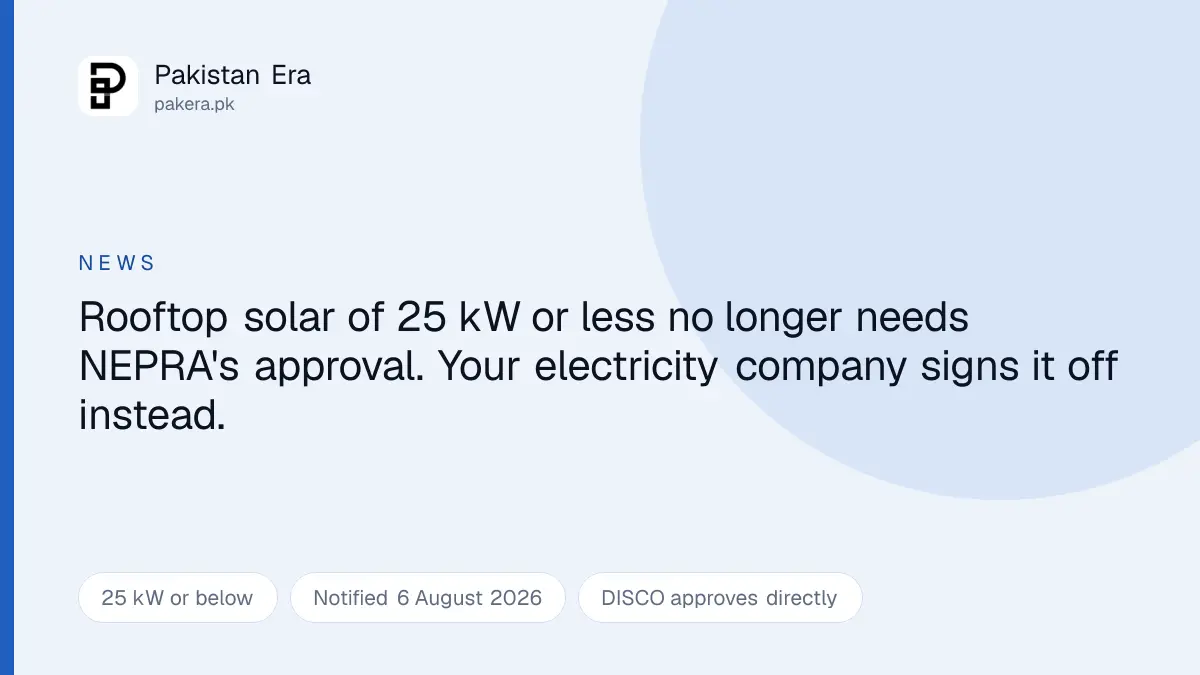
If your rooftop solar system is 25 kilowatts or smaller, you no longer need approval from NEPRA to connect it to the grid. Your electricity distribution company approves it on its own.
NEPRA notified the change on 6 August 2026. We downloaded the notification from NEPRA's own website and read it. This is the sentence that matters:
"Provided that a prosumer having distributed generation facility of 25 kW or below capacity shall not be required to seek concurrence from the Authority and the concerned licensee shall accord its approval."
In plain words: "the Authority" is NEPRA and "the concerned licensee" is your DISCO, so LESCO, K-Electric, IESCO, MEPCO and the rest. One approval step has been removed from the process.
25 kW covers almost every home system
A normal Pakistani household solar system is 5 kW to 15 kW. A large house with several air conditioners might reach 20 kW. So this change covers nearly every domestic installation in the country, plus small shops and offices.
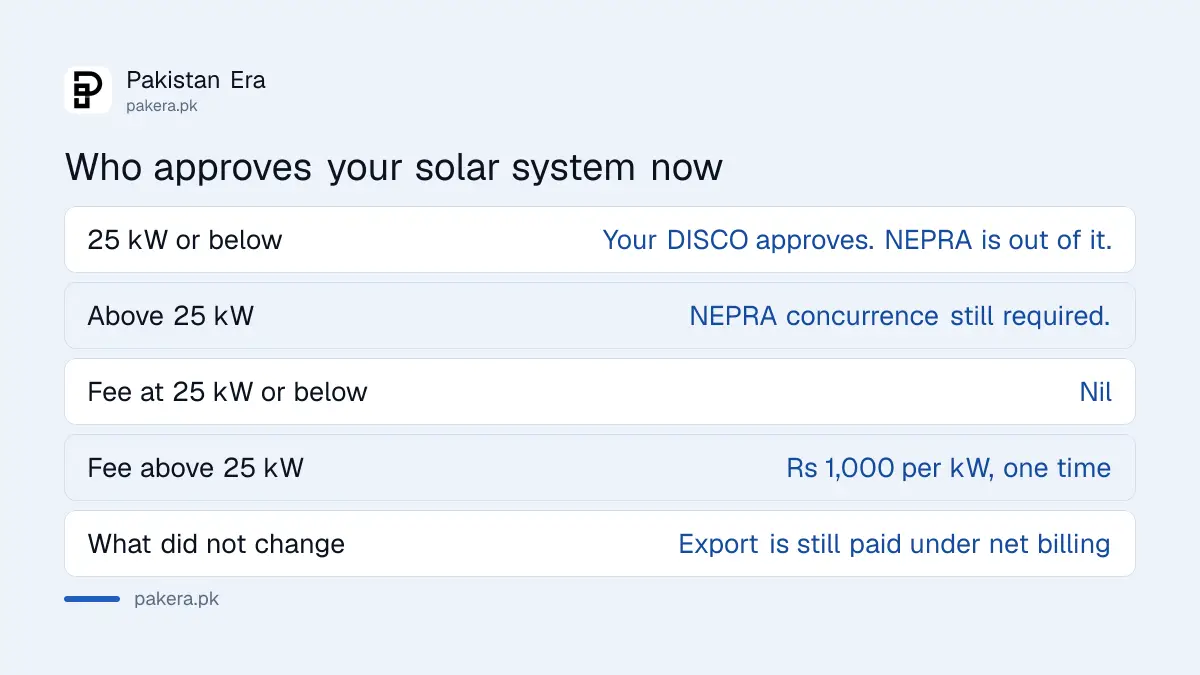
Above 25 kW, nothing changes. Those systems still need NEPRA concurrence, and they still pay a fee.
It applies whoever paid for the panels. If you are coming through a provincial scheme rather than buying outright, the same approval route applies, and we set out the eligibility rules in the guide to the Punjab free solar scheme.
The fee was already nil below 25 kW
This is the part most reports have missed. The 25 kW line was not drawn yesterday. NEPRA set the same threshold for fees back on 28 April 2026, in a separate notification we also read in full.
| System size | Concurrence fee | Who approves, from 6 August 2026 |
|---|---|---|
| 25 kW or below | Nil | Your DISCO |
| Above 25 kW | Rs 1,000 per kW, one time | NEPRA |
That fee notification was made effective from 9 February 2026, backdated. So a small system already cost nothing to get approved. What yesterday's change removed was the waiting, not the money.
For a 50 kW system on a factory or a large shop, the fee is Rs 50,000, paid once, in favour of NEPRA.
What this does not change, and this part matters more
We want to be direct with you here, because the headlines make this sound like better news than it is.
The approval step got shorter. The money you are paid for your solar export did not change at all.
Since 9 February 2026, Pakistan does not have net metering any more. It has net billing. Under the old system, a unit you exported cancelled a unit you imported, one for one. Under net billing, you buy at the full retail tariff and you sell at a much lower wholesale rate. We have explained how that arithmetic works, and what it does to payback periods, in our guide to what Pakistan now pays for solar export.
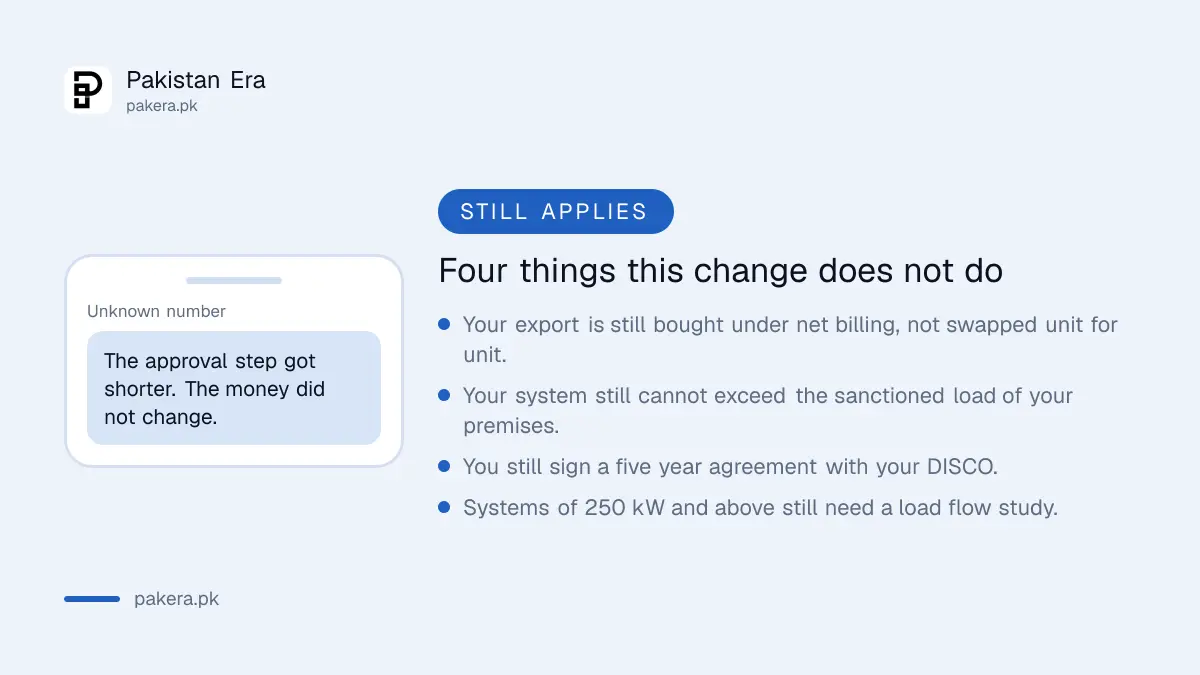
Four other rules also stay exactly where they were.
- Your system cannot exceed the sanctioned load of your premises. If your connection is sanctioned for 10 kW, you cannot install 25 kW just because approval is now easier.
- You still sign a five year agreement with your DISCO, running from the date your system is commissioned. It can be renewed for another five by mutual consent.
- Systems of 250 kW and above still need a load flow study, carried out through the DISCO or a consultant registered with the Pakistan Engineering Council.
- The connection still has to be three phase, at 400V or 11kV.
How the rules moved through 2026
Four separate notifications changed the rules for solar owners this year. Read together they explain why the advice you were given in January is no longer correct.
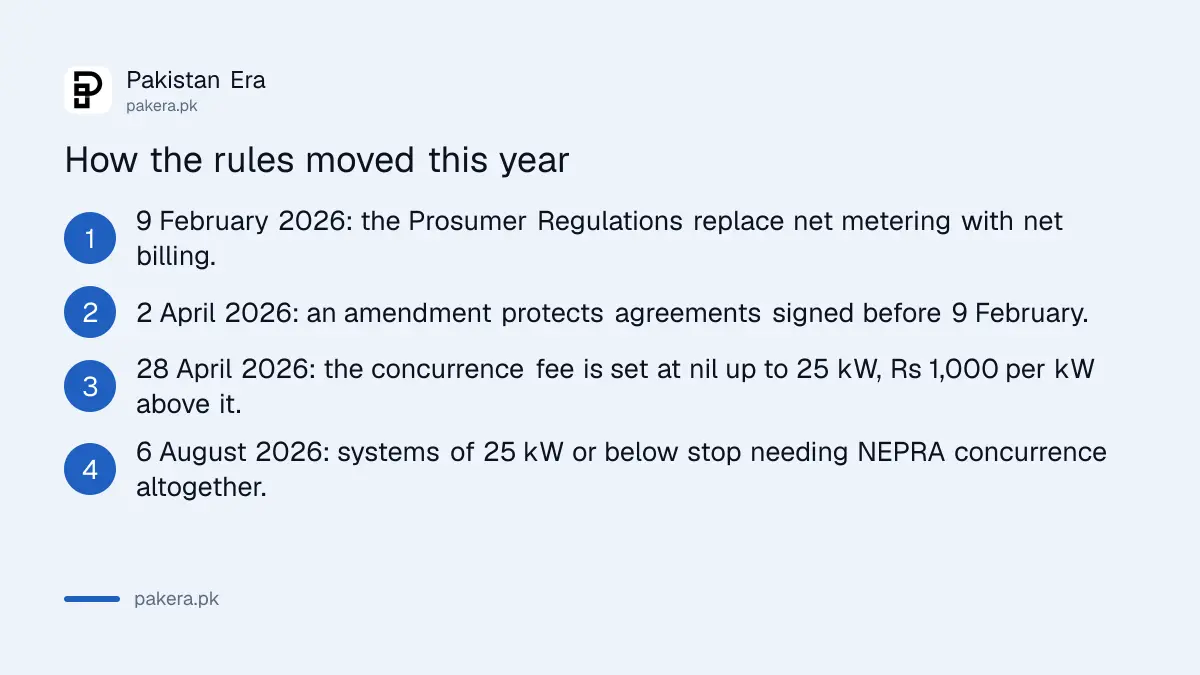
| Date | What it did |
|---|---|
| 9 February 2026 | Net metering repealed, net billing introduced |
| 2 April 2026 | Agreements signed before 9 February protected until they expire |
| 28 April 2026 | Concurrence fee set at nil up to 25 kW, Rs 1,000 per kW above |
| 6 August 2026 | Concurrence itself dropped for 25 kW and below |
One detail we could not settle
NEPRA's own file is named SRO 1330(I)-2026. At least one news outlet reported the same notification as SRO 1320(I)/2026. We are going with the number on NEPRA's server because that is the primary document, but we are telling you about the difference rather than hiding it. If you are quoting the number in an application, check the copy on NEPRA's site first.
What to do if you are installing solar now
- Confirm your sanctioned load before you size the system. It is printed on your bill, and it is the real ceiling.
- Apply to your DISCO, not to NEPRA, if you are at 25 kW or below.
- Do not pay anyone a NEPRA fee for a small system. There is no fee to pay at or below 25 kW.
- Budget on net billing, not net metering. Any installer still showing you a one for one unit swap is working from rules that were repealed in February.
- Keep the signed agreement. Its date decides which rules apply to you for the next five years.
If you are weighing whether solar still pays at these rates, the honest answer depends on how much of your own generation you use during the day rather than export. That is a different calculation from the one most people ran in 2024, and it is the one we work through in the piece on battery storage.
Questions readers are asking
Do I need NEPRA approval for a 10 kW solar system?
No. Since 6 August 2026, systems of 25 kW or below do not need NEPRA concurrence. Your distribution company approves the application itself.
What is the NEPRA fee for solar approval?
Nothing at 25 kW or below. Above 25 kW it is Rs 1,000 per kW as a one time payment to NEPRA, set on 28 April 2026 and backdated to 9 February 2026.
Does this mean net metering is back?
No. Net metering was repealed on 9 February 2026 and replaced by net billing. This change is only about who signs the approval, not about what your exported units are worth.
Can I install a bigger system than my sanctioned load?
No. The regulations say the capacity of the generation facility shall not exceed the sanctioned load of the premises. NEPRA can revise that limit by notification, but it has not.
How long is the agreement with the DISCO?
Five years from the date the system is commissioned, renewable for another five years by mutual consent.
I signed before 9 February 2026. Am I affected?
Not by this change, and not by the switch to net billing either. A separate amendment on 2 April 2026 protects agreements executed before 9 February 2026 until their term ends.
About the author

Tax, Bills and Technology Writer
Ali Akhtar is a young and curious voice here at Pakistan Era. He is currently pursuing his A-Levels and has a growing interest in Pakistan’s changing industrial landscape and educational trends. Ali likes to write in a way that helps him explain and explore the world around him. His writing reflects the perspective of the new generation navigating the evolving trends of Pakistan where technology, youth innovation, and shifting opportunities are reshaping the country’s future.