How to Get a Faulty Electricity Meter Checked and Replaced in Pakistan
A fast or slow electricity meter can be tested for Rs 500 within 7 working days under NEPRA rules. Who pays for the new meter, refunds, and the theft risk.
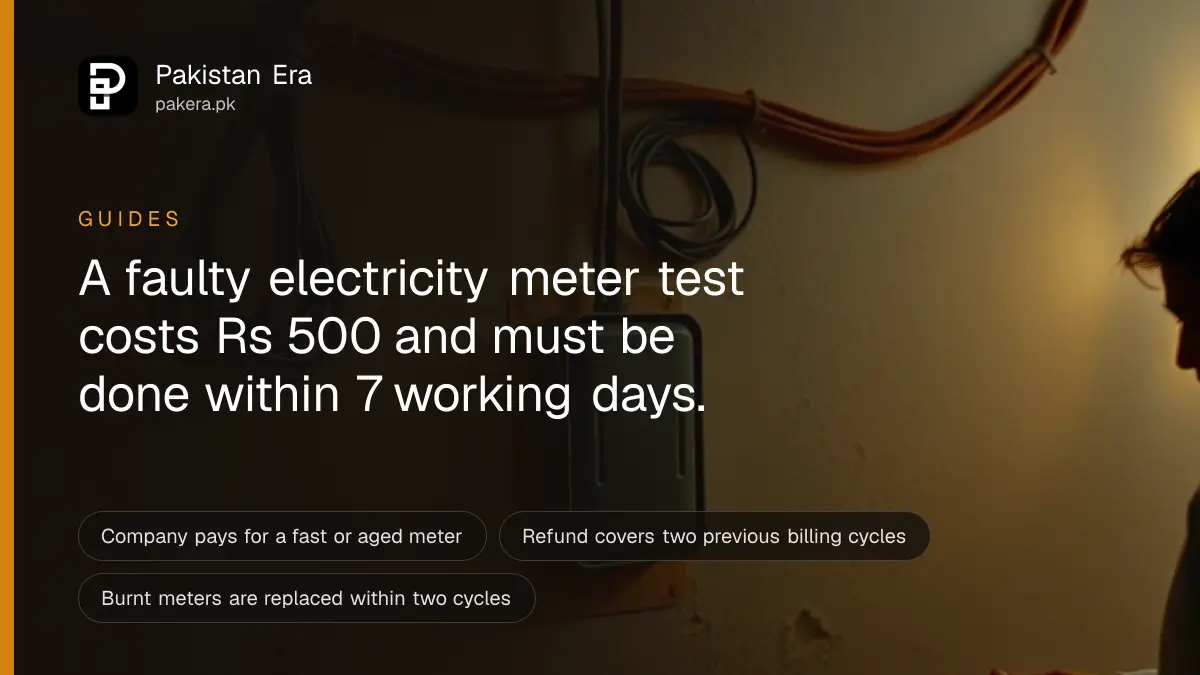
If you think your electricity meter is running fast or slow, apply to your electricity company for a meter check. The fee is Rs 500 for a single phase meter and Rs 1,000 for three phase. The company must test it within 7 working days of payment, in front of you. If the meter is faulty, the company pays for the new one.
Those rules are in clause 4.3.4 of NEPRA's Consumer Service Manual, the rulebook every electricity company in Pakistan must follow. We read the revised version, dated 26 November 2025, page by page on 28 September 2026. It is a scanned PDF on NEPRA's website, so we read the page images.
A meter check is worth doing when your units jump for no reason. But one risk comes with it, and most people never hear about it until too late. We cover that below, before you apply.
How to request a meter check from your electricity company
Tell your electricity company, known as a DISCO, that you doubt the meter's accuracy. It issues a demand notice for the meter challenge fee. Pay it, and the company must check the meter within 7 working days, with you or your representative present.
- Write to your sub-divisional office or One Window counter. Give your reference number and say you want the meter checked for accuracy.
- Get the demand notice: Rs 500 for single phase, Rs 1,000 for three phase.
- Pay it and keep the receipt. The 7 working day clock starts on the date of payment.
- Be present at the test, or send someone you trust.
- Ask for the result in writing, including how fast or slow the meter was found.

The test is done in one of two ways. The company puts a calibrated "check meter" next to yours, wired in series so both record the same supply. Or, if it has no check meter, an expert from its metering and testing department tests yours with a rotary sub-standard or a digital power analyser. Both are instruments that measure what your meter should be showing.
Keep your last 12 bills and a few photos of the meter reading before you apply. A bill history is your best evidence if the result goes against you.
Who pays for the new meter: the company or you
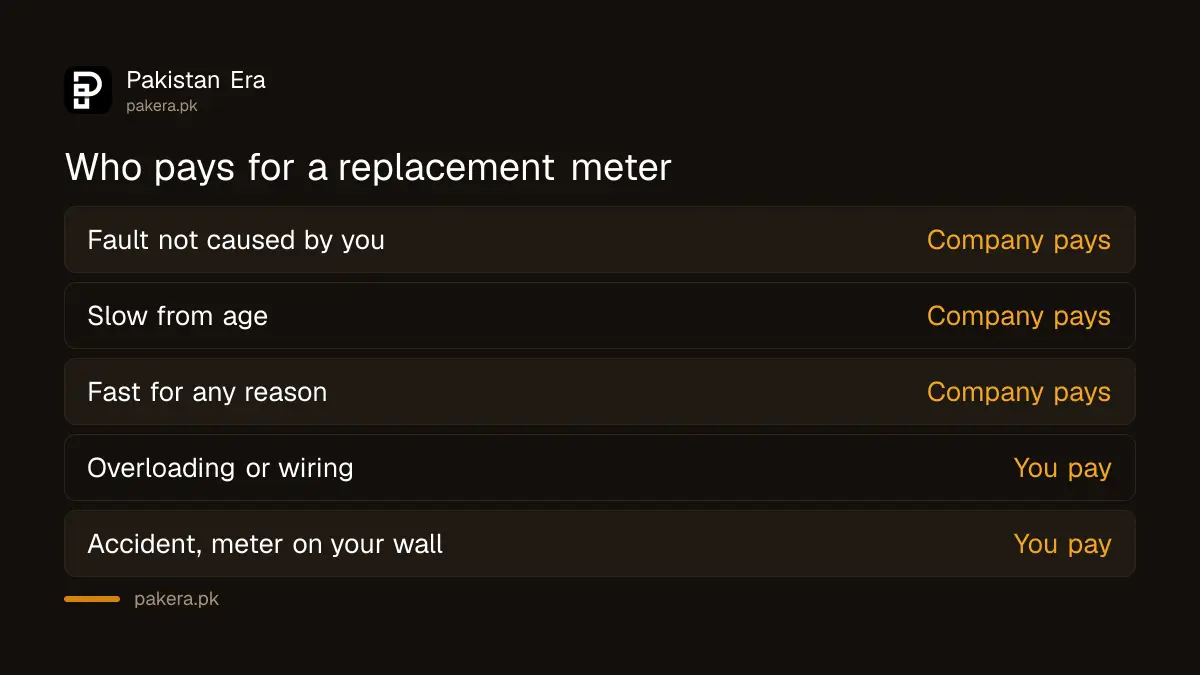
The electricity company pays when the meter fails through no fault of yours, when it is slow from age, or when it is fast for any reason. You pay when the damage is your fault, such as overloading or faulty house wiring. Section 4.4 of the manual sets this out.
| Meter problem | Who pays for replacement |
|---|---|
| Defective, burnt, display washed, internal fault or weather damage, not your fault | Electricity company |
| Slow because of age or other reasons not linked to theft | Electricity company |
| Fast, for any reason | Electricity company |
| Damaged by your overloading or internal wiring defect | You |
| Missing or damaged in an accident, meter on your premises | You |
| Missing or damaged in an accident, meter on a pole or structure | Electricity company |
When you do pay, the company may add the cost to your electricity bill so the new meter goes in faster. And if you bought the meter yourself, the manual says no meter rent can be charged. Companies with no meters in stock can ask you to buy one from their approved vendors, so ask for the vendor list in writing.
What happens if the meter is fast or slow
A fast meter is replaced at once at the company's cost, and you get credit for the extra units for up to two previous billing cycles. A slow meter is also replaced at the company's cost, but you are charged for the missed units for two previous billing cycles.
So the two-month limit works both ways. You cannot claim back a year of overbilling through a meter test, and the company cannot back-charge a year of slowness either.
| Situation | Rule in the manual | Clause |
|---|---|---|
| Meter found fast | Replaced at company cost, credit for 2 previous billing cycles | 4.3.4(d) |
| Meter found slow | Replaced at company cost, 2 previous billing cycles charged | 4.3.4(e) |
| Meter burnt or defective, correct until last bill | Replaced within 2 billing cycles, no back charges | 4.3.1 |
| Billing while waiting | Average bill for at most 2 months | 4.3.1(b) |
| House empty, meter defective | Only minimum charges, with proof | 4.3.6 |
While you wait for a new meter, the company may bill on average for up to two months. That average is 100 per cent of the units in the same month last year, or the average of the last 11 months, whichever is higher. If your house was empty and you can prove it, clause 4.3.6 says you pay only minimum charges.
A display wash, where the screen goes blank, has its own rule. The company must retrieve the meter's stored data within 3 months, or 6 months if the meter goes to its maker. Miss that window and it cannot debit your account for those units.
The detection bill risk before you apply
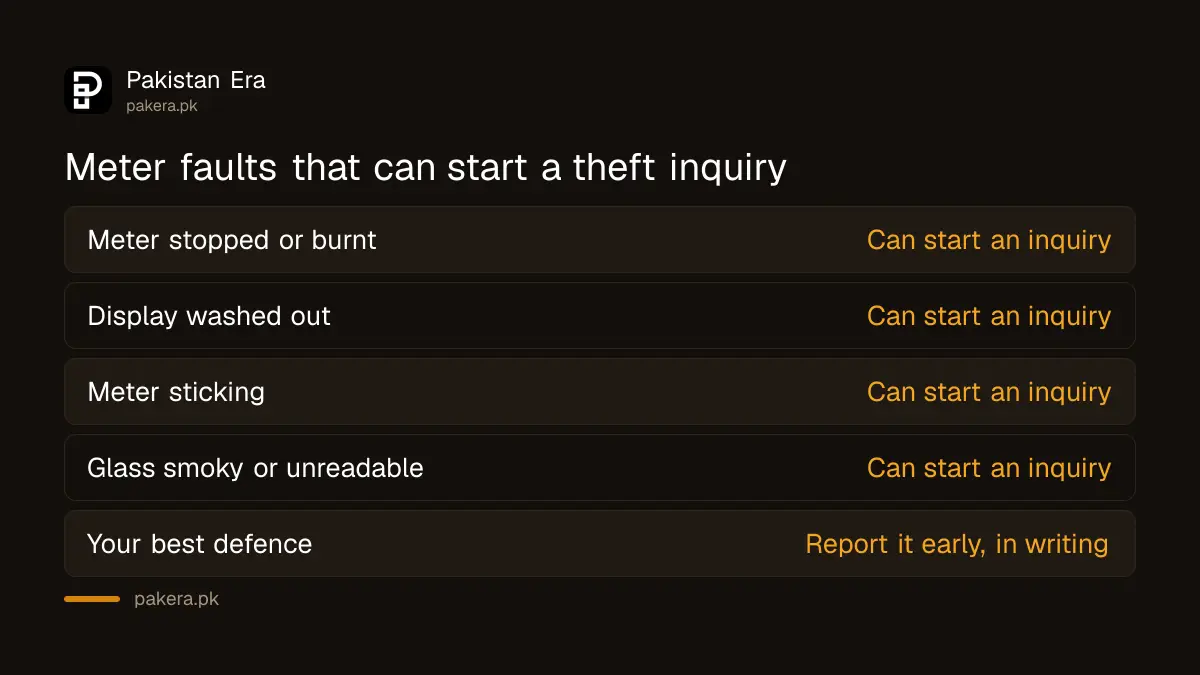
Some meter faults also appear on NEPRA's list of signs of electricity theft. Clause 9.2.1 names a stopped, burnt or display-washed meter, a sticking meter and smoky glass as signs that "shall lead to further investigations." A genuine fault can still start a theft inquiry.
That is not a reason to stay quiet about a faulty meter. It is a reason to report it early and in writing, before a company team notices it first. A complaint dated before any inspection shows good faith.
If the company does suspect theft, the manual sets a procedure. It must secure the meter in your presence, fit a check meter, and serve a notice giving you 7 days to reply. Only after that can a detection bill be issued. For home, commercial and general service users (tariffs A-1, A-2 and A-3), the bill is limited to three billing cycles. It can go up to six months only with approval from the company's chief executive or a committee of three senior officers.
The bill must be worked out first from your past billing history, then from later undisputed use, and only last from a load formula. That order is your strongest point when you dispute a detection bill before the company's review committee, which must give you a personal hearing. NEPRA has also proposed longer detection periods for tampered meters, which are not in force yet.
Your other route: the provincial Electric Inspector
You can ask the Electric Inspector, the provincial Office of Inspection (POI), to test the meter instead. Tell the company in writing that you have done this. It then cannot remove your meter until the inspector has tested it, and the inspector must test within one month.
Use this route when you do not trust the company's own test. A slow or fast meter must then be replaced within two billing cycles, and the debit or credit goes back at most two months.
Complain to the company first, then NEPRA
File a complaint at your sub-divisional office, Customer Service Centre or One Window counter, and get a dated acknowledgement. The manual gives the company 7 days for errors from wrong readings, 15 days for detection bill complaints, and two billing cycles to replace a defective meter.
If the company misses those deadlines or rejects a fair claim, take it to NEPRA. Register on NEPRA's online complaint system and complain about the wrong electricity bill with your company complaint number, the test result and your bills attached.
Argue about units, not the bill total. A total moves with fuel charges and taxes, which are not meter faults. Units against your own photos of the meter are what get corrected. Wrong bills are not rare either: auditors told a National Assembly committee that Rs 47.81 billion was overbilled in a single month.
Common questions
How much is the meter checking fee in Pakistan?
Rs 500 for a single phase meter and Rs 1,000 for a three phase meter. This is the meter challenge fee in clause 4.3.4 of NEPRA's Consumer Service Manual.
How long does the electricity company have to check my meter?
7 working days from the date you pay the challenge fee. The check must be done in front of you or your representative.
Do I pay for a new meter if mine is faulty?
No, if it failed through no fault of yours, is slow from age, or is fast. You pay only if the damage came from your overloading or wiring, or if a meter on your premises was lost in an accident.
Can I get money back if my meter was running fast?
Yes, but only for up to two previous billing cycles. The company must credit the extra units and replace the meter at its own cost.
Can a faulty meter lead to a detection bill?
It can start an inquiry. A burnt, stopped or sticking meter is on NEPRA's list of signs that lead to investigation. You must get a notice and 7 days to reply before any detection bill.
How we verified this
What we checked, where we read it, and what we could not confirm.
Last checked on 28 September 2026. Every rule here is read in NEPRA's Consumer Service Manual, revised 2025, stamped "as on November 26, 2025". We read clause 4.1 on meter cost and rent, 4.2.1 and 4.2.2 on custody and theft, 4.3.1 to 4.3.6 on replacement, testing and billing, 4.4 on who pays, 9.2.1 to 9.2.4 on theft signs and detection bills, and 10.3.1 on complaint deadlines. The PDF has no text layer, so we read each page as an image. We did not apply for a meter test ourselves. Your company's forms and counters may differ, but the manual binds every electricity company.
About the author

Senior Writer, Public Services and Technology
Shahid joined us in 2024 as an author. He is a senior contributor to Pakistan's leading technology websites. He writes detailed articles, mostly covering his expertise in the latest tech, mobiles, apps, gadgets, and step-by-step guides. His ideology is to help people understand the latest trends and explain complex methods through very easy-to-understand guides.