How to Dispute an Electricity Detection Bill
NEPRA rules set how a detection bill is worked out and how far back it can reach. What to ask for in writing, and how to escalate the dispute.
A detection bill is not a number the company may simply choose. It is a charge raised when a distribution company believes electricity was taken without being properly metered, and the way it is worked out is governed by NEPRA's Consumer Service Manual rather than by the sub division office.
That matters, because the two things most worth checking on a detection bill are the method used to calculate it and the number of months it covers. Both are constrained. If you do nothing else, ask for those two things in writing.
The manual sets an order of priority for the calculation
We read a NEPRA document on the Consumer Service Manual which sets out how a detection bill for a registered consumer is to be issued, in an explicit order of priority.
| Priority | Method |
|---|---|
| First | Previous consumption, meaning your own billing history |
| Second | Future undisputed consumption, if no credible history exists |
| Third | A formula using load, load factor, hours and months |
The order is the point. A formula based on your connected or sanctioned load produces a much larger figure than your actual history usually would, and the manual places it last, to be used when the earlier methods cannot be. A bill that jumps straight to the formula while a perfectly good billing history exists is a bill worth questioning.
The period is capped, and instances change the multiplier
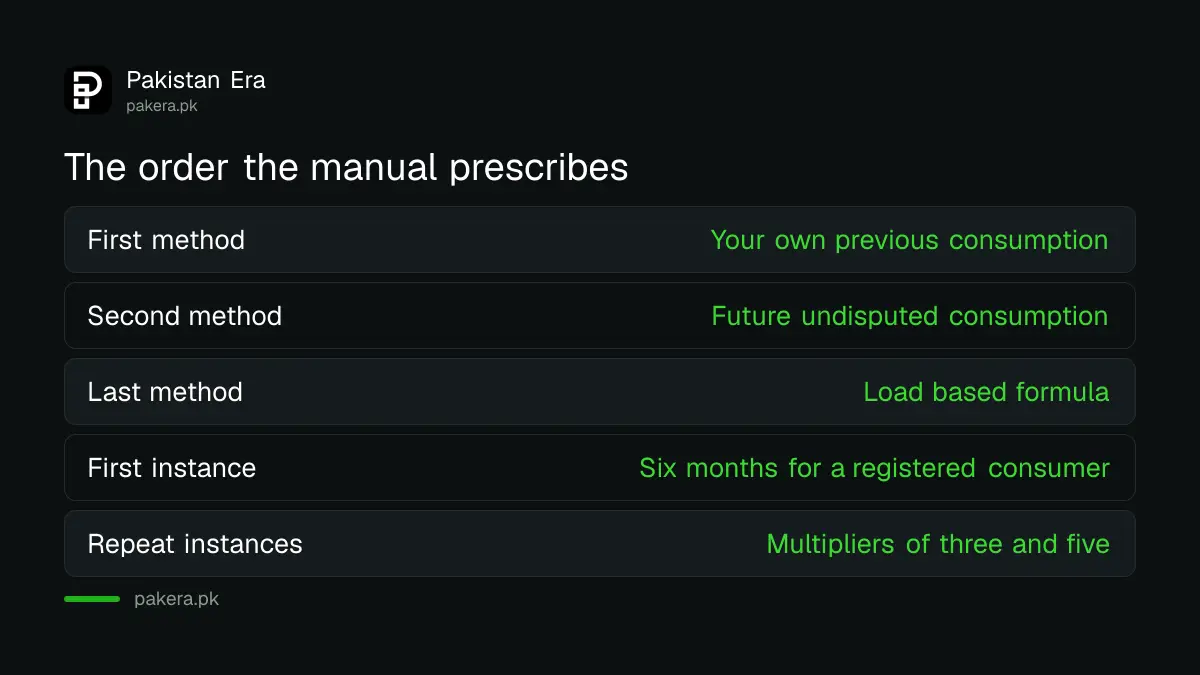
The same document describes limits on how far back a detection bill may reach. For a first instance it describes charging a registered consumer for six months, against twelve months for an unregistered connection, with multipliers of three and five applied for second and third instances.
Read that against your own bill. If a detection charge covers a longer period than the framework allows for your situation, that is a specific, checkable objection rather than a general complaint that the bill feels too high.
One caution about our own source, because it changes how much weight to put on the exact figures. The NEPRA document we could read is an annex presenting existing clauses and proposed clauses side by side, so we can describe the framework confidently but cannot certify which precise wording is in force today. Treat the numbers as the shape of the rules and ask NEPRA or your company to confirm the current clause.
What to do the day it arrives
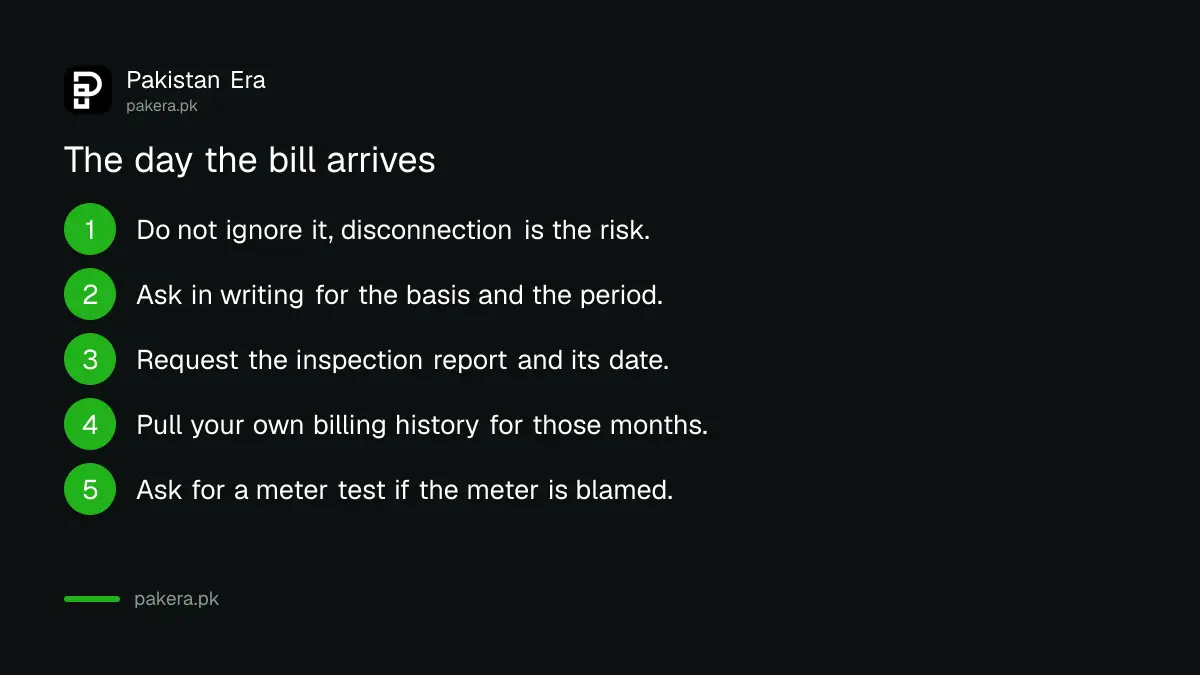
- Do not ignore it, because an unpaid amount can lead to disconnection while you argue.
- Go to the sub division and ask in writing for the basis of the calculation and the period charged.
- Ask for a copy of any inspection report and the date of the inspection.
- Pull your own billing history for the same months and keep it.
- Ask for the meter to be tested if the meter itself is said to be at fault.
Getting the basis in writing is the whole game. A detection bill that cannot be explained on paper is far harder to sustain than one that can, and the request costs you nothing.
Compare it against your own history
Before you argue, know your own numbers. Pull twelve months of billing for the connection and look at what you normally consume in the same season, because summer and winter are not comparable.
Our guide to checking a LESCO bill shows how to retrieve the history by reference number, and our breakdown of bill line items explains which entries are the detection charge and which are the ordinary tariff, fuel adjustment and taxes. Separating those is necessary before you can say what is actually being disputed.
Escalating beyond the sub division
If the office will not explain or will not revise, the dispute goes upward within the company first and then to the regulator. NEPRA handles consumer complaints against distribution companies, and we set out how that complaint is made in our guide to complaining to NEPRA.
Take the paperwork with you: the detection bill, the written basis if you obtained one, the inspection report, your billing history and any meter test result. A complaint with documents is a different proposition from a complaint without them.
If theft is being alleged rather than a metering error, the matter can become more serious than a billing dispute, and that is a point to take legal advice rather than to handle at a counter.
Common questions about detection bills
Can I refuse to pay while I dispute it?
Non payment risks disconnection. Raise the dispute in writing immediately and ask the company what it requires while the matter is examined, rather than simply withholding.
How far back can a detection bill go?
The NEPRA framework caps the period, and the document we read describes six months for a registered consumer on a first instance. Confirm the current clause, since our source presents existing and proposed wording together.
What if my meter was faulty rather than tampered with?
Ask for the meter to be tested and for the test result in writing. A slow or defective meter is a different case from tampering and should be treated as one.
Does the company have to explain the calculation?
Ask for it in writing. The manual prescribes methods in an order of priority, so which method was used and why is a fair and specific question.
Who decides if the company refuses?
NEPRA is the regulator for consumer complaints against distribution companies. Exhaust the company's own process first and keep the record.
How we verified this
What we checked, where we read it, and what we could not confirm.
Last checked 26 August 2026. The calculation methods in order of priority, the load based formula, the six and twelve month periods and the multipliers for second and third instances were read by us from a NEPRA document on the Consumer Service Manual 2021, downloaded from nepra.org.pk on that date. That document is an annex setting out existing clauses beside proposed clauses, so while the framework is clear we cannot certify which exact wording is currently in force, and the body says so rather than presenting the figures as settled. A separate NEPRA authority decision we downloaded on the same date was a scanned file with no text layer and could not be read. This is general information and not legal advice, and an allegation of theft rather than a metering error warrants a lawyer.
About the author

Tax, Bills and Technology Writer
Ali Akhtar is a young and curious voice here at Pakistan Era. He is currently pursuing his A-Levels and has a growing interest in Pakistan’s changing industrial landscape and educational trends. Ali likes to write in a way that helps him explain and explore the world around him. His writing reflects the perspective of the new generation navigating the evolving trends of Pakistan where technology, youth innovation, and shifting opportunities are reshaping the country’s future.