Why YouTube Monetization Income in Pakistan Isn't Taxed at PSEB's 0.25% Rate
AdSense and platform monetization fall under section 154B, not PSEB's export rate. Here is the legal reason, and how to declare the foreign wire you receive.
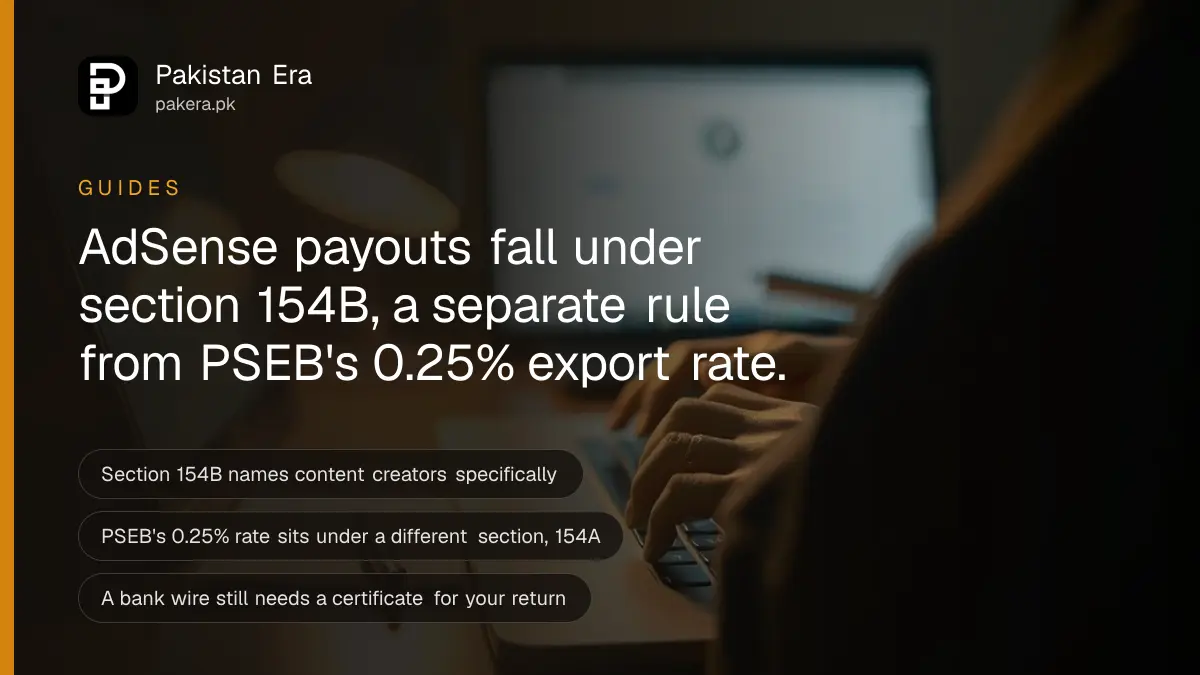
Registering with the Pakistan Software Export Board does not pull your AdSense money onto its 0.25% tax rate. That rate belongs to a different section of the law, and AdSense income is taxed under its own, separate rule.
Update, 11 October 2026: YouTube's Partner Program rules change from 1 February 2027. See the new thresholds.
It is an easy mix-up. Both numbers sound like they describe the same thing: money a Pakistani earns from a foreign source, paid into a local bank account. They don't.
Two sections tax two different kinds of foreign income
Pakistan's Income Tax Ordinance 2001 has section 154A for IT and IT-enabled service exports, and section 154B, added by the Finance Act 2026, for social media platform revenue. They are separate withholding provisions, not two rates sitting under one rule.
A bank does not ask which rate a creator would prefer. It looks at what the money actually is and applies the section that matches it.
Section 154A is for registered IT exporters, not platform creators
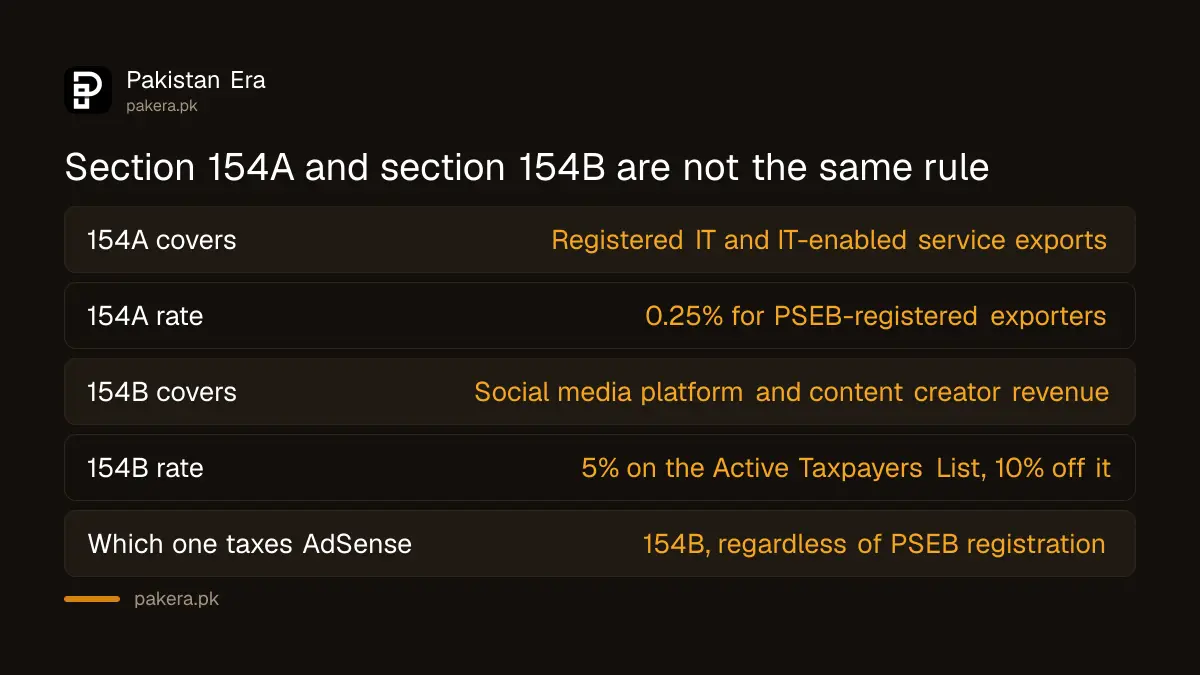
Section 154A gives a reduced final tax of 0.25% to exporters of computer software, IT services or IT-enabled services who are registered with and certified by PSEB. That is the rate freelancers chase when they register with PSEB for the export discount.
| Point | Section 154A | Section 154B |
|---|---|---|
| What it taxes | IT and IT-enabled service exports | Social media platform revenue |
| Who qualifies for the low rate | PSEB-registered exporters | Not applicable, rate is fixed by filer status |
| Rate | 0.25% | 5% filer, 10% non-filer |
| Added by | Finance Act 2021 | Finance Act 2026 |
| Tax treatment for residents | Final tax | Minimum tax |
Nothing in 154A mentions content creation, monetization or platforms. It was written for software development, IT consulting and service contracts billed to a client abroad, and PSEB certification exists to confirm exactly that kind of work.
Section 154B names content creator income specifically
Section 154B defines a digital content creator or social media influencer as anyone deriving income from the creation, publication or monetization of content on digital platforms, naming YouTube, Facebook, Instagram and TikTok outright. Revenue from those platforms gets its own deduction rule the moment a bank credits it.
That definition does the real work here. Lawmakers could have folded creator income into the existing export regime. Instead, the Finance Act 2026 wrote a new section that applies regardless of whether the recipient is PSEB registered for other work.
PSEB registration does not change which section applies
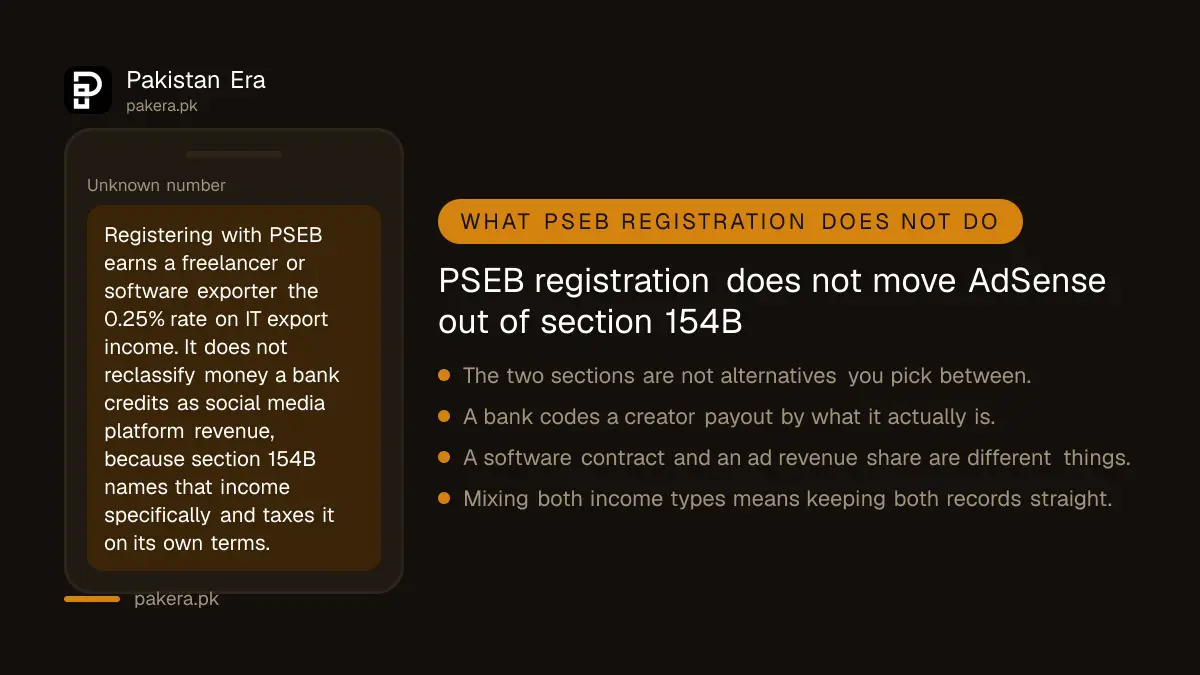
A freelancer who does paid client work and also runs a monetized YouTube channel is not choosing between two rates on the same rupee. The client invoice income can sit under 154A if it is genuinely an IT export and PSEB registered. The AdSense payout from the same person's channel sits under 154B, because that is what the bank sees arriving: platform revenue, not an export invoice. Confusing the two is where creators run into trouble, usually by assuming a PSEB certificate covers everything that lands in the account from abroad. It covers what it was issued for, and nothing else.
How an AdSense payout actually reaches your bank account
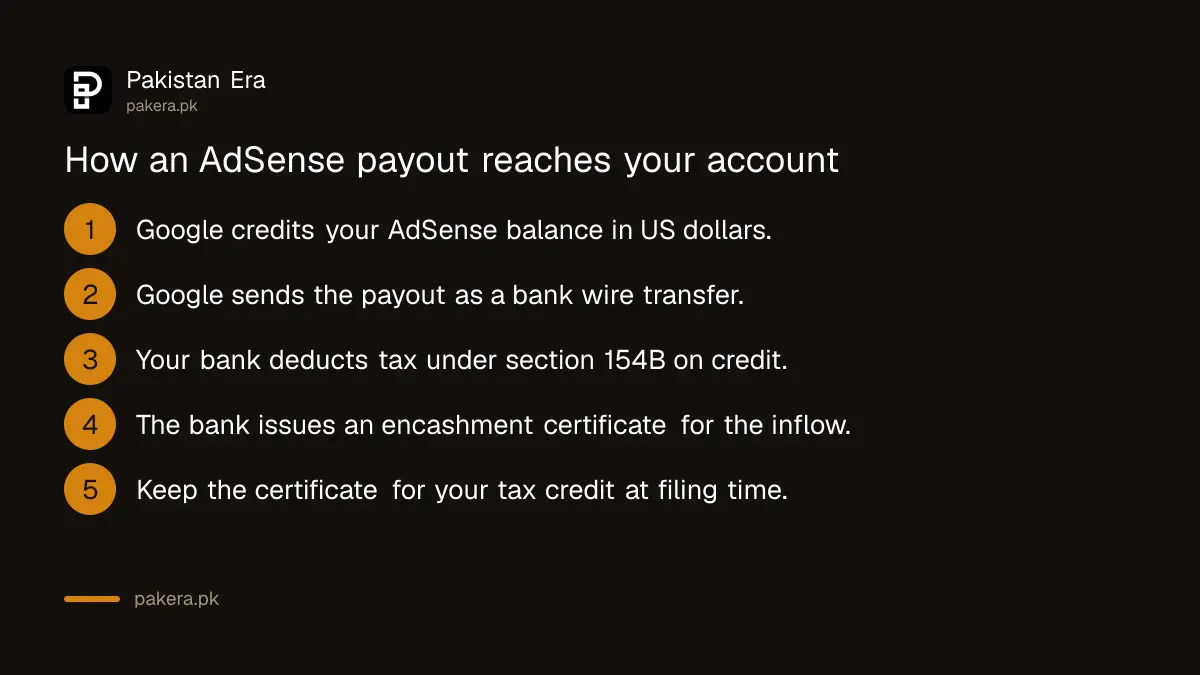
Google pays AdSense balances as a wire transfer once a channel crosses the payment threshold, converted and routed through the international banking network into your Pakistani account.
- Google credits the AdSense balance in US dollars once the threshold is reached.
- Google issues a bank wire transfer to the account on file.
- The receiving bank converts the inflow and deducts tax under section 154B on credit.
- The bank records the inward remittance and can issue a certificate covering it.
- That certificate becomes the evidence you attach to your own tax return.
The State Bank of Pakistan's Foreign Exchange Manual sets out how an authorised dealer bank handles an inward remittance and issues the matching documentation, electronically, for exactly this kind of foreign credit.
What to keep for your tax return
Three things matter when it is time to file: the bank's deduction certificate under section 164, the AdSense payment history showing the dollar amount before conversion, and a record of the exchange rate applied on the date of credit. Without the certificate, you cannot claim the tax your bank already took as a credit against what you owe, and you end up arguing the numbers from memory instead of from paper.
If your channel's audience and earnings are modest, the dollar figures involved may surprise you either way, which is worth checking against what a channel at your size actually tends to pay before you plan around a number from somewhere else.
Common questions
Does PSEB registration lower the tax on my AdSense income?
No. PSEB's 0.25% rate applies to IT export income under section 154A. AdSense revenue is taxed under section 154B, a separate section, regardless of PSEB registration.
Can I register the same channel income under both sections?
No. A single payment is taxed under the section that matches what it is. Platform revenue falls under 154B; a separate IT export contract, if you have one, falls under 154A.
What document proves my bank already deducted tax on an AdSense payout?
The deduction certificate your bank issues under section 164 of the Ordinance, which you attach when claiming the credit on your return.
Does my AdSense payout need a Proceeds Realization Certificate?
Banks issue electronic Proceeds Realization Certificates for export proceeds under the State Bank's manual, but whether your bank issues that specific document for a platform payout rather than a standard certificate is worth confirming with your own bank branch.
Is the 5% deduction on AdSense income final or adjustable?
For a Pakistani resident it is a minimum tax, which you can read in full detail with worked examples on our section 154B filing guide.
Does the exchange rate on the day of credit matter for my return?
Yes. Your rupee income figure for tax purposes is based on the rate applied when the bank converted the inflow, so keep that record alongside the certificate.
How we verified this
What we checked, where we read it, and what we could not confirm.
Last checked 5 October 2026. The section 154B definition of digital content creator and social media influencer, and its minimum-tax treatment for residents, were read at source in FBR's own Income Tax Ordinance 2001 text on 24 September 2026 and are reused here rather than re-fetched, since no further amendment has been reported since. Section 154A's PSEB certification condition for the 0.25% rate was confirmed today through secondary legal and financial reporting on the Finance Act 2021 provision, not re-read on an FBR PDF today. The inward remittance and electronic Proceeds Realization Certificate mechanics are read from the State Bank of Pakistan's Foreign Exchange Manual, Chapter 10, and from reporting on SBP's October 2025 ePRC format revision for IT exporters and freelancers. Whether an AdSense payout specifically receives an ePRC or a standard bank encashment certificate was not confirmed at source and is flagged above as a question for your own bank. For the 154B rate table and the full filing process, see our guide on declaring YouTube and TikTok income in your FBR return. Not tax advice.
About the author

Technology Journalist & Multimedia Producer
Ahmad Ali is a technology journalist and multimedia producer at Pakistan Era, joining the team in October 2026. He covers consumer technology and digital life for Pakistani readers, combining research with hands-on product testing.