How to Declare YouTube and TikTok Income in Your FBR Tax Return
Banks deduct 5% of YouTube and TikTok income, 10% for non-filers, under FBR section 154B. Here is how to declare it and claim the credit by 30 September.
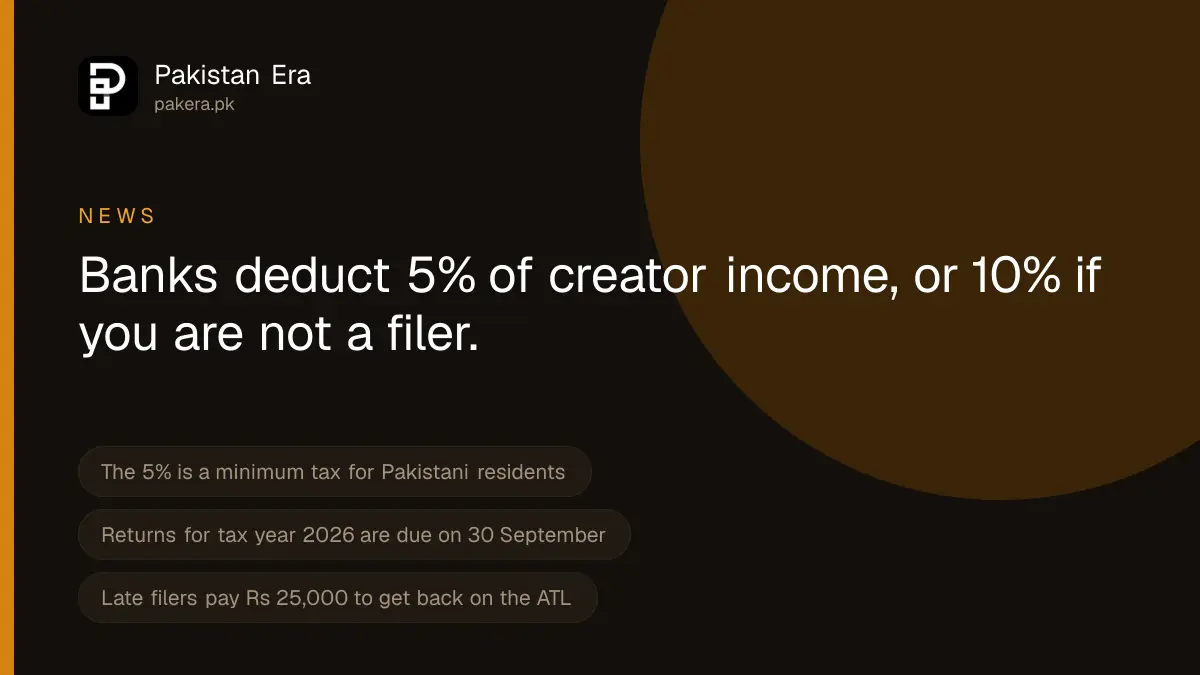
If you earn from YouTube, TikTok, Facebook or Instagram in Pakistan, you must declare it in your income tax return. Since the Finance Act 2026, your bank deducts 5% of every platform payment if you are on FBR's Active Taxpayers List, and 10% if you are not. For a Pakistani resident that 5% is a minimum tax, not a final one. The return for tax year 2026 is due on 30 September 2026.
That is the short answer. The detail matters, because the return you file this month covers a year when the new rule did not yet apply.
We read section 154B in FBR's own copy of the Income Tax Ordinance 2001, amended up to 30 June 2026, and the matching line in FBR's Withholding Income Tax Rate Card, on 24 September 2026. Everything we could not read on an FBR page is marked as reported below.
Section 154B puts a 5% or 10% deduction on creator income at the bank
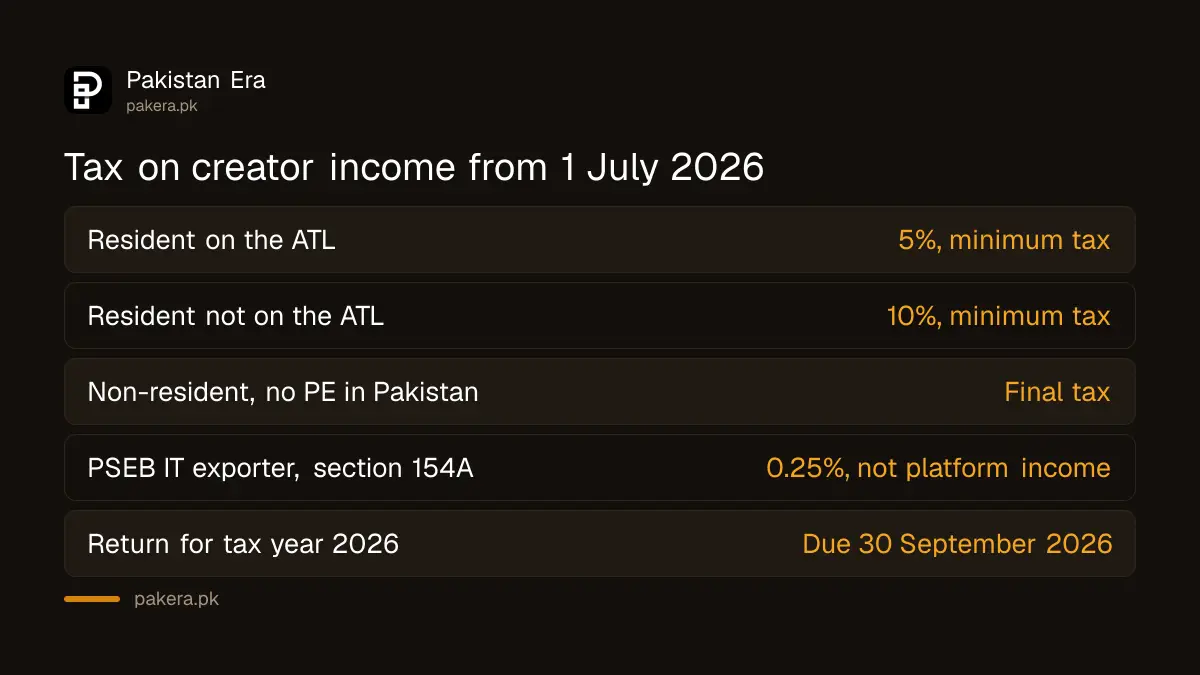
Section 154B tells every bank and non-bank financial institution to deduct tax when it credits money that represents revenue from social media platforms. FBR's rate card sets the rate at 5% for people on the Active Taxpayers List and 10% for everyone else.
The Active Taxpayers List, or ATL, is FBR's list of people who filed their return on time. You can check your filer status by CNIC in a minute.
The law is wide on purpose. It covers any person or company earning from creating, publishing or monetising content on platforms "including but not limited to YouTube, Facebook, Instagram, Tik Tok". A payment includes any inward remittance or credit through banking channels, even when it passes through an online payment service first. So routing AdSense money through Payoneer into your bank does not take it outside the rule. Payouts for TikTok LIVE gifts, the main way TikTok pays creators in Pakistan, appear to fall inside it too.
| Your position | Rate the bank deducts | What the deduction is |
|---|---|---|
| Resident creator on the ATL | 5% | Minimum tax. You may owe more when you file. |
| Resident creator not on the ATL | 10% | Minimum tax, at double the rate. |
| Non-resident with no permanent establishment in Pakistan | 5% (10% if not on the ATL) | Final tax on that income. |
| PSEB-registered IT or software exporter | 0.25% under section 154A | Final tax, but for IT export receipts, not platform revenue. |
| Other service exporter under section 154A | 1% | Final tax if the section's conditions are met. |
The PSEB row is where most creators get confused. The 0.25% rate belongs to PSEB registration for IT and software exports. News reports in June 2026 said creators had been pulled out of that reduced regime. The Ordinance does not say that in so many words, but section 154B applies to any credit that is social media revenue, so your bank will use 5% or 10% on it whatever other registration you hold.
The 5% is a minimum tax, not a final tax, for residents
For a Pakistani resident, section 154B(3)(a) makes the deduction a minimum tax. Your tax on that income can never be lower than what the bank took. If your normal tax works out higher, you pay the difference when you file.
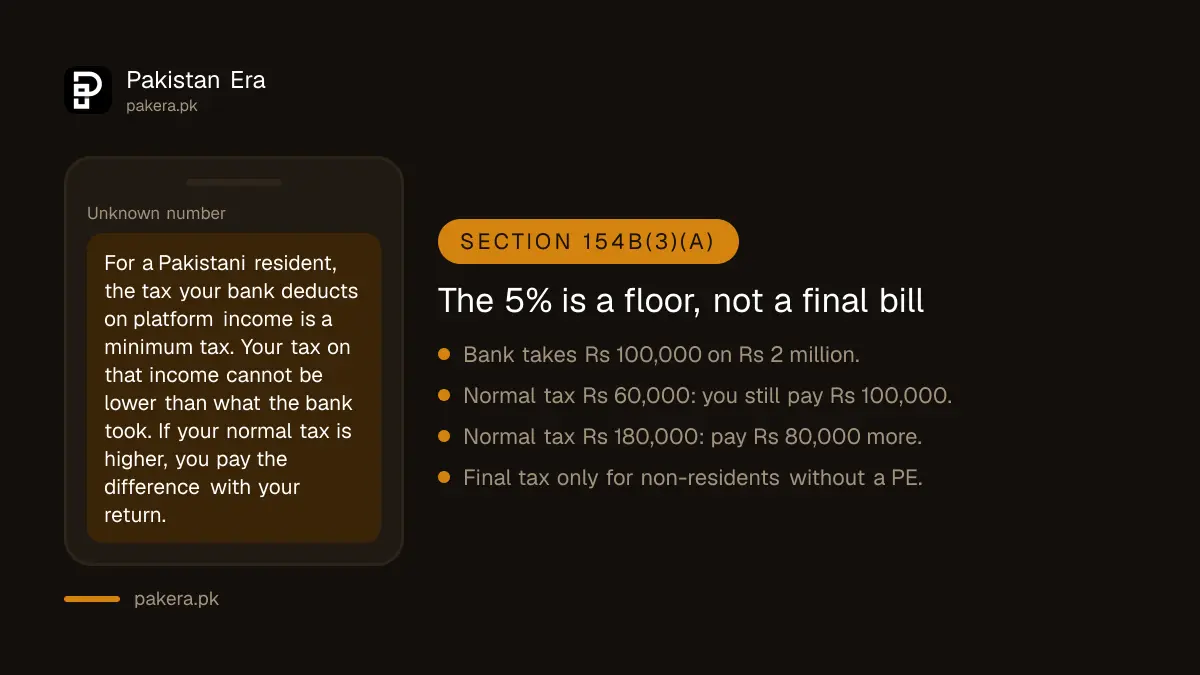
Here is how that plays out on Rs 2,000,000 of platform income received in a year, with Rs 100,000 deducted by the bank at 5%. That is a big channel by Pakistani standards, given what YouTube pays in Pakistan per thousand views.
- Your tax at normal rates, after business expenses, comes to Rs 60,000. You still pay Rs 100,000. The extra Rs 40,000 is not refunded.
- Your tax at normal rates comes to Rs 180,000. The Rs 100,000 counts as credit, and you pay the other Rs 80,000 with your return.
The Rs 60,000 and Rs 180,000 figures are our own examples to show the mechanism, not your actual tax. News reports say excess minimum tax cannot be refunded, adjusted or carried to next year. That is what "minimum" normally means in the Ordinance.
Non-residents are different. Section 154B(3)(b) makes the deduction a final tax for a non-resident with no permanent establishment in Pakistan. A final tax settles the bill on that income, so it is not added to other income or taxed again.
Your 30 September return covers the year before the new rule
The return due on 30 September 2026 is for tax year 2026, which runs from 1 July 2025 to 30 June 2026. Section 154B was added by the Finance Act 2026 and reported as starting on 1 July 2026. So the 5% bank deduction mostly affects next year's return.
That does not make last year's creator income tax free. It was taxable before section 154B existed. What changes is how you work out the tax.
For tax year 2026, look at what your bank actually deducted on each payment. Depending on how your bank coded the payment, it may have deducted under section 154A as an export of services, at 1%, or 0.25% for a PSEB-registered person. It may also have deducted nothing. Your bank's certificate shows which section it used, and that decides how the income sits in your return.
If the income faced no deduction at all, declare it in full as business income and let the return work out tax at normal rates. If you missed deadlines in earlier years, filing now still beats waiting for a notice, and missing 30 September adds a Rs 25,000 surcharge to get back on the ATL.
How to declare YouTube and TikTok income in IRIS or Tax Asaan
Declare platform earnings as income from business, enter your costs, and claim the tax your bank deducted as credit using its certificate. You can do this on FBR's IRIS portal in a browser or on the Tax Asaan phone app.
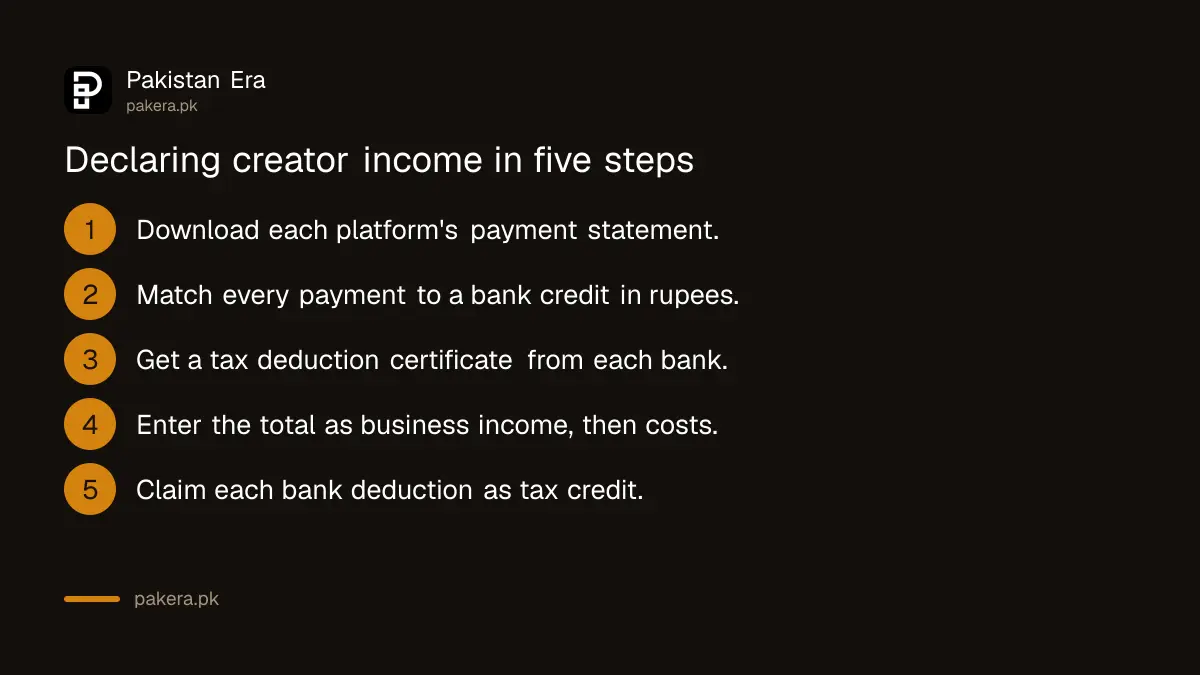
- Download a statement from each platform for the tax year: YouTube or AdSense payments, TikTok payouts, Facebook and Instagram payouts, and brand deals paid to you directly.
- Match each payment to the credit in your bank statement, in rupees, on the date it arrived.
- Get a tax deduction certificate from each bank for the same period.
- In the return, enter the rupee total under business income, then your real costs such as equipment, editing software, internet and a studio room's rent.
- Enter each bank deduction in the tax credit or adjustable tax part of the form, with the section number printed on the certificate, then submit and keep the acknowledgement.
We could not see the tax year 2026 form from the inside without a live return, so we cannot tell you which exact screen or code number IRIS 2.0 uses for these entries. The sequence above is the logic the form follows. Most IRIS 2.0 login errors come from an old password or a session that timed out, and filing on the Tax Asaan app works for a simple return.
Keep your wealth statement honest too. A new camera, car or flat bought from channel money needs the income behind it in the same return.
Your bank must give you a certificate for every deduction
Section 164 of the Ordinance says anyone who deducts tax must give you a certificate showing the amount, and your return must be backed by those receipts. Ask your bank for a tax deduction certificate covering 1 July 2025 to 30 June 2026.
Most banks send it on request through their app, internet banking, email or the branch. The route differs by bank, so we cannot give one method for all of them. Ask for it by name: "income tax deduction certificate for tax year 2026".
Check three things when it arrives. Your CNIC must be correct. The section number must match the kind of money it was. And the total must match what your statement shows was held back. A certificate with the wrong CNIC is a credit you cannot claim, so get it fixed before you file.
Banks also pass account data to FBR, so assume the credits in your statement are already visible to it.
FBR is already checking creators, so answer any notice on time
On 23 September 2026, FBR was reported as saying that people earning from social media content are already in the tax system and must pay tax on it. Earlier this year, news reports said FBR had started action against 38 influencers over about Rs 15 billion of undeclared income.
We could not find either action on an FBR page, so treat both as unconfirmed. News reports in June 2026 also said a drive against non-filers showing wealthy lifestyles on social media would begin from 1 October 2026.
FBR published draft rules in April 2026 as SROs 545(I) and 546(I) of 2026, and made them final on 23 September 2026 as SROs 1641(I) and 1642(I). The final rules count every 1,000 views as Rs 195 of income, or your real earnings if higher, less costs of up to 30%. Their 50,000 threshold counts users in Pakistan and applies only to non-residents. Residents have no threshold, and the bank deducts under section 154B from the first rupee.
If a notice arrives, it will name the section it is issued under and give a date. Reply through IRIS by that date, with your platform statements and bank certificates. If you need more time, ask for it in writing before the date passes. FBR's helpline is 051 111 772 772. For anything beyond a simple return, a registered tax practitioner is worth the fee.
Common questions
Do I have to pay tax on YouTube income in Pakistan?
Yes. Income from YouTube, TikTok, Facebook and Instagram is taxable. From 1 July 2026 your bank deducts 5% if you are on the ATL, or 10% if not, under section 154B.
Is the 5% tax on YouTube income final?
No, not for a Pakistani resident. Section 154B makes it a minimum tax, so you pay more if your normal tax is higher. It is final only for a non-resident with no permanent establishment in Pakistan.
Can a YouTuber use the 0.25% PSEB rate?
Not on platform revenue from 1 July 2026, according to news reports. Section 154B applies to any credit that is social media revenue, and the 0.25% rate under section 154A is for IT and software exports.
Which head of income is YouTube and TikTok money?
Declare it as income from business. That lets you deduct genuine costs, and claim the bank's deduction as tax credit. For tax year 2026 check which section your bank used, since that decides how it is treated.
Is there a 50,000 subscriber limit before tax applies?
Not for residents. The 50,000 figure in the final rules, SRO 1642(I)/2026, counts users in Pakistan and applies only to non-residents. Section 154B has no threshold, so tax is deducted on every payment.
What is the last date to file for tax year 2026?
30 September 2026 for individuals, under section 118. Filing late puts you off the ATL until you pay a Rs 25,000 surcharge, and while off it your bank deducts 10%, not 5%.
How we verified this
What we checked, where we read it, and what we could not confirm.
Last checked 24 September 2026. We read the text of section 154B, including its definition of a digital content creator, the meaning of payment, and the rule that the deduction is minimum tax for a resident and final tax for a non-resident without a permanent establishment, in FBR's Income Tax Ordinance 2001, amended up to 30 June 2026. The same copy gives the 5% rate in Division IIIAB of Part III of the First Schedule, the 30 September due date in section 118, the Rs 25,000 surcharge in section 182A, the certificate duty in section 164, and the section 154A final tax and its conditions. The 5% and 10% ATL and non-ATL rates, and the 0.25% and 1% section 154A rates, are read from FBR's Withholding Income Tax Rate Card, updated up to 30 June 2026. The 1 July 2026 start, the removal of creators from the reduced IT export regime and the rule that excess minimum tax is not refunded come from news reports. The 23 September FBR statement, the action against 38 influencers, and the 1 October lifestyle drive also come from news reports; we found none of them on an FBR page. On 25 September 2026 we read the April drafts and the final rules, SROs 1641(I) and 1642(I) of 2026, on FBR's SRO list. The worked example is our own arithmetic. Nothing here is tax advice for your own circumstances.
About the author

Tax, Bills and Technology Writer
Ali Akhtar is a young and curious voice here at Pakistan Era. He is currently pursuing his A-Levels and has a growing interest in Pakistan’s changing industrial landscape and educational trends. Ali likes to write in a way that helps him explain and explore the world around him. His writing reflects the perspective of the new generation navigating the evolving trends of Pakistan where technology, youth innovation, and shifting opportunities are reshaping the country’s future.