What Your Bank Already Reports to FBR
The new tracking story is not a new power. Reporting dates from 2014, the thresholds are lower than assumed, and filers are no longer exempt.
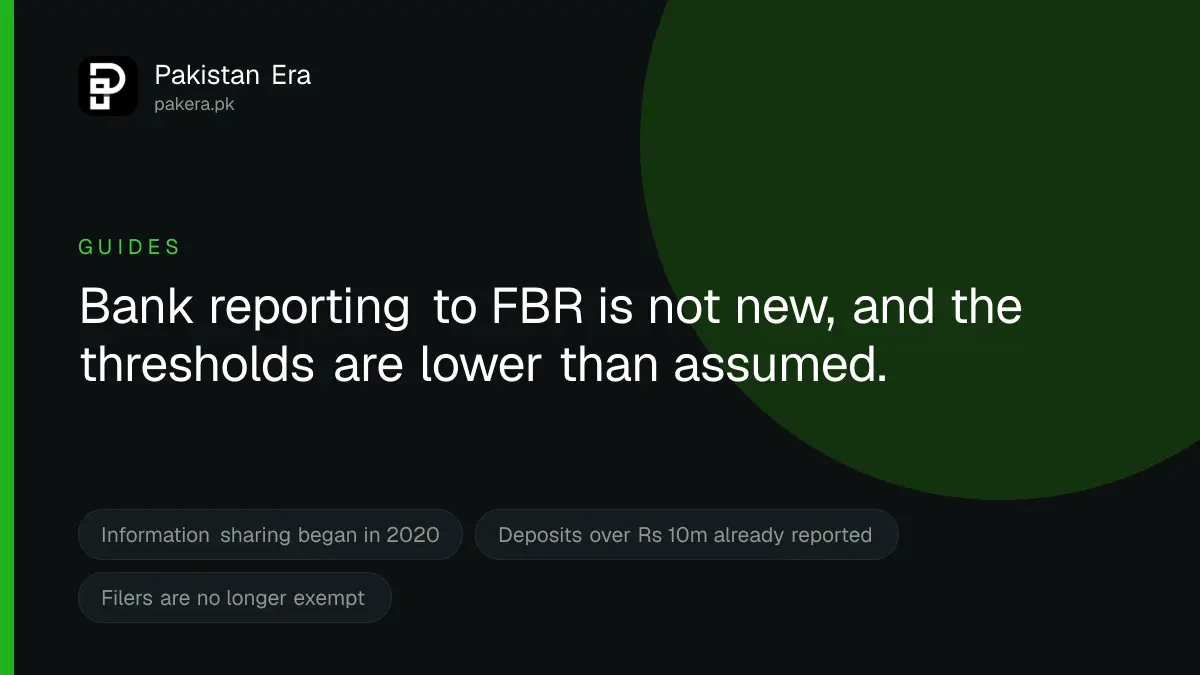
Your bank has been reporting account information to FBR since 2020, and the thresholds are lower than most people assume. Coverage of a new automated system has been read as FBR gaining sight of bank accounts for the first time. It did not. The reporting requirement dates from 2014 and has been operating for years.
What is reported to change under the Finance Act 2026 is the matching, not the visibility. Large transactions are to be compared automatically against a taxpayer's own records, with discrepancies capable of triggering follow up. That is a real change, and it is a different thing from being watched for the first time.
What is already reported
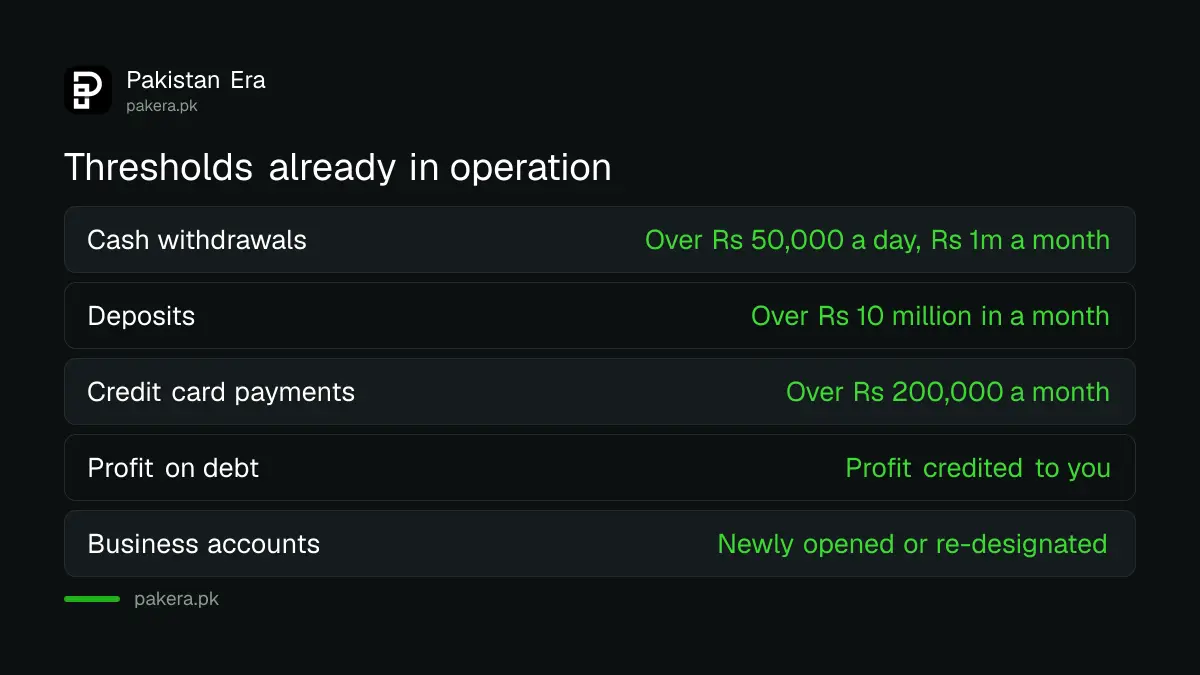
These thresholds have been in operation, not newly announced. If any of them describe your account, the information has already been going across.
| Activity | Reported threshold |
|---|---|
| Cash withdrawals | Over Rs 50,000 in a day, where the month totals Rs 1 million or more |
| Deposits | Over Rs 10 million in a single calendar month |
| Credit card payments | Over Rs 200,000 in a month |
| Profit on debt | Profit credited on your deposits |
| Business accounts | Newly opened or re-designated accounts |
Note the deposit line in particular. Rs 10 million in a month is the same figure now being reported as a new tracking threshold, which is part of why the story has been read as bigger than it is.
Being a filer no longer keeps you off the list
There used to be a carve out. Banks did not have to report account holders who held an NTN and had filed a return for the previous year. That exclusion is reported to have been withdrawn.
So filing does not remove you from the reporting. What filing does is give the reported figures something to match against, which is the whole point of the change. An account showing activity with no corresponding return is the mismatch the system is built to surface.
What actually changed
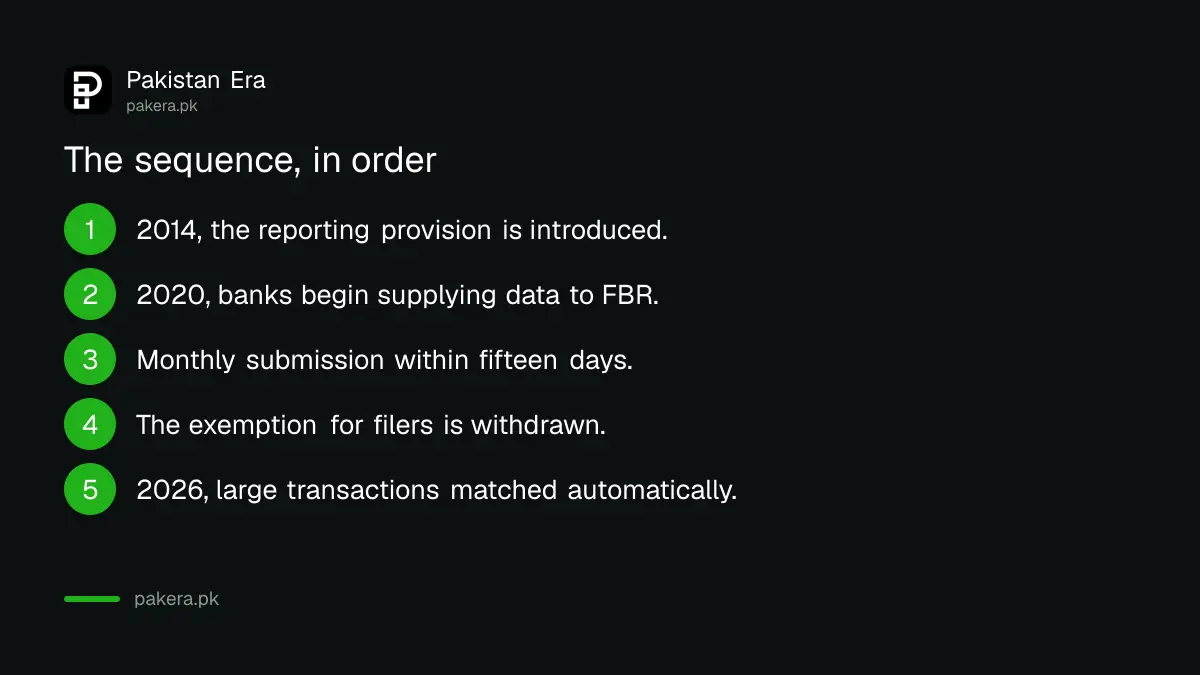
- The reporting itself is not new, and dates from a 2014 provision.
- Banks began providing the information through an FBR system in September 2020.
- Reporting periods moved to monthly submission within fifteen days of month end.
- The exemption for filers was withdrawn, so all account holders are covered.
- Under the Finance Act 2026, large transactions are to be matched automatically against tax records.
Read as a sequence, the direction is obvious and it has been consistent for a decade. Anyone treating the latest step as a sudden reversal has not been watching the previous ones.
What this means in practice
For most people the answer is nothing, because their income is salaried, taxed at source and unremarkable against their account activity. The people who should pay attention are those whose banking does not obviously match their declared position.
That includes freelancers receiving foreign payments, people selling online, anyone holding money on behalf of family, and anyone whose account carries deposits from a property or vehicle sale. None of those are wrong. All of them are easier to explain with records than from memory two years later.
So keep the paper. A large deposit with a sale agreement behind it is a five minute conversation. The same deposit with nothing behind it is a longer one.
Filing is what makes the match work in your favour
The system compares transactions against your record. If there is no record, there is nothing for the transaction to reconcile with, which is the position that generates queries rather than resolves them.
Our guide to filing an income tax return covers the process, and the cost of staying outside has risen sharply, with the late filing surcharge going from Rs 1,000 to Rs 25,000 for individuals as covered in our page on the ATL surcharge. If you are unsure whether you are registered at all, verifying an NTN is the first check.
Keep accounts in your own name
Reporting is by account holder. Money moving through an account belonging to a relative, an employee or a friend is reported against that person, and explaining it becomes their problem before it becomes yours.
That arrangement was always awkward and automated matching makes it worse, because the mismatch is now found by a system rather than by chance. If you are opening an account for a business or for freelance income, open it properly in the right name, and our guide to opening a bank account covers what the branch will ask for.
Common questions about bank reporting to FBR
Is FBR seeing my bank account for the first time?
No. The reporting provision dates from 2014 and banks began supplying information through an FBR system in 2020. What is reported to change is automated matching.
What is the deposit threshold?
Deposits over Rs 10 million in a single calendar month are reported. That figure is not new.
Does filing my return keep me off the list?
No. The exemption for filers is reported to have been withdrawn, so all account holders are covered whether they file or not.
Should I move money to another account?
Moving money into somebody else's name does not remove it from reporting, it moves the explaining onto them. Keep accounts in the correct name and keep records.
What if a large deposit is from a property sale?
That is a normal thing to have in an account. Keep the sale documentation so the deposit can be explained with paper rather than from memory.
How we verified this
What we checked, where we read it, and what we could not confirm.
Last checked 28 August 2026. Nothing here is read on an FBR page. The reporting thresholds, the 2014 origin of the provision, the September 2020 start of information sharing between banks and FBR, the move to monthly submission within fifteen days, the withdrawal of the exemption for filers, and the automated matching under the Finance Act 2026 are all reported. We have set out the sequence because the coverage of the latest step has been widely read as the first step, and the dates matter to understanding what actually changed. Thresholds and requirements are amended regularly, so confirm the current position with a tax professional before acting on it. This is general information and not tax advice.
About the author

Public Services and Education Journalist
Fajr Riaz is a journalist and content writer at Pakistan Era, based in Lahore. She covers the questions people meet in everyday life in Pakistan: how a public service works, what a change in the rules means, and where to find a reliable answer.